
Matcha popsicles hold even color and clean release when the base, powder dispersion, mold fill, stick timing and freeze cycle are designed together. Static freezing gives particles time to settle, and poorly timed sticks can tilt or pull through a soft center. The commercial matcha dessert guide gives wider menu context; the pilot below turns published recipes into measurable frozen-pop decisions.
Reliable matcha popsicles begin with a uniform base and a freeze cycle proven in the actual mold. Teams should inspect top-to-bottom color, stick alignment, release force and drip after tempering.
In short:
Key points:
- Choose the carrier base by channel and label target.
- Set dose through fixed-base trials using original publisher units.
- Validate mold, stick, freeze and release as one process.
Which matcha popsicle base fits the target channel?
Choose coconut milk for a rich plant-based concept, yogurt for tang and body, or a blended-milk system for a lighter profile. The references include coconut milk, Greek yogurt, oat milk, avocado and blueberries across different formats.
Define the consumer promise only after every ingredient and facility control supports it. Choose one base architecture first; avoid calling a product dairy-free because its headline ingredient is coconut milk when other ingredients or controls have not been reviewed.
The commercial frozen-dessert guide provides useful adjacent-format context.
Key Takeaway: Build the claim and texture target from the complete formula.
How much matcha should a frozen-pop pilot use?
For a matcha popsicle pilot, keep publisher doses attached to their batch sizes. With Food + Love uses 1 tbsp with 1 cup coconut milk and half an avocado; Fig Jar uses 2 1/2 tbsp with a 15 oz can of coconut milk and 2/3 cup oat milk.
Kara Lydon uses 1 tbsp with 3 cups Greek yogurt, while Matcha Oishii uses 1 tsp in a smaller blueberry-yogurt formula. Run a dose ladder inside one base and score after full freezing, because cold changes perceived flavor.
| Publisher benchmark | Original base and matcha | Mold decision |
|---|---|---|
| With Food + Love | 1 cup coconut milk; ½ avocado; 1 tbsp matcha | Can the base fill 6–10 molds without settling? |
| Fig Jar | 15 oz coconut milk; ⅔ cup oat milk; 2½ tbsp matcha | Does the ten-pop system freeze and release evenly? |
| Kara Lydon | 3 cups Greek yogurt; 3 tbsp honey; 1 tbsp matcha | Does the six-pop yogurt base remain biteable? |
Buyers can start sample comparison with the culinary matcha range.
Key Takeaway: Compare dose only after fixing the base and portion.
How do coconut, yogurt and milk bases change matcha popsicles?
Coconut fat and avocado can add body, yogurt adds protein and acidity, and oat or dairy milk changes water content. Those differences affect iciness, release and drip as much as matcha flavor.
Run A/B bases at equal mold volume and freeze conditions. Measure bite after a defined temper, visible ice crystals and melt loss. Avoid switching sweetener at the same time, because the team will not know whether texture came from solids, fat or sugar.
Key Takeaway: Compare base systems under one mold and freeze protocol.
Which sweetener supports matcha popsicle flavor and texture?
Sweetener changes sweetness, solids and freeze softness. The references use coconut condensed milk, honey and agave syrup in different bases, so their quantities cannot be treated as equivalent sweetness or functionality.
Hold total base mass and matcha fixed, then compare one sweetener route. Record fill viscosity, frozen bite, drip and aftertaste. Too little dissolved solids may make a hard icy pop; excess sweetness can bury matcha and weaken the product brief.
The pastry sourcing guide helps frame powder cost against finished sensory performance.
Key Takeaway: Select sweetener by frozen texture and tea balance, not label appeal alone.
How should matcha be dispersed before filling molds?
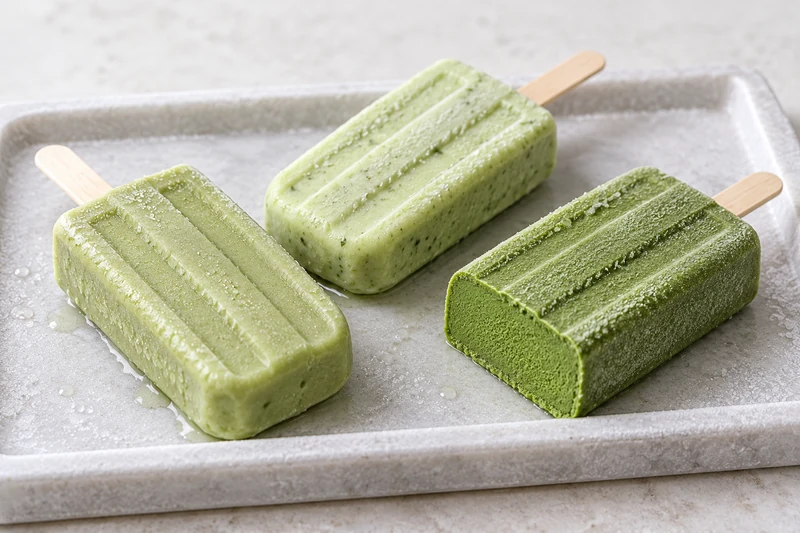
Sift and pre-disperse matcha into a measured portion of the liquid base, then blend it through the full batch without excessive foam. A uniform kettle does not guarantee a uniform mold if filling pauses allow settling.
Record mixing tool, speed, time, base temperature and maximum delay to fill. Inspect the first, middle and last molds. AdoroHu’s ultrasonic screening supports a fine-powder discussion, but the finished base still needs line-specific suspension control.
Key Takeaway: Validate dispersion across the complete fill run.
Which inclusions fit a matcha popsicle concept?
Use matcha popsicle inclusions that remain evenly distributed and do not block filling or weaken the stick zone. Blueberries appear in two reference concepts, while vanilla and protein-led formulas require their own sensory and claim review.
Compare a plain base with one inclusion at a defined size and loading. Check flotation, sediment, color bleed, bite and mold damage. Avoid large whole fruit around the stick, because it can create weak planes and erratic release.
Key Takeaway: Approve inclusions by distribution, structure and held appearance.
What fill weight should a matcha popsicle pilot target?
Set a fill weight from the actual cavity volume and required headspace. Published yields range from six to ten depending on mold; Matcha Oishii specifies six pops of about 120 ml each.
Weigh early, middle and late fills and calculate overfill. Mold count alone hides portion drift. A few excess milliliters can cause lid interference and reduce saleable yield across a production run.
| Frozen-pop release check | Record | Reject when |
|---|---|---|
| Fill | Weight of first, middle and last cavities | Settling or overfill changes saleable yield |
| Stick | Set time, alignment, pull-through | Tilt prevents pack fit or weakens release |
| Freeze and temper | Center condition, release force, drip | Soft centers break or the bite stays excessively icy |
Key Takeaway: Control grams or milliliters per cavity, not only number of pops.
How should matcha popsicle sticks and mold release be designed?
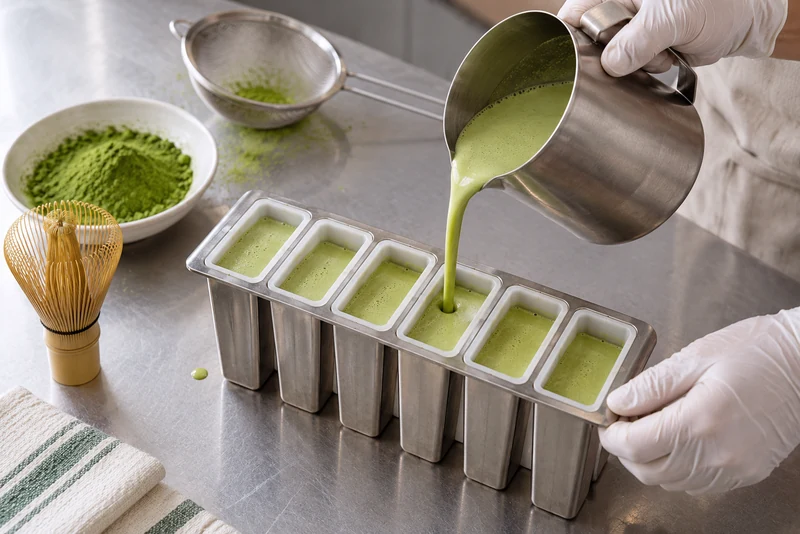
Place sticks when the base or mold system can hold them centered. Savory Spin chills 30–40 minutes before placing sticks, then freezes 2.5–3 hours; other molds may use integrated lids.
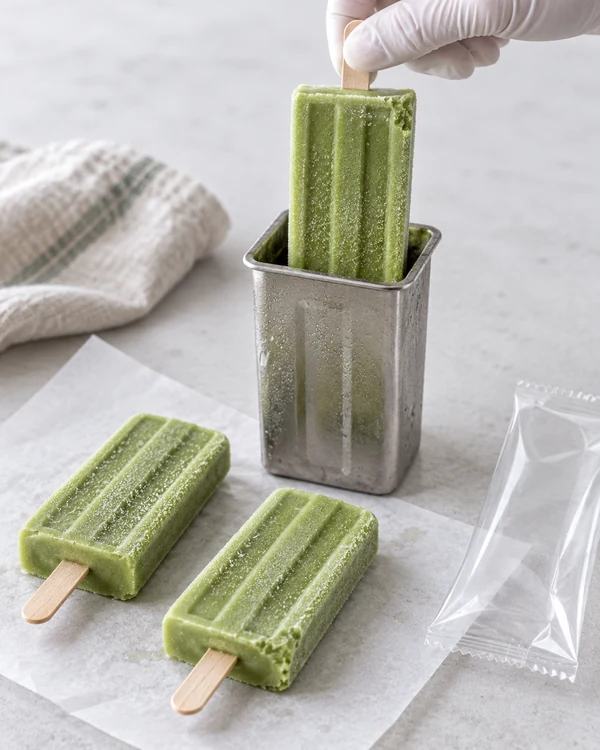
Choose the placement method around equipment and base viscosity. Avoid forcing sticks through a fully soft base without a guide, because tilted sticks reduce package fit and can tear through the pop during release. Record water-dip or temper conditions for demolding.
Key Takeaway: Treat stick alignment and release as engineered process steps.
What matcha popsicle freeze time should the line validate?
Published times range from 2.5–3 hours after a staged set to four hours, six hours or overnight. These figures reflect different molds, bases and freezers.
Record cavity volume, initial base temperature, freezer air temperature, load and time to a release-ready center. Avoid promising the shortest published cycle; a warmer or denser production load can leave the core soft and increase breakage.
Key Takeaway: Validate freezing by center condition and release, not elapsed time alone.
What allergen review does a packaged matcha popsicle need?
Review every matcha popsicle component and processing context before choosing label language. Coconut, milk, yogurt, oat ingredients and condensed products can change the allergen profile, while inclusions add further possibilities.
For U.S. packaged foods, 21 U.S.C. §343(w) requires declaration of nine major allergens under FALCPA as expanded by the FASTER Act: milk, egg, fish, Crustacean shellfish, tree nuts, peanuts, wheat, soybeans and sesame. Apply the FDA major food allergen guidance and qualified label review to the exact SKU. Avoid carrying a recipe’s “dairy-free” description into a commercial package without full formula and facility evidence.
Key Takeaway: Base allergen statements on the finished formula and controls.
What belongs in a supplier-ready matcha popsicle brief?
Specify base, matcha grade and dose, sweetener, inclusions, mold volume, fill, stick method, freeze cycle, release, package and acceptance tests. Add projected powder demand and certification needs.
AdoroHu’s EU Standard and Organic Series let buyers request clear grade candidates, while sealed 10 kg or 20 kg cartons support bulk planning. Those pack facts help sourcing; they do not establish a minimum order or finished-pop shelf life.
Key Takeaway: Send measurable process and powder requirements without inventing commercial terms.
FAQ
- How long do matcha popsicles need to freeze?
- Published recipes range from about three hours to overnight, so validate time in the actual base, mold and freezer load.
- Why does matcha settle at the bottom of a popsicle?
- Poor dispersion, low base viscosity and a long delay before freezing can create a darker sediment layer.
- When should sticks be inserted?
- Use a guided lid or insert after a short staged set when the base can hold the stick centered.
- Can coconut milk popsicles be called dairy-free?
- Only when the complete formula, ingredient documentation and facility controls support that claim.
- What portion size should a commercial pop use?
- Set the fill from actual mold volume, headspace, package and target serving; one source reports about 120 ml.
- Which matcha grade works in popsicles?
- Compare culinary and premium samples in the frozen base, then choose by color, flavor and cost.
Conclusion
Release a matcha popsicle only after the first, middle and last cavities show consistent color, fill and stick alignment. Confirm bite and drip after the intended temper because freezer exit is not the customer’s full experience. Contact AdoroHu Matcha with the base, mold volume, freeze process, target claims and projected powder demand.