The right matcha powder for a beverage brand is a finely milled, color-stable grade that disperses evenly, stays suspended, and survives your processing, whether cold-fill, hot-fill, or HPP. Here’s the challenge that defines beverage formulation: a matcha that whisks beautifully in a cup can clump, separate, or turn brown in a bottled drink, because RTD systems place completely different demands on the powder.
That gap sinks products. A beverage brand that picks the wrong matcha gets sediment at the bottom of the bottle, a dull brown color on the shelf, or a batch that tastes different from the last. Each means returns, wasted production runs, and lost retail listings. Matcha powder for a beverage brand is about solubility, color stability, and batch consistency at production scale, not just taste. This guide covers grade, formulation, processing, and supply, and shows how sourcing a beverage-optimized matcha for latte and RTD use supports a shelf-stable product.
The best matcha powder for a beverage brand is finely milled for clean solubility, color-stable to resist browning, and consistent batch to batch for production. Formulating a shelf-stable RTD drink involves balancing matcha’s bitterness with sweeteners and creamy bases, controlling acidity (often pH 4.0 to 4.5) for microbial safety, homogenizing to prevent particle separation, and choosing a processing method (hot-fill, cold-fill, or HPP). Light-protective packaging and nitrogen flushing preserve color and flavor on the shelf.
In short: beverage brands need a soluble, color-stable, consistent matcha, then formulate for suspension, acidity, and shelf stability with the right processing and packaging.
Key points:
- Beverage matcha must disperse cleanly and stay suspended, not settle as sediment.
- Shelf-stable RTD formulation controls acidity (often pH 4.0 to 4.5) and uses homogenization.
- Color stability, light-protective packaging, and batch consistency are critical at scale.
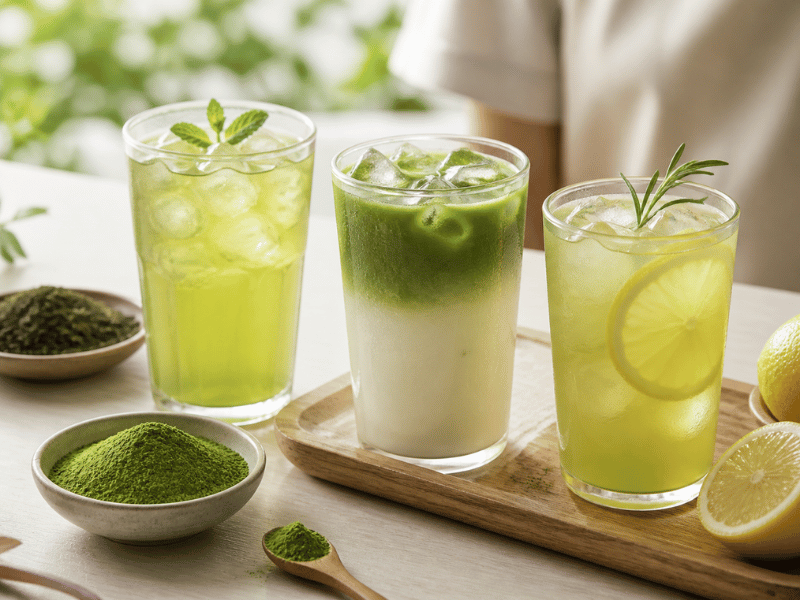
How is matcha for beverage brands different from cafe matcha?
Matcha for beverage brands is different because it must perform in a packaged, shelf-stable product, not a drink made and served immediately. Here’s the distinction that reshapes sourcing: a cafe matcha is consumed minutes after mixing, while a beverage brand’s matcha must stay suspended, green, and stable for weeks or months in a bottle.
This raises the bar on every property. An RTD or bottled drink demands solubility that resists settling, color that survives processing and storage, and batch consistency that holds across large production runs. A powder that works for straight whisked tea may not deliver in an industrial beverage system. The judgment: select beverage matcha by its final use and processing fit, not by grade name alone. A beverage brand developing a bottled matcha for latte product needs a different evaluation than a cafe choosing a powder for same-day service.
Key Takeaway: Beverage matcha must perform in a packaged, shelf-stable product, demanding solubility, color stability, and batch consistency over weeks, not minutes; select it by processing fit and final use, not by grade name as a cafe would.
What grade of matcha powder should beverage brands use?
Beverage brands should choose grade by their product’s positioning and cost target: premium for high-end drinks, culinary for cost-effective flavored formulations. Here’s the practical split: a premium, brand-forward RTD may justify a higher grade, while a sweetened or flavored mass-market drink performs well on a robust culinary grade.
Grade follows the formula. A premium beverage tasted close to neat benefits from a higher grade’s smoothness, but in a sweetened, acidified, or milk-based RTD, much of that nuance is masked, so a bold culinary or beverage grade delivers the needed color and “matcha presence” at lower cost. The experienced rule: do not overpay for ceremonial smoothness that sweeteners and acids will cover anyway. A brand can formulate a cost-effective line on culinary grade matcha while reserving higher grades for a premium SKU, matching grade to each product’s price point and flavor profile.
Key Takeaway: Match grade to positioning and cost: premium grade for high-end, near-neat beverages, robust culinary or beverage grade for sweetened or flavored RTDs, since sweeteners and acids mask the ceremonial smoothness you would otherwise overpay for.
Why does solubility and suspension matter for beverage matcha?
Solubility and suspension matter because matcha that settles ruins a bottled beverage’s appearance and consistency. Here’s the visible failure brands must prevent: if the powder sinks to the bottom, customers see sediment and get an uneven product from first sip to last.
Particle fineness drives both. A finely milled matcha disperses evenly and resists settling, while a coarse powder clumps and sinks. In a static bottled product, this is more demanding than in a freshly stirred cafe cup, since the drink may sit for weeks before opening. Formulators use homogenization and high-shear mixing to distribute particles uniformly and prevent separation, and stabilizers like acacia gum or sunflower lecithin help keep matcha suspended, especially in nut-milk bases. The foundation, though, is the powder itself. AdoroHu uses ultrasonic screening to achieve an ultra-fine, consistent particle size, giving formulators a matcha that suspends cleanly rather than fighting a coarse powder that wants to settle.
Key Takeaway: Solubility and suspension are critical because settled matcha shows as sediment and uneven taste in a bottle; start with an ultra-fine powder, then use homogenization and stabilizers, since fine particle size is the foundation that keeps matcha evenly suspended.
How do beverage brands formulate a shelf-stable matcha drink?
Beverage brands formulate shelf-stable matcha drinks by balancing flavor, controlling acidity, and choosing a processing method that ensures safety and shelf life. Here’s the formulation backbone: matcha’s earthy bitterness must be balanced, while acidity and processing protect against spoilage.
The core formulation levers work together.
- Flavor balance: sweeteners (cane sugar, monk fruit, stevia) and creamy bases (oat, coconut, almond milk) round out matcha’s natural bitterness.
- Acidity control: maintaining a target pH, often around 4.0 to 4.5, supports microbial safety in the finished drink.
- Color and oxidation management: ascorbic acid (vitamin C) or citric acid help stabilize color and flavor against oxidation.
- Functional positioning: matcha’s L-theanine, EGCG, and natural caffeine support “calm energy” and antioxidant claims that differentiate the product.
The judgment from experience: formulate for the whole system, not just taste, since a delicious drink that browns or separates on the shelf still fails. A brand can build a functional matcha private label beverage around these levers with a supplier that supports formulation.
Key Takeaway: Formulate shelf-stable matcha drinks by balancing bitterness with sweeteners and creamy bases, controlling acidity near pH 4.0 to 4.5 for safety, and stabilizing color with ascorbic or citric acid, designing for the whole system, not taste alone.
What processing methods work for RTD matcha beverages?
The main processing methods for RTD matcha are hot-fill, cold-fill with preservatives, and high-pressure processing (HPP), each with different shelf-life and label trade-offs. Here’s the decision that shapes the product: the processing method determines shelf life, equipment cost, and what “clean-label” claims you can make.
Each method suits a different goal. Hot-fill, often at around 80 to 85°C, pasteurizes the drink for room-temperature shelf stability but applies heat that can affect matcha’s color. Cold-fill with preservatives avoids heat but may need additives some clean-label brands avoid. HPP uses pressure rather than heat to extend shelf life while preserving fresh color and flavor, which is why premium refrigerated matcha RTDs often use it, at a higher processing cost. The experienced judgment: choose the method that matches your shelf-life target, budget, and label positioning, since a clean-label premium brand and a shelf-stable mass product will land on different methods. Color-stable, robust matcha gives more tolerance across all three.
Key Takeaway: Choose RTD processing, hot-fill for room-temperature shelf stability, cold-fill to avoid heat, or HPP to preserve fresh color at higher cost, based on your shelf-life target and clean-label positioning, since each method trades off differently.
How do beverage brands keep matcha green in a bottle?
Beverage brands keep matcha green by managing oxidation, light, and heat from formulation through packaging. Here’s the preservation chain: matcha’s color is attacked at every stage, so protecting it requires action in the formula, the process, and the package together.
The threats and defenses are specific. In the formula, oxidation browns matcha, so antioxidants like ascorbic acid help maintain color. In processing, excessive heat shifts green toward brown, which is why HPP or careful hot-fill control matters. In packaging, light and oxygen continue the damage, so brands use light-protective packaging (opaque or UV-blocking PET, cans, or colored glass) and nitrogen flushing before sealing to reduce oxidation. Starting with a vivid, high-chlorophyll matcha gives more color headroom before any browning shows. The judgment: protect color at all three stages, since a great formula in a clear bottle on a lit shelf still fades. A consistently vibrant powder makes the whole chain easier.
Key Takeaway: Keep bottled matcha green by defending color at three stages: antioxidants in the formula, controlled or pressure-based processing, and light-protective, nitrogen-flushed packaging; a vivid high-chlorophyll powder gives headroom, but all three stages must work together.
Why is batch consistency critical for matcha beverage brands?
Batch consistency is critical because a beverage brand produces at scale, so any variation in the matcha shows up across an entire production run. Here’s the scale reality: when thousands of bottles share one formula, an inconsistent matcha means inconsistent color and taste customers will notice across the shelf.
Consistency protects the brand. A color or flavor shift between batches produces drinks that look or taste different from one production run to the next, undermining customer trust and risking failed QC. RTD and beverage systems need repeatable batch performance, which depends on a matcha that is the same every time. Only a supplier controlling its shade-growing and stone-milling can deliver that repeatability at volume. AdoroHu’s 350-hectare self-owned estate and 3,000-tonne capacity provide the batch consistency and scale a beverage brand needs, while a trader assembling lots from scattered farms ships the variation that surfaces in a brand’s finished bottles.
Key Takeaway: Batch consistency is critical because variation multiplies across thousands of bottles in a production run; a beverage brand needs a supplier controlling its own estate and milling to deliver the repeatable color and flavor that protect the product at scale.
What documentation and compliance do beverage brands need?
Beverage brands need full QA documentation and certifications from their matcha supplier to meet food-safety and labeling requirements. Here’s the compliance chain: a beverage brand’s own claims and audits depend on documentation flowing from its ingredient supplier.
The required set supports both safety and marketing claims.
- Batch-specific Certificate of Analysis covering heavy metals, pesticides, and microbiology.
- Food-safety certifications like ISO 22000, HACCP, and FDA registration.
- Organic certifications (USDA, EU, JAS) for organic-labeled beverages.
- Documentation supporting clean-label and functional claims.
A brand cannot make a compliant label claim its supplier’s documents do not support, so the supplier’s credentials become part of the brand’s compliance file. AdoroHu holds ISO 22000, FDA registration, USDA (NOP), EU Organic, and JAS, so a brand building a certified organic matcha beverage line sources documentation that supports its own claims and audits rather than scrambling to verify a trader’s paperwork.
Key Takeaway: Beverage brands need batch COAs, food-safety and organic certifications, and claim-supporting documentation, because their label claims and audits depend on it; the supplier’s credentials effectively become part of the brand’s own compliance file.
What mistakes do beverage brands make with matcha?
The biggest mistake is choosing matcha by taste alone, ignoring the solubility, color stability, and consistency a packaged beverage demands. Here’s the pattern across failed RTD launches: each mistake maps to a specific, costly failure.
Watch for these traps, each with a named consequence.
- Choosing a coarse powder, getting sediment and uneven product in the bottle.
- Ignoring oxidation and light, letting the drink turn brown on the shelf.
- Skipping acidity control, risking microbial safety and a short shelf life.
- Sourcing without batch consistency, shipping bottles that vary run to run.
- Sourcing without certifications, unable to support label and clean-label claims.
Each is avoidable by formulating and sourcing for the full system. A vertically integrated supplier offering beverage-optimized matcha, formulation support, and complementary lines like hojicha powder for a roasted RTD option removes much of the risk in one relationship.
Key Takeaway: Stop choosing beverage matcha by taste alone; the mistakes that sink RTD products, sediment, browning, weak acidity control, and inconsistency, each carry a specific cost, and all are avoided by formulating and sourcing for the whole packaged system.
FAQ
- What kind of matcha is best for RTD and bottled beverages?
- A finely milled, color-stable matcha with clean solubility and consistent batch performance is best. It must disperse evenly and stay suspended rather than settling as sediment, resist browning through processing and storage, and stay consistent across large production runs. Select it by processing fit and final use, not grade name alone.
- What grade of matcha should a beverage brand use?
- It depends on positioning: premium grade for high-end, near-neat beverages, and robust culinary or beverage grade for sweetened or flavored RTDs. Because sweeteners, acids, and milk bases mask ceremonial smoothness, a bold culinary grade often delivers the needed color and flavor at a lower cost for mass-market drinks.
- How do you stop matcha from separating in a bottled drink?
- Start with an ultra-fine powder that disperses cleanly, then use homogenization or high-shear mixing to distribute particles uniformly. Stabilizers like acacia gum or sunflower lecithin help keep matcha suspended, especially in nut-milk bases. Fine, consistent particle size is the foundation that prevents settling.
- How do beverage brands keep matcha green in a bottle?
- Protect color at three stages: use antioxidants like ascorbic acid in the formula, control heat with careful hot-fill or use HPP, and use light-protective packaging with nitrogen flushing before sealing. Starting with a vivid, high-chlorophyll matcha gives more color headroom before browning shows.
- What pH should a shelf-stable matcha beverage be?
- Shelf-stable matcha beverages are often formulated to a target pH around 4.0 to 4.5 to support microbial safety, using acidity regulators like citric or malic acid. The exact target depends on the full formulation and processing method, so it should be validated with a food scientist for your specific product.
Conclusion
Matcha powder for a beverage brand must deliver clean solubility, color stability, and batch consistency in a packaged, shelf-stable product, then be formulated with balanced flavor, controlled acidity, and the right processing and packaging to stay green and stable on the shelf. The decisive takeaway is to select and formulate for the whole system, not taste alone, and to source from a vertically integrated supplier that ensures the consistency RTD production demands. To develop a shelf-stable matcha beverage on a soluble, consistent, fully documented supply, contact AdoroHu Matcha to request samples, specifications, and a wholesale quote matched to your formulation and volume.