Judging matcha quality comes down to five verifiable signals: a vivid jade-green color, an ultra-fine talc-like texture, a fresh grassy aroma, a smooth balanced taste, and documented lab purity. Here’s the problem most buyers face: they rely on a single tin, a pretty label, or a “ceremonial grade” sticker, and discover too late that the powder is dull, gritty, or fails a customs test.
That gap costs real money. A distributor who ships oxidized, yellowish matcha loses repeat orders. A beverage brand that skips a Certificate of Analysis risks a rejected container at port. A private-label client who never standardizes specs ends up with color and flavor that drift from batch to batch, eroding customer trust. This matcha quality guide fixes that. It walks through every sensory and laboratory checkpoint serious buyers use, then shows how to verify a supplier like AdoroHu Matcha before money changes hands, so what you order is what you receive.
High-quality matcha shows five signs: a bright, vivid jade-green color from shade-grown leaves; an ultra-fine, talc-like texture from stone-milling; a fresh, sweet, grassy aroma; a smooth taste with umami and low bitterness; and a clean Certificate of Analysis covering heavy metals, pesticides, and microbiology. Color and texture are visible instantly, but lab documentation is what protects commercial buyers from contaminated or non-compliant stock.
In short: matcha quality is judged by sensory cues you can see and taste, plus lab documentation that protects you at scale.
Key points:
- Color, texture, aroma, and taste are fast first-pass quality filters anyone can apply.
- A Certificate of Analysis covering contaminants is non-negotiable for commercial sourcing.
- Batch consistency and supplier control matter more than any single tasting.
What does a matcha quality guide say about color?
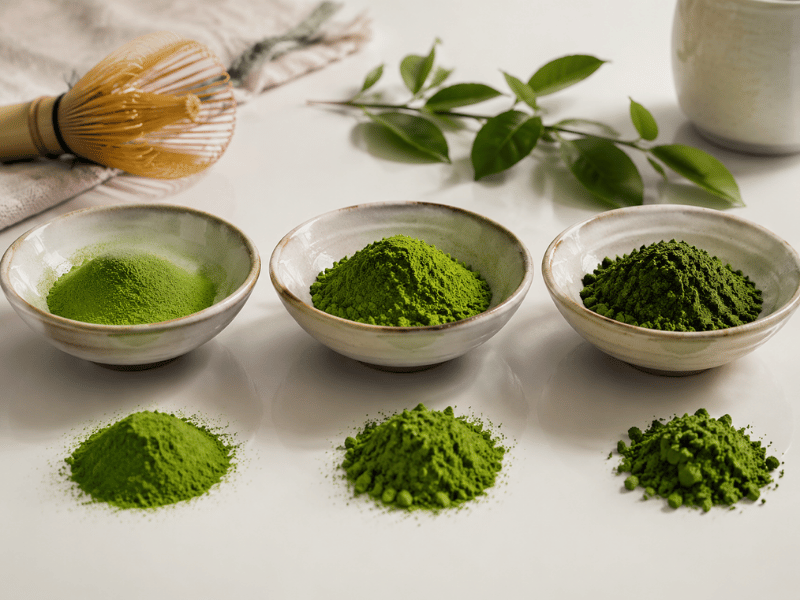
A matcha quality guide always starts with color, because a vivid, jade-green hue is the fastest visible sign of quality. Look at the powder in natural light: high-grade matcha glows like spring grass, while low-grade powder looks dull, yellowish, or even brownish. That green comes from chlorophyll, and chlorophyll comes from shade-growing, where bushes are covered for roughly three weeks before harvest.
Here’s why that matters for buyers: shading also builds L-theanine, the amino acid behind matcha’s smooth umami. A yellow or olive tint usually signals older leaves, poor storage, or oxidation, all of which dull both color and flavor. AdoroHu controls shading at its own 350-hectare estate, so the green is built into the leaf before milling ever begins. For any product where appearance sells, like lattes or smoothies, that color is a commercial asset, not just an aesthetic one.
Key Takeaway: Use color as your instant first filter; vivid jade-green signals proper shade-growing, while yellow or brown tones reveal age, oxidation, or low-grade leaves.
How do you assess matcha quality through texture and particle size?
You assess matcha quality through texture by feeling for an ultra-fine, talc-like powder, since fineness is a direct result of careful milling. Rub a pinch between your fingers. Premium matcha feels silky and soft, almost like flour or pollen. Coarse, sandy, or gritty powder points to rushed processing or lower-grade leaves.
Try this simple field test buyers swear by: drag a finger streaked with matcha across white paper. The finer the powder, the longer and smoother the line. Fineness is not cosmetic. It controls how evenly matcha suspends in water, milk, or batter, and it affects mouthfeel in the final product. AdoroHu finishes its powder through a 20-unit stone mill plus 56 ball mills and an ultrasonic screening system built specifically for ultra-fine particle size. That precision is what keeps a premium matcha blending cleanly instead of clumping.
Key Takeaway: Feel for talc-like fineness and run the paper-line test; gritty texture signals coarse milling that will clump and disappoint in finished products.
What does this matcha quality guide recommend for aroma and taste?
This matcha quality guide recommends evaluating aroma and taste together, because both reveal freshness and leaf quality that color alone cannot. Open the package and smell it. Fresh, high-quality matcha gives off a sweet, grassy, slightly marine scent. A stale, fishy, hay-like, or flat smell warns of oxidation or age.
Now taste it. Let’s break down what you should detect: a smooth entry, gentle natural sweetness, a savory umami middle, and a clean finish with only mild astringency. Aggressive bitterness or a harsh, drying aftertaste usually means later-harvest leaves or poor handling. The first-harvest spring flush carries the most amino acids and the least bitterness, which is why it commands the highest quality tier. For a buyer, aroma and taste together confirm whether the color is backed by real flavor or just surface appeal.
Key Takeaway: Trust your nose and palate; a sweet grassy aroma and a smooth, low-bitterness taste confirm fresh, well-handled leaves, while harshness exposes age or rushed processing.
Why do matcha grades matter in a matcha quality guide?
Matcha grades matter because they signal intended use, not a simple good-to-bad ranking, which is the single most misread idea in any matcha quality guide. Ceremonial grade comes from the youngest first-flush leaves and is tuned for drinking neat. Culinary grade uses slightly more mature leaves with higher catechin content, giving a bolder flavor built to survive milk, sugar, and heat.
Here’s the trap buyers fall into: assuming “ceremonial” is always better and overpaying for applications where its nuance is wasted. The right grade depends entirely on the end product. AdoroHu organizes its range into an EU Grade Series (E-1 to E-7) and an Organic Grade Series (O-1 to O-6), so a buyer can match an exact color-and-flavor point to a recipe.
| Grade | Leaf & harvest | Flavor profile | Best application |
|---|---|---|---|
| Ceremonial | Youngest first-flush | Smooth, sweet, low bitterness | Whisked neat, tasting |
| Premium | First-flush, balanced | Clean, rounded, holds up in milk | Signature lattes, retail |
| Culinary | Slightly later harvest | Bold, robust, more astringent | Baking, smoothies, blends |
| Organic (any tier) | Certified, varies by grade | Matches its base grade | Certified-organic products |
To pick precisely, match the grade to where it ends up: neat tea wants ceremonial grade matcha, while culinary grade matcha is engineered for baking and blended drinks.
Key Takeaway: Grades indicate use, not rank; match the grade to your end product instead of defaulting to the most expensive ceremonial tier.
What lab tests belong in a matcha quality guide for buyers?
For commercial buyers, the most important part of any matcha quality guide is the laboratory testing, because you consume the whole leaf and ingest anything in it. Sensory checks catch obvious problems, but only a Certificate of Analysis (COA) confirms safety and compliance. Demand a current, batch-specific COA from an accredited lab before you commit.
A complete COA should cover several categories. Skipping any of them is where import problems begin.
Contaminant and safety panels
These tests determine whether a shipment is legal and safe in your market.
- Heavy metals: lead, cadmium, mercury, and arsenic levels.
- Pesticide residue: a broad panel, often 200 to 500+ compounds via LC-MS/MS, matched to your market’s limits.
- Microbiology: total plate count, E. coli, Salmonella, plus yeast and mold.
Composition and stability markers
These tell you whether the powder will perform and last.
- Moisture and ash content, which affect shelf life and purity.
- Active markers where relevant, such as catechins or L-theanine.
- Particle size or screening data confirming fineness.
AdoroHu backs this with a 1,000 m² purification workshop, two German metal-detection systems, and a Japanese green-tea sterilization line, plus ISO 22000 and FDA registration on the food-safety side.
Key Takeaway: Never source commercially on taste alone; require a batch-specific COA covering heavy metals, pesticides, and microbiology to protect against rejected or unsafe shipments.
Which certifications signal matcha quality for global markets?
Certifications signal verified quality because they prove a third party audited the farming and processing, a layer no sensory test can replace. For organic claims, the recognized standards are USDA Organic (NOP), EU Organic, and JAS Organic. Each market enforces its own paperwork, so the right certificate prevents customs and labeling problems.
Consider what’s at stake: an organic claim without matching certification can get a shipment held or relabeled. Beyond organic, food-safety and ethical certifications widen your market access. AdoroHu holds organic certification across 150 hectares of its estate and carries China Organic, USDA (NOP), EU Organic, JAS, Halal, Rainforest Alliance, ISO 22000, and FDA registration. A buyer building a certified organic matcha line should confirm both the certificate type and its renewal date, since expired certifications are a known red flag.
Key Takeaway: Match certifications to your target market and verify renewal dates; the right organic and food-safety paperwork is what clears customs and protects your label claims.
How do you verify matcha quality before a wholesale order?
You verify matcha quality before a wholesale order by combining sample evaluation, document review, and supplier transparency into one process. A single great-looking tin is not proof. Here’s the process experienced buyers follow to avoid costly surprises.
Start with a representative sample, then check it against the supplier’s own COA. Ask direct questions about estate location, processing, and traceability. A legitimate supplier shares documentation readily; reluctance to provide COAs or vague sourcing answers are warning signs.
A pre-order verification checklist
Run through these steps before committing budget.
- Request a sample and evaluate color, texture, aroma, and taste yourself.
- Obtain a batch-specific COA and confirm it covers contaminants and microbiology.
- Verify organic and food-safety certificates, including their renewal dates.
- Confirm batch traceability and lot tracking.
- Treat unusually low pricing as a red flag for compromised quality.
AdoroHu supports this with sample requests and full documentation, and you can request a sample and quote tied to your specification.
Key Takeaway: Verify with samples plus paperwork, never one alone; a supplier that hesitates to share COAs or sourcing details is signaling risk you should avoid.
Why does batch consistency define matcha quality at scale?
Batch consistency defines matcha quality at scale because a commercial buyer needs identical color and flavor in batch one and batch five hundred. A home cook judges one tin, but a manufacturer judges repeatability. Inconsistent matcha forces recipe adjustments, ruins brand uniformity, and triggers customer complaints.
Think about it this way: consistency is engineered upstream, not sorted at the end. It demands a supplier that controls cultivation, milling, and screening under one roof. AdoroHu’s vertical integration, from its own estate through stone-milling, ball-milling, and ultrasonic screening, with a 3,000-tonne annual capacity, exists to deliver that repeatability. A trader buying from scattered farms cannot guarantee the same green or the same taste twice, which is exactly the risk that damages a growing brand.
Key Takeaway: Demand documented batch consistency from a vertically integrated supplier; uniform color and flavor across every order is what protects a brand far more than one excellent sample.
How does packaging and storage protect matcha quality?
Packaging and storage protect matcha quality by shielding the powder from its three enemies: air, light, and heat. Even the finest matcha degrades fast once exposed. Oxidation dulls the green, flattens aroma, and turns sweet umami into bitterness within weeks of poor handling.
Here’s what protects it: airtight, light-blocking packaging and cool, dry storage. For bulk supply, that means sealed food-grade liners; for retail, opaque pouches or tins rather than clear containers. AdoroHu packs bulk supply in 20 kg or 25 kg cartons with sealed food-grade liners, and offers retail formats from zip-lock pouches (30 g–500 g) to single-serve 1–3 g sachets. Most quality guides advise using opened matcha within 60 to 90 days, so packaging that supports your turnover and format matters commercially.
Key Takeaway: Insist on airtight, light-protective packaging and proper storage; the right format preserves the color, aroma, and flavor you paid to source.
What common mistakes hurt buyers in this matcha quality guide?
The most common mistake is judging matcha quality by brand prestige or grade labels instead of verifiable evidence. Buyers repeatedly fall into the same traps, and each one carries a named cost.
First, over-paying for ceremonial grade in blended applications where its nuance is lost. Second, skipping the COA and risking a contaminated or non-compliant shipment. Third, ignoring batch consistency and ending up with color drift across orders. Fourth, sourcing from a trader with no estate control, so quality cannot be guaranteed twice. Fifth, chasing the lowest price, which often signals diluted or over-harvested leaves. A supplier that owns its supply chain end-to-end, and offers full private label and OEM support with documentation, removes most of these risks at once.
Key Takeaway: Stop buying on prestige or price alone; evaluate color, texture, lab documents, and supplier control together to avoid the mistakes that quietly erode margin and trust.
FAQ
- How can I tell if matcha is high quality at a glance?
- Check the color first. Vivid, jade-green powder signals proper shade-growing and high chlorophyll, while dull yellow or brown tones indicate older leaves, oxidation, or low grade. Then confirm with an ultra-fine, talc-like texture and a fresh, sweet, grassy aroma.
- Is ceremonial grade always the highest quality matcha?
- Not exactly. Ceremonial grade is made from the youngest first-flush leaves for drinking neat, but grades indicate intended use, not a simple quality ranking. Culinary grade is purpose-built for baking and blended drinks, where its bolder flavor performs better than ceremonial nuance.
- What documents should a matcha supplier provide before a bulk order?
- Request a batch-specific Certificate of Analysis covering heavy metals, pesticide residue, and microbiology, plus organic certificates (USDA, EU, or JAS) and food-safety credentials like ISO 22000 and FDA registration. Confirm certificate renewal dates and batch traceability as well.
- Why does my matcha taste bitter or look yellow?
- Bitterness and a yellow tint usually point to later-harvest leaves, oxidation, or poor storage. Fresh, first-harvest, shade-grown matcha is smoother and greener. Airtight, light-protective packaging and cool, dry storage help preserve both color and flavor.
- Can I get samples and lab documentation before committing?
- Yes. AdoroHu supports sample requests so you can evaluate color, texture, aroma, and blend performance, and provides documentation for quality verification. Pricing is quoted by grade and quality, and lead time is set against order volume.
Conclusion
Judging matcha quality well means combining the sensory checks anyone can run, color, texture, aroma, and taste, with the laboratory and certification evidence that protects you at commercial scale. The practical takeaway is simple: verify with samples and a batch-specific COA together, and source from a supplier that controls its own estate and milling for consistency. To evaluate quality firsthand, contact AdoroHu Matcha to request a sample and a wholesale quote matched to your grade and volume.