
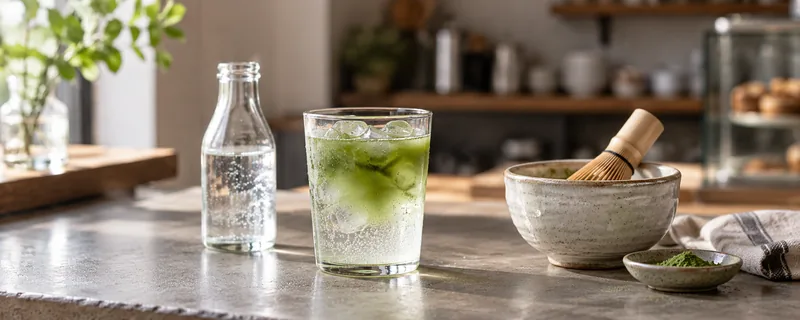
Matcha sparkling water works commercially when tea dispersion, acid balance, carbonation, filling sequence, and settling expectations are designed together. A fresh bench glass can foam over, separate, or lose its visual appeal after filling. Thin carbonated beverages expose every particle and process mistake.
For matcha sparkling water, define whether the product is a clear-leaning refreshment, intentionally suspended matcha drink, soda, or fruit-flavored sparkling beverage. AdoroHu’s instant tea for drink applications provides a useful comparison when conventional matcha suspension does not fit the brief.
Matcha sparkling water differs from still RTD matcha and lemonade because carbonation changes mixing, foam, filling, and sensory perception. The product team must decide what settling is acceptable and how consumers will handle the pack. Process sequence should protect carbonation after the matcha phase is already uniform.
In short:
Key points:
- Define clarity, suspension, settling, and shake instructions before formulation.
- Build and filter or homogenize the matcha base before carbonation where the process allows.
- Validate foam, fill, pressure behavior, sediment, and flavor in the final package.
How is matcha sparkling water different from still RTD matcha?
Matcha sparkling water adds carbonation and a thin liquid matrix to the usual RTD challenges. Bubbles amplify foam during mixing and filling, while low viscosity makes particles and sediment more visible.
| Beverage | Main structure | Distinct development issue |
|---|---|---|
| Sparkling matcha water | Thin, carbonated liquid | Foam, fill loss, and visible settling |
| Still RTD matcha | Thin or lightly bodied liquid | Suspension and flavor stability |
| Matcha lemonade | Acidified fruit beverage | Citrus balance and pulp interaction |
| Matcha latte | Milk or plant-base system | Protein, fat, and opacity |
Key Takeaway: Treat carbonation as a process variable, not a garnish.
What appearance standard should the beverage use?
The appearance standard should state whether the beverage is uniformly cloudy, lightly suspended, visibly settling, or based on a more soluble tea system. Matcha is a leaf powder, so promising permanent clarity without suitable formulation evidence is unsafe.
Define acceptable color, ring formation, bottom sediment, particle visibility, and consumer handling. If “shake before use” is considered, validate how opening behaves after agitation in a carbonated pack.
The practical trade-off is to accept some natural settling when aggressive stabilization would damage flavor or label goals. A realistic standard is better than forcing a thin beverage to imitate clear soda.
Key Takeaway: Decide what consumers may see before choosing the powder system.
Which matcha grade fits sparkling water?
Premium or suitable culinary matcha may fit, depending on flavor intensity, sweetness, acid, and visual target. AdoroHu’s E-1 and E-2 are culinary grades, while E-3 and E-4 are premium. Organic O-1 and O-2 are culinary, and O-3 is premium.
Thin water exposes bitterness quickly, so a grade that works in lattes may taste harsh here. Compare coded candidates in the carbonated finished beverage, not only in still water.
Avoid ceremonial grade as an automatic choice. Carbonation and acid can change perception, and the consumer may value refreshment over delicate whisked-tea aroma.
Key Takeaway: Approve grade after carbonation and flavor adjustment.
How should matcha be dispersed before carbonation?
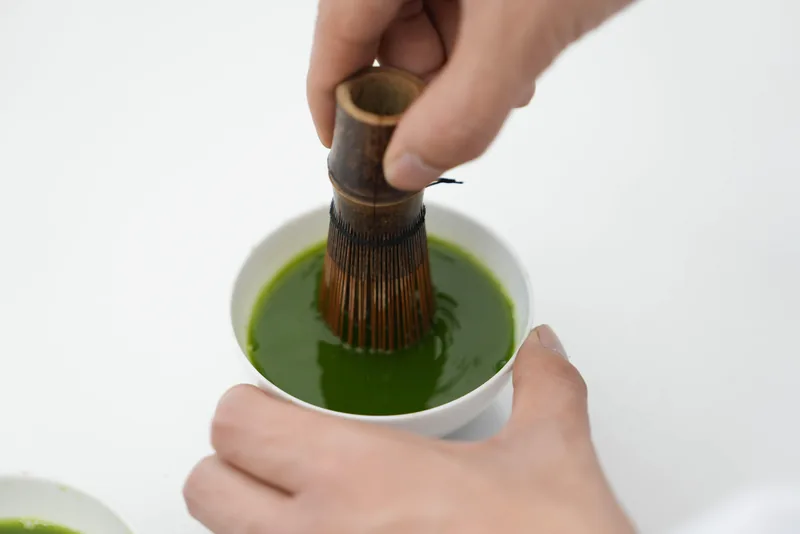
Matcha should be dispersed into a controlled liquid base before carbonation where the equipment and validated process permit. Adding dry powder to carbonated water creates foam, clumps, and rapid gas loss.
AdoroHu uses ultrasonic screening for ultra-fine matcha, supported by multiple milling systems. Fine powder helps reduce large agglomerates, while the beverage line still needs defined wetting, shear, water quality, and addition order.
Do not solve settling with endless high shear. Excess process energy can raise temperature and add air before carbonation. The correct endpoint is a repeatable base, not the longest possible mix.
Key Takeaway: Make the matcha phase uniform before introducing carbonation.
How should acid and sweetness be balanced?
Acid and sweetness should be balanced after matcha grade and flavor direction are set. Citrus or fruit acids can brighten the drink but may also sharpen bitterness and change green color.
Build a small matrix across matcha candidate, acid system, and sweetness level. Score tea aroma, acidity, bitterness, sweetness, finish, color, and refreshment after carbonation.
| Direction | Sensory benefit | Risk to control |
|---|---|---|
| Unsweetened | Clean, adult profile | Bitterness feels exposed |
| Lightly sweetened | Rounds tea and acid | Sweetness may linger |
| Citrus | Familiar sparkling refreshment | Acid can dominate matcha |
| Fruit flavor | Broad concept range | Aroma may obscure tea identity |
Key Takeaway: Balance the carbonated drink, not the still concentrate.
What carbonation and filling sequence should a pilot compare?
A pilot should compare only sequences supported by the plant’s equipment and process authority. The key decision is how to deliver a uniform matcha base to carbonation and filling with controlled foam and gas loss.
Record base temperature, deaeration where applicable, carbonation setting, transfer path, filler behavior, foam, net fill, seam or closure checks, and first-to-last container appearance. Do not publish universal pressure or temperature numbers without equipment-specific validation.
Reject a sequence that produces attractive lab bottles but constant line stops or large fill losses. Process reliability is part of product quality.
Key Takeaway: Choose the sequence that protects both uniformity and fill performance.
How should settling and redispersion be tested?
Settling and redispersion should be tested in the final container over the intended distribution route. The team should observe sediment depth, rings, clumps, color gradient, and the effort needed to restore a uniform appearance.
For carbonated products, consumer handling needs special care. Vigorous shaking may create an opening hazard or foam loss, so any instruction must be tested with the actual package and carbonation system.
The AHM guide to matcha solubility testing helps distinguish dissolution language from practical dispersion and suspension performance.
Key Takeaway: Validate what happens before and after the consumer moves the pack.
When should an instant tea system be considered?
An instant tea system should be considered when the product requires easier dissolution, lower visible sediment, or a different sensory profile than whole-leaf matcha can provide. It is a formulation choice, not a claim that matcha naturally dissolves completely.
Compare conventional matcha, instant tea, and custom blends against the same appearance and flavor brief. AdoroHu’s custom instant blend service can support a defined beverage target.
The trade-off is identity versus process behavior. Whole-leaf matcha gives a recognizable product story, while an instant system may make thin carbonated processing easier.
Key Takeaway: Choose the tea system that matches the appearance promise.
What should a sparkling beverage pilot measure?
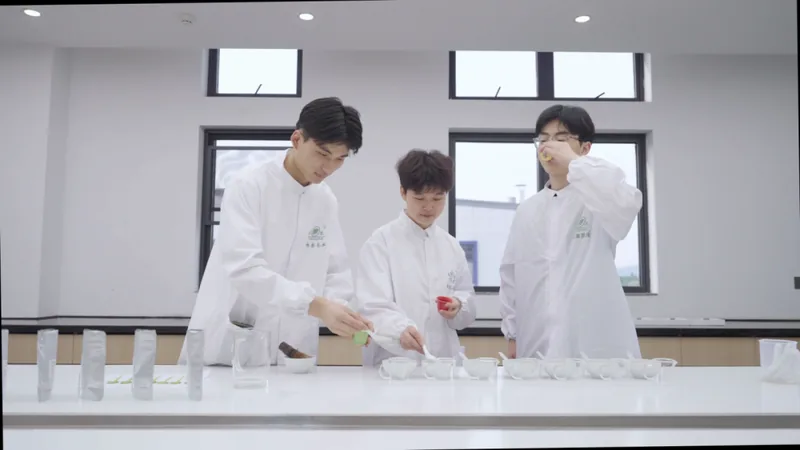
A pilot should measure dispersion, sediment, color, foam, fill loss, net content, closure performance, carbonation retention, flavor, and container-to-container consistency. These outputs connect formulation with line and package reality.
Record matcha and flavor lots, water source, base sequence, mixing method, hold time, carbonation conditions, filler observations, and packaged checkpoints. AdoroHu’s in-house microbiology and physical-chemical laboratories support matcha lot documentation.
For US production, 21 CFR 117.80 requires food-manufacturing operations to use adequate sanitation principles and suitable quality-control operations. For the buyer, that means the sparkling pilot record must fit the plant’s documented production and preventive-control system rather than sit apart as an R&D note.
Use samples from the beginning, middle, and end of the run. A stable average can hide settling in the supply tank.
Key Takeaway: Test first-to-last container uniformity.
Which package and label decisions belong in development?
Package and label decisions belong in development because light exposure, oxygen, headspace, closure, pressure, and consumer instructions affect product performance. The container also determines how visible sediment appears.
Use the final can or bottle in distribution trials. Inspect color, sediment, leakage, deformation, flavor, and opening behavior at defined checkpoints. The AHM guide to matcha oxygen-barrier packaging provides ingredient context, while the carbonated finished product needs its own validation.
Do not claim a shelf life from a bench observation. Use qualified process and food-safety specialists for the finished beverage.
Key Takeaway: Design the appearance promise around the actual pack.
What supplier evidence should procurement request?
Procurement should request a current specification, lot-specific Certificate of Analysis, allergen statement, traceability information, storage guidance, and relevant certification evidence. The approved powder and production shipments should share one defined identity.
AdoroHu lists USDA Organic (NOP), EU Organic, JAS Organic, BRCGS Food Safety, FDA registration, ISO 22000, Halal, and Kosher among its current certifications. Buyers should verify the scopes relevant to the planned claim and market.
Bulk 10 kg and 20 kg cartons use sealed food-grade liners. Controlled opening and resealing matter because line-side powder exposure can undermine the consistency established in development.
Key Takeaway: Approve the lot evidence and handling plan with the sensory sample.
FAQ
- Does matcha dissolve completely in sparkling water?
- Conventional matcha is a fine leaf powder, so the product should define realistic dispersion, suspension, and settling expectations.
- Which matcha grade works best in sparkling water?
- Premium or suitable culinary matcha may work, but candidates should be compared after acid, sweetness, and carbonation are applied.
- When should matcha be added to a carbonated drink?
- Build a uniform matcha base before carbonation where the validated plant process allows, then minimize unnecessary gas loss.
- Can consumers shake sparkling matcha water?
- Any movement or shake instruction must be tested with the actual carbonation level and package to confirm safe, acceptable opening behavior.
- When is instant tea better than conventional matcha?
- Consider instant tea when easier dissolution or lower visible sediment matters more than a whole-leaf matcha format.
- How should commercial shelf life be set?
- Test the final beverage in its final package through intended distribution using appropriate quality, package, process, and safety criteria.
Conclusion
Commercial matcha sparkling water needs a realistic appearance standard, controlled base preparation, carbonated-process trials, and final-package validation. Compare tea systems by first-to-last container performance. Contact AdoroHu Matcha to discuss a matcha or instant-blend beverage brief.