
Matcha pancakes need a conventional griddle benchmark before a café experiments with soufflé height, toppings, or holding. A standard batter made with culinary matcha powder is faster to portion and easier to reproduce during service than an egg-foam soufflé system.
Published recipes give useful starting facts, but they describe different batters and equipment. Use them as external benchmarks, then measure the café’s own scoop weight, griddle temperature, time, yield, and five-minute eating quality.
A griddle pancake and a soufflé pancake are different products. Fix the service model first, preserve each published recipe’s original units, and validate the selected batter on the actual station. No published recipe establishes an AdoroHu-tested formula or commercial holding limit.
In short:
Key points:
- Choose standard griddle pancakes for throughput or soufflé pancakes for made-to-order theater.
- Control portion volume, surface temperature, rest time, and flip cues together.
- Price the plate from actual pancakes served, including the first pieces used to stabilize the griddle.
Should matcha pancakes use a griddle or soufflé process?
Matcha pancakes should use a standard griddle process when service speed and repeatable batches matter most. Ovenspiration, Laura Fuentes, and Senbird each portion about ¼ cup batter and use roughly two minutes before flipping. That creates a practical café reference.
The soufflé benchmark is more complex: Just One Cookbook states two separated eggs, partially frozen whites, a lidded 12-inch pan, water for steaming, and three 3-inch pancakes. Its 1 tsp matcha is explicitly given as 2 g. Choose soufflé only when the menu price and customer wait can support egg separation, meringue handling, covered cooking, and smaller batch output.
| Format | Published process cue | Operating consequence |
|---|---|---|
| Standard griddle | ¼-cup deposits; visible bubbles; flip once | Faster training and several pieces per surface load |
| Soufflé | Meringue, lid, steam water, three 3-inch pieces | Higher labor and lower simultaneous output |
Key Takeaway: Choose standard griddle service for volume; avoid a soufflé promise when the line cannot protect its labor and wait time.
Which published matcha pancake benchmark fits a café portion?
A useful matcha pancake benchmark links batter portion to cooking time and stated yield. Ovenspiration uses ¼ cup per pancake, cooks 2–3 minutes before the flip and 1–2 minutes after, and states a yield of 4. Laura Fuentes also uses ¼ cup, about 2 minutes before flipping and 1 minute after, with a yield of 4.
A Taste of Madness uses a larger ⅓-cup scoop with 1 tbsp matcha in a 1-cup-flour batter. That portion is 33% more volume than ¼ cup before accounting for batter density. It will change diameter, center cook and plate cost.
| Benchmark | Flour and matcha | Deposit and timing |
|---|---|---|
| Ovenspiration | 1½ cups flour; 1 tbsp matcha | ¼ cup; 2–3 min plus 1–2 min |
| Laura Fuentes | 1½ cups flour; 1 tbsp matcha | ¼ cup; about 2 min plus 1 min |
| A Taste of Madness | 1 cup flour; 1 tbsp matcha | ⅓ cup; source does not state a per-side time |
Key Takeaway: Pick ¼ cup or ⅓ cup before costing; scoop volume changes the product even when the keyword is the same.
How should a café control griddle temperature for matcha pancakes?
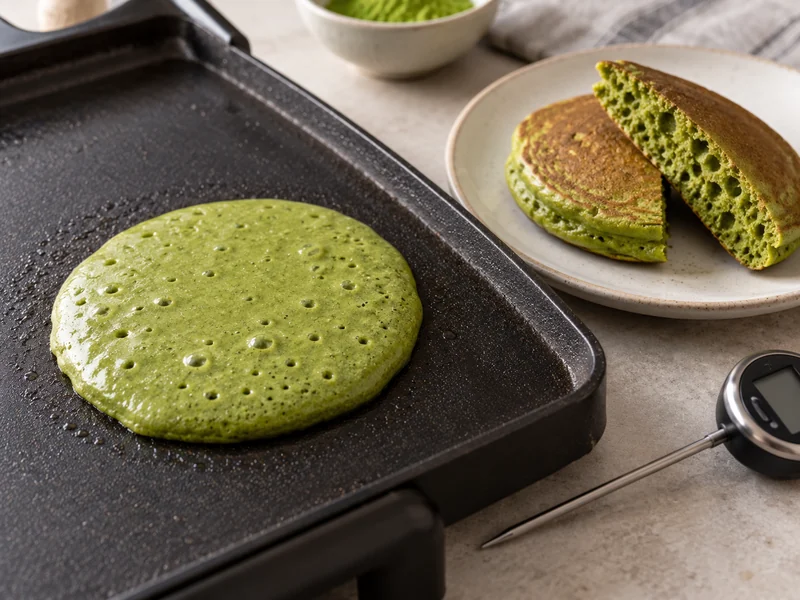
Matcha pancakes need a recorded surface condition because browned exteriors can hide the green cue before the center sets. Laura Fuentes reports a griddle setting of 300–350°F, while other sources say medium heat without a number. The numeric range is a published starting point, not a universal setting.
Use an actual surface reading when available and note the recovery after each load. Record the first acceptable batch separately; the first pieces may behave differently while the plate stabilizes. Flip on a defined combination of edge shape and bubbles, then check the center of a fixed sample.
Avoid raising heat to shorten the queue when the outside darkens before the center cooks. The consequence is a bitter-looking surface and inconsistent holding.
Key Takeaway: Validate one surface range with the chosen scoop and batter rather than copying a dial position.
What does a five-minute rest change in matcha pancake batter?
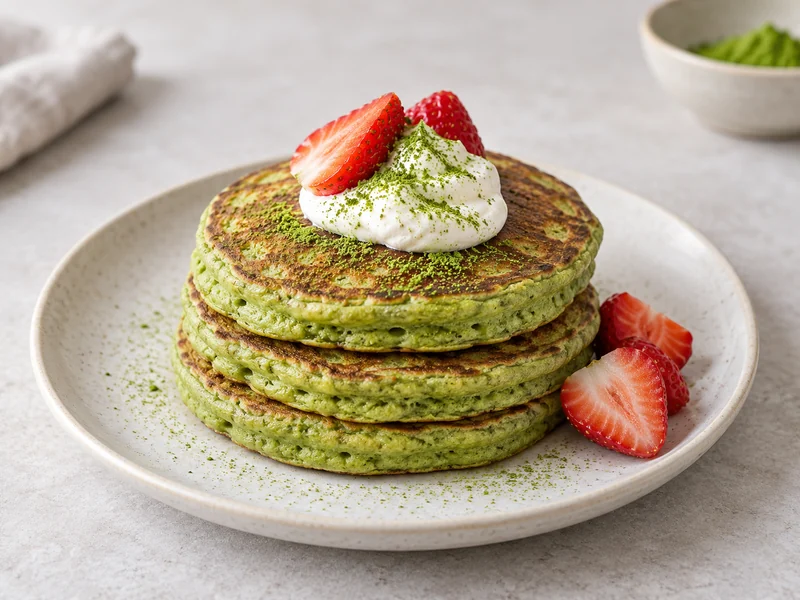
A five-minute rest is a concrete starting control for matcha pancake batter because Ovenspiration states that interval. It gives flour time to hydrate and lets the team observe whether matcha settles or the batter thickens before service.
Compare the first portion immediately after mixing with one after five minutes, using the same scoop and griddle zone. Record spread diameter, height, bubbles, color and center texture. If the café holds batter longer, sample at the actual service intervals rather than extending the five-minute result by assumption.
Senbird warns that overmixing can produce dense pancakes. That makes mixing time and rest time separate variables: solve lumps with a controlled fold, not prolonged beating.
Key Takeaway: Use five minutes as a published trial point and measure any longer service hold independently.
Which matcha grade should a pancake team compare?
A matcha pancake team should begin with adjacent culinary grades because flour, browning and toppings reduce the value of dry-powder appearance. AdoroHu identifies E-1/E-2 and O-1/O-2 as Culinary grades. Higher numbers within each series indicate deeper color, more sweetness and less bitterness.
Cook the same batter on the same griddle zone and compare cut centers under fixed light. Choose the higher grade only when the finished pancake keeps a visible or sensory advantage through the intended topping.
Avoid evaluating under maple syrup first. Sweet syrup can mask bitterness and make two grades seem identical, leading to a higher powder cost without a menu benefit.
Key Takeaway: Grade the plain center first, then confirm the winner with the finished plate.
How should toppings be screened for matcha pancakes?
Toppings for matcha pancakes should add contrast without covering the tea or collapsing the stack. Berries and citrus bring acid and water; yogurt adds tang and dairy; red bean adds sweetness and density; syrup changes the surface quickly.
Use one fixed stack and weigh each topping. Photograph at plating and after five minutes. Measure syrup absorption, slide, sogginess, color contrast and total plate cost. A topping that looks good at pass but pools during delivery needs a separate pack or should be rejected.
The matcha baking guide helps compare pancakes with other flour applications, while the dessert sourcing guide supports the wider ingredient choice.
Key Takeaway: Approve toppings at the customer’s likely eating time, not only at the pass.
How should a café calculate matcha pancake yield and capacity?
Matcha pancake yield should be calculated from measured batter weight and accepted portions. Published yields vary: Ovenspiration and Laura Fuentes state 4, Senbird states 8 servings, and the soufflé source states three 3-inch pancakes. “Serving” and “pancake” are not equivalent units.
| Station measure | Record | Buyer use |
|---|---|---|
| Portion | scoop volume and actual batter weight | ingredient cost per pancake |
| Load | accepted pancakes per griddle cycle | orders per hour |
| Loss | test pieces, scorched pieces, leftover batter | realistic gross margin |
| Hold | quality at pass and five minutes | dine-in versus delivery decision |
Cost the plate from the café’s number of accepted pancakes and toppings. Avoid using “yield 4” without checking whether the source means pieces or servings.
Key Takeaway: Convert the recipe into station cycles and accepted plates before setting a price.
What must the finished matcha pancake label or menu reflect?
The finished matcha pancake menu must reflect the actual milk, egg, wheat, toppings and shared-equipment context. Plant milk or plant butter in one component does not automatically make the full plate dairy-free or vegan.
The FDA food-allergen overview identifies major U.S. allergens and explains label reading. Operators still need to review every ingredient and their destination-market rules.
AdoroHu supplies pure matcha powder rather than pancake mix or finished pancakes. Buyers can review its matcha baking application and contact AdoroHu Matcha with the selected batter, heat exposure, grade comparison and volume plan.
Key Takeaway: Describe the real plate and process; do not transfer dietary claims from the matcha alone.
FAQ
- Are soufflé matcha pancakes suitable for fast café service?
- Only when the station can support egg separation, meringue handling, covered steaming and the stated three-pancake batch size.
- Should a café portion matcha pancake batter with ¼ cup or ⅓ cup?
- Choose one based on the target diameter and plate cost, then keep it fixed; the larger scoop changes cook time and yield.
- Is 300–350°F the correct griddle setting for every matcha pancake?
- No. It is one published benchmark range. Validate surface temperature with the chosen batter, scoop and equipment.
- Why test a five-minute batter rest?
- One published recipe specifies five minutes, making it a useful first comparison for hydration, spread and matcha settling.
- Can plant milk make matcha pancakes vegan?
- Not by itself. Egg, butter, toppings and shared equipment must also be reviewed.
- How should a café compare matcha grades in pancakes?
- Cook adjacent grades in the same plain batter, compare cut centers, then retest the winner with the intended topping.