
Matcha truffles depend on a ganache that emulsifies cleanly, sets for the chosen forming method, and holds a consistent piece weight. Powder pockets, excess liquid, or warm handling can make centers oily, soft, or streaked.
Develop matcha truffles around the actual chocolate, cream system, forming method, and coating. The matcha for chocolate formulation guide gives broader context; the truffle trial must resolve center set and handling.
Fix chocolate type, liquid composition, matcha addition, cooling, and portioning before comparing centers. Release requires a smooth emulsion, defined set condition, repeatable piece weight, and coating that survives packout.
In short:
Key points:
- Set the chocolate-to-liquid balance for rolling, molding, depositing, or enrobing.
- Disperse matcha before the emulsion closes to prevent dark powder pockets.
- Validate center set, piece weight, coating, and allergen controls as one process.
What should a commercial matcha truffle brief define?
Define the center style, chocolate type, coating, target tea intensity, piece weight, storage condition, service temperature, and production volume. Matcha truffles built for hand rolling, molds, enrobing, or depositing need different set and flow behavior.
Include the intended shelf-life study and allergen profile in the brief. These choices affect formula, equipment, packaging, and cleaning before the first trial.
Key Takeaway: Define the center and handling process together.
How should chocolate type be chosen for matcha?
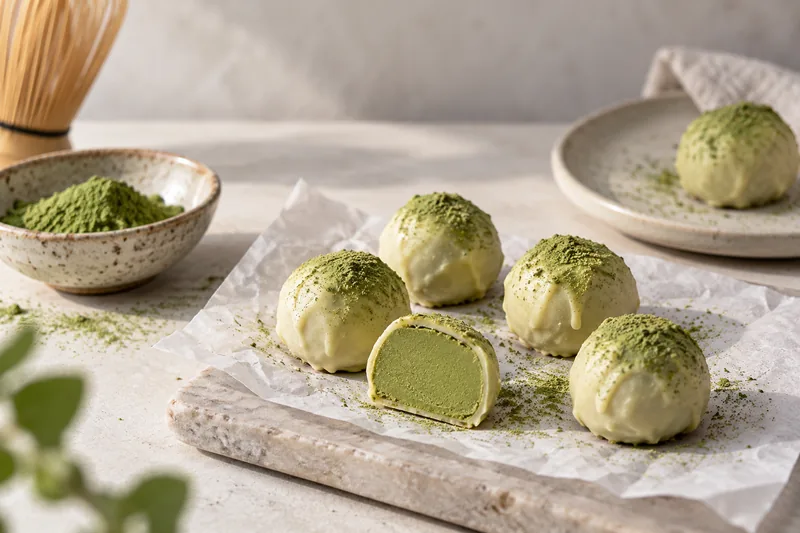
White chocolate gives color contrast and a mild cocoa profile, milk chocolate adds caramel and dairy notes, and dark chocolate can dominate tea aroma. Compare them at matched center texture rather than using one cream ratio for all three.
Choose the chocolate that supports the product promise. White chocolate makes matcha visible but can be very sweet; darker chocolate reduces sweetness but may require a clearer, more assertive tea grade.
| Chocolate system | Matcha consequence | Process question |
|---|---|---|
| White chocolate | High color visibility, high sweetness | Can tea remain clear without thickening the center? |
| Milk chocolate | Dairy and caramel competition | Does matcha remain recognizable at service temperature? |
| Dark chocolate | Strong cocoa competition | Is a sharper tea profile intentional and balanced? |
Key Takeaway: Select chocolate by flavor balance and process behavior.
How should matcha dose be screened in ganache?
AdoroHu’s grade ladder identifies E-3/E-4 as conventional Premium and O-3 as Organic Premium. Use those codes for controlled samples, then let the finished center decide. Run a dose ladder in one locked ganache and evaluate it at the intended serving temperature. Score tea aroma, bitterness, sweetness, color, powder perception, and aftertaste. Use weighed ingredients and finished yield so cost per piece remains visible.
Avoid approving the darkest center. Color can increase before flavor balance improves, especially in a pale chocolate base.
For sourcing trials, compare representative samples against the application target rather than relying on labels alone. The premium matcha powder page provides the relevant product route.
Key Takeaway: Choose the lowest dose that delivers a clean tea finish.
What addition sequence prevents matcha pockets?
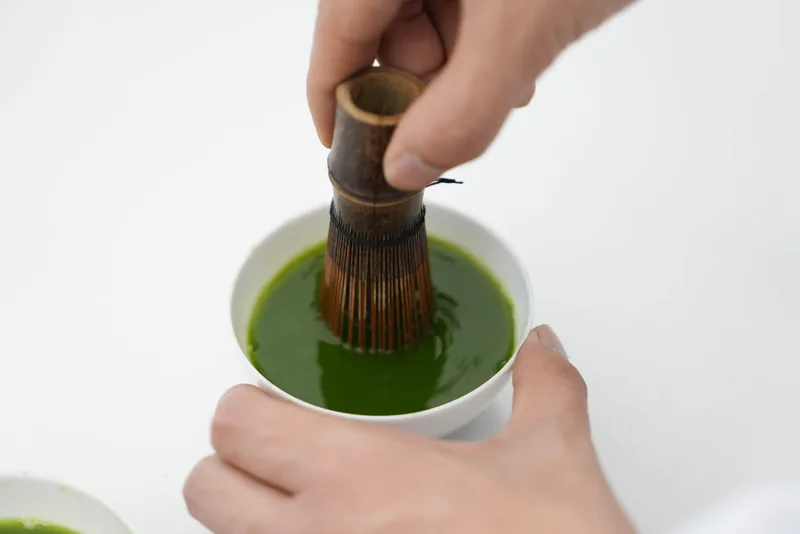
AdoroHu uses ultrasonic screening and multiple milling routes, including 20 stone mills, 56 ball mills, and 8 continuous ball mills. Confirm that comparison lots follow the agreed process and specification. Sift matcha and disperse it into a controlled portion of warm cream or another suitable liquid phase before emulsifying with chocolate. Record temperatures, mixing tool, time, and scrape-down steps. Dry powder added late can create dark pockets that appear only after cutting.
Protect the emulsion while dispersing the powder. High shear may smooth the center, but unnecessary aeration introduces bubbles and weakens appearance.
Key Takeaway: Use a repeatable pre-dispersion and low-air emulsion step.
How should the chocolate-to-liquid ratio be set?
Set the ratio for the chosen chocolate, liquid composition, butter or invert sugar, and required handling temperature. A ratio that pipes well may be too soft for hand rolling; a firm center may crack during enrobing.
The tradeoff is throughput versus eating quality. A firmer center handles faster, while a softer center can give a better melt but demands tighter temperature control.
| Ganache condition | Likely process variable | Controlled response |
|---|---|---|
| Too soft to portion | Chocolate-to-liquid balance or set | Recheck formula and cooling condition |
| Oily or split | Emulsion temperature and sequence | Correct emulsion process before dose |
| Dark green pockets | Matcha wetting and scrape-down | Standardize pre-dispersion |
Key Takeaway: Approve ratio against the actual forming method.
What does cooling and crystallization control?
Cooling controls set, fat crystallization, portioning behavior, and oil separation. Record ganache depth, container, cooling environment, time, and center temperature before forming. Covering practices should protect the surface without trapping damaging condensation.
Do not use an arbitrary overnight hold as the process specification. Define the observable and measurable condition that makes the center ready.
Key Takeaway: Release the center by condition, supported by time and temperature.
How can portion and coating variation be reduced?
Use a defined deposit or scoop weight, tool temperature, forming time, and coating method. Check a sample of pieces for weight, shape, surface defects, and matcha coverage. Matcha dusting can look attractive but may taste dry or absorb surface moisture.
If a powder coating becomes patchy during storage, solve the surface and packaging problem rather than applying more powder.
Keep this decision connected to the wider application context in bulk matcha for food manufacturing.
Key Takeaway: Control the piece before decorating it.
How should allergens and sanitation be handled?
Most chocolate truffle systems contain milk, and some include nuts or soy ingredients. The FDA food allergen page identifies milk, tree nuts, peanuts, soy, and sesame among the nine major allergens and requires accurate source declaration for packaged foods.
21 CFR 117.80 also requires controls against allergen cross-contact and contamination. Include shared equipment, cleaning, rework, label verification, and line-clearance evidence in the trial plan.
| Production check | Record | Release use |
|---|---|---|
| Portioning | Piece weights and forming temperature | Control count and texture |
| Coating | Cracks, bare spots, transfer | Confirm handling and packout |
| Set | Center condition before forming | Define ready-to-process state |
Key Takeaway: Bind allergen controls to the exact formula and line.
What evidence should release matcha truffles?
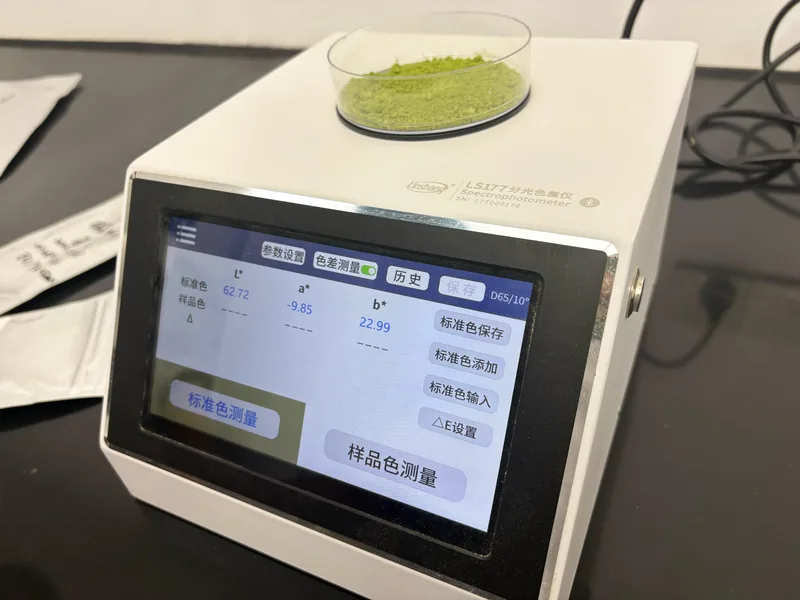
AdoroHu’s in-house microbiology and physical-chemical laboratories can support lot-linked powder COA inputs. Its 10 kg and 20 kg formats use sealed food-grade liners, so pack size should match batch use and post-opening storage. Release needs the locked formula, ingredient and matcha lots, temperature record, emulsion method, set criteria, piece-weight checks, coating result, storage plan, allergen review, deviations, and named approval. Repeat the process at representative scale.
A short refrigerated hold is not a shelf-life study. Validate the intended package, storage, distribution, and service conditions before making a life claim.
Key Takeaway: Release a repeatable center, forming method, and storage window.
FAQ
- Which chocolate works best for matcha truffles?
- The best choice depends on the target sweetness, tea intensity, color, and forming process; compare chocolate types at matched center texture.
- Why does matcha form dark pockets in ganache?
- Unsifted powder, late dry addition, weak wetting, or incomplete scrape-down can leave concentrated pockets that appear after setting.
- Why are matcha truffle centers too soft to roll?
- The chocolate-to-liquid balance, chocolate type, added fats or sugars, temperature, and crystallization conditions all affect firmness.
- Should matcha truffles be dusted with matcha powder?
- They can be, but the team should test dryness, bitterness, moisture pickup, appearance, and packaging before approving the finish.
- What must be recorded in a commercial truffle trial?
- Record ingredient lots, weights, temperatures, mixing sequence, set criteria, piece weights, coating results, storage conditions, allergens, deviations, and approvals.
Conclusion
A commercial truffle is ready when its ganache sets predictably, portions consistently, and reaches packout without cracks, transfer, or powder pockets. Share the chocolate system, forming method, target piece, and trial volume through the contact page for sample planning.