
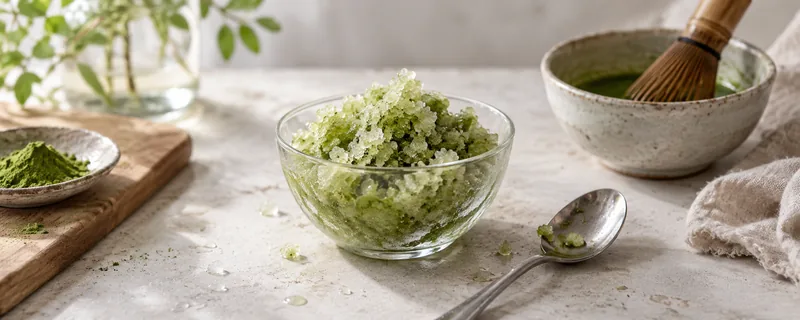
Matcha granita succeeds when crystal growth, matcha sediment, and scrape timing stay aligned. A sweet frozen block can still fail if tea collects at the tray bottom or crystals become inconsistent across service.
Develop matcha granita with one tray material, fill depth, freezer position, and scrape tool. The commercial matcha ice cream guide gives frozen-dessert context, but granita needs its own interrupted-freezing protocol.
Fix base solids, matcha dispersion, tray depth, freezer setting, and scrape sequence before comparing batches. Release depends on repeatable crystals, even tea distribution, melt behavior, yield, and service handling.
In short:
Key points:
- Balance sugar for flavor and scraping behavior in the same trial.
- Inspect the tray surface, middle, and bottom during every scrape.
- Stop scraping at a defined crystal condition and document the service window.
What should a commercial matcha granita brief define?
Define portion, vessel, service temperature, tea intensity, sweetness, acidity, crystal target, scrape method, holding, and garnish. A plated granita, drink topping, and café cup require different crystal and melt behavior.
Lock the freezer, tray geometry, fill depth, and service window before comparing powders.
Key Takeaway: Define the frozen format and service path first.
How should the liquid base be balanced?
Sugar concentration affects freezing and crystal formation, while acids and flavors alter tea perception. Build a measured base and change one variable at a time.
The tradeoff is clear: more dissolved solids can soften the scrape but may make the product too sweet or slow to freeze. Approve sweetness and crystal behavior together.
| Base variable | Frozen consequence to observe | Decision |
|---|---|---|
| Lower dissolved solids | Firmer freeze and harder scrape | Check texture and service labor |
| Higher dissolved solids | Softer freeze and sweeter taste | Check tea clarity and shape |
| Added acid or flavor | Changed tea perception | Rebalance without hiding defects |
Key Takeaway: Balance flavor and freezing behavior in the same trial.
Which matcha candidates should be screened?
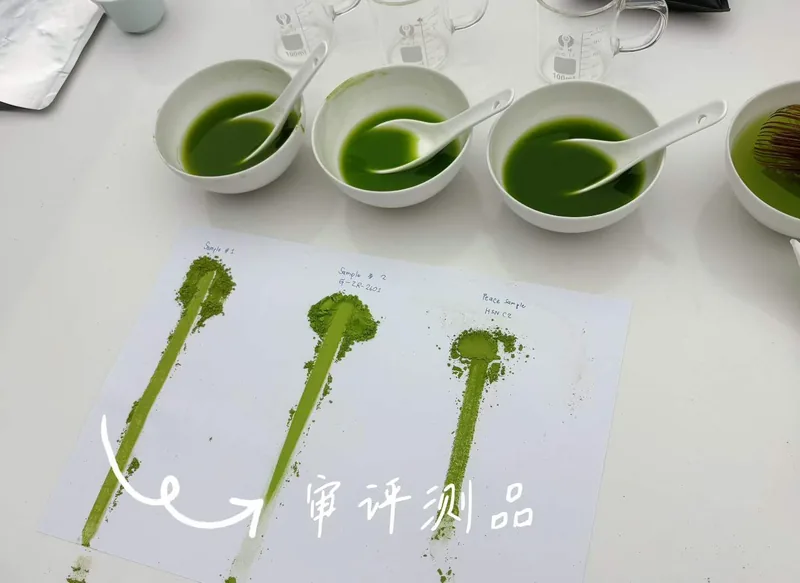
Use AdoroHu’s E-1/E-2 Culinary, E-3/E-4 Premium, and O-3 Organic Premium codes for controlled sample identity. Compare at fixed dose and service temperature.
A brighter dry powder may not hold the best flavor after freezing. Select from scraped, partially melted samples.
For controlled trials, the premium matcha powder page is the relevant product route.
Key Takeaway: Choose from the served granita.
How should matcha be dispersed before freezing?
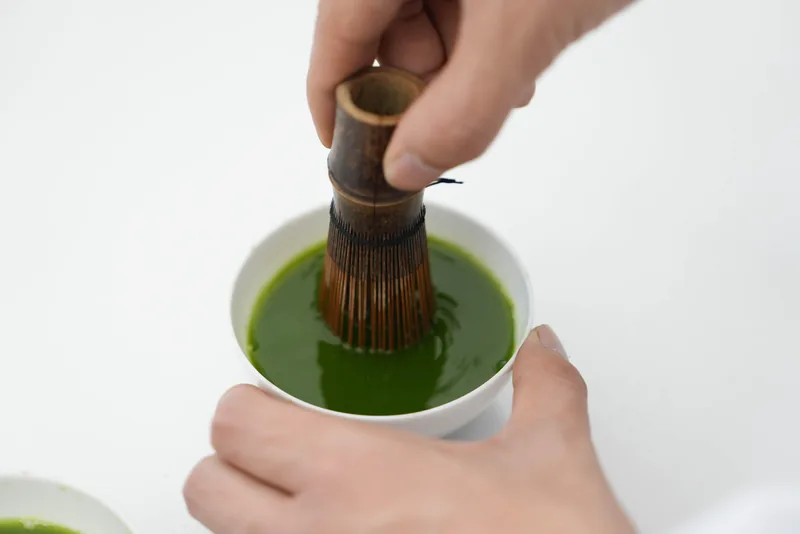
AdoroHu uses ultrasonic screening and multiple milling routes, including 20 stone mills, 56 ball mills, and 8 continuous ball mills. Confirm matched process and specification, then standardize sifting, concentrate ratio, liquid temperature, and mixing.
Inspect the tray before freezing and during early scraping. Dark sediment at the bottom signals distribution failure.
Keep the powder decision connected to best matcha for desserts.
Key Takeaway: Control suspension before the freezer.
How do tray depth and scrape timing shape crystals?
Use one tray material, fill depth, freezer position, and scrape tool. Record the first-ice time and every scrape interval rather than relying on a clock copied from a home recipe.
Shallow fills freeze quickly but demand frequent attention; deeper fills slow the center and widen crystal variation. Choose the format staff can execute.
| Tray factor | Record | Why it matters |
|---|---|---|
| Fill depth | Measured depth and batch mass | Freezing rate and center lag |
| Freezer position | Fixed shelf or zone | Repeatability |
| First-ice point | Time and visible condition | Start of scrape sequence |
Key Takeaway: Match tray geometry to labor and crystal target.
How should sediment be checked during scraping?
Observe the surface, middle, and tray bottom at each scrape. Fold deliberately so concentrated matcha does not remain at the bottom or collect in dark streaks.
Extra scraping can reduce crystal size but also increases labor and melt exposure. Stop when the defined texture and distribution are reached.
Key Takeaway: Use scraping to redistribute, not merely break ice.
What measurements belong in a granita trial?
AdoroHu’s in-house microbiology and physical-chemical labs can support powder COA inputs; the operator validates finished granita. Record base mass, soluble-solids method where used, fill depth, freezer setting, scrape times, yield, crystal assessment, melt, color, and sensory balance.
Use the same elapsed service time for comparisons. Granita changes quickly after portioning.
Use bulk matcha for food manufacturing for the adjacent manufacturing context.
Key Takeaway: Measure production and service behavior.
How should food controls and service hold be set?
Under 21 CFR 117.80, processing and holding conditions must minimize microbial growth, allergen cross-contact, contamination, and deterioration. Use the approved food-safety plan and equipment instructions rather than treating freezing as a universal kill step.
Define refill, utensil, cover, discard, and deviation rules for the actual service model. Do not convert a short trial into a shelf-life claim.
| Scrape checkpoint | Inspect | Action |
|---|---|---|
| Surface | Crystal size and dry crust | Scrape or continue freezing |
| Middle | Texture and green uniformity | Fold and redistribute |
| Bottom | Dark sediment or hard layer | Correct dispersion or sequence |
Key Takeaway: Set safety and service rules outside sensory judgment.
What evidence should release matcha granita?
AdoroHu’s 10 kg and 20 kg formats use sealed food-grade liners. Match pack size to use rate and post-opening storage. Release only after repeat trays meet dispersion, freezing, scrape, crystal, sediment, sensory, yield, and service limits.
Keep formula, lots, tray and freezer settings, scrape log, results, deviations, and approvers together.
Key Takeaway: Release a repeatable scrape protocol.
FAQ
- How is matcha granita different from matcha sorbet?
- Granita is formed by interrupted freezing and scraping rather than a churned sorbet process, so crystal control and redistribution are different.
- Why does matcha settle in granita?
- Matcha remains suspended rather than dissolved, so poor pre-dispersion and slow freezing can concentrate particles near the tray bottom.
- How often should granita be scraped?
- Set the interval from the actual freezer, tray depth, and crystal target, then record and validate it instead of copying a universal time.
- Can more sugar fix hard granita?
- More sugar changes freezing and softness but also sweetness and tea balance, so adjust it through a measured formula trial.
- What records belong in a commercial granita trial?
- Keep formula, lots, tray depth, freezer setting, scrape times, yield, crystal and sediment checks, service rules, deviations, and approvals.
Conclusion
Matcha granita is ready when staff can repeat the same scrape sequence, crystal texture, tea distribution, and service result. Share the base, tray, freezer, serving format, and trial volume through the contact page for sample planning.