To audit a matcha supplier, use a structured on-site or remote assessment to verify that the producer’s facility, processes, documentation, and capacity match its claims, from shade-grown cultivation through milling, clean-room production, laboratory testing, and traceability records. Here’s what separates an audit from the paperwork checks that precede it: documents tell you what a supplier says they do, while an audit shows you whether they can.
The distinction matters commercially. A buyer who verifies a business licence has confirmed a company exists, not that it owns a mill. One who accepts a certification logo has confirmed a scheme was passed at some point, not that hygiene controls run daily. One who never checks capacity against equipment discovers during peak season that their “guaranteed” allocation was never physically producible. Auditing is how you close those gaps, and for any volume that matters commercially, it is the step that turns a supplier relationship from hopeful into evidenced.
This guide covers how to run one on a matcha supplier, whether in person, by live video, or through a third-party body.
The evidence an audit should test
A matcha supplier audit should assess six areas: certification and documentation (GFSI-recognised schemes such as BRCGS, SQF, FSSC 22000, plus organic scope and validity); cultivation and raw material control (shading practice, tencha sourcing, traceability to garden); production facility (clean-room classification, milling equipment, particle-size control, hygiene and pest programmes); laboratory and testing capability; traceability and recall systems tested by a mock trace; and capacity verification against your volume requirements.
Audits can be on-site, live video, or third-party (SGS, Bureau Veritas, TÜV, Intertek), and findings should be scored, ranked by severity, and closed through a corrective action plan with deadlines.
In short: audit certification, cultivation, facility, laboratory, traceability, and capacity, then score the findings and close them through a corrective action plan with deadlines.
Key points:
- An audit verifies capability; document checks only verify claims.
- Run a mock traceability exercise, it exposes system gaps faster than any inspection.
- Score findings by severity and require a corrective action plan with dates, not promises.
When should you audit a matcha supplier?
You should audit before committing to significant volume, and then periodically thereafter, at a risk-based interval. Here’s the trigger point most buyers use: audit before the order value or supply dependency reaches a level where failure would hurt.
Timing follows risk rather than a fixed rule. A first audit belongs after documented samples and a trial order have proven basic capability, but before you sign a volume contract or make your business dependent on that supplier. After approval, re-audit intervals should follow the buyer’s risk assessment, customer requirements, certification programme, and performance history, with additional audits triggered by specific events: a quality incident, a change in the supplier’s production location or ownership, a new product category, or a significant increase in your order volume.
The judgment worth applying: the audit’s depth should scale with your exposure, so a live video walkthrough may suffice for a modest recurring order, while a container-scale annual commitment justifies an in-person or third-party audit. This sits downstream of the desk-based checks in our guide to matcha supplier verification, which confirms the company exists before you spend money confirming what it can do.
Key Takeaway: Audit before committing to volume that would hurt if it failed, then at the documented risk-based interval, with extra audits triggered by quality incidents, ownership or site changes, new categories, or volume increases; scale audit depth to your exposure rather than applying one fixed standard.
What certifications should a matcha supplier audit verify?
The audit should verify GFSI-recognised food safety certification plus the specific organic and market certifications your channel requires. Here’s why scheme names matter: your retail customers may specify which one they accept.
Certification verification has two layers. First, confirm which GFSI-recognised scheme the facility holds, since the major ones differ by market: Confirm the programme required by the buyer or channel against the current GFSI recognition list and the programme owner’s current rules. ISO 22000 is a management-system standard; FSSC 22000 is a separate certification programme that incorporates ISO 22000 requirements. Second, verify scope and validity: check the certificate names the operator you are contracting with, covers the specific site and product category, and remains current.
The practical point: certification is a baseline, not a differentiator, and a certificate proves a system passed on audit day rather than that it runs correctly every day, which is exactly why buyer-side audits exist alongside certification audits. Our own facility operates under ISO 22000 with organic certification across China Organic, USDA Organic (NOP), EU Organic, and JAS Organic, covering the 6,000 mu of our tea gardens under organic certification.
Key Takeaway: Verify which GFSI-recognised scheme applies (the current GFSI-recognised programme required by the buyer or channel) plus organic scope and validity; certification proves a system passed on audit day, not that it runs correctly daily.
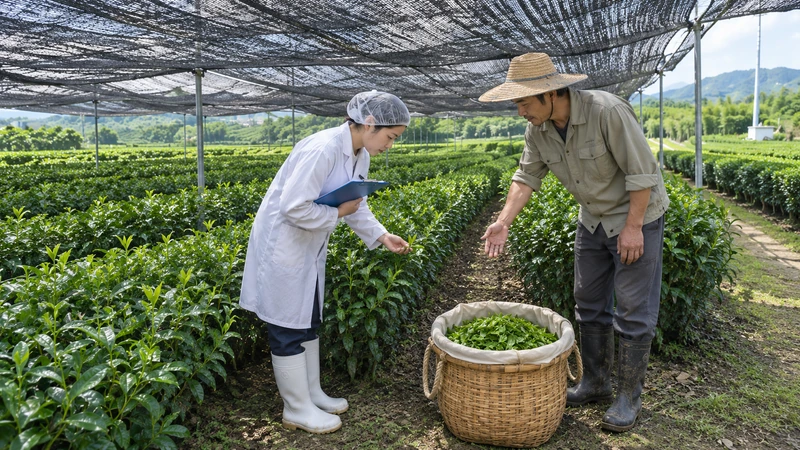
What should you inspect in the cultivation and raw material stage?
Cultivation is where matcha quality is created, and it is the stage generic food audit checklists ignore entirely. Here’s the specific risk: a facility can be immaculate and still be milling mediocre leaf.
Focus this section on control and traceability rather than aesthetics.
- Shading practice: confirm shade structures exist and ask how long before harvest shading is applied, since this drives L-theanine and chlorophyll development.
- Garden control: establish which gardens are self-owned versus partner-managed, and how partner gardens are supervised for input compliance.
- Tencha handling: check how quickly harvested leaf reaches processing, since delay degrades colour and aroma.
- Organic separation: for certified lines, verify physical or temporal separation from conventional material, plus buffer zones and input records.
- Traceability: ask to trace a finished lot back to a specific garden and harvest date, using their records rather than their memory.
The judgment here: garden ownership determines how much of this a supplier actually controls. Our own operation covers 20,000 mu of self-owned and partner-managed tea gardens in Jingshan, with 6,000 mu certified organic, which is what allows a lot to be traced back to a defined harvest rather than a pooled purchase.
Key Takeaway: Inspect shading practice and duration, garden ownership and supervision, speed from harvest to processing, organic separation and buffer zones, and traceability from finished lot back to garden and harvest date, since a spotless facility can still be milling mediocre leaf.
What should you inspect in the production facility?
The production audit should verify environment classification, equipment, process control, and hygiene programmes against the supplier’s claims. Here’s the check that catches exaggeration fastest: compare installed equipment against the daily capacity they quoted you.
Follow product flow through the facility
Work through the facility in production sequence.
- Clean-room classification: confirm the stated class, and check air handling, temperature and humidity controls are operating rather than merely installed.
- Milling equipment: count and identify the mills, distinguishing stone mills from ball mills, and ask throughput per unit.
- Particle-size control: ask how D50 and D90 are controlled and screened, and see the screening system running.
- Sterilisation and homogenisation: verify equipment exists and ask how process parameters are set and recorded.
- Prerequisite programmes: check cleaning and sanitation records, pest management monitoring and trend analysis, equipment calibration schedules, preventive maintenance records, staff training records, and environmental monitoring results.
The revealing test is arithmetic: if a supplier claims a daily tonnage, ask them to show how the installed mills produce it in a shift, and whether that assumes continuous operation. Our production runs across two Class-100,000 clean workshops with 20 stone mills, 56 ball mills and 8 continuous ball-mills, Japanese flash high-temperature sterilisation and a 300 kg homogeniser, supporting 6 tonnes per day, and those figures should reconcile on any audit of a culinary grade matcha line.
Key Takeaway: Verify clean-room classification is operating not just installed, count and identify milling equipment, see particle-size screening running, and review the seven prerequisite programmes; then test the arithmetic of claimed daily capacity against installed equipment and shift patterns.
How do you audit a matcha supplier’s laboratory and testing?
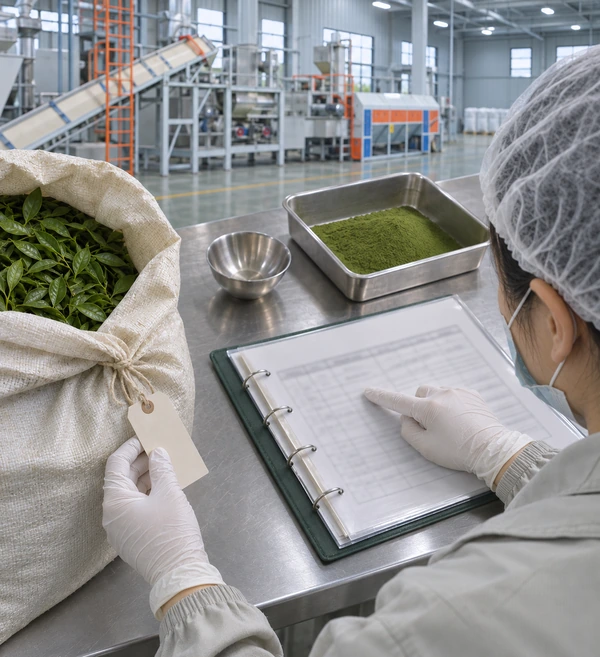
Audit the laboratory by confirming it physically exists, what it can actually test, and how its results connect to release decisions. Here’s the distinction to establish early: in-house testing supports process control, but buyer assurance requires accredited third-party results.
Examine four things. First, the physical laboratory: ask to see it, identify the instruments, and establish which parameters are tested internally, typically microbiology, moisture, and physico-chemical measures. Second, third-party arrangements: confirm which ISO/IEC 17025 accredited laboratory handles heavy metals and pesticide residues, and how often. Third, the release decision: ask how a batch is approved for shipment and who has authority to reject, then look for evidence of a batch that was actually held or rejected, which tells you whether the system has teeth.
Fourth, retained samples: check that samples are kept from each lot, which is your evidence base in any future dispute. The judgment: a supplier who can produce a record of rejecting their own batch is demonstrating a functioning quality system more convincingly than any certificate. Our facility runs in-house microbiology and physico-chemical laboratories alongside accredited third-party testing, and understanding how to interpret the resulting documents is covered in our guide to reading a matcha COA.
Key Takeaway: Confirm the laboratory physically exists and identify what it tests, verify which ISO/IEC 17025 accredited third party handles heavy metals and pesticides, examine who can reject a batch, and ask for evidence of a batch actually held, since that proves the quality system has teeth.
How do you test traceability and recall systems?
Test traceability by running a mock trace during the audit rather than reviewing the written procedure. Here’s why this is the highest-value hour of any audit: a traceability system that works on paper but not in practice fails precisely when you need it.
Run the exercise in both directions. Pick a finished lot number and ask them to trace backwards to the harvest date, garden, tencha batch, milling run, and packaging materials. Then pick a raw material batch and ask them to trace forwards to every finished lot and every customer it reached. Time it: set and test a trace-retrieval target based on the applicable programme, customer requirements, distribution complexity, and the buyer’s recall plan.
Check the mass balance too, whether the quantity traced reconciles with production records, since gaps indicate either poor recording or undisclosed material inputs. Also review whether they have ever run a mock recall themselves, and ask to see the report. The practical significance: your own recall obligations depend on their records, so their traceability failure becomes your regulatory problem. Traceability obligations should also be written into your agreement, alongside the other protections in our guide to matcha supply contracts.
Key Takeaway: Run a live mock trace in both directions, finished lot back to garden and raw batch forward to customers, and time it; mature systems complete within hours, mass balance should reconcile, and a supplier who needs days would fail a real recall, making their gap your regulatory problem.
How do you verify production capacity and allocation claims?
Verify capacity by reconciling equipment, staffing, and records against the volume the supplier has promised you. Here’s the seasonal trap this exposes: a producer can have genuine annual capacity and still be unable to serve you during first-harvest peak.
Capacity verification works through evidence, not assertion. Compare stated daily output against installed milling equipment and realistic operating hours. Review actual production records across the past twelve months to see real output versus theoretical capacity, and note the seasonal peaks. Ask what proportion of capacity is already committed to existing customers, and how allocation is decided when demand exceeds supply. Check storage capacity too, since a producer with output but no conditioned storage cannot hold stock for staggered delivery.
The judgment that protects you: ask specifically what happens to your order in a short-harvest year, and whether allocation priority is contractual or discretionary. A vague answer here is itself the finding. Capacity questions connect directly to how minimum order quantities and delivery schedules are structured, discussed in our matcha MOQ guide.
Key Takeaway: Reconcile claimed capacity against installed equipment, operating hours, and twelve months of actual production records, then establish how much capacity is already committed, how allocation is decided in short supply, and whether your priority is contractual or discretionary.
How do you score audit findings and follow up?
Score findings by severity, then require a corrective action plan with named owners and deadlines. Here’s what turns an audit into improvement rather than paperwork: the follow-up, not the visit.
Structure the outcome in three steps. First, classify each finding by severity: critical issues that threaten food safety or legality and must be resolved before shipment; major issues indicating a systemic gap requiring action within a defined period; and minor issues for improvement. Second, require a written corrective action plan specifying the root cause, the action, the responsible person, and a completion date, rather than accepting a general assurance. Third, verify closure with evidence, photographs, updated records, or a follow-up check, and only then approve the supplier.
Establish a re-audit interval, risk-based, and define what would trigger an earlier one. The experienced point: how a supplier responds to findings is itself diagnostic, since a producer who engages constructively with a critical finding is showing you how they will handle a problem with your shipment. Your specification and acceptance criteria should be settled alongside this, as covered in our guide to matcha spec sheets, and the same standards should extend across complementary lines such as hojicha powder.
Key Takeaway: Classify findings as critical, major, or minor, require a written corrective action plan with root cause, owner, and deadline, and verify closure with evidence before approval; how a supplier responds to findings predicts how they will handle a problem with your shipment.

FAQ
- What should a matcha supplier audit cover?
- Six areas: certification and documentation (GFSI-recognised schemes plus organic scope and validity), cultivation and raw material control (shading practice, garden ownership, tencha handling, traceability), the production facility (clean-room classification, milling equipment, particle-size control, hygiene and pest programmes), laboratory and testing capability, traceability and recall systems tested by a live mock trace, and capacity verification against your volume requirements.
- Can I audit a matcha supplier remotely?
- Yes. A live video walkthrough works if you direct it in real time rather than accepting pre-recorded footage, asking to see specific equipment, the laboratory, storage areas and the packing line. For higher-value commitments, an in-person visit or a third-party audit by SGS, Bureau Veritas, TÜV Rheinland or Intertek gives stronger assurance and produces an independent report.
- Which food safety certification should a matcha supplier hold?
- It depends on the buyer, channel, product, and market. Check the current GFSI recognition list and the programme owner’s rules, then confirm that the certificate names the correct operator, site, and product scope and is currently valid. ISO 22000 alone is a management-system standard; do not describe it as a GFSI-recognised certification programme.
- How often should you audit a matcha supplier?
- Use a documented risk-based interval after approval, with additional audits triggered by a quality incident, a change in production site or ownership, entry into a new product category, or a significant increase in your order volume. The first audit should come after samples and a trial order but before committing to volume.
- What is a mock traceability exercise and why does it matter?
- It is a live test during the audit where you pick a finished lot and ask the supplier to trace it back to harvest date, garden, tencha batch and milling run, then pick a raw batch and trace it forward to all finished lots and customers. Set and test a retrieval target from the applicable programme, customer requirements, distribution complexity, and recall plan. It matters because your own recall obligations depend on their records.
Conclusion
A matcha supplier audit verifies across six dimensions, certification, cultivation, facility, laboratory, traceability and capacity, what documents can only assert, and its value lies as much in the follow-up as the visit: findings classified by severity, closed through a corrective action plan with named owners and deadlines, and re-checked with evidence. The decisive takeaway is that the arithmetic tests, capacity against installed equipment, and the live tests, a timed mock trace, expose more than any checklist walked passively.
A producer controlling cultivation, milling, testing and packing under one system has fewer places for those tests to fail. To arrange an audit, request certification documents, or run a live facility walkthrough, contact AdoroHu Matcha to start with samples and a wholesale quote.