
A matcha trial order is a small commercial order, a commercially representative quantity, placed after samples are approved but before you commit to volume, and its purpose is to test whether the entire commercial process works, not whether the powder tastes good. Here’s the distinction that decides whether a trial order earns its cost: a sample tests the product, while a trial order tests the supplier’s ability to convert an approved product into a controlled shipment.
Skipping this step is where sourcing goes expensive. A buyer who moves from an approved 100 g sample straight to a container discovers that production-scale material differs from a hand-selected sample. One who never tests the paperwork finds out at customs that the supplier cannot produce export documents correctly. One who never times the process learns their real lead time only when a stockout is already underway. A trial order buys that knowledge at a fraction of the exposure. This guide covers how to structure one properly with any matcha supplier you are qualifying.
The six systems a trial order tests
A matcha trial order is a small commercial order, a commercially representative quantity, placed after sample approval to test six systems under real conditions: production consistency against your approved sample, documentation accuracy (COA, packing list, certificates), packaging and protection in transit, actual lead time versus quoted, communication and exception handling, and customs clearance in your destination market. Order the same grade and packaging format you intend to buy at volume, compare the trial COA against the sample COA line by line, and treat any process failure as significant even when the product itself passes.
In short: a trial order is a small commercial order that tests production, documentation, packaging, lead time, communication, and customs, not just product quality.
Key points:
- A trial order tests the process; a sample only tests the product.
- Order the exact grade and packaging you plan to scale with, not a simplified version.
- Process failures matter as much as product failures, because they repeat at volume.
What is a matcha trial order and how does it differ from a sample?
A matcha trial order is a small but genuine commercial transaction, while a sample is an evaluation quantity sent outside normal production and shipping systems. Here’s the difference that matters: samples are often prepared by hand and shipped by courier, so they bypass exactly the systems you most need to test.
The two stages answer different questions. Samples, typically a quantity chosen for the buyer’s defined sensory, application, and laboratory plan, answer whether the product is right. A trial order, a commercially representative quantity, answers whether the supplier can produce that product on their normal line, document it correctly, pack it for a real journey, and deliver it on the quoted schedule. A sample can be cherry-picked; a production run cannot. The experienced sequence runs sample, then trial order, then volume contract, with each stage reducing a different risk.
Skipping the trial means your first real test of the supplier’s systems happens with your money and your production schedule fully exposed. This follows directly from the evaluation covered in our guide to ordering matcha samples.
Key Takeaway: A sample (50 g–2 kg) tests whether the product is right and can be hand-selected; a trial order (a commercially representative quantity) tests whether the supplier’s normal production, documentation, packing and delivery systems work, since samples bypass exactly the systems that fail at volume.
What volume should a matcha trial order be?
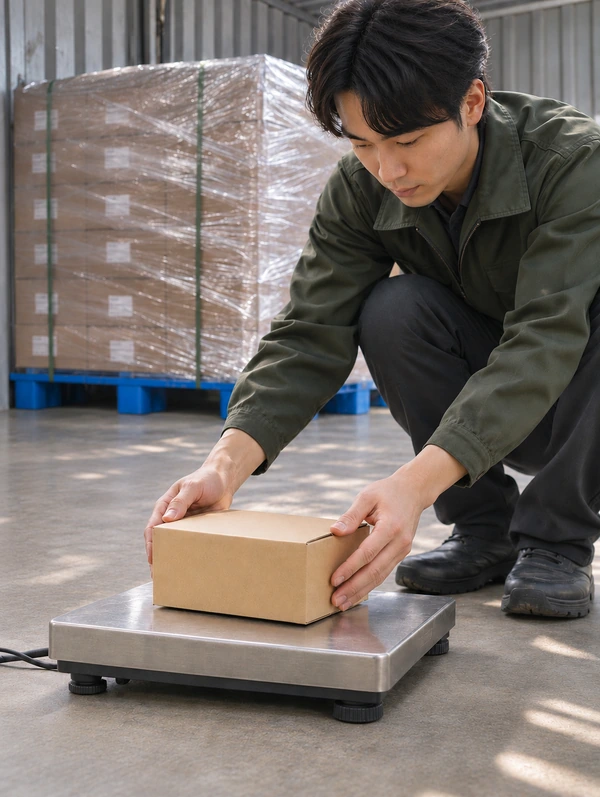
A matcha trial order usually sits between 5 and 50 kg, sized so it is commercially real for the supplier but limited in your exposure. Here’s the sizing principle: order enough to trigger a genuine production run and a real shipment, but not enough to hurt if it fails.
Three factors set the number. First, your application: if you need to run a production-line trial, bake a real batch, or bottle an RTD test run, order enough for that trial plus retained samples, which often means the upper end of the range. Second, the supplier’s minimum: many producers accept a reduced minimum for a first order when future volume looks credible, so the trial quantity is often negotiable, a point covered in our matcha MOQ guide.
Third, format realism: order the same packaging format you intend to use at scale, because a trial shipped in 1 kg pouches tells you nothing about how 20 kg cartons with liners will arrive. The judgment worth applying: a trial order that is too small stops being a real test, since a supplier can hand-pack 2 kg from a good batch as easily as a sample, defeating the purpose.
Key Takeaway: Size the trial at a commercially representative quantity, enough to trigger a genuine production run and real shipment while limiting exposure; order the same grade and packaging format you plan to scale with, since a trial too small can be hand-picked and stops being a real test.
What should you test during a matcha trial order?
You should test six systems, only one of which is the product itself. Here’s the framing that makes trial orders worth their cost: every element that could fail at volume should fail cheaply here first.
Assess each of these deliberately.
- Production consistency: does material from a normal production run match your approved sample?
- Documentation: are the COA, packing list, commercial invoice, and certificates accurate, complete, and lot-matched?
- Packaging and protection: do cartons, liners, and any nitrogen flushing arrive intact and correctly labelled?
- Lead time accuracy: does actual production and shipping time match what was quoted?
- Communication: how promptly and clearly do they respond, and do they proactively flag issues?
- Customs clearance: does the paperwork clear your destination market without holds?
The judgment that separates experienced buyers: process failures deserve as much weight as product failures. A trial where the matcha is excellent but the COA arrived late, the lot numbers did not match, and shipping ran two weeks over is a failed trial, because those problems recur at every order and become far more expensive at volume. Lead time in particular deserves measurement rather than assumption, and our guide to matcha lead times sets out what is realistic by season.
Key Takeaway: Test six systems, production consistency, documentation accuracy, packaging integrity, actual versus quoted lead time, communication quality, and customs clearance; a trial where the product passes but documents and timing fail is a failed trial, because those failures repeat and scale.
How do you compare trial order quality against your approved sample?
Compare the trial against the sample using measured data, not impressions, by putting the two COAs side by side. Here’s the most common trial-order failure: the trial material is acceptable in isolation but measurably different from what you approved.
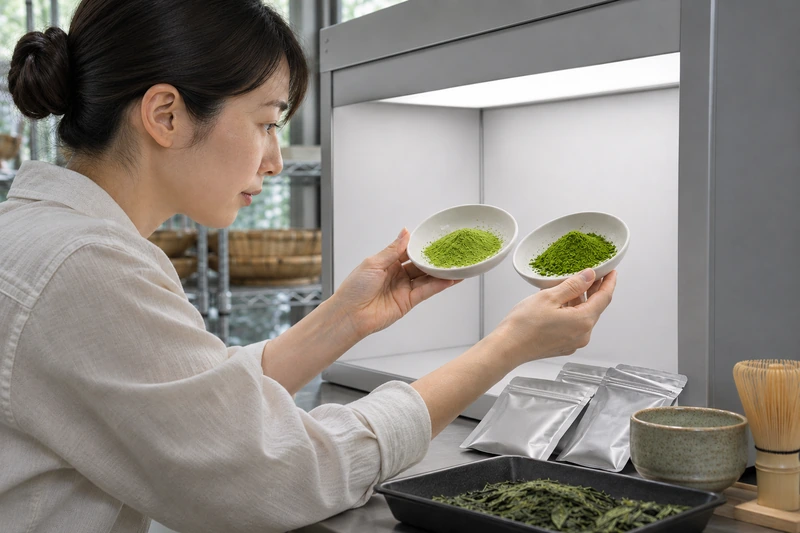
Run the comparison in three layers. First, documentation: place the sample COA and trial COA side by side and compare each parameter, particle size D50 and D90, colour Lab* values, moisture, L-theanine, catechins, ash, and microbiological results, noting the delta on each rather than just whether both passed. Second, sensory: prepare both identically, ideally blind, and assess colour, aroma, flavour, and texture against each other rather than against memory.
Third, application: run the trial material through your actual process, latte line, bake, or formulation, since a small difference in particle size or moisture can behave very differently in production than in a cup. The standard to hold: variation should sit inside the tolerances you set in your matcha spec sheet, which is exactly why the specification should be agreed before the trial rather than after.
Our own approach is to draw sample and bulk from the same batch process and provide a side-by-side COA comparison, which makes this check straightforward rather than adversarial.
Key Takeaway: Compare trial and sample COAs parameter by parameter noting deltas, run a blind sensory comparison prepared identically, and test the material in your actual production process; variation should sit inside your agreed spec tolerances, which must be set before the trial.
What documentation should a matcha trial order produce?
The trial order should produce the complete export documentation set you will receive on every future shipment, and it is your chance to verify that set is correct. Here’s why this matters more than buyers expect: documentation errors that seem minor on a 20 kg trial become customs holds on a container.
Check the full package. The batch-specific COA should be lot-matched and issued against the parameters you specified, and knowing how to interpret it properly is covered in our guide to reading a matcha COA. The commercial invoice and packing list should match each other and the physical goods on weight, count, and description. Certificates, organic and food safety, should name the correct operator and, for organic, include a per-lot transaction certificate. Labelling should carry lot codes, production and best-before dates that reconcile with the COA.
The practical test: hand the whole document set to your customs broker before the goods sail and ask whether anything would cause a query. The judgment: a clean trial document package supports confidence in the process; repeated corrections identify a system issue that must be resolved and retested before scale-up.
For U.S.-bound orders, use the FDA guidance on importing human foods as an initial documentation checklist, then confirm the requirements for the product and shipment with the responsible parties.
Key Takeaway: Verify the full document set, lot-matched COA, matching invoice and packing list, correctly named certificates with per-lot organic transaction certificate, and labelling that reconciles with the COA; give the package to your broker before sailing, since minor errors on a trial become customs holds on a container.
How do you evaluate a supplier’s communication during a trial order?
Evaluate communication by observing response speed, clarity, and whether problems are raised proactively rather than discovered by you. Here’s the predictive value: how a supplier communicates during a small trial is how they will communicate during a crisis.
Watch three behaviours. Response speed: response performance should be measured against an agreed service level and the urgency of the issue. Proactive disclosure: the real test is whether they tell you about a delay or a deviation before you ask, since a supplier who volunteers bad news early is one you can plan around, while a supplier who conceals it leaves you discovering problems at the worst moment. Technical competence: can they answer specification questions directly, or does every technical question require escalation and a two-day wait?
Also note whether you have a single accountable contact or a rotating cast. The experienced view: communication quality is not a soft factor, it is the mechanism through which every other problem gets solved or does not, which is why it belongs in the supplier evaluation criteria in our matcha supplier checklist.
Key Takeaway: Judge response speed (measure against the agreed service level and issue urgency), proactive disclosure of delays before you ask, technical competence without constant escalation, and whether you have one accountable contact; communication is the mechanism by which every other problem is solved or hidden.

What happens after a successful matcha trial order?
After a successful trial, you move to a volume agreement that locks in the specification, price, and terms the trial validated. Here’s the step buyers often waste: the trial generates evidence, and that evidence should be written into the contract rather than left as goodwill.
Convert the trial into commercial structure. Fix the approved trial batch as your reference standard, with retained samples held by both parties, so future batches have a physical benchmark rather than an abstract spec. Write the validated specification and tolerances into the supply agreement as an annex, along with the documentation obligations the trial confirmed they can meet. Lock the lead time you actually measured, not the one originally quoted, and agree how peak-season timing will be handled.
Then negotiate volume pricing and, in a tight market, allocation priority, which is where a demonstrated trial gives you standing as a serious buyer. These elements sit naturally alongside the protections in our guide to matcha supply contracts, and the payment structure you settle should follow the conventions in our guide to matcha payment terms.
Key Takeaway: Convert trial evidence into contract terms: fix the approved batch as a physical reference standard with retained samples, annex the validated specification and tolerances, lock the measured lead time rather than the quoted one, and negotiate volume pricing and allocation priority from a position of demonstrated commitment.
What should you do if a matcha trial order fails?
If a trial order fails, diagnose whether the cause is systemic or a one-off before deciding whether to walk away. Here’s the useful distinction: some failures are correctable process gaps, while others reveal a capability the supplier simply does not have.
Separate the two. Correctable failures include documentation errors, packaging choices, labelling omissions, and communication gaps, all of which a competent supplier can fix if they respond constructively when raised. Structural failures include material that sits outside your specification on a normal production run, an inability to hold particle size or colour, capacity that cannot support your volume, or certifications that turn out not to cover your product. The diagnostic step: raise the findings formally, request a root-cause explanation and a corrective action plan with dates, then decide.
A supplier who explains the cause and fixes it is often stronger afterwards, while one who dismisses findings or repeats them is showing you the future. The judgment worth holding: a failed trial that saved you from a bad volume commitment has done its job and repaid its cost many times over, and it is far cheaper than the supplier audit findings you would otherwise discover after signing. The same qualification discipline applies across complementary lines such as hojicha powder.
Key Takeaway: Separate correctable failures (documentation, packaging, labelling, communication) from structural ones (out-of-spec production, unstable particle size or colour, insufficient capacity, certification gaps); request root cause and a dated corrective action plan, and treat a failed trial as money well spent.
FAQ
- What is a matcha trial order?
- A matcha trial order is a commercially representative order placed after sample review and before a larger commitment. Define a quantity and format that use the intended production, packing, documentation, and shipping route while limiting exposure; verify that the supplier will actually process the trial through those normal systems.
- How much matcha should I order for a trial?
- Choose a commercially representative quantity from the supplier’s actual production and packing route, the buyer’s application-trial needs, retained-sample plan, shipping method, and acceptable exposure. Use the intended product and packaging format, and document any ways the trial differs from normal volume production.
- What is the difference between a matcha sample and a trial order?
- A sample supports sensory, application, and laboratory review at a scale chosen for those methods. A trial order tests the intended commercial production, documentation, packaging, shipping, and communication process. Confirm the supplier’s actual route for each rather than relying on a universal sample-size range.
- What should I check when the trial order arrives?
- Compare the trial COA against your sample COA parameter by parameter, run a blind sensory comparison, and test the material in your actual production process. Separately, check that documentation is complete and lot-matched, packaging arrived intact with correct labelling, actual lead time matched the quote, and customs cleared without holds.
- Should I sign a contract before or after a trial order?
- Sequence the trial and longer-term agreement according to risk, leverage, allocation timing, and legal advice. A representative trial can provide measured lead time, specification, documentation, and packaging evidence for later terms; if an earlier agreement is necessary, use conditions, staged commitments, and exit rights tied to successful qualification.
Conclusion
A matcha trial order is the bridge between an approved sample and a volume commitment, and its value comes from testing six systems, production consistency, documentation, packaging, lead time, communication, and customs, under real conditions at limited exposure. The decisive takeaway is that process failures matter as much as product failures, because a supplier that cannot document the representative trial correctly has not yet demonstrated readiness for scale-up, and the trial exists precisely so that discovery costs you a small order rather than a season.
To structure a trial order that tests the full process, contact AdoroHu Matcha to request samples, documentation, and a wholesale quote for your grade and volume.