
A matcha supplier scorecard is a single document that converts your performance data into a weighted composite score, reviewed on a fixed cadence, and used to drive real commercial decisions about allocation, renewal, and volume. Here’s what separates a scorecard that works from one that dies in a spreadsheet: it is built around decisions you will actually make, not around every metric you could theoretically collect.
Most scorecards fail for the same three reasons. They contain too many metrics, so no single number drives action. Their thresholds are invented rather than derived from what your supplier has historically achieved, so scores are arbitrary. And they are never shown to the supplier, which turns a tool for joint improvement into a private grievance file. A scorecard built properly does the opposite: it gives both sides one shared version of reality, updated on a schedule, with consequences attached.
This guide covers how to build one for a matcha supplier relationship specifically.
The controls that turn scores into decisions
Build a matcha supplier scorecard with five to seven weighted metrics across delivery, quality, documentation, and service. Set thresholds from your own twelve-month history rather than invented targets, and define a 1–5 scoring scale with written descriptions for each level. Weight by business impact, with a guardrail preventing any single metric from dominating. Adjust delivery expectations separately for peak and off-peak season, since matcha lead times vary with the harvest.
Review monthly at operational level and quarterly with the supplier, share the methodology in advance, and attach defined consequences to sustained scores so the document drives decisions rather than describing them.
In short: five to seven weighted metrics, thresholds from your own history, seasonal adjustment, shared with the supplier, reviewed on a fixed cadence with consequences attached.
Key points:
- Limit to 5–7 metrics; more dilutes accountability and nothing drives action.
- Set thresholds from 12 months of your own data, not from invented targets.
- Share criteria and weights with the supplier before you start scoring them.
What makes a matcha supplier scorecard different from a generic one?
A matcha scorecard differs in three structural ways: fewer suppliers to compare, data that arrives by batch rather than by transaction, and performance that varies legitimately by season. Here’s why that matters: generic scorecard design assumes conditions matcha buyers rarely have.
Adapt on three fronts. Most matcha buyers work with one to three suppliers rather than thirty, so the comparative ranking function of a typical scorecard has little value and the emphasis should fall on trend against the supplier’s own history instead. Much of the important data arrives with the Certificate of Analysis rather than from a purchasing system, meaning colour values, particle size, and moisture must be recorded manually per batch, which favours a simpler scorecard updated per shipment over an automated dashboard.
And delivery performance legitimately differs between regular season and first-harvest peak, so a single annual target will misjudge a good supplier during the very period when supply is hardest. The judgement that follows: build the scorecard around what your COAs and purchase records actually contain, rather than around a template designed for high-volume component supply. The underlying metrics themselves are covered in our guide to matcha supplier KPIs.
Key Takeaway: Matcha scorecards need adapting because buyers have few suppliers (so trend matters more than ranking), key quality data arrives per batch via COAs rather than from a purchasing system, and delivery performance legitimately differs between regular and peak season.
Which metrics belong on a matcha supplier scorecard?
Include five to seven metrics spanning delivery, quality, documentation, and service. Here’s the constraint that keeps a scorecard useful: limiting metrics is not a simplification, it is what makes the composite score capable of driving a decision.
Choose metrics tied to buyer decisions
A workable metric set looks like this.
- On-time in-full delivery, measured separately for regular and peak season.
- Batch conformance to specification, the proportion of batches meeting every parameter.
- Consistency, measured as the trend in key parameters across batches rather than pass/fail alone.
- Documentation accuracy and timeliness, covering COA completeness and whether documents arrived before the goods.
- Responsiveness, measured as average reply time to enquiries.
- Issue resolution, measured as time to close a corrective action.
Each metric needs three things defined before it goes on the card: a clear definition so everyone measures the same thing, a data source so the number is reproducible, and a measurement frequency. The consistency metric deserves the most attention, because it is the one that predicts the quality complaint your customers will raise, and it requires the specification and tolerances to exist first, as covered in our guide to matcha spec sheets.
The ISO 9001 Auditing Practices Group guidance on external providers highlights defined purchasing criteria, performance monitoring, and verification of specified requirements. Buyers can apply that control logic to supplier scorecard definitions and review.
Key Takeaway: Use five to seven metrics across delivery (split by season), batch conformance, consistency trend, documentation accuracy, responsiveness, and issue resolution time; each needs a written definition, a named data source, and a measurement frequency before it goes on the card.
How should you weight a matcha scorecard?
Weight metrics by their business impact, and add a guardrail so no single metric can dominate the total. Here’s what weighting actually expresses: your strategy, written as numbers.
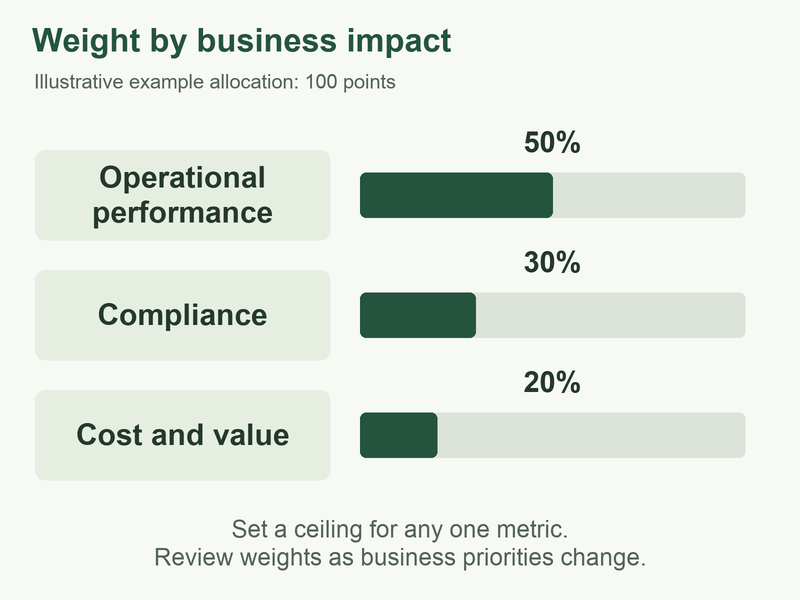
Distribute 100 points according to what failure would cost you. As an illustrative starting model, you might allocate 50% to operational performance, 30% to compliance, and 20% to cost and value, but the right split depends on your product. A brand whose identity depends on colour consistency should weight quality and consistency highest; a café group running lean inventory should weight delivery highest; a business selling into a regulated retail channel should weight documentation and compliance highest.
Two design rules make weighting robust: set a ceiling so one metric cannot swamp the composite score, and review the weights periodically, since business conditions change and a weighting set two years ago may no longer reflect your priorities. The practical test to apply: look at the weights and ask whether a supplier optimising purely for the highest score would actually be behaving the way you want. If gaming the scorecard produces behaviour you dislike, the weights are wrong.
Key Takeaway: Distribute 100 points by business impact, with a guardrail so no single metric dominates the composite; test the weighting by asking whether a supplier optimising purely for score would behave as you want, and review the weights periodically as priorities shift.
How do you set scoring thresholds that mean something?
Set thresholds from your own historical performance data rather than from invented targets. Here’s the discipline that makes scores credible: green, amber, and red bands should be derived from twelve months of actual purchase order performance.
Calibrate thresholds against actual history
Build thresholds in three steps. First, gather baseline data, ideally twelve months of delivery, quality, and documentation history, which tells you what your supplier actually achieves rather than what a template says they should. Second, set the bands relative to that baseline and to your operational need: green where performance supports your business comfortably, amber where it is workable but warrants attention, red where it causes real disruption.
Third, define the scoring scale explicitly, since a 1–5 scale means nothing until each level is described, typically 5 for exceeds expectations, 4 for meets expectations, 3 for partially meets, 2 for below expectations, and 1 for unacceptable. Without those written descriptions, one evaluator’s 3 is another’s 4 and the arithmetic is performed on noise.
The seasonal adjustment matters here too: a delivery threshold appropriate for regular season will mark a supplier red during first harvest for reasons outside their control, so set separate bands using the seasonal ranges in our guide to matcha lead times.
Key Takeaway: Derive green, amber, and red bands from twelve months of your own performance history rather than invented targets, write an explicit description for each level of the 1–5 scale, and set separate delivery bands for regular and peak season.
Should you share the scorecard with your matcha supplier?
Yes, and you should share the methodology before you start scoring rather than presenting results afterwards. Here’s the principle that determines whether the scorecard improves anything: a scorecard should be a roadmap for success, not a trap.
Transparency changes what the document does. A supplier who knows the metrics, weights, thresholds, and review cadence in advance can prioritise the things you actually value, whereas one who receives a surprise score sheet experiences it as a grievance list and responds defensively. Sharing also improves your data quality, since suppliers frequently spot measurement errors, orders you counted as late that were delayed at your end, or specification deviations that were agreed by concession.
The practical approach: publish the criteria at onboarding or at contract signature, walk the supplier through the first scorecard in person or on a call, and invite them to comment on the figures before they are finalised. Include space on the document for supplier commentary, which turns a one-way judgement into a shared record. The relationship value compounds: a supplier engaged with your scorecard tends to raise problems earlier, which is worth more than the scoring exercise itself. This alignment naturally begins during supplier onboarding.
Key Takeaway: Share metrics, weights, thresholds, and cadence before scoring begins, walk the supplier through the first scorecard, and invite comment before finalising; transparency turns the document into a roadmap rather than a trap, and suppliers frequently catch measurement errors in your own data.
What review cadence keeps a matcha scorecard alive?
Use a layered cadence: operational review monthly, a formal review with the supplier quarterly, and a strategic review annually. Here’s the failure mode a cadence prevents: scorecards that are built once, used twice, and then quietly abandoned.
Match the frequency to the purpose. Monthly internal operational review keeps the data current and catches deterioration early, and for matcha this can simply be updating the card as each shipment’s COA arrives. Quarterly review with the supplier is the standard cadence for a strategic relationship, where both sides look at the same numbers, discuss trends, and agree actions. Annual strategic review covers contract terms, capacity planning for the coming season, and audit scheduling.
For matcha, add one seasonal anchor: schedule a review before the harvest allocation window, since that is when performance data has the most negotiating value and when capacity decisions are made. Also build in periodic revision of the scorecard itself, since metrics and weights should be revisited quarterly or half-yearly rather than treated as fixed, and a scorecard that is never revised gradually stops measuring what matters. The accumulated record then feeds directly into your contract renewal negotiation.
Key Takeaway: Layer the cadence, monthly internal updates as COAs arrive, quarterly joint review with the supplier, annual strategic review, plus one review timed before harvest allocation; revisit the metrics and weights themselves quarterly or half-yearly so the card keeps measuring what matters.

How do you connect scorecard results to actual decisions?
Attach defined consequences to sustained scores, or the scorecard becomes reporting rather than management. Here’s the question that tests any scorecard: what happens differently because of this number?
Attach action to sustained performance
Link scores to four decisions. Corrective action: a red score or a repeated amber triggers a formal corrective action request with root cause, owner, and deadline, rather than a conversation. Volume allocation: sustained strong performance justifies more committed volume and, in a constrained season, priority; sustained weak performance justifies reducing exposure. Contract renewal: the twelve-month record is your evidence base at renewal, both for price discussions and for tightening clauses that were tested and found wanting.
Relationship status: persistent underperformance after corrective action moves a supplier from approved to conditional or triggers qualification of an alternative. The design point that makes this work: the consequences should be defined in advance and ideally referenced in the supply agreement, so applying them is invoking an agreed term rather than opening a new negotiation, which is why they belong among the provisions covered in our guide to matcha supply contracts.
Key Takeaway: Attach defined consequences to sustained scores, corrective action requests, volume and allocation adjustments, renewal leverage, and approval-status changes, and define them in advance in the supply agreement so applying them invokes an agreed term rather than starting a new negotiation.
Who should be involved in a matcha supplier scorecard?
Involve procurement, quality, and operations at minimum, with named ownership for each metric. Here’s why cross-functional input matters more than it sounds: the person who feels the consequence of a metric is rarely the person collecting it.
Assign responsibilities explicitly. Procurement typically owns the commercial metrics and the supplier relationship. Quality owns conformance, consistency, and documentation review, since they read the COAs. Operations owns the delivery and availability metrics, since they feel the stockouts. Finance may own cost and payment-related measures.
Establish a small working group to own the metric definitions and manage changes, so the scorecard has version control rather than drifting as different people adjust it. For a smaller business where one or two people cover all these functions, the principle still applies in simplified form: write down who updates the card, who reviews it, and who is empowered to act on a red score.
The failure this prevents is common and quiet: a scorecard that everyone reads and nobody owns, where a deteriorating trend is visible for six months because no individual had responsibility for responding to it. Findings should also inform the scope of the next supplier audit.
Key Takeaway: Assign named ownership per metric across procurement, quality, and operations, with a small group owning metric definitions and version control; in a small business, still write down who updates, who reviews, and who can act on a red score, since an unowned scorecard lets trends deteriorate visibly for months.
What makes matcha supplier scorecards fail?
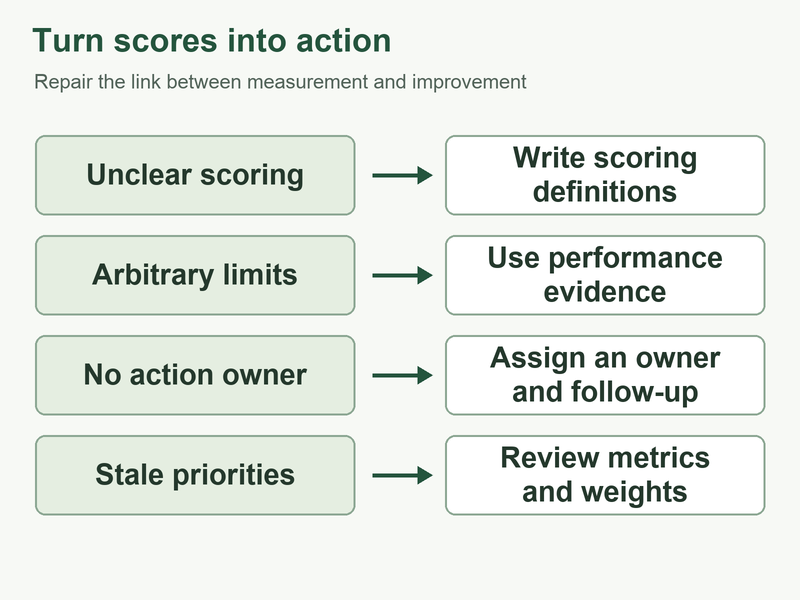
Scorecards fail when they measure everything, mean nothing, and change nothing. Here’s the pattern: each failure mode breaks the link between measurement and action.
Watch for these and their consequences.
- Too many metrics, so the composite score reflects everything and drives nothing.
- Invented thresholds unconnected to historical performance, making scores arbitrary and easy to dismiss.
- No written scoring definitions, so different evaluators produce incomparable numbers.
- Never sharing the scorecard with the supplier, forfeiting both improvement and error correction.
- A single annual target for delivery, penalising suppliers for legitimate peak-season variation.
- No consequences attached, turning the exercise into reporting rather than management.
- Set-and-forget design, where metrics and weights are never revisited as priorities change.
- No named owner, so a declining trend is observed by everyone and acted on by no one.
Each is a design fault rather than an execution problem, and each is fixable at the point the scorecard is built. The same framework extends to complementary lines such as hojicha powder, usually with fewer metrics given the smaller volumes involved.
Key Takeaway: Scorecards fail through too many metrics, invented thresholds, undefined scoring scales, never sharing with the supplier, unadjusted seasonal targets, absent consequences, set-and-forget design, and no named owner, each breaking the link between measurement and action.
FAQ
- What should a matcha supplier scorecard include?
- Five to seven weighted metrics across delivery (on-time in-full, measured separately for regular and peak season), quality (batch conformance to specification and consistency trend across batches), documentation (COA accuracy and timeliness), and service (responsiveness and issue resolution time). Each metric needs a written definition, a named data source, a measurement frequency, and thresholds derived from your own historical performance.
- How do you weight a supplier scorecard?
- Distribute 100 points according to what failure would cost your business. An illustrative starting split is 50% operational, 30% compliance, and 20% cost and value, but the right allocation depends on your product: weight quality highest if colour consistency defines your brand, delivery highest if you run lean inventory. Add a guardrail so no single metric dominates the composite score, and revisit the weights periodically.
- Should you show the scorecard to your matcha supplier?
- Yes, and share the metrics, weights, thresholds and review cadence before scoring starts rather than presenting results afterwards. Transparency lets the supplier prioritise what you value, and suppliers frequently identify measurement errors in your data, such as delays that originated at your end. Include space for supplier commentary so the document becomes a shared record rather than a one-way judgement.
- How often should you review a matcha supplier scorecard?
- Use a layered cadence: update internally each month or as each shipment’s COA arrives, review formally with the supplier quarterly, and hold an annual strategic review covering contract terms and capacity planning. For matcha, add a review timed before the harvest allocation window, when performance data carries the most negotiating value. Revisit the metrics and weights themselves quarterly or half-yearly.
- Why do supplier scorecards fail?
- Most commonly because they include too many metrics so nothing drives action, use invented thresholds unconnected to actual historical performance, lack written definitions for each scoring level, are never shared with the supplier, or have no consequences attached to sustained scores. A scorecard with no named owner is another frequent failure, since a declining trend can remain visible for months without anyone responsible for responding.
Conclusion
A matcha supplier scorecard works when it is small enough to drive a decision, calibrated to your own historical data rather than to invented targets, adjusted for the seasonal reality of an annually harvested product, and shared openly with the supplier before scoring begins.
The decisive takeaway is that the scorecard’s value lies entirely in what changes because of it: without defined consequences attached to sustained scores, and a named owner empowered to act on them, even a well-designed card becomes a monthly reporting ritual that documents deterioration rather than preventing it. To discuss the performance data and documentation that make a scorecard measurable, contact AdoroHu Matcha to request samples, specifications, and a wholesale quote.