
A buyer can collect supplier data for months and still miss a supply problem because the metric names, denominators, and review windows do not agree. That creates arguments about the numbers just when procurement needs a decision.
Matcha supplier KPIs should turn purchase orders, receipts, COAs, deviations, and corrective actions into a small set of repeatable measures. This guide defines the measures and the action loop; the separate matcha supplier scorecard guide explains how a buyer may combine measures for ranking or commercial decisions.
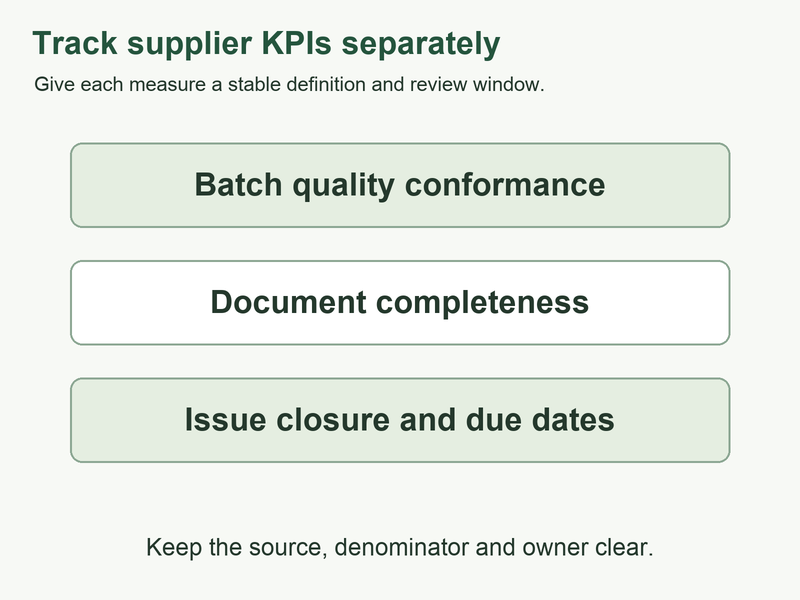
Define every matcha supplier KPI with an event, numerator, denominator, time window, source record, owner, and exception rule. Measure delivery, batch quality, documentation, and issue closure separately before drawing a conclusion. Clean disputed and missing records, review trends on a fixed cadence, and assign an owner and due date whenever a result crosses the buyer’s agreed trigger.
What decision should each matcha supplier KPI support?
Start with the decision, then choose the measure. Delivery data should answer whether inventory exposure is rising; batch data should answer whether material consistently meets the agreed specification; documentation data should show whether a lot can be reviewed and released; corrective-action data should show whether a recurring problem is being contained.
Practitioner judgment: if a team cannot name the action that a KPI can trigger, keep the underlying record but remove the number from the management view. Measurement without a decision owner creates reporting work rather than control.
How should buyers write a KPI definition before measuring it?
Use one definition sheet for every KPI. The ISO 9001 Auditing Practices Group guidance on external providers points auditors toward defined purchasing criteria, performance monitoring, and activities that verify specified requirements. A buyer’s definition sheet makes that monitoring reproducible.
| Definition field | Question to settle | Example record |
|---|---|---|
| Event | What starts and ends the measurement? | Confirmed ship date and accepted receipt |
| Numerator | What counts as success or failure? | Lines received on time and in full |
| Denominator | Which eligible events are included? | All due order lines in the window |
| Window | Shipment, month, rolling period, or lot? | Monthly with a rolling trend |
| Source | Which system or signed record governs? | PO, receipt, COA, deviation log |
| Exceptions | How are buyer-caused or agreed changes treated? | Approved PO revision excluded with reason |
What is the right OTIF denominator for matcha orders?
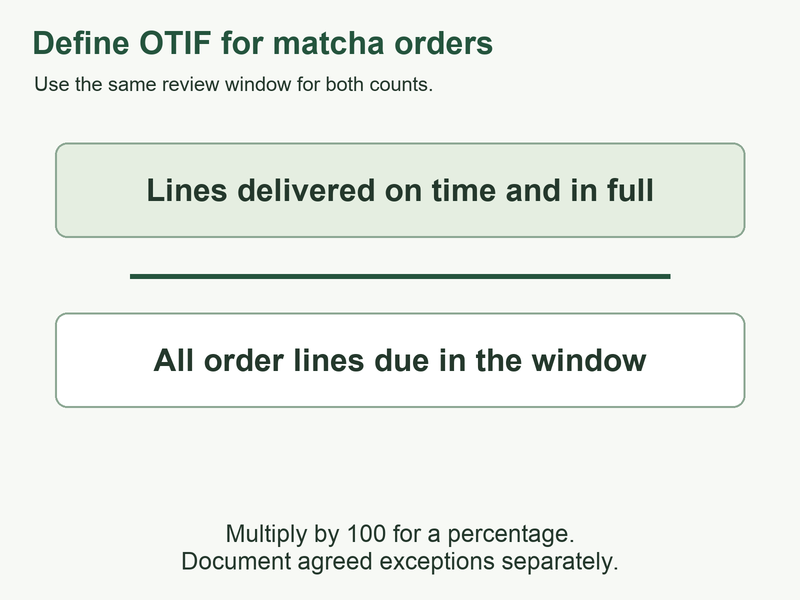
For on-time-in-full (OTIF), use all order lines due in the review window as the denominator unless the contract defines another unit. Count a line as successful only when the agreed quantity reaches the agreed location within the agreed delivery window. Record the original promise, approved revisions, actual receipt, accepted quantity, and exception reason.
Do not quietly remove partial shipments, late lines, or unreceived orders from the denominator. Keep buyer-caused holds and mutually approved date changes in a separate exception field so the raw event history remains auditable. The delivery window should match the purchase order and Incoterm handoff rather than a generic calendar rule; the matcha lead-time guide provides context for planning that window.
Which batch quality KPIs reveal recurring risk?
Measure conformance at batch level: batches accepted without deviation divided by batches reviewed. Track each failed specification parameter separately so one repeated issue is not hidden inside a pass rate. Useful companion measures include confirmed quality incidents per received batch, repeat incidents by cause, and the share of lots released only under concession.
| KPI | Numerator | Denominator | Source |
|---|---|---|---|
| Batch conformance | Batches accepted without deviation | Batches reviewed | COA and release record |
| Confirmed incident rate | Confirmed supplier-attributable incidents | Batches received | Complaint and investigation log |
| Repeat-cause rate | Incidents repeating an agreed root-cause category | Confirmed incidents | CAPA log |
| Concession rate | Lots accepted under documented concession | Lots released | Deviation approvals |
How should documentation performance be measured?
Measure both completeness and timing. A document pack is complete only when all agreed records for that lot are present, internally consistent, and linked to the correct batch. A separate timeliness KPI records whether the usable pack arrived by the buyer’s agreed release checkpoint.
A checklist should name the required COA fields, specification revision, lot identity, certification evidence where applicable, and shipping documents. The guide to reading a matcha COA and the matcha specification-sheet guide explain the underlying records.
Which time windows make KPI trends comparable?
Use the shortest window that contains enough eligible events to interpret, then show a longer rolling trend beside it. A high-frequency buyer may review monthly; a low-frequency buyer may need a quarterly or rolling shipment view. These are operating hypotheses, not universal thresholds: document the chosen window and change it only through version control.
Practitioner judgment: never compare a five-shipment period with a one-shipment period without displaying the denominators. The percentage alone can make a single event look like a stable trend.
How should dirty or disputed KPI data be handled?
Keep an exception queue rather than editing the source record. Flag missing promise dates, duplicate incidents, cancelled lines, quantity-unit mismatches, buyer-requested changes, and disputed attribution. Assign each exception an owner, resolution status, and audit note; recalculate only after the correction is approved.
| Data issue | Treatment | Control |
|---|---|---|
| Missing required date | Mark KPI event incomplete | Do not infer a date silently |
| Approved PO change | Retain original and revised promise | Require approval reference |
| Duplicate complaint | Link records to one incident | Preserve both source messages |
| Disputed cause | Keep attribution pending | Separate confirmed and open incidents |
What action should follow a missed KPI?
A missed trigger should open a defined review, not produce an automatic penalty. Confirm the data, describe the operational effect, separate an isolated event from a repeated pattern, and agree containment, root-cause work, owner, due date, and verification evidence. Commercial consequences should follow the supply agreement and the buyer’s approval process.
Use the KPI record to scope the next quality complaint or supplier review, and contact AdoroHu Matcha if you want to align sample, specification, COA, and delivery records before a trial order.

FAQ
- What are the core matcha supplier KPIs?
Track OTIF, batch conformance, confirmed incident rate, documentation completeness and timeliness, and corrective-action closure. Keep each measure separate until its definition and source data are stable. - How do you calculate OTIF?
Divide eligible order lines received on time and in full by all eligible order lines due in the same review window. Preserve agreed revisions and exceptions as auditable fields. - Should cancelled orders be in the OTIF denominator?
Follow the written KPI rule. A genuinely cancelled line may be excluded, but the cancellation and approval should remain visible so teams cannot improve the rate by deleting failures. - How should quality incidents be counted?
Count confirmed incidents against received batches and keep open investigations separate. Link multiple messages about one event to one incident record. - How often should KPI definitions change?
Only when the business need or source system changes, through a documented revision. Repeated ad hoc changes destroy trend comparability. - Are KPI targets the same as scorecard weights?
No. A KPI target defines expected performance for one measure; a scorecard weight determines how measures contribute to a composite decision.
About the author: AdoroHu Matcha is a B2B matcha supply and private-label partner with production in Jingshan, Hangzhou and international operations in Shenzhen. Its approved company profile describes tea-garden resources, clean production workshops, in-house microbiological and physicochemical laboratory capability, and support from samples through bulk supply, packaging, and export service.