
Raising a matcha quality complaint that gets resolved means acting inside your contractual notification window, presenting measured evidence rather than impressions, requesting a formal corrective action with a root cause, and verifying afterwards that the fix actually held. Here’s what determines the outcome more than anything else: whether you complain with data or with adjectives.
The difference is stark in practice. A buyer who writes “this batch looks duller than usual” invites a debate about perception. A hypothetical complaint might say, “[affected batch] measured [result] against the agreed [limit], supported by the attached COA and a retained sample from [accepted batch] at [comparison result].” That format presents evidence the supplier can address without implying that invented batch numbers are real records. The first gets a sympathetic reply and no change; the second gets a replacement and a corrective action.
Powder makes this harder than components, because there is no visible crack to photograph, so the evidence has to be built rather than observed. This guide covers how, with any matcha supplier.
The six steps in an evidence-led complaint
Raise a matcha quality complaint in six steps. First, quarantine the affected lot immediately and stop using it, since continued use undermines both your claim and your traceability. Second, check your contractual notification window and notify within it, in writing. Third, build the evidence: the batch COA against your specification, your own incoming test results, a retained sample from an acceptable earlier lot for comparison, and photographs with lot codes visible.
Fourth, submit a formal complaint stating the non-conformance, the affected lot and quantity, the commercial impact, and the remedy you are seeking. Fifth, request a corrective action report identifying root cause, not just a replacement. Sixth, verify effectiveness on subsequent batches before closing.
In short: quarantine, notify inside the contractual window, build measured evidence, state the remedy you want, request a root-cause corrective action, then verify it held.
Key points:
- Quarantine first; using the material weakens your claim and your traceability.
- Complain with measured deviations against your specification, not with adjectives.
- Ask for root cause, not just replacement, or the same failure returns.
When does a matcha quality issue justify a formal complaint?
A formal complaint is justified when the material deviates from your agreed specification, or when a pattern emerges across batches. Here’s the threshold that keeps complaints credible: a formal complaint should reference a defined standard, not a preference.
Distinguish three situations. A measured result outside the agreed tolerance normally warrants documented review and, when confirmed under the agreed test method and retest rules, a formal complaint, and in food quality systems an out-of-specification laboratory result is a standard trigger for corrective action with the lot quarantined pending investigation. A borderline result inside tolerance but at the far edge may not justify a formal complaint on its own, but does justify raising a trend concern, particularly if successive batches are drifting the same way.
A subjective dissatisfaction with no specification reference is not a complaint but a specification problem, and the answer is to tighten the specification for future orders rather than to dispute this batch. The judgement worth applying: a single anomaly may be genuine one-off variation, while a repeated deviation is a systemic issue, and the two warrant different responses. Everything here depends on having agreed measurable criteria in advance, which is the purpose of a matcha spec sheet.
Key Takeaway: Complain formally when a measured parameter breaches your agreed specification, raise a trend concern when results drift within tolerance across batches, and treat dissatisfaction with no specification reference as a specification problem to fix for future orders rather than a dispute over this one.
What should you do in the first 24 hours?
Quarantine the affected material and preserve the evidence before doing anything else. Here’s why speed matters commercially: the value of your evidence declines from the moment the goods arrive, and continued use can be read as acceptance.
Quarantine the lot and preserve traceability
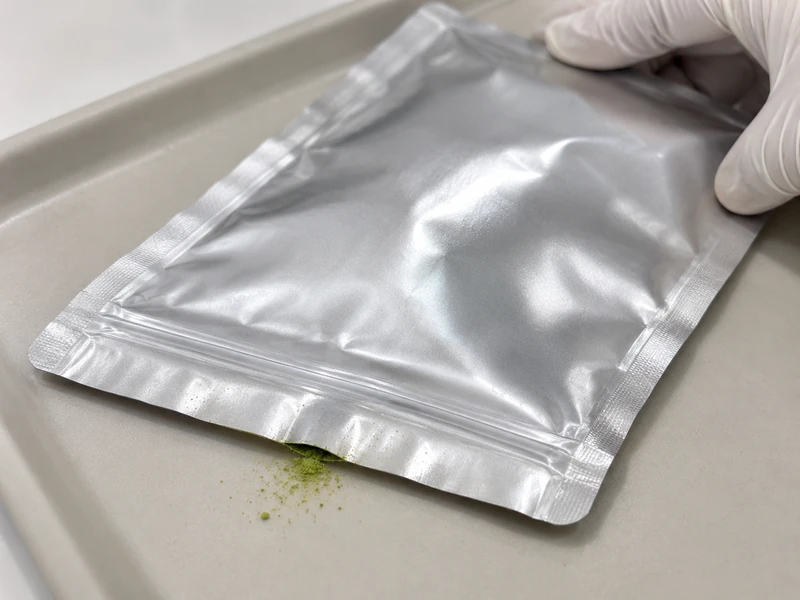
Take four actions immediately. Quarantine the lot physically and in your system, stopping further use and preventing it entering production, which is standard practice when a food batch returns an out-of-specification result. Preserve samples from the affected lot, sealed and labelled with the lot code and date, since these are your evidence if testing is disputed later. Record the condition on arrival, photographing packaging, seals, labels, and any transit damage with lot codes visible in frame.
And check your notification deadline, because supply agreements typically define a period from receipt within which quality claims must be raised, and missing it can forfeit the claim regardless of merit. The related judgement: also isolate any finished product already made with the affected lot, since a quality problem that has moved downstream into your own goods changes both the commercial impact and the urgency. Documentation obligations of this kind belong in your purchase order and framework agreement precisely so this moment is governed rather than improvised.
Key Takeaway: Quarantine the lot physically and in your system, preserve sealed labelled samples, photograph arrival condition with lot codes visible, and check the contractual notification deadline immediately, since continued use can imply acceptance and missing the window can forfeit an otherwise valid claim.
How do you build evidence for a matcha quality complaint?
Build evidence by converting what you observed into measured deviations from your specification. Here’s the standard to meet: your complaint should be verifiable by a third party who was not present.
Compare the result with the agreed specification
Assemble five elements.
- The supplier’s batch COA for the affected lot, with the deviating parameters identified against your specification limits.
- Your own incoming inspection or independent laboratory results, ideally from an accredited laboratory, since a third-party result is harder to dispute than your internal one.
- A retained sample and COA from a previously accepted lot, which establishes what “acceptable” looks like in measured terms rather than in memory.
- Photographic evidence with lot codes, packaging condition, and the product itself visible.
- Storage and handling records on your side, demonstrating the material was held correctly since arrival.
That last item deserves emphasis, because it pre-empts the most common supplier response. When a colour or freshness complaint arises, the first question will be whether degradation occurred in transit or in your warehouse rather than at production, and a buyer who can show controlled storage conditions and arrival-condition photographs removes that defence.
Knowing how to read the certificate properly is what turns it into evidence rather than paperwork, as covered in our guide to reading a matcha COA, and your storage records should reflect the conditions described in our guide to storing matcha powder.
The FDA’s CGMP and preventive-controls overview describes current good manufacturing practice, hazard analysis, and risk-based preventive controls under 21 CFR Part 117. Qualified personnel should use the applicable specification and hazard analysis to define the applicable food-safety and preventive-control review.
Key Takeaway: Build evidence from the batch COA against specification limits, your own or third-party test results, a retained sample from an accepted lot as a measured reference, photographs with lot codes, and your storage records, which pre-empts the supplier attributing degradation to transit or your warehouse.
How should the complaint itself be written?
Write it as a factual notice stating the non-conformance, the impact, and the remedy sought, not as an expression of dissatisfaction. Here’s the structural point: a complaint that does not name the remedy invites the supplier to propose the cheapest one.
Cover six elements in writing. Identification: the lot number, quantity affected, purchase order reference, and date of receipt. The non-conformance: which parameters deviate, by how much, against which specification limits, with the supporting documents attached. Detection: when and how the issue was found and by whom, since a complaint that cannot trace to a specific detection event is weaker. Commercial impact: production stopped, batches scrapped, delivery deadlines missed, and any downstream cost, stated factually with figures where you have them.
The remedy sought: replacement, credit, return, or acceptance under a price concession, chosen deliberately rather than left open. And the response required, including a request for root-cause investigation and the date by which you expect an initial response. Keep the tone measured and professional, because the objective is resolution and continued supply, not the satisfaction of expressing annoyance. The remedies available to you should already be defined in your agreement, as set out in our guide to matcha supply contracts.
Key Takeaway: State the lot and quantity, the measured deviation against specification, how and when it was detected, the commercial impact with figures, the specific remedy you want, and a response deadline; a complaint that omits the remedy lets the supplier propose the cheapest option.
What is a corrective action request and why should you ask for one?
A corrective action request obliges the supplier to identify why the failure happened and prevent recurrence, rather than simply replacing the affected goods. Here’s the distinction that decides whether you complain about this again in three months: replacement fixes the batch, corrective action fixes the cause.
Require root cause and verified correction
Request a structured response rather than an explanation. Supplier corrective action requests are commonly issued in the 8D format, which walks through problem definition, containment, root cause, corrective action, implementation, and effectiveness verification. Root cause analysis should use a recognised method such as 5 Whys, a fishbone diagram, or fault tree analysis, and the answer should reach a process cause rather than stopping at a person.
Ask specifically for four things: the root cause identified, the corrective action taken on the affected material, the preventive action taken to stop recurrence, and how effectiveness will be verified. The warning signs of a weak response are well documented in quality practice: fixing the immediate problem without finding root cause, retraining an operator without changing the process that permitted the error, and closing an action because a due date passed rather than because it was demonstrably effective.
The judgement: a supplier who produces a genuine root-cause analysis is demonstrating a quality system, and that response tells you more about their reliability than the original defect did.
Key Takeaway: Request a structured corrective action, commonly in 8D format, asking for root cause via a recognised method, correction of the affected material, preventive action against recurrence, and effectiveness verification; treat retraining without process change or closure on a due date as a weak response.
How do you verify the problem is actually fixed?
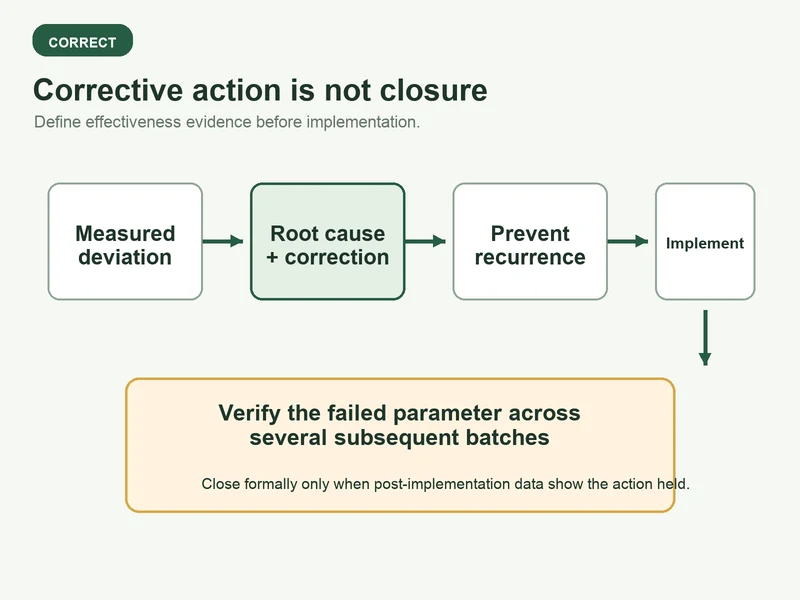
Verify by checking subsequent batches against the specific parameter that failed, over enough shipments to be meaningful. Here’s the step most buyers skip: a corrective action is not closed when the supplier says it is closed, but when the data shows it held.
Verification has three parts. Define what evidence would demonstrate effectiveness before the supplier begins, typically a defined number of subsequent batches within specification on the parameter that failed. Collect that data as shipments arrive, which requires recording the parameter per batch rather than only noting pass or fail, since a parameter that has moved back inside tolerance but sits at the edge has not been fully resolved. Then close the action formally, recording the evidence, since an undocumented closure leaves you without a record if the issue recurs.
The timing point worth respecting: effectiveness verification must come after implementation, not before, and requires data gathered over a period rather than a single good batch. Note also that arbitrarily short deadlines are counterproductive, since a supplier pressed to close within an unrealistic window will produce a superficial fix rather than a real one. This parameter-level tracking is the same discipline that underpins the consistency measure in our guide to matcha supplier KPIs.
Key Takeaway: Define upfront what evidence proves effectiveness, then verify across several subsequent batches by recording the failed parameter’s actual value rather than pass/fail, and close formally with documentation; verification must follow implementation and needs data over time, not one good batch.
How do you escalate when a matcha complaint is not resolved?
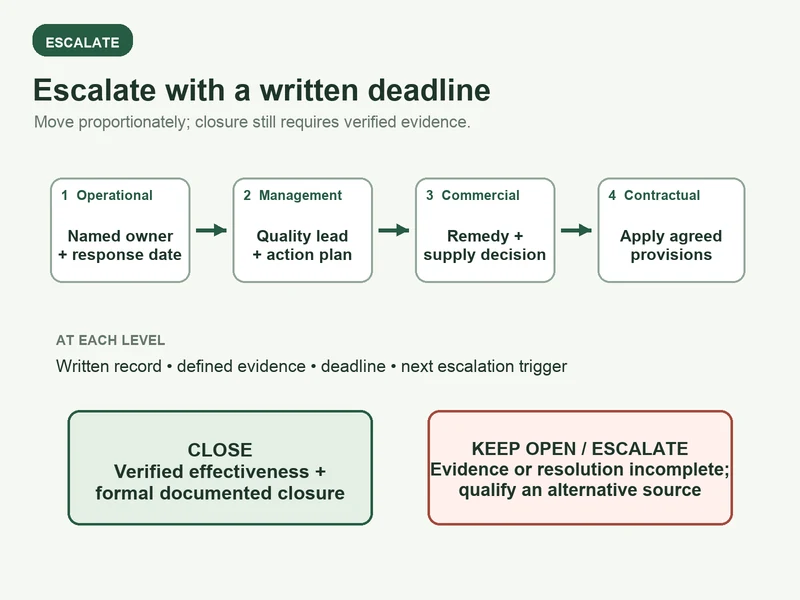
Escalate in defined stages, moving from operational contacts to commercial consequences. Here’s the leverage sequence: escalation works when each step has a consequence the supplier would prefer to avoid.
Move through four levels. Operational: your quality or purchasing contact and their counterpart, with a written deadline for response. Management: escalate to senior commercial management on both sides, restating the facts and the unmet deadline rather than the frustration. Commercial: apply the remedies your agreement provides, which may include withholding payment for the affected lot, claiming compensation for downstream costs, or reducing committed volume. Contractual: invoke the dispute resolution mechanism your contract names, and where performance failures persist, the exit provisions.
Two supporting actions strengthen every stage: record the complaint and its outcome in your supplier performance data so the pattern is visible at review time, as covered in our guide to building a matcha supplier scorecard, and begin qualifying an alternative source if resolution stalls, since negotiating without an alternative is negotiating from weakness. The judgement to keep in view: escalation should be proportionate and reversible, because most supply relationships are worth preserving and a supplier who resolves a serious issue well often becomes more reliable afterwards.
Key Takeaway: Escalate through operational, management, commercial, and contractual levels with a written deadline at each, record every complaint in your supplier performance data so patterns surface at review, and begin qualifying an alternative if resolution stalls, since escalating without options is escalating from weakness.
What mistakes weaken a matcha quality complaint?
The most damaging mistake is complaining in adjectives rather than measurements. Here’s the pattern: each error either removes evidence or removes obligation.
Watch for these and their consequences.
- Describing the problem subjectively, inviting a debate about perception rather than a response to a fact.
- Using or discarding the affected material, destroying the evidence and implying acceptance.
- Missing the contractual notification window, forfeiting a claim that was otherwise valid.
- Complaining by phone with no written record, leaving nothing to escalate or reference later.
- Accepting a replacement without a root cause, guaranteeing the same failure recurs.
- Keeping no retained samples from accepted lots, so you cannot demonstrate what good looked like.
- Failing to document your own storage conditions, letting the supplier attribute the problem to your warehouse.
- Never recording the complaint in performance data, so a recurring pattern stays invisible at renewal.
Each is avoidable with a simple internal procedure agreed before you need it. The same discipline applies across complementary lines such as hojicha powder, where smaller volumes often mean complaints are handled informally and patterns go unrecorded.
Key Takeaway: Complaints fail through subjective description, using or discarding the material, missing notification windows, verbal-only records, accepting replacement without root cause, no retained reference samples, undocumented storage, and never recording the event in performance data.
FAQ
- How do you raise a matcha quality complaint properly?
- Quarantine the affected lot immediately, check your contractual notification window and notify in writing within it, then build evidence: the batch COA showing which parameters deviate from your specification, your own or third-party test results, a retained sample from a previously accepted lot for comparison, photographs with lot codes visible, and your storage records. Submit a written complaint stating the lot, the deviation, the commercial impact, and the specific remedy you want.
- What evidence do you need for a matcha quality claim?
- Measured deviations rather than descriptions. That means the supplier’s batch COA with the failing parameters identified against your specification limits, independent laboratory results where the deviation is disputed, a retained sample and COA from an accepted lot as a reference point, photographs showing lot codes and packaging condition on arrival, and records demonstrating you stored the material correctly since receipt.
- How quickly must you report a matcha quality problem?
- Within the notification period defined in your supply agreement or purchase order, which typically runs from receipt of goods. Missing that window can forfeit the claim regardless of its merit, so check the deadline as soon as an issue is suspected. Quarantine and notify first, then build the detailed evidence, rather than delaying notification until your investigation is complete.
- What is a supplier corrective action request?
- A formal request obliging the supplier to investigate why a failure occurred and prevent recurrence, rather than simply replacing the affected goods. It is commonly issued in the 8D format and should identify root cause using a recognised method such as 5 Whys or a fishbone diagram, state the corrective action on affected material, the preventive action against recurrence, and how effectiveness will be verified.
- What should you do if the supplier does not resolve the complaint?
- Escalate in stages: from operational contacts to senior management with written deadlines, then to commercial remedies provided by your agreement such as withholding payment for the affected lot or claiming downstream costs, and finally to the dispute resolution mechanism your contract names. Record the complaint in your supplier performance data throughout, and begin qualifying an alternative source if resolution stalls.
Conclusion
A matcha quality complaint succeeds when it moves fast enough to preserve evidence, stays inside the contractual notification window, and presents measured deviations against an agreed specification rather than subjective dissatisfaction. The decisive takeaway is that asking for a root cause matters more than asking for a replacement, because a replaced batch solves this shipment while a corrected process solves every shipment after it, and how a supplier responds to that request tells you more about their reliability than the original defect ever did.
To discuss specifications, documentation, and the quality controls that prevent these situations, contact AdoroHu Matcha to request samples and a wholesale quote.