
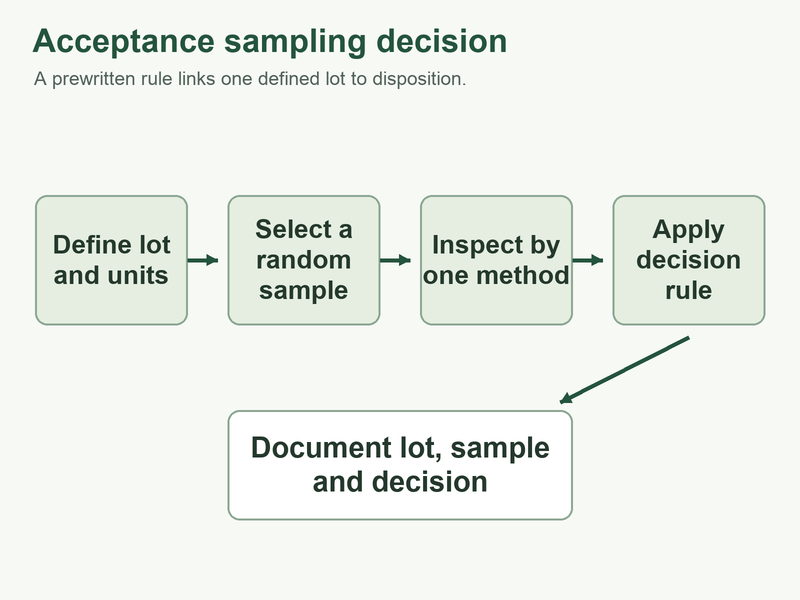
Acceptance sampling uses results from a selected sample to accept or reject a defined lot under a prewritten plan. It can reduce inspection effort, but it never proves that every unit conforms and it cannot turn a generic AQL into a food-safety guarantee.
For acceptance sampling in matcha procurement, begin with the defect or measurement and the lot decision. The matcha pre-shipment inspection guide covers broader checks; this article focuses on the statistical rule connecting a random sample to lot disposition.
Acceptance sampling sentences a lot rather than estimating or improving the production process. The plan sets how units are selected, what is measured, and which result accepts or rejects the lot. Its operating-characteristic behavior exposes the chance of accepting lots at different incoming quality levels.
In short:
Key points:
- Define the lot, sampling frame, defect, and disposition before selecting a plan.
- Read AQL, LTPD, producer risk, and consumer risk as linked plan behavior.
- Keep visual or dimensional acceptance plans separate from representative food-safety sampling.
What is acceptance sampling and what decision does it make?
Acceptance sampling decides whether to accept or reject a lot from evidence collected on a sample. The NIST/SEMATECH handbook describes it as lot sentencing rather than process estimation. It sits between no inspection and complete inspection.
That distinction limits the conclusion. A passed sample means the observed result met the plan’s acceptance rule; it does not mean the lot contains no defects. A rejected lot also does not prove every unit is bad. Both outcomes are decisions under stated sampling risk.
Write the disposition in advance: accept, reject, hold for review, sort, return, or take another action allowed by the plan. Without that route, the team can change the meaning of results after seeing them.
Acceptance sampling should not be confused with process-control sampling. Lot inspection decides the fate of submitted material; process data estimate and improve how production behaves over time. A supplier can pass several lots under a permissive plan while its process drifts, so buyers still need complaints, trend data, audits, and corrective action outside the accept-or-reject calculation.
Key Takeaway: Acceptance sampling makes a risk-based lot decision; it does not certify every unit or diagnose the process.
When is acceptance sampling appropriate for a matcha shipment?
Acceptance sampling is appropriate when a defined unit can be selected randomly, the characteristic can be inspected consistently, and full inspection is impractical, costly, or destructive. Examples may include sealed retail units checked for label presence, closure damage, print defects, or package dimensions.
It is less suitable when the “unit” is unclear, defects cluster within bulk powder, the test destroys a large portion, or representative analytical sampling requires a separate scientific design. Matcha in a 20 kg lined carton and individual 30 g retail pouches create different sampling frames even when they share a shipment.
Economics should be stated with the risk. Inspection cost includes access, opening, sample handling, destructive tests, laboratory work, delay, and restoring the lot after selection. Compare that cost with the consequence of accepting defects and rejecting acceptable goods. A cheap plan that provides little protection may be more expensive after claims and sorting.
The bounded recommendation is to use acceptance sampling only where the inspected unit and defect are observable and actionable. Do not force a convenient unit count onto a heterogeneous bulk-food hazard.
Key Takeaway: Use a lot plan for clearly defined inspection units, not as a shortcut for every bulk or safety question.
How should the lot and sampling frame be defined?
The lot should contain units produced and presented under conditions that justify one acceptance decision. Record item code, supplier, production or packaging lot, quantity, package format, shipment references, and any stratification by line, shift, date, or pallet.
The sampling frame must give every eligible unit a known route into selection. Convenience samples from the front of a pallet or top of a carton can miss clustered defects. Define randomization, access, replacement rules, and the handling of damaged or inaccessible units.
When a shipment contains several production lots, do not pool them merely to reduce the sample count. Each lot may have different defect prevalence and traceability. Either sentence them separately or document a defensible basis for the combined lot. Preserve the relationship between selected units and the sublots they represent.
| Lot element | Required definition | Risk if omitted |
|---|---|---|
| Product and package | Exact item, size, and revision | Unlike units are mixed |
| Time and source | Line, shift, date, or supplier lot | Clustered variation is hidden |
| Quantity | Units eligible for the decision | Wrong plan input is used |
| Physical locations | Pallets, cartons, or positions | Sample overrepresents easy access |
| Disposition boundary | Units covered by accept or reject | Decision spreads beyond evidence |
Key Takeaway: Define a homogeneous decision lot and an accessible sampling frame before drawing units.
What is the difference between attributes and variables plans?
Attributes plans classify units or defects into categories such as conforming or nonconforming, then compare counts with an acceptance rule. Variables plans use measured values and their statistical behavior under the chosen procedure. The two approaches need different data and assumptions.
Use attributes when the decision is categorical and the inspection method produces repeatable classification. Use variables only when the measurement system, distribution assumptions, specification limits, and plan procedure support it. A number on an instrument does not automatically make a variables plan valid.
Define defect classes before selection. Critical, major, and minor labels are meaningful only when each has an operational boundary and consequence. A missing mandatory label element, a cosmetic scuff, and a compromised seal should not share one undifferentiated count. Separate rules prevent harmless appearance defects from masking severe package failures.
| Plan type | Data | Example question | Main caution |
|---|---|---|---|
| Attributes | Defect or unit classification | Is the label missing? | Classification must be consistent |
| Variables | Continuous measured value | Is package mass within a defined limit? | Assumptions and measurement capability matter |
| Count of defects | Number of defects per unit | How many print defects appear? | One unit may contain several defects |
| Separate analytical plan | Laboratory result from material samples | Does a composite meet a criterion? | Requires representative scientific sampling |
Key Takeaway: Choose the plan type from the data and assumptions, not from which table is easiest to obtain.
How do AQL and LTPD affect acceptance risk?
AQL and LTPD are reference quality levels used to describe plan behavior, not promises about an individual lot. AQL is associated with quality considered satisfactory for a sampling-series purpose, while LTPD or a comparable poor-quality point helps express protection against undesirable lots under the chosen design.
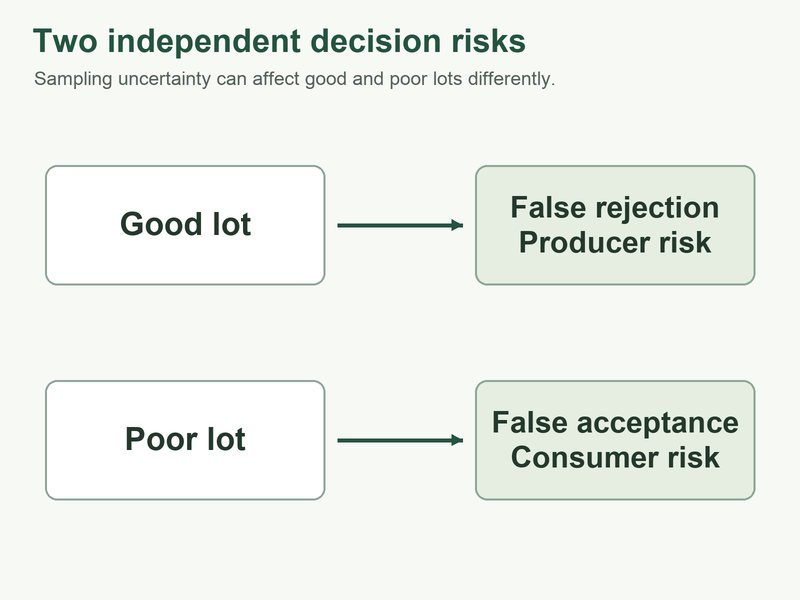
The NIST operating-characteristic explanation shows acceptance probability across incoming quality levels. Producer risk is the chance of rejecting a lot at a designated good-quality point; consumer risk is the chance of accepting a lot at a designated poor-quality point.
Do not read “AQL 1.0” as “this lot contains exactly one percent defects” or “the lot is 99 percent good.” The plan produces probabilities based on its sample size, rule, and assumptions.
Different plans can use the same AQL and still provide different protection because inspection level, lot size, sample size, acceptance number, and switching status interact. Record the whole plan reference. Quoting only an AQL in a purchase order leaves suppliers free to choose incompatible procedures that produce different acceptance probabilities.
Key Takeaway: Read AQL and LTPD through the OC curve and stated risks; neither describes the exact defect rate in one accepted lot.
How should an operating-characteristic curve be used?
An operating-characteristic curve should be used to compare how likely a plan is to accept lots across plausible incoming quality levels. It makes the tradeoff visible: increasing discrimination usually requires more inspection or a different rule.
Review at least the probability of acceptance near the desired and undesirable quality points. Also compare plans that look similar by sample size; different acceptance numbers can produce materially different curves.
Consider average inspection effort when comparing single, double, and multiple plans. A double plan may stop early when results are clearly good or poor, but it needs controlled rules for the second sample and combined decision. Operational complexity can erase the expected saving if inspectors improvise between stages.
The practical judgment is to reject a plan selected only because its sample size feels affordable. Cost matters, but the OC curve shows what protection the buyer actually purchases. If the curve accepts unacceptable quality too often, revise the plan or the business decision.
Key Takeaway: Choose the plan from acceptable risk behavior, then assess whether its inspection cost is workable.
What does ISO 2859-1 contribute to attributes sampling?
ISO 2859-1:2026 establishes attributes acceptance-sampling procedures indexed by acceptance quality limit for continuing lots. It includes plan selection and switching concepts within the purchased standard. The public standard page does not authorize inventing a code letter, inspection level, sample size, or AQL.
A buyer using the standard must control edition, lot size, inspection level, plan type, AQL, switching state, and disposition. Supplier and buyer should use the same inputs; otherwise, each can claim compliance while applying different tables.
Switching rules matter because a continuing-lot system responds to quality history. Using one normal-inspection table forever, without the applicable history and rules, removes part of the design.
Key Takeaway: Use the current purchased standard as a complete procedure, not as a sample-size lookup page.

Why can acceptance sampling not guarantee food safety?
Acceptance sampling cannot guarantee food safety because hazards can be rare, unevenly distributed, invisible, or dependent on sample collection and analytical method. A generic attributes AQL for packaging defects does not establish that a powder lot is free from microbiological or chemical hazards.
FDA food sampling programs use program-specific collection and analysis for surveillance, compliance, and investigations. That does not convert a generic inspection plan into representative hazard sampling. The buyer must connect hazard, lot structure, sample increments, composite design, method, laboratory, criterion, and disposition.
Keep the matcha CoA guide separate from lot-plan design. A CoA result is meaningful only with its sampling plan and method; an acceptance number cannot repair unrepresentative material sampling.
Key Takeaway: Use hazard-specific sampling and testing for food-safety decisions; an AQL plan cannot supply that evidence.
How should samples be selected and inspected?
Samples should be selected through a documented random or probability-based method that covers the defined frame. Record unit identifiers or locations, selector, time, condition, and any departures from the procedure. Protect selected samples from substitution.
Inspect against an operational defect definition with photographs, boundary examples, tools, lighting, and training where useful. Run agreement checks when classification is subjective. A plan’s statistics assume the recorded results mean the same thing across inspectors.
Protect sample integrity after selection. If units are opened, mark their status, prevent them from returning to sale unintentionally, and record whether inspection itself caused damage. For destructive checks, include consumed units in the cost and inventory disposition. These controls keep the statistical sample connected to physical lot records.
| Control | Evidence | Failure prevented |
|---|---|---|
| Random selection | Generated positions or documented method | Convenience bias |
| Unit traceability | Pallet, carton, and unit identity | Sample substitution |
| Defect standard | Written boundary and visual examples | Inspector disagreement |
| Measurement control | Suitable calibrated equipment | False pass or fail |
| Blind or independent review | Recheck of disputed units | Result steering |
Key Takeaway: Random selection and repeatable inspection are both required; good tables cannot rescue biased samples or vague defects.
How should lot disposition and plan performance be reviewed?
Lot disposition should follow the prewritten rule, with exceptions controlled by authorized review. Preserve sample results, defect categories, photographs, calculations, lot identity, plan version, and final action. Do not resample repeatedly until a lot passes unless the governing procedure explicitly permits that route.
Track rejected lots, accepted-lot downstream defects, inspection agreement, supplier response, and switching history. Acceptance sampling controls disposition; supplier corrective action and process improvement address why defects occurred.
When specifications, packaging, suppliers, production routes, inspection methods, or risk tolerance change, reassess the plan. A wholesale matcha supply decision should connect product identity with the correct inspection and analytical evidence, not reuse one plan across unlike formats.
Key Takeaway: Apply the stated disposition once, then review plan performance and supplier causes with separate records.
FAQ
- What is acceptance sampling?
- Acceptance sampling uses results from a selected sample and a prewritten rule to accept or reject a defined lot.
- Does acceptance sampling prove every unit conforms?
- No. It makes a lot decision under stated sampling risk and cannot prove that every unit is conforming.
- What is the difference between attributes and variables sampling?
- Attributes plans use classifications or counts, while variables plans use measured values under defined statistical assumptions and procedures.
- Does AQL mean the accepted lot has that defect percentage?
- No. AQL is a reference quality level used in plan design and does not state the exact defect rate of an accepted lot.
- Can AQL sampling release matcha for microbiological safety?
- No. Food-safety release needs hazard-specific representative sampling, a suitable analytical method, criteria, and qualified review.
- What should happen after a sample rejects the lot?
- Follow the prewritten disposition, preserve the evidence, and investigate supplier or process causes without informal repeated sampling.
Conclusion
Acceptance sampling is useful when a defined lot, random sample, repeatable inspection, and explicit risk tradeoff support the buyer’s decision. Keep attributes or variables plans separate from food-safety sampling, and use the OC curve to understand protection before choosing inspection cost. For matcha product, package, and shipment requirements, contact AdoroHu Matcha before fixing the plan.