
Matcha crepe cake production depends on repeatable sheets, measured filling, aligned stacking, controlled chilling, and a defined saleable slice. A beautiful first cake can hide losses from startup crepes, uneven diameters, compressed cream, sliding layers, and ragged portions.
A matcha crepe cake program should begin with a fixed batter and culinary matcha for bakery applications. Once the sheet is stable, assembly controls can show whether a defect comes from the crepe, the cream, or the way the chilled cake is cut.
A commercial matcha crepe cake is a stacked system of thin crepes and controlled filling layers. Its performance depends on sheet geometry, flexibility, fill weight, layer alignment, moisture movement, chill, and cutting. Ordinary crepe production is only the first half of the process.
In short:
Key points:
- Standardize the cooked sheet before setting the cake’s layer count.
- Control cream condition and fill weight so the stack stays level.
- Measure startup loss, trim, assembly loss, and saleable slices together.
What makes matcha crepe cake a separate production task?
Matcha crepe cake requires ordinary crepe controls plus assembly, moisture, chilling, and slicing controls. A sheet that works for immediate café service may be too thick, dry, irregular, or fragile for a multi-layer cake. The stack magnifies small errors repeated across many crepes.
The published matcha cake production guide covers cake crumb and moisture, while this task begins where thin crepe sheets become a measured stack. Define finished diameter, height, layer count, fill pattern, portion count, and service presentation before trials. Keep the crepe-cake layer system separate from ordinary batter cakes.
Build a layer budget from those targets. Estimate the contribution of one crepe and one cream layer, then compare the estimate with the assembled cake. A widening gap can reveal compressed filling, variable sheet moisture, missing layers, or excessive trim. This provides a useful diagnostic before the cake reaches cutting.
Reject a design that depends on hiding irregular sheets inside the stack. Those mismatches create a domed cake, uneven cream pressure, poor slice faces, and unpredictable yield.
Key Takeaway: Approve the crepe as a cake component, then validate the stacked and chilled product as a separate system.
How should batter rest and flow be controlled?
Batter rest and flow should be controlled because hydration, bubbles, suspended particles, and viscosity can change during a production run. Record ingredient temperature, mixing energy, strain or screen step, rest condition, remix method, and elapsed time from first to last sheet.
A 2026 cake study connected measured batter flow and viscoelastic behavior with finished cake quality in a different batter matrix. It does not establish a matcha crepe formula, but it supports the decision to measure flow rather than describe batter only as “thin.” Choose a simple plant method, such as flow distance or cup time, and correlate it with sheet spread and thickness.
If batter changes across the hold, compare early, middle, and late sheets. Avoid adding liquid casually at the pan because that changes solids, colour, and yield without a controlled record.
Sampling should reflect the pan station, not only the mixing bowl. Record batter condition beside deposit mass, pan surface reading or validated setting, cook observation, and cooked-sheet mass. A flow result without the corresponding sheet cannot show whether drift came from the batter, heat input, or spreading technique.
Key Takeaway: Track a practical batter-flow measure through the run and connect it to sheet geometry and flexibility.
How should egg-containing crepe batter be handled?
Egg-containing batter should follow an approved food-safety plan covering receipt, storage, mixing, cooking, exposure, and cleanup. The FDA egg-safety guidance advises safe buying, storage, preparation, and cooking for shell eggs and egg-containing foods. Apply current local requirements and the facility’s validated process.
Separate safety controls from quality controls. Pan colour or easy release does not prove a safe process, while a safe cook does not guarantee flexible cake sheets. Define the evidence for each decision and train operators not to substitute one observation for the other.
Plan batch size around actual throughput so mixed batter does not wait outside its controlled condition. Record disposition for unused batter and prohibit uncontrolled carryover into the next production day.
Map utensil and hand-contact points during sheet removal, cooling, trimming, and stacking. Thin crepes have a large handled surface and may wait while the rest of the batch cooks. A hygienic layout should prevent raw batter tools, egg containers, and finished sheets from crossing paths while preserving the gentle handling needed for intact layers.
Key Takeaway: Control egg safety through the applicable process plan while evaluating sheet quality with separate measures.
How should sheet thickness and diameter be standardized?
Sheet thickness and diameter should be standardized with deposit mass, spread pattern, pan geometry, and a finished-sheet check. Thickness drift changes cake height, flexibility, perceived chew, and the amount of cream needed to maintain the design.
Weigh representative deposits and cooked sheets, then check diameter at more than one axis. A sheet can meet average diameter while remaining oval or having a heavy edge. Define where thickness is measured and whether trimming happens before or after cooling.
| Sheet measure | What it reveals | Assembly consequence |
|---|---|---|
| Deposit mass | Batter delivery consistency | Predicts thickness and yield |
| Cooked mass | Evaporation and process drift | Affects moisture and flexibility |
| Two-axis diameter | Roundness and spread | Controls stack alignment |
| Center and edge thickness | Pan and spreading pattern | Prevents ridges and dry rims |
| Fold or bend check | Handling flexibility | Predicts cracking during stacking |
Key Takeaway: Control mass, diameter, roundness, and thickness together because one measure cannot describe the whole sheet.
How can startup loss be reduced without accepting bad crepes?
Startup loss should be reduced by defining pan readiness and the acceptable first-sheet condition, not by forcing early rejects into the cake. Published recipes acknowledge losing several crepes while the pan settles, which exposes a commercial yield problem even though the exact loss is not universal.
Create a startup sequence for preheat, surface preparation, test deposit, release, colour, and geometry. Record the first sheet number that meets the standard. If stabilization takes too long, investigate pan temperature recovery, surface condition, deposit technique, or batter temperature.
Keep startup loss separate from routine reject loss. The first measures how efficiently the station reaches control; the second reveals drift after it is running. Combining them can hide a poor setup behind an apparently acceptable total yield, or trigger needless formula work when the real issue is an operator restart.
The bounded judgment is to discard nonconforming startup sheets rather than bury them in lower layers. Their thicker or drier structure changes stack pressure and creates a defect that becomes expensive only after filling and chilling.
Key Takeaway: Standardize pan startup and count its loss, but never convert an out-of-standard crepe into a hidden cake layer.
How should matcha colour and flavour be balanced across the cake?
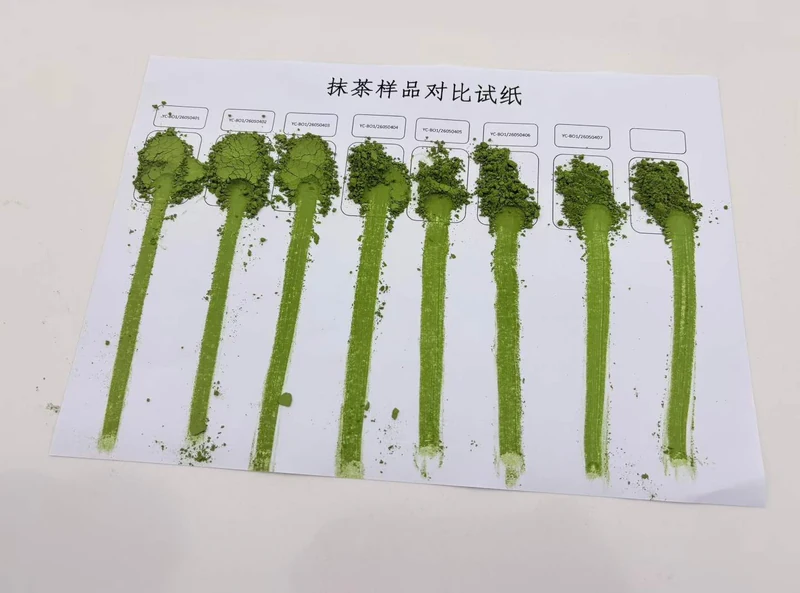
Matcha colour and flavour should be balanced between the crepe and cream rather than optimized in isolation. Decide whether the matcha sits in the sheet, filling, surface finish, or more than one component. Each route changes bitterness, visual contrast, hydration, and total dose.
Use the commercial matcha baking guide to frame grade selection, then test the actual chilled cake. A powder that looks vivid in dry flour may appear different after cooking or after contact with dairy fat and moisture.
Bind every trial to the exact commercial grade. AdoroHu’s approved conventional series assigns E-1/E-2 to culinary, E-3/E-4 to premium, and E-5/E-6/E-7 to ceremonial tiers; its organic series assigns O-1/O-2 to culinary, O-3 to premium, and O-4/O-5/O-6 to ceremonial tiers. For a crepe-cake comparison, record the exact code and lot rather than writing only “matcha.” Otherwise, a grade change can be mistaken for a batter, cook, or cream effect.
Hold sugar, dairy, crepe thickness, and matcha identity constant when adjusting dose. Evaluate a full slice because many thin layers can build stronger cumulative flavour than a single crepe tasting suggests.
Key Takeaway: Approve matcha in the finished layered slice because the sheet and cream change its colour and cumulative flavour.
How should cream viscosity and fill weight be controlled?
Cream should be firm enough to hold a defined layer yet spread without tearing the crepe or trapping large voids. Control ingredient temperature, whipping or mixing endpoint, elapsed hold, and fill weight per layer. Record rework rules when cream softens or begins to separate.
Set fill weight from the intended cake height and eating balance, then verify it with a suitable calibrated scale. Establish the working tolerance from the cake design and demonstrated assembly capability rather than borrowing a universal layer limit.
Check scale resolution against the size of one filling portion. If the display increment is large relative to the target, the recorded weight may look stable while the cream layer varies materially. Confirm taring practice, container placement, and cleaning because residue under a bowl can also shift readings through the assembly run.
| Filling check | Method | Defect prevented |
|---|---|---|
| Batch condition | Visual and flow standard | Grainy, loose, or overworked cream |
| Portion weight | Tared scale | Height and cost drift |
| Spread diameter | Marked guide | Dry edges or squeeze-out |
| Layer surface | Straightedge or visual standard | Tilt and voids |
| End-of-hold check | Repeat flow and appearance | Late-batch collapse |
Key Takeaway: Measure cream condition and weight per layer so the cake’s height and cost do not depend on operator feel.
How should stacking alignment and moisture migration be managed?
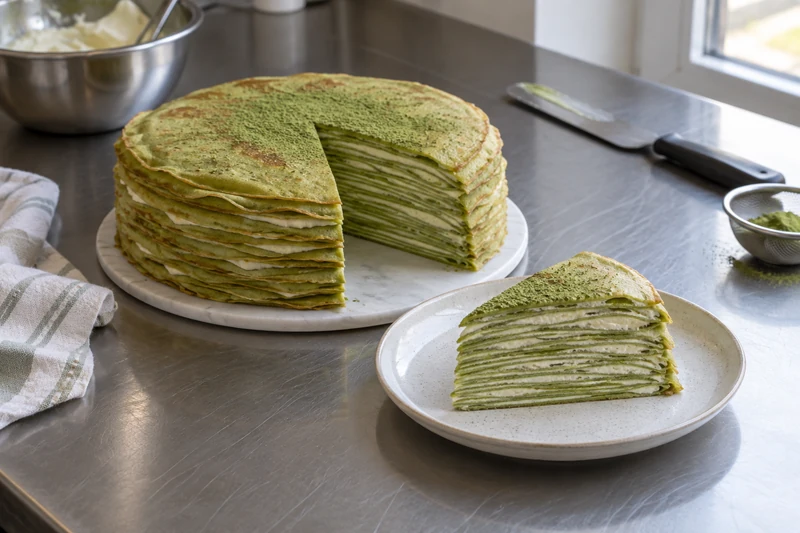
Stacking alignment should keep crepe centers, edges, and filling distribution concentric from the first layer. Use a guide or jig, rotate only through a defined method, and inspect verticality during assembly rather than correcting the finished cake.
Moisture moves between cream and crepe during chilling. That can soften a dry sheet, but it can also produce gummy interfaces, squeeze-out, or a weak slice if the balance is wrong. Compare slice texture at planned chilled checkpoints using the actual sheet and cream.
Inspect both the center and outer edge. Exposed edges can dry while the center absorbs moisture, creating a slice with two different textures. Covering, edge trimming, cream spread diameter, and chill airflow all influence that contrast. Photograph a standard slice at each checkpoint and record whether the layers remain distinct under normal fork pressure.
Do not solve sliding only by making the filling stiffer. Excessively firm cream can tear sheets and produce a heavy bite. First check sheet surface, cream temperature, fill weight, stack alignment, and chill before reformulating.
Key Takeaway: Control alignment and evaluate moisture transfer after chilling because the assembled cake continues to change.
How should chilling and cold holding be validated?
Chilling should set the stack for cutting while preserving safe handling and the intended texture. Define cake dimensions, rack spacing, covering, cooling equipment, start condition, and the point at which cutting is allowed. Avoid treating a fixed clock time from a home recipe as universal.
The FDA Food Code provides model provisions for cooling and cold holding in retail food operations. Local adoption varies, and the model code does not establish a crepe-cake shelf life. Use applicable rules and a qualified food-safety review.
Check center condition as well as surface firmness. A cake that feels set outside may deform during cutting if the interior cream has not stabilized. Validate the actual size, formula, equipment load, package, and service route.
Key Takeaway: Release the cake for cutting only after its actual chill process meets both safety and slice-performance criteria.
How should slice yield and production loss be measured?
Slice yield should be measured from total approved ingredients to saleable portions. Separate batter left in the vessel, startup crepes, pan rejects, trim, damaged sheets, cream left in equipment, assembly squeeze-out, cutting loss, and unsaleable end portions.
Use a slice template or indexed cutting guide, clean the blade through a defined routine, and weigh representative portions. Track both count and mass because equal angles do not guarantee equal portions when the cake is off-center.
| Yield stage | Record | Improvement question |
|---|---|---|
| Sheet production | Approved sheets from batter | Is startup or pan loss excessive? |
| Assembly | Sheets and cream used | Is fill weight drifting? |
| Chill and trim | Cake mass before and after | Is edge correction consuming yield? |
| Cutting | Saleable slice count and mass | Are alignment or blade methods causing rejects? |
| Service | Returned or damaged portions | Does the slice hold through handling? |
Key Takeaway: Measure saleable slices after chilling and cutting, not theoretical portions from the recipe.

FAQ
- What is a matcha crepe cake?
- It is a chilled layered cake built from thin matcha crepes and controlled filling, then cut into slices that show a repeated layer pattern.
- Can ordinary café crepes be used for crepe cake?
- Only if their thickness, diameter, flexibility, moisture, and flavour remain suitable after stacking and chilling.
- Why does a matcha crepe cake slide?
- Check cream condition, fill weight, sheet surface, alignment, cake temperature, and chill before making the filling stiffer.
- How can every layer stay even?
- Control deposit mass, cooked-sheet geometry, filling weight, spread diameter, and stack alignment with defined checks.
- Does the first crepe have to be discarded?
- Discard any startup crepe that misses the approved standard, then improve pan setup to reduce recurring loss.
- How long should a matcha crepe cake be chilled?
- Validate the actual cake size, formula, equipment, food-safety plan, and cutting performance rather than copying a universal time.
Conclusion
A repeatable matcha crepe cake starts with approved sheets and ends with saleable slices, not an attractive uncut stack. Measure batter flow, sheet geometry, cream weight, alignment, chilled condition, and cutting loss as one production chain. For matcha selection and bakery application support, contact AdoroHu Matcha with the intended cake format and service plan.