
HACCP validation vs verification separates evidence that a control or plan can control a significant hazard from checks that the plan is implemented and remains effective. Matcha buyers should request both kinds of evidence without importing meat, seafood, or juice requirements into a facility outside that jurisdiction.
For supplier review, HACCP validation vs verification follows the framework and hazard decision. The matcha supplier audit guide helps place scientific support, monitoring records, calibration, record review, and corrective action within the actual product and process.
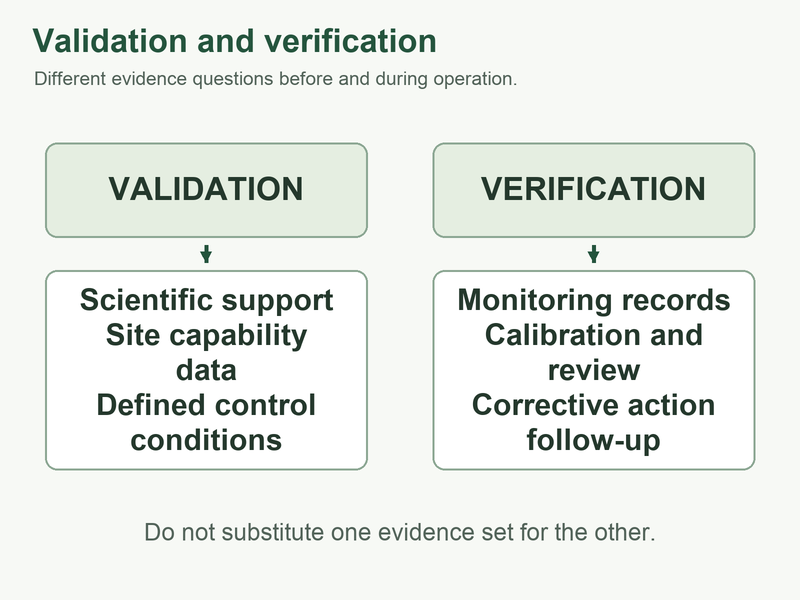
Validation asks whether the control design is capable under defined product and operating conditions. Verification asks whether the plan is followed and continues to control hazards. Monitoring is the routine observation or measurement used to determine whether a control is operating as intended.
In short:
Key points:
- Validate control capability with applicable scientific and technical evidence.
- Verify implementation through review, observation, calibration, sampling, and records.
- Reassess and revalidate when meaningful changes weaken the original support.
What is the HACCP validation vs verification difference?
The HACCP validation vs verification difference is capability evidence versus implementation evidence. Validation evaluates whether control measures, critical limits, and plan elements can control the identified significant hazards under the operation’s conditions. Verification checks whether the plan is followed and remains effective.
Codex HACCP guidance treats validation as part of establishing that plan elements together can control hazards. Verification includes activities beyond routine monitoring. The exact legal duties and frequencies depend on the governing food rule and jurisdiction.
Keep both questions in the approval record. A scientifically supported limit can fail when staff do not follow it, while perfect records can document a control that was never technically capable.
Separate validation, monitoring, verification, and reassessment fields in the plan. If all are labeled “checks,” owners may repeat monitoring data when reviewers need scientific support. Clear terminology allows a buyer to route a missing study to technical experts and a missing record review to operational management.
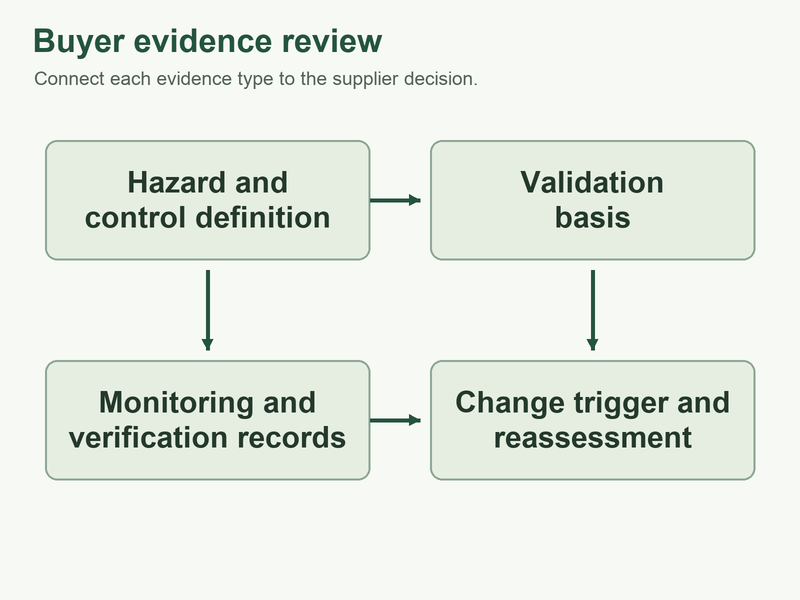
Build an evidence index for each significant hazard and control. The index should point to validation sources, approved limits, monitoring records, verification activities, changes, and current status. When one source changes, the owner can identify affected plan elements instead of searching an undifferentiated HACCP file.
Key Takeaway: Validation supports control capability; verification checks implementation and ongoing effectiveness.
What must validation prove before implementation?
Validation must prove that the selected control measure and critical limit are capable of controlling the significant hazard for the defined product, process, equipment, and operating range. External evidence must be applicable, not merely related to another food.
Evidence can include authoritative guidance, regulations, peer-reviewed literature, predictive models, challenge studies, equipment studies, and data from comparable operations. The plan should explain why the source fits formulation, water activity, particle form, load, time, temperature, and worst-case conditions.
Define the claim narrowly. Validation might support a critical temperature and hold time for one product family, an allergen-cleaning procedure on named equipment, or a supplier control for a specified hazard. It does not validate the entire factory. State endpoints, operating bounds, prerequisites, and deviations that invalidate the claim.
The Codex General Principles of Food Hygiene provides the HACCP framework, but it does not validate a matcha process automatically.
Key Takeaway: Validate the specific control against the hazard and the operation’s defined worst-case conditions before relying on it.
How should external scientific support be assessed?
External scientific support should be assessed for hazard, product matrix, process mechanism, equipment, scale, operating range, endpoint, and uncertainty. A heat study on a liquid cannot automatically validate a dry-powder process, and a supplier brochure cannot replace technical evidence.
Create an applicability bridge that lists the study conditions beside the facility conditions. Identify matches, conservative differences, gaps, and supplemental data. If the facility operates beyond the supported range, conduct an appropriate study or narrow the operating limit.
Review evidence quality as well as similarity. Confirm source authority, study design, sample size, analytical method, controls, uncertainty, peer review, and whether the full source is available. A vendor summary may identify a lead, but a plan should not rely on a marketing conclusion whose methods and limits cannot be examined.
| Evidence feature | Applicability question | Decision |
|---|---|---|
| Hazard and endpoint | Is the target and reduction relevant? | Accept or seek new support |
| Matrix | Do composition and physical state compare? | Assess conservative differences |
| Process | Do time, temperature, flow, and load fit? | Bound operating range |
| Equipment | Is scale and configuration comparable? | Add site evidence |
Prefer evidence that clearly covers the worst case. Adding an arbitrary safety margin without knowing the mechanism can create cost while leaving the real gap unresolved.
Key Takeaway: Translate external evidence into the actual process through a documented applicability assessment.
What site data can support validation?
Site data can support validation when collected under a protocol with objective, scope, worst-case conditions, method, acceptance criteria, responsibilities, deviations, analysis, and approval. The study should not expose consumers or product to uncontrolled hazard.
For a critical operating parameter, confirm sensor location, load pattern, startup and shutdown, product properties, and process variability. Laboratory methods and sampling need adequate sensitivity and recovery for the endpoint. Failed or invalid runs remain in the record.
Use qualified expertise to design and interpret studies. A few favorable production results are not automatically validation because routine product testing may lack the sample size, challenge condition, or endpoint needed to demonstrate capability.
Predefine acceptance criteria and analysis. Selecting the best runs after seeing results creates biased support. Include expected variability, measurement uncertainty, failed runs, deviations, and conclusions. If evidence supports only part of the operating range, narrow the approved range rather than extending the conclusion through judgment alone.
Key Takeaway: Use a preapproved protocol and worst-case evidence rather than converting routine production results into validation after the fact.
What activities belong to HACCP verification?
HACCP verification activities can include plan review, CCP record review, corrective-action review, observation of monitoring, calibration or accuracy checks, targeted sampling and testing, internal audits, and confirmation that responsible people perform assigned tasks. The mix depends on the plan and governing rule.
Verification should combine activities that test different failure modes. Record review can reveal missed limits, observation can reveal weak technique, calibration can reveal unreliable measurements, and targeted testing can challenge the resulting control evidence. The applicable plan determines which combination and frequency are justified.
Verification should have a defined method, frequency or trigger, responsible person independent enough for the check, record, and response to failure. A signature without criteria is not evidence of a meaningful review.
Design record review to detect missing, late, altered, or out-of-limit entries and confirm corrective action. Sampling only perfect records weakens the check. Include different shifts, products, operators, and deviations where risk warrants, then document the sampled population and limitations.
Trend verification findings separately from control deviations. Repeated late reviews, calibration failures, or incomplete corrective actions can reveal weakness before the control itself fails. Assign escalation criteria and management review so recurring verification gaps do not close as isolated paperwork errors.
Key Takeaway: Build verification around specific implementation questions, evidence, ownership, and failure response.
How is monitoring different from verification?
Monitoring is the planned sequence of observations or measurements used to determine whether a control is operating within its limit. It happens at the frequency needed to detect loss of control and supports immediate decisions. Verification checks the monitoring system and wider plan.
An operator recording time or temperature is monitoring. A supervisor reviewing records, checking the device calibration, or observing the operator can be verification. The same person may perform activities in small operations where allowed, but roles and independence should be considered.
Verification timing must allow action. Reviewing a release-critical record after shipment may document a problem without protecting the customer. Set review timing from the hazard, process, product hold system, and governing requirement, and define backup ownership when the reviewer is unavailable.
| Activity | Primary question | Typical timing |
|---|---|---|
| Monitoring | Is the control within its limit now? | Continuous or defined production intervals |
| Record review | Were checks complete and acceptable? | Promptly after operation |
| Calibration check | Can the device support the decision? | Scheduled and event-triggered |
| Plan verification | Is the system followed and effective? | Periodic and after change |
Key Takeaway: Monitoring makes the operational control decision; verification tests the reliability of that decision system.
Which records should a matcha buyer review?
A matcha buyer should review the validation summary, evidence references, applicability assessment, approved operating range, monitoring form, representative completed records, deviation and corrective-action records, calibration status, verification reviews, and change history. Sensitive process details can be controlled.
FAO’s Assessment and Management of Seafood Safety and Quality gives concrete verification-record examples: review of CCP monitoring records, review of corrective-action records, instrument calibration, and targeted sampling or testing. That source is seafood guidance, so it supports the record mechanisms in this section without imposing seafood frequencies or legal duties on matcha operations.
Connect the records to the product and facility in scope. A study from another line or a monitoring form without a lot identifier may not support the supplied matcha. The matcha production-process verification guide helps trace records without replacing scientific validation.
Ask for a controlled summary when the full study contains confidential parameters. The summary should identify hazard, control, product family, equipment, operating range, evidence types, conclusion, approver, revision, and limitations. Redaction should protect secrets without erasing the basis needed to evaluate applicability.
| Evidence package | What it supports | Limit |
|---|---|---|
| Validation summary | Control can work in defined range | Does not prove daily execution |
| Monitoring records | Control status during production | Depends on device and operator |
| Verification records | Plan implementation was checked | Samples selected times |
| Change history | Support remained applicable | Requires timely escalation |
Key Takeaway: Review capability and implementation evidence separately, then connect both to the supplied product and line.

When do changes trigger reassessment or revalidation?
Changes trigger reassessment when they can affect the hazard analysis, control design, critical limits, or supporting evidence. Examples include a new raw material, formulation, supplier, equipment, load, line speed, packaging, intended use, hazard information, repeated deviation, or failed verification.
For US meat and poultry establishments, 9 CFR 417.4 contains scope-specific reassessment and validation duties. Those provisions should not be presented as a universal matcha requirement.
Use change control to ask whether the existing evidence remains applicable. Some changes require documentation only; others require new scientific support or a site study before implementation. Record the decision and qualified reviewer.
Create trigger routes from procurement, maintenance, product development, complaints, and regulatory surveillance. Technical reviewers cannot reassess a change they never receive. Periodic plan review remains useful, but event-driven escalation prevents the plan from relying on obsolete evidence between scheduled reviews.
Key Takeaway: Reassess applicability after meaningful change and revalidate when existing evidence no longer supports the operating conditions.
How should failed verification be handled?
Failed verification should protect potentially affected product, restore the checking system, determine the exposure period, investigate cause, and assess whether the plan or its implementation failed. A failed calibration can affect records since the last acceptable check; a missed review can leave deviations undiscovered.
Do not automatically label every verification failure as validation failure. First determine whether the control design remains capable and whether execution, measurement, review, or records broke down. Repeated implementation failures may still show that the designed system is impractical.
If the control cannot be performed reliably under routine staffing, speed, or equipment conditions, revisit the design even when a laboratory study showed capability. Practical feasibility is part of the control system. The corrective action may require automation, a wider operating margin, different monitoring, or another control.
Preserve the failure, product decision, correction, corrective action, and effectiveness check. The matcha recall plan guide supports response if distributed product becomes involved.
Key Takeaway: Bound product exposure and diagnose whether capability, implementation, measurement, or review failed.
How should supplier validation and verification evidence be approved?
Supplier evidence should be approved against a defined hazard-control claim, facility, line, product family, operating range, responsible experts, and current revision. The reviewer should state what the validation supports and which verification records were sampled.
Reject a generic “validated process” statement without the control, hazard, and operating boundary. Also reject a stack of monitoring sheets when no applicable scientific support exists. These are different gaps and need different corrective actions.
Use conditional approval only when the open evidence is bounded and interim product protection is defined. Block approval when the significant hazard, capability evidence, operating limit, or responsible owner is unresolved. This distinction prevents routine document follow-up from concealing a fundamental control-design gap.
For wholesale matcha sourcing, connect this review with specifications and supplier change notification. Contact AdoroHu Matcha when a product, process, and documentation scope needs alignment.
Key Takeaway: Approve a bounded capability claim and a separate sample of implementation evidence, with change triggers recorded.
FAQ
- What comes first, HACCP validation or verification?
- Validation generally establishes capability before reliance, while verification checks implementation after the plan operates.
- Is monitoring the same as verification?
- No. Monitoring makes routine control decisions; verification checks the monitoring system and wider plan.
- Can published literature validate a control?
- It can support validation when its hazard, matrix, process, equipment, and operating conditions apply.
- Does one successful product test validate a process?
- Usually not. Validation needs evidence designed to demonstrate control capability under defined conditions.
- When is revalidation needed?
- Revalidate when changes or new evidence make the existing scientific support no longer applicable.
- Are meat HACCP verification rules universal for matcha?
- No. Meat and poultry requirements have a defined US regulatory scope and cannot be applied universally to matcha.
Conclusion
The next decision is whether the supplier has applicable evidence that each significant control can work and separate records showing the plan is followed. Record gaps as validation or verification issues so the corrective action fits the problem. Contact AdoroHu Matcha for a scoped matcha documentation review.