
Beverage homogenization works for a matcha RTD team when pressure, pass count, temperature, and equipment sequence are treated as trial variables rather than copied as a universal recipe. A setting that improves one emulsion may overheat another formula or leave a suspension with unacceptable sediment. Start with the intended drink and its premium matcha, then prove the operating window on that matrix.
The practical problem is attribution. If a pilot team changes pressure, inlet temperature, stabilizer, and heat treatment together, a smooth first bottle cannot reveal which change helped. That uncertainty becomes expensive during scale-up, when a different machine, flow rate, or cooling capacity changes the result.
Choose the physical problem first, hold the formula and upstream preparation constant, then compare pressure, pass count, and temperature as separate factors. Judge the complete process with particle, separation, viscosity, colour, flavour, and redispersion evidence after a defined storage challenge.
In short:
Key points:
- Define whether the main target is emulsion droplet control, suspended-particle control, or both.
- Record inlet and outlet temperature with pressure, flow, valve configuration, and number of passes.
- Transfer results by comparable process evidence, not by copying one pressure number between machines.
What Decision Should a Beverage Homogenization Trial Make?
A beverage homogenization trial should identify the lowest-severity operating window that meets the finished drink’s agreed physical and sensory criteria. That means the decision is broader than “Which pressure makes the sample look smooth today?” It should establish which formula, sequence, pressure, pass count, and cooling arrangement can repeatedly produce acceptable product before and after the selected storage challenge.
Write the decision before running samples. A useful statement might be: select one operating condition for a fixed matcha-oat formula that meets limits for separation, deposit character, viscosity, colour change, flavour, and redispersion at the chosen checkpoints. This keeps the trial focused on process settings. Questions about basic matcha wetting and dispersion belong in a separate matcha solubility test program.
Key Takeaway: Define the operating decision and pass/fail measures before choosing pressure levels.
Is the Drink an Emulsion, a Suspension, or Both?
An oil-in-water emulsion and a matcha suspension fail through different physical mechanisms. Emulsion droplets may cream or coalesce. Insoluble leaf particles may settle, form a loose deposit, or compact into hard sediment. A plant-based matcha drink can contain both systems, so one attractive reading cannot represent the whole stability problem.
Map each failure to a measurement. Droplet-size evidence may be relevant to the emulsion phase, while particle-size distribution, sediment height, deposit firmness, or redispersion can describe the suspended phase. Viscosity affects movement of both phases but does not prove that droplets or particles are appropriately controlled.
| Physical system | Likely failure | Useful evidence | Misleading shortcut |
|---|---|---|---|
| Oil-in-water emulsion | Creaming or coalescence | Droplet distribution, cream layer, microscopy where suitable | Calling a drink stable because it is opaque |
| Matcha suspension | Settling or hard deposit | Particle distribution, sediment, redispersion, visual score | Calling matcha “dissolved” because no clump is visible |
| Combined system | Creaming plus sediment or aggregation | Both evidence sets, viscosity, sensory texture | Using viscosity alone as proof of stability |
The tradeoff is clarity versus test burden. Separate measures take more work, but they prevent an emulsion improvement from hiding a worse powder deposit.
Key Takeaway: Identify the emulsion and suspension questions separately, even when both occur in one bottle.
How Should Pressure and Pass Count Be Tested?
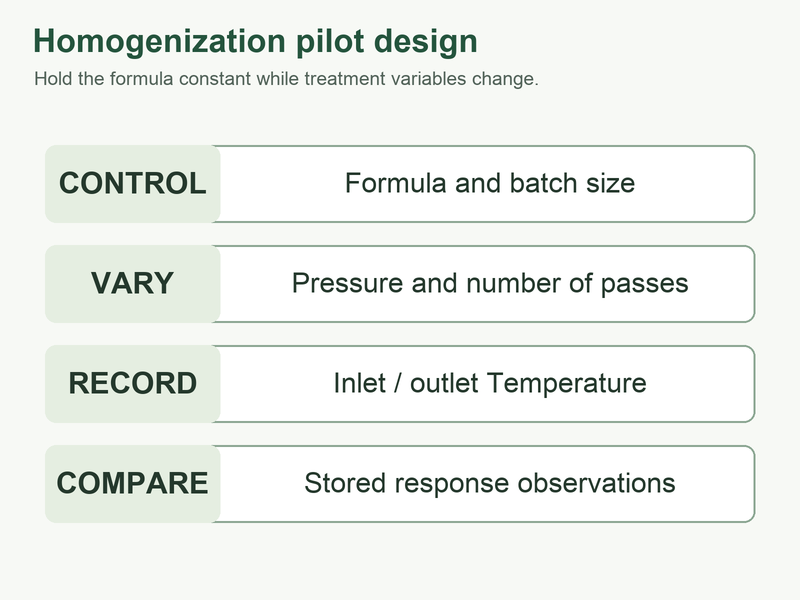
Test pressure and pass count as distinct factors. Use a control and a small, equipment-feasible pressure range, then compare one pass with an additional pass only where the machine and thermal plan allow it. Randomize or otherwise control run order, and collect replicate evidence rather than relying on one bottle from each condition.
Original mixed-juice research crossed 25, 100, 140, and 180 MPa with one or two passes and two inlet temperatures. That study is useful for trial design because it separates factors. Its results do not predict the correct matcha setting: the juice matrix, equipment, and objectives differ. Pressure ranges must come from the intended machine and a safe pilot plan, not from copying this study.
| Module | Hold constant | Change deliberately | Record for every run |
|---|---|---|---|
| Pressure screen | Formula, feed preparation, pass count, inlet target | Pressure | Actual pressure, flow, temperatures, sample order |
| Pass screen | Formula, chosen pressure, inlet target | One versus additional pass | Residence sequence, temperatures, total exposure |
| Confirmation | Selected setting and full process | Replicate run or lot | All settings, deviations, analytical and sensory results |
Higher pressure or another pass may improve a selected physical measure, but it also increases process severity, energy use, heat load, and equipment demand. Select the lowest condition that meets the whole acceptance set.
Key Takeaway: Cross pressure and pass count deliberately; do not treat repeated passes as simply “more pressure.”
Why Must Inlet and Outlet Temperature Be Recorded?
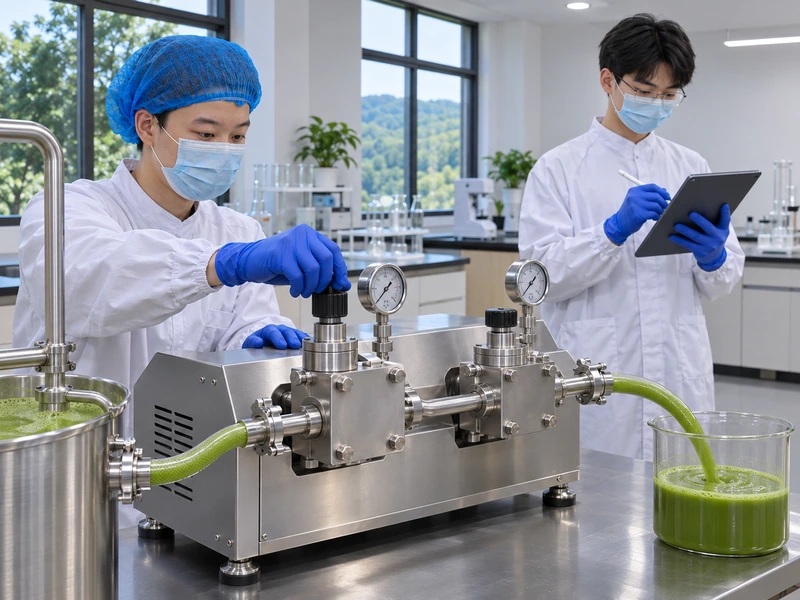
Homogenization can raise product temperature, and temperature can alter viscosity, flavour, colour, proteins, stabilizers, and the behavior of particles or droplets. Recording pressure without the actual inlet and outlet temperatures leaves a major part of the treatment undefined. A nominal cooling setpoint is not a product temperature measurement.
Set an inlet-temperature target and record the observed outlet temperature for each pass. If multiple passes are used, state whether the product is cooled between passes. In an original beetroot-juice study, investigators cooled every cycle to restore an inlet temperature of 20.5 ± 0.5 °C while comparing 50, 100, and 140 MPa over one or three cycles. That is a concrete thermal-control model for experimental attribution, not a temperature or pressure specification for matcha.
There is a practical tradeoff between throughput and thermal control. Slower flow or added cooling capacity may keep the comparison clean, while maximum throughput can allow temperature to drift and blur the pressure effect. During early trials, favor interpretable data. Throughput optimization can follow after a workable window is found.
Key Takeaway: Treat inlet temperature, outlet temperature, and between-pass cooling as controlled process variables.
Where Should the Homogenizer Sit in the Process Sequence?
Equipment order determines what reaches the homogenizer and what happens afterward. Record powder wetting, hydration time, mixing, filtration or screening, preheating, homogenization, heat treatment, cooling, and filling in their actual order. Moving homogenization before or after a heating step can change feed viscosity, microbial-control integration, and the meaning of the trial.
Keep upstream preparation constant during the operating screen. If one batch enters with dry pockets and another is uniformly wetted, the test is comparing feed preparation as well as homogenization. The same applies to stabilizer hydration, fat melting, dissolved solids, pH, and hold time.
Hold matcha grade and lot constant too. AdoroHu identifies E-1 and E-2 as Culinary grades and E-3 and E-4 as Premium grades. Those labels distinguish ingredient options; they do not predict which grade will perform best in a beverage. Changing from one grade or lot to another during a pressure screen would confound the ingredient change with the operating-setting effect.
For beverage teams choosing matcha powder for RTD formulation, the supplier conversation should capture intended formula, heat process, package, shelf conditions, and available equipment. A powder selection can support the process, but it cannot replace pilot validation on the finished matrix.
Key Takeaway: Freeze the upstream feed preparation and document the full equipment sequence before comparing settings.
Which Measurements Belong in the Pilot Data Sheet?
The data sheet should join process conditions to immediate and stored-product results. At minimum, record formula version, ingredient lots, batch size, solids or other relevant composition checks, pre-mix method, machine identity, valve or stage configuration, pressure, pass count, flow, inlet and outlet temperatures, cooling, sample point, and any deviation.
Evaluate the outcomes that matter to the drink. These may include particle or droplet distributions, viscosity at a defined method and temperature, colour values, visible separation, sediment amount and character, redispersion method, flavour, and mouthfeel. Safety and shelf-life validation remain separate required programs; physical stability alone does not establish either.
The beetroot study shows why colour needs numbers rather than a visual adjective. Reported ΔE values were 0.13–0.17 after one cooled cycle and 0.29–0.43 after three cooled cycles; uncooled 140 MPa treatments reached 0.69 and 0.94 for one and three cycles. These values belong to beetroot juice and do not predict a matcha result or define an acceptable ΔE limit. They demonstrate that pass count and cooling can measurably change the outcome being compared.
| Evidence group | Immediate checkpoint | Stored checkpoint | Decision use |
|---|---|---|---|
| Process | Actual settings and temperatures | Not applicable | Confirms what treatment occurred |
| Physical | Distribution, viscosity, initial appearance | Creaming, sediment, aggregation, redispersion | Tests stability of emulsion and suspension |
| Sensory | Colour, flavour, texture | Change against control | Detects damage hidden by physical measures |
| Execution | Sample identity and deviations | Storage time, temperature, orientation | Makes comparisons traceable |
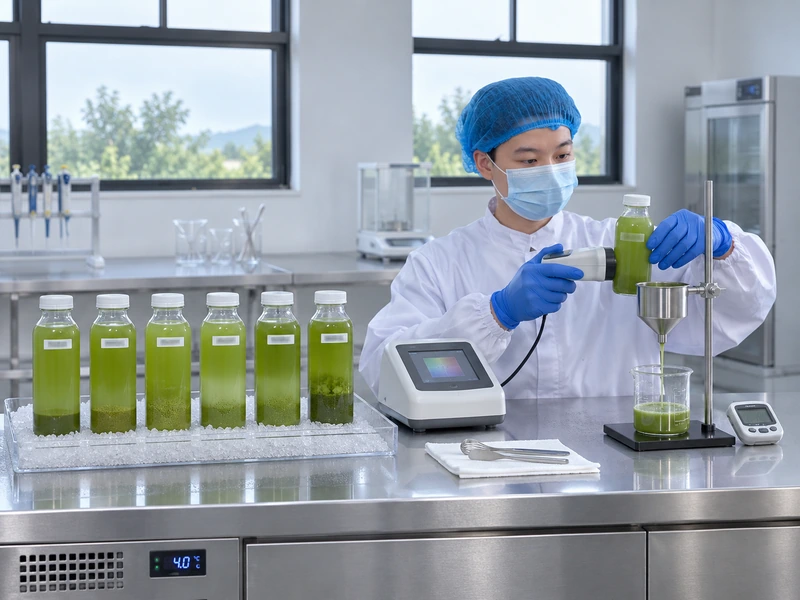
Define storage time and temperature before the trial, because a fresh reading alone cannot describe later separation or deposit character. The selected checkpoints must fit the intended product and distribution study; a short physical screen is not an adequate shelf-life protocol for a commercial matcha drink.
Key Takeaway: Connect actual operating conditions to immediate, stored, physical, and sensory evidence.
How Can the Team Protect Data Quality During Trials?
Protect data quality by controlling sample identity, order, replication, instruments, and deviations. Use unique run codes and preserve the link between every bottle and its formula, machine condition, sampling point, and storage position. Calibrate or verify instruments as appropriate, define measurement methods in advance, and avoid choosing only the best-looking bottle.
Run-order effects deserve attention. A machine warming during the day, progressive valve wear, incomplete cleaning, or a changing feed tank can make the last setting look different for reasons unrelated to pressure. Use a planned sequence, stabilize the machine, document flush and hold conditions, and include a repeat condition when feasible.
The team should predefine how to handle a blocked valve, temperature excursion, delayed sample, or mislabeled bottle. Excluding a result after seeing it invites bias. A deviation may justify repeating the condition, but both the event and the decision should remain visible.
Key Takeaway: A traceable run code and predefined deviation rule are as important as the instrument reading.
How Should Pilot Settings Transfer to Production Scale?
Scale transfer should compare equipment and process conditions rather than copy pressure alone. Record homogenizer type, stage arrangement, valve geometry where available, rated flow, actual flow, feed temperature, outlet temperature, cooling, number of passes, and sampling location. Two machines displaying the same pressure can deliver different residence, shear, heat, and distribution outcomes.
Confirm the candidate setting on production equipment with the same acceptance measures used in the pilot. Include startup, steady-state, and credible operating variation if these states can affect product. Define an operating window and action logic, not just a single center point that may be difficult to hold.
Powder-production equipment descriptions do not establish a liquid pressure-homogenizer rating. Beverage developers should document the actual co-manufacturer or pilot equipment used for their formula.
Key Takeaway: Transfer a measured process window and acceptance set, not a pressure number detached from the machine.
When Should a Team Stop Increasing Process Severity?
Stop increasing severity when the selected condition meets the full acceptance set and a more severe condition adds no meaningful benefit or worsens another important result. For example, a higher pressure may reduce visible separation while increasing temperature, dulling colour, changing flavour, or demanding more cooling and energy.
Use a decision matrix with must-pass criteria and ranked preferences. Must-pass items might include defined limits for separation, deposit, sensory change, and execution. Preferences might include lower energy, fewer passes, easier cooling, higher throughput, or a wider operating window. Do not average away a critical failure with several attractive secondary scores.
This is the second core tradeoff: maximum physical refinement versus product quality, cost, and manufacturing resilience. The right setting is rarely the highest available setting. It is the least severe repeatable condition that meets the business and product requirements.
Key Takeaway: Approve the lowest repeatable severity that passes every critical requirement.
What Evidence Should a Matcha Beverage Buyer Request?
A buyer should request the formula-specific process summary, machine identity, operating window, actual temperature records, pass sequence, and acceptance results. The evidence should show how the selected matcha and finished matrix behaved after the stated storage challenge, including both emulsion and suspension observations where relevant.
Ask which variables were held constant, how many independent runs supported the window, what deviations occurred, and what changes trigger revalidation. A supplier certificate or a powder particle-size value cannot prove finished-beverage homogenization performance. Likewise, research from juice, beetroot, carrot, or strawberry matrices can guide an experiment but cannot serve as the buyer’s matcha specification.
The review should also show who approved the formula version, which sample represented the production target, and whether storage bottles came from startup or steady-state flow. When a co-manufacturer proposes a setting change, compare it against the same critical measures and document the reason before accepting the revised window.
This record makes later deviations easier to investigate and repeat trials easier to compare.
Key Takeaway: Request a traceable formula-and-equipment trial package, not a generic promise that matcha “homogenizes well.”
FAQ
- What pressure should be used for matcha beverage homogenization?
- There is no universal matcha pressure in the cited evidence. Select an equipment-feasible range, hold the formula and inlet conditions constant, and choose the lowest repeatable setting that meets physical and sensory acceptance criteria.
- Does a second homogenization pass always improve stability?
- No. Another pass increases total treatment and heat load and may improve one measure while worsening colour, flavour, viscosity, or throughput. Test pass count as a separate factor.
- Is homogenization the same as dissolving matcha?
- No. Whole-leaf matcha contains insoluble particles and forms a suspension. Homogenization can change dispersion and particle behavior, but it does not make the leaf material molecularly soluble.
- Why record both inlet and outlet temperature?
- The temperature rise describes part of the actual treatment and can affect viscosity, colour, flavour, stabilizers, proteins, and physical stability. A pressure value alone is incomplete.
- Can juice homogenization research define a matcha specification?
- No. Non-matcha studies provide matrix-dependent trial-design evidence. Their numerical results must be confirmed in the actual matcha formula on the intended equipment.
- How should a pilot condition be transferred to a production homogenizer?
- Compare machine type, stage arrangement, flow, temperatures, cooling, pass count, and product results, then confirm the operating window on production equipment instead of copying pressure alone.
Conclusion
Beverage homogenization becomes a defensible scale-up decision when the team separates the physical problem, controls the formula, records the complete treatment, and judges stored product against predefined criteria. Beverage developers can contact AdoroHu to discuss matcha grade, application requirements, and the evidence needed for a formula-specific pilot.