
A carton compression test becomes useful when it measures the finished export carton under defined conditions and feeds a clear shipping decision. A peak force without carton construction, conditioning, load direction, and failure criteria cannot protect matcha through stacking and distribution.
For B2B buyers, the problem starts when a board certificate is treated as proof of a complete case. Match the test plan to the filled pack, pallet pattern, storage exposure, and actual handling route, then connect results with the matcha transport-temperature review rather than blending separate risks into one number.
A carton compression test measures how a specified carton or unit load responds to compressive force. The result belongs to the tested design, materials, contents, orientation, conditioning, and method. Use it to compare or accept defined configurations, not to declare a universal stack height.
In short:
Key points:
- Test the complete carton configuration that will enter distribution.
- Record conditioning, platen method, deformation, and failure mode with peak load.
- Translate the result into a route-specific acceptance decision and change-control trigger.
What does a carton compression test tell a matcha buyer?
A carton compression test shows the compressive response of a defined carton configuration under a defined loading method. It can support design comparison, production acceptance, or investigation, but the report must state which job it is doing.
| Test question | Useful output | Buyer decision |
|---|---|---|
| Which design carries more load? | Comparable force-deformation results | Select a prototype for route trials |
| Is production consistent? | Lot results against an approved method | Accept, hold, or investigate cartons |
| Why did a stack deform? | Failure location and deformation pattern | Correct board, conversion, filling, or pallet support |
A high peak alone can hide early bulging, corner damage, or unacceptable deformation. Ask for the force-deformation trace and observed failure mode, because usable performance may end before complete collapse.
Key Takeaway: Define the decision first, then require the compression output that answers it.
Why must carton compression testing use the finished package design?
Carton compression testing should represent the finished design because board, dimensions, joints, print and converting, contents, and internal support act together. A material data sheet cannot recreate those interactions.
ISO 12048:1994 specifies compression and stacking tests for complete, filled transport packages using a compression tester. That scope supports testing the actual pack, while the standard abstract does not supply an AHM force limit, sample count, or stacking factor.
AdoroHu’s approved bulk formats include 10 kg and 20 kg cartons with sealed food-grade liners. Those two fill roles may create different loads and support conditions, so neither format inherits the other’s carton result automatically.
Key Takeaway: Bind every result to the exact carton, contents, closure, and fill configuration tested.
How do ECT and a box compression test differ?
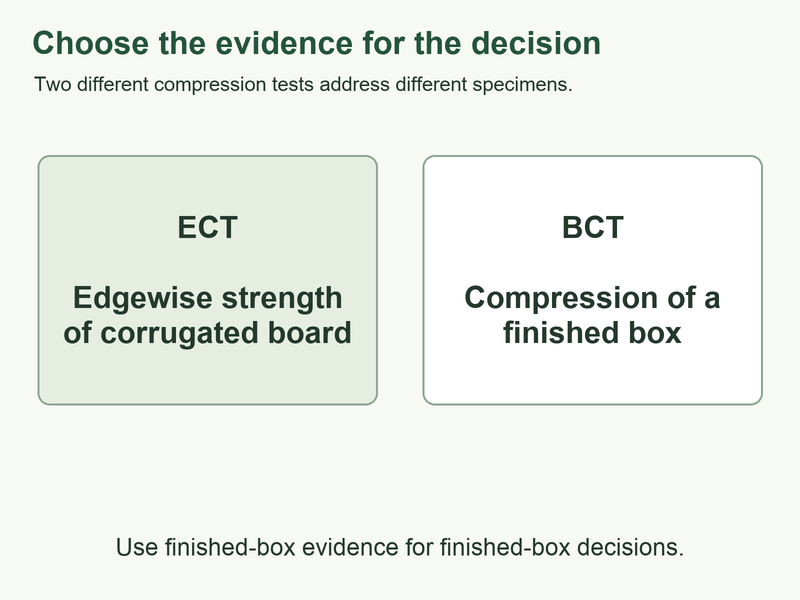
ECT measures edgewise compression of corrugated board, while a box compression test measures a finished box or unit under compression. The values are related inputs, not interchangeable acceptance results.
Board grade helps a carton supplier develop a design. Finished-box performance also changes with flute orientation, panel dimensions, score lines, joints, converting damage, and support from the packed product. That is why a formula or ECT value can screen concepts but cannot replace physical validation.
For buyers sourcing wholesale matcha, keep the carton specification beside the product and liner configuration. This prevents a board substitution from passing unnoticed when the finished case is the controlled shipping unit.
Key Takeaway: Use ECT for board-level evidence and BCT for the approved finished-carton configuration.
How should compression-test conditioning reflect warehouse humidity?
Carton conditioning should reproduce the temperature and relative-humidity state required by the selected method and distribution question. Corrugated fiberboard responds to moisture, so unrecorded conditioning can make carton compression test results incomparable.
ASTM D4332 provides standard and special conditioning atmospheres for packages and components to simulate field conditions. Its public scope says cellulosic materials change physical properties with temperature and relative humidity, and specimens should approach equilibrium so measurements are meaningful and reproducible. Record the chosen atmosphere and duration; one laboratory condition does not represent every route.
Use the separate matcha warehouse-humidity framework to map real exposure. Then choose representative laboratory conditions without claiming that one humidity reproduces every warehouse or lane.
Key Takeaway: Record and control carton moisture history before comparing compression results.
Which carton compression test method should the protocol name?
The protocol should name the test standard, current edition, loading mode, orientation, platen settings, endpoint, and reporting units. “Run a BCT” leaves too much room for laboratories to produce different answers.
ASTM D642 covers compressive resistance of shipping containers, components, and unit loads, and its public scope allows comparison of defined container designs. The public abstract does not establish a universal acceptance value, so the buyer must approve method details and pass criteria separately.
| Protocol field | What to lock | Why it matters |
|---|---|---|
| Specimen identity | Drawing revision, board code, joint, print, fill | Prevents mixed configurations |
| Load setup | Orientation, platen mode, preload, speed | Controls how force is applied |
| Endpoint | Peak, deformation, failure event, hold condition | Aligns output with the decision |
| Report | Trace, peak, displacement, failure images | Makes anomalies reviewable |
Key Takeaway: Cite a method and specify its options; the standard name alone is incomplete.
How should top load and pallet support enter compression-test acceptance?
Carton acceptance should begin with the load carried by the lowest case, then account for how the pallet and neighboring cartons share that load. A carton compression test result cannot be converted directly into stack height without route and support evidence.
Column alignment, interlocked patterns, pallet-deck gaps, overhang, stretch wrap, dividers, and product support can change load paths. Storage time and humidity can also reduce usable performance. Model these inputs explicitly, then confirm the chosen palletized configuration through appropriate distribution validation.
Avoid a generic safety factor copied from a supplier article. Its apparent simplicity hides route duration, environment, handling, and the consequence of failure.
Key Takeaway: Base acceptance on the real stack system, not a carton value viewed in isolation.
What sample plan makes box compression results credible?
A credible sample plan represents normal production variation and states how specimens were selected. Box compression results from hand-picked prototypes do not establish routine converting consistency.
Define lots, lines or converting runs, specimen condition, exclusions, repeats, and treatment of invalid tests before testing begins. Record board and adhesive identity, dimensions, joint quality, score alignment, and visible damage so a weak result can be traced.
The correct quantity depends on the validation objective, variation, risk, and chosen method. Do not import another test configuration’s sample plan as a universal rule.
Key Takeaway: Approve selection and invalid-test rules before anyone sees the first result.

How should a carton compression test pass limit be set?
A carton compression test pass limit should connect the expected distribution load with an approved margin and validated package performance. It should not be copied from another carton, a generic calculator, or a material certificate.
| Evidence input | Decision use | Guardrail |
|---|---|---|
| Expected static load | Establishes the base demand | Confirm actual case count and load path |
| Route and storage exposure | Identifies performance losses | Keep temperature, humidity, and duration scoped |
| Physical BCT distribution | Shows design and production variation | Use the approved configuration only |
| Pallet or distribution trial | Checks system behavior | Do not substitute it with BCT alone |
Set both action and disposition rules: pass, conditional review, hold, or reject. A borderline result needs a named owner and escalation path, not an improvised shipment decision.
Key Takeaway: Derive the limit from documented load and validation evidence, then control it by revision.
What should QA investigate after a failed compression test?
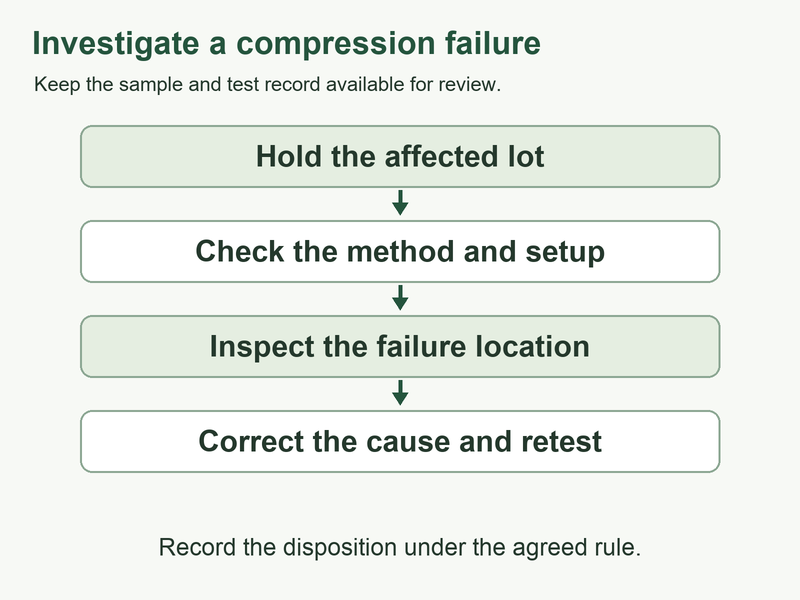
QA should contain the affected carton lot, confirm the test validity, and separate material, conversion, filling, conditioning, and handling causes. Repeating until one specimen passes obscures the failure instead of explaining it.
Review equipment calibration, specimen identity, platen alignment, conditioning records, and invalid-test criteria first. Then inspect board code, caliper, scores, slots, joint, adhesive, dimensions, fill support, and damage patterns. Compare retained samples or an approved reference where available.
AdoroHu’s in-house physical-chemical laboratory capability can support product-side investigation under approved methods. It does not replace a qualified packaging laboratory or prove a carton strength target.
Key Takeaway: Confirm method validity, contain the lot, and investigate the physical failure path before retesting.
When should carton compression testing be repeated?
Carton compression testing should be reconsidered when a change could alter strength, load path, or distribution exposure. Change control protects the meaning of the approved result.
Triggers can include board or supplier changes, dimension revisions, joint or adhesive changes, new printing or converting, different fill weight, liner or dunnage changes, pallet-pattern changes, and a new route or warehouse climate. The review may justify document-only assessment, targeted testing, or full requalification.
For private-label programs, place carton drawings, test methods, limits, and notification duties in the matcha private-label specification. This keeps artwork, packing, and procurement changes connected to the validated shipping unit.
Key Takeaway: Repeat or justify testing whenever a change can disturb the tested configuration or load environment.
FAQ
- What is a carton compression test?
- It applies controlled compressive force to a defined carton, package, or unit load and records its force-deformation response under a named method.
- Is ECT the same as a box compression test?
- No. ECT measures edgewise compression of corrugated board, while a box compression test measures the response of a finished box or defined unit.
- Can a BCT result determine maximum stack height by itself?
- No. Stack decisions also depend on case count, load sharing, pallet pattern, humidity, storage time, handling, and an approved performance margin.
- Should a carton be empty or filled during compression testing?
- Follow the named protocol and decision objective. When finished-pack performance is the question, use the approved complete configuration or a justified equivalent support condition.
- How many cartons should be tested?
- Set the quantity from the method, validation objective, production variation, and risk. A single universal sample count is not defensible.
- What should happen when a carton fails the test?
- Contain the affected lot, confirm test validity, inspect the failure path, investigate material and process causes, and apply the pre-approved disposition rule.
Conclusion
A useful compression program links the tested carton to real contents, conditioning, stacking, and distribution decisions. Keep method options, traces, failure images, and revisions with the specification so the result survives supplier and design changes. Contact AdoroHu Matcha to align bulk format, private-label packing, and export-carton evidence for your project.