
Matcha transport temperature should be managed through a lane-specific exposure map, calibrated monitoring, package evidence, and a documented receiving decision. A peak reading alone does not show how long product was exposed, where the logger sat, or whether the sealed powder changed. Buyers using wholesale matcha supply should define the evidence before shipment.
Map the route, seasons, dwell points, and pallet positions before placing loggers. Reconstruct an excursion from timestamps, package condition, and handoffs. Release, test, reject, or claim only after comparing the exposure with relevant product evidence.
In short: Transport temperature decisions need lane context, traceable logger data, package inspection, and product assessment.
Key points:
- Design monitoring for the lane instead of placing one logger wherever convenient.
- Keep unopened product under control while receiving evidence is collected.
- Compare an excursion with relevant stability work and controls without inventing universal limits.
What product and shipment attributes define transport risk?
Risk depends on matcha grade, pack size, liner and carton, pallet pattern, shipment duration, transport mode, season, route, and intended shelf life. The same air-temperature event can produce different product temperatures in an outer carton and a pallet centre.
Record product lot, manufacture or pack date, pack construction, case count, pallet layout, container, route, handoffs, and planned storage on arrival. Tie the decision to the quality endpoints used in matcha shelf-life validation.
Key Takeaway: Define the shipped product and route before defining monitoring or acceptance evidence.
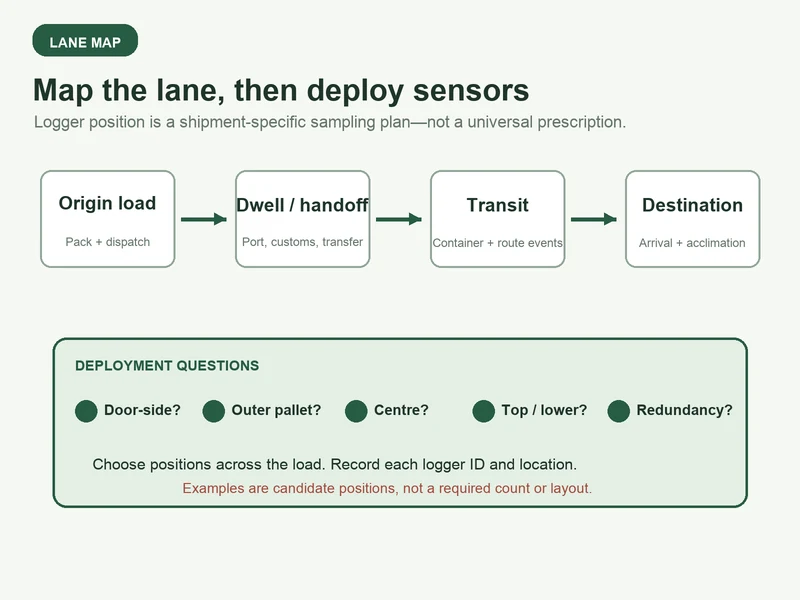
Which lane, season, dwell, and container events should be mapped?
Map origin loading, port or airport dwell, customs, transshipment, container yard, inland transfer, weekend holds, and destination unloading. Include plausible high and low seasonal conditions and direct sun exposure.
| Event | Possible exposure | Planning response |
|---|---|---|
| Origin loading | Warm staging or rain | Limit dwell and protect pallets |
| Port or yard | Solar heating and long hold | Review season and container position |
| Transshipment | Repeated door opening | Preserve seal and custody records |
| Destination | Cold-to-warm transition | Stage sealed product before opening |
Key Takeaway: The lane map identifies where monitoring and preventive controls can answer a real decision.
Where should temperature and humidity loggers be placed?
Place loggers to capture meaningful variation, such as door-side, outer pallet, centre pallet, top, and lower positions where justified by shipment size and risk. One device beside a door may record container air but not the product core.
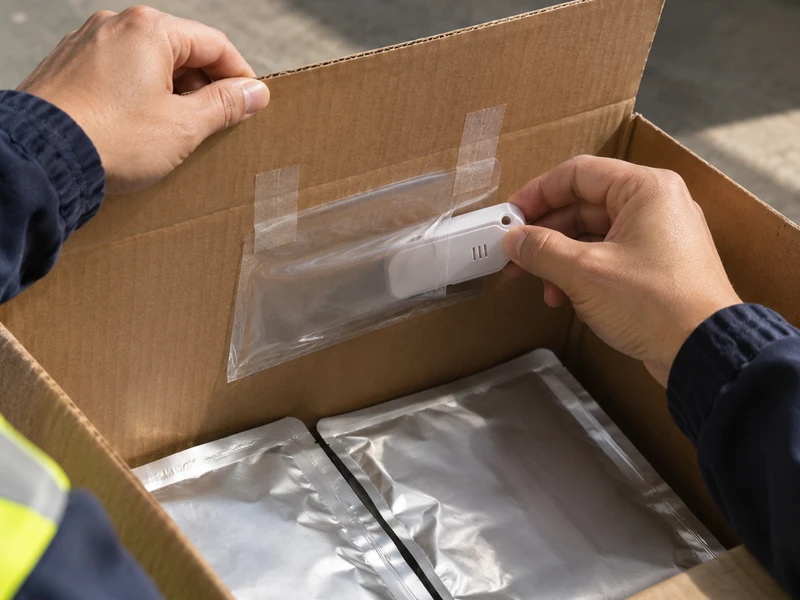
Use calibrated, uniquely identified devices with a suitable range, interval, clock, battery, and tamper controls. Document placement with a pallet diagram and photograph. Humidity data can support condensation and package investigations, but only when sensor limitations are understood.
WHO's technical supplement on transport monitoring requires devices in its pharmaceutical scope to be qualified for the intended operating environment and calibrated over the intended operating range, with calibration traceable to a recognized standard. Used here as a method principle, a matcha shipment logger should have calibration evidence covering the temperatures it is expected to measure. The supplement's pharmaceutical performance requirements are not transferred to matcha.
Practitioner decision: do not choose logger quantity from habit. Choose positions that can distinguish product exposure across the actual load.
Key Takeaway: Logger placement is a sampling plan for the shipment’s thermal variation.
What records must travel with the shipment?
Preserve packing list, lot and pallet map, logger IDs and locations, calibration status, dispatch time, container and seal identifiers, route, carrier handoffs, and special handling instructions. Receiving needs access to these records before stock is released.
Maintain chain of custody for downloaded files. Keep the original export, software version, timezone, and any edited analysis separate. If clocks differ, reconcile them without overwriting raw evidence.
The WHO supplement also treats recording frequency as a decision based on logger capacity and expected transport period and requires documentation that can be stored and accessed. Applied here as a method principle, the sampling interval must be short enough to resolve the events the matcha buyer plans to evaluate while preserving the original record.
Key Takeaway: A temperature trace is useful only when it can be tied to product, place, and time.
How should packaging and secondary protection affect the assessment?
Packaging changes heat transfer, moisture exposure, physical protection, and oxygen ingress. Cartons and pallet wrap may slow short air changes, while a damaged liner can increase the consequence of humid exposure.
Use the matcha packaging guide to document each protective layer. Inspect corner crush, punctures, wet cartons, torn wrap, broken seals, odour, and contamination at receiving.
AdoroHu's approved bulk configuration is 10 kg or 20 kg per carton with a sealed food-grade liner. That first-party fact identifies the supplied protection layers the receiver should inspect. It does not validate a lane, prove temperature control, or support release after damage.
Key Takeaway: Assess temperature data beside the package condition that mediated the product exposure.
What receiving checks should occur before stock is moved or opened?
Quarantine the shipment as required, verify container and seal identity, photograph the load, inspect pallets and packages, retrieve loggers, and record receiving temperature and conditions. Keep cold product sealed while it acclimates where condensation is possible.
Do not discard packaging or move every pallet before documenting location-specific observations. Escalate visible water, odour, infestation, contamination, or tampering under the applicable receiving procedure.
Key Takeaway: Preserve location and condition evidence before routine warehouse movement erases it.
How should excursion duration and conditions be reconstructed?
Reconstruct start, peak, duration, recovery, repeated cycles, and the positions affected. Compare logger timestamps with route and handoff records.
Separate air temperature from estimated or measured product temperature. Consider logger response, placement, missing data, timezone, calibration, and whether a device sat against a wall or heat source. Avoid reducing a complex profile to the maximum value.
Key Takeaway: Review the complete trace and its measurement context, not one peak screenshot.
Which product checks may be relevant after an excursion?
Relevant checks may include package integrity, powder appearance, colour, aroma, sensory profile, flow, clumping, moisture content, water activity, dispersion, and performance in the intended application. Choose checks that address the plausible failure mechanism.
| Check | Possible use | Boundary |
|---|---|---|
| Colour and sensory | Compare quality with control | Does not prove safety or cause alone |
| Moisture or water activity | Investigate humid exposure | Method and sampling matter |
| Application test | Confirm fitness for intended use | Must use a controlled formula |
| Package integrity | Identify barrier damage | Intact appearance may need further evidence |
Key Takeaway: Test what the exposure could plausibly change and what the disposition decision needs.
How should control and retained samples be used?
Use traceable retained samples and unaffected units to distinguish shipment effects from normal lot variation or test noise. Confirm that controls were stored under documented conditions.
Blind or code sensory and application comparisons where practical. Sample across affected positions rather than taking one scoop from the easiest carton. Preserve unopened units for later review if the decision remains uncertain.
Key Takeaway: Controls make change interpretable only when their identity and storage are trustworthy.
When can shelf-life evidence support release?
Existing shelf-life evidence can support release when the shipped product, package, exposure range, duration, checkpoints, and quality endpoints are sufficiently relevant. Extrapolation beyond the evidence needs qualified review or new testing.
An original 2026 study stored matcha at water activities from 0.11 to 0.93 under light-shielded or continuous laboratory LED exposure of about 450–500 lx. It reported faster degradation of measured compounds under higher water activity and light. This is useful evidence for moisture-and-light mechanisms, but it did not reproduce a freight lane and does not establish a universal transport-temperature limit. The public scope of ISO/TR 21380:2022 helps define matcha characteristics but does not supply route acceptance criteria.
Key Takeaway: Use stability evidence only inside its demonstrated product, package, condition, and endpoint boundary.
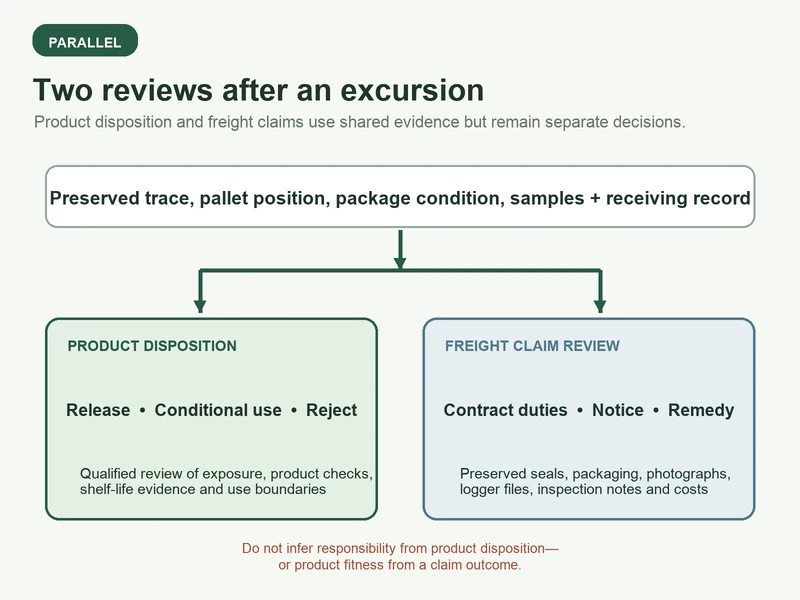
Who decides release, conditional use, rejection, or a claim?
The organization’s authorized quality role should decide disposition with input from logistics, procurement, technical, supplier, insurer, or carrier as needed. Commercial urgency should not bypass evidence review.
Release when evidence supports fitness for the intended use. Conditional use needs a defined application and traceability. Reject when the product is unsuitable or uncertainty exceeds the company’s acceptance standard. File a claim with preserved contemporaneous evidence and contract terms.
Practitioner decision: keep the disposition and claim decisions linked but distinct. A carrier dispute does not determine product suitability, and usable product does not erase a service failure.
Key Takeaway: Record decision authority, evidence, affected scope, and next action.
What CAPA should change the next shipment plan?
Corrective and preventive action should address the confirmed or most credible cause: route, season, booking, dwell, container type, pallet placement, package protection, logger plan, handoff, receiving, or communication.
Assign an owner and effectiveness check. The next shipment should test whether the revised control reduced exposure or improved decision evidence. Keep raw traces so lane performance can be compared over time.
Create a lane file that stays stable across shipments. It should contain the approved route and alternates, seasonal risk review, forwarder instructions, container or service choice, pallet diagram, logger plan, package specification, escalation contacts, receiving checklist, and disposition authority. Shipment-specific records then show what changed from this baseline.
Review data gaps as evidence failures. A logger that never started, disappeared, exceeded its range, lost its clock, or cannot be tied to a pallet leaves a different decision than a complete passing trace. Decide in advance whether redundant devices, carrier data, container telematics, or product testing can address each gap. Do not reconstruct missing values from assumption.
Use a written sampling plan after an excursion. Select units from positions linked to the most severe trace, intermediate positions, and a credible control. Preserve unopened reserve units, identify every sample, and avoid pooling before local differences are understood. This is especially important when only outer pallets show package damage or heat exposure.
Conditional use needs a tight boundary. Name the product, quantity, intended application, destination, additional controls, shorter review period if justified, and traceability requirement. A release for one validated food application should not silently become general approval for every customer or remaining shelf life.
Claims preparation should begin at receiving, while positions and damage are visible. Preserve seals, packaging, photographs, logger files, inspection notes, carrier notices, and costs according to contract requirements. Keep factual observations separate from conclusions about responsibility until the evidence review is complete.
Trend lanes by event type rather than only by pass or fail. Repeated port dwell, solar heating, customs delays, door openings, wet cartons, missing devices, and slow receiving each suggest different prevention. Compare revised shipments with the same decision-relevant measures to show whether CAPA improved control.
Agree on notification timing with the supplier, forwarder, carrier, warehouse, and quality team. Early notice can preserve seals, container positions, and third-party records that disappear after unloading.
Run a short post-shipment review even when the load passes. Confirm that devices were recovered, placement matched the plan, files are readable, receiving followed the checklist, and emerging route changes do not require a new seasonal assessment.
Key Takeaway: CAPA closes when the revised lane control is implemented and shown to work.
FAQ
- What temperature should matcha be transported at?
- Set transport conditions from the specific product, pack, route, duration, and validated quality evidence rather than a universal number.
- Does one high logger reading mean the matcha must be rejected?
- No. Review duration, position, device evidence, package condition, product exposure, and relevant stability data before disposition.
- How many temperature loggers does a shipment need?
- Use enough qualified devices and positions to represent decision-relevant variation across the load and lane risk.
- Should matcha be opened at receiving for inspection?
- Inspect shipping and package condition first, and keep cold matcha sealed during acclimation to avoid creating condensation exposure.
- Can sensory testing release a temperature-exposed lot?
- Sensory testing may support a quality decision, but it cannot answer every safety, moisture, package, or shelf-life question on its own.
- What evidence supports a freight claim?
- Preserve raw logger files, calibration and placement records, timestamps, handoffs, photographs, package condition, lot scope, inspection results, and contract records.
Conclusion
A defensible matcha transport temperature decision combines lane design, representative monitoring, careful receiving, and product evidence. For shipment planning or post-excursion sample review, contact AdoroHu Matcha.
Institutional Author
AdoroHu Matcha