
Composite sampling works for incoming matcha when the pooled result answers the buyer’s decision without hiding unacceptable variation between bags. A cheap average can become an expensive mistake if one wet, contaminated, or mislabeled unit disappears inside a passing composite.
For buyers comparing premium matcha powder, the practical composite sampling problem is not whether pooling is convenient. It is whether the lot definition, increment pattern, analytical method, and release rule make the result fit for its stated purpose.
Composite sampling combines defined analytical units into one tested mixture, so it estimates an average across the material included. Use it only when the method permits pooling and an average supports the decision. Keep individual identities or separate tests when a local defect, unit-to-unit variation, or traceability question could change acceptance.
In short:
Key points:
- Define the lot and decision before choosing a pooled or individual test.
- Confirm that the analyte method permits the proposed composite size and preparation.
- Preserve enough unit identity to investigate variation, failures, and supplier action.
What decision should composite sampling support for an incoming matcha lot?
Composite sampling should support one written decision, such as estimating average composition or screening a defined lot with a method that allows pooling. The decision determines the lot, sample units, increment mass, laboratory preparation, and action after a result. Without that sequence, a composite result can look precise while answering the wrong question.
Start by writing the decision in operational language: release the lot, hold it for more testing, compare its average nutrient value, or investigate a suspected defect. Then name the unit that can fail. A shipment may contain pallets, cases, bags, or production sublots, and those units do not carry equal risk.
This matters because a passing average cannot prove every bag passes. If the purchase specification applies to each package, pooling may remove the evidence needed to enforce it. If the specification applies to the lot average, separate tests may add cost without changing disposition.
| Buyer decision | Useful sample design | Main limitation |
|---|---|---|
| Estimate average composition | Representative composite may fit | Local extremes disappear into the mean |
| Detect a heterogeneous defect | Individual or stratified units | More analyses and higher laboratory cost |
| Release against a method-specific pathogen plan | Follow that method exactly | Results apply only to the sampled lot and method |
| Investigate one suspect package | Keep and test its identity separately | Result cannot describe the whole lot |
The practical recommendation is to choose the cheapest design that can still detect the failure that would change your decision. Avoid pooling merely to reduce test fees; a false release can cost more than the extra individual analyses.
Key Takeaway: Write the acceptance question first, then select the composite design that can answer it without erasing decision-critical variation.
How should a buyer define the lot before composite sampling begins?
A buyer should define a lot as material produced under stated, traceable conditions that can be sampled and acted on as one decision unit. The lot description should connect production code, date or run, supplier batch, package count, location, and any sublot boundaries. A warehouse receipt number alone rarely proves production uniformity.
Now the consequence becomes concrete. If two production runs share one shipping document but differ in raw material, cleaning changeover, or packaging time, one pooled sample can blur a real process break. The laboratory result then cannot show which run needs a hold or corrective action.
Record exclusions as carefully as inclusions. Damaged bags, wet cartons, broken seals, or units stored apart may need separate handling rather than silent removal from the sampling frame. The pre-shipment inspection guide belongs upstream of this decision because package condition and document identity affect which units can represent the shipment.
Key Takeaway: A defensible composite starts with a traceable lot boundary; do not pool across a production break merely because the goods arrived together.
How should individual matcha sample units be selected for a composite?
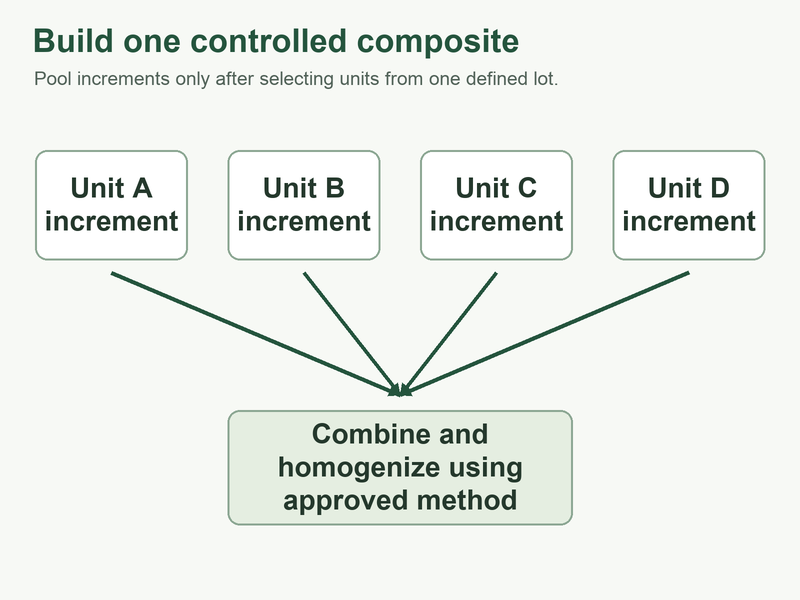
Individual sample units should be selected through a documented random or risk-based pattern that covers the lot rather than the easiest bags to reach. Locations across pallets, layers, package positions, and time segments may matter when settling, moisture exposure, filling order, or handling can create gradients.
The FDA BAM food-sampling chapter describes random sample units intended to represent a lot in its stated regulatory context. That principle has an immediate buyer consequence: convenience samples from the front row can miss defects concentrated at the back, bottom, or end of a filling run.
A workable field record names every selected package, the selection method, increment location, sampler, time, tool, and seal. When risk is uneven, use a stratified plan and state why. For example, sample each pallet stratum before random selection within it rather than pretending all positions have equal exposure.
Key Takeaway: Spread documented sample units across the actual lot structure; access convenience is not evidence of representativeness.
When does composite sampling hide unacceptable variation?
Composite sampling hides unacceptable variation whenever a high and low unit can average into a passing result while either unit would matter on its own. Moisture pockets, localized contamination, inconsistent color, foreign material, and package-specific mix-ups are common examples of failures that an average may dilute or conceal.
Here is the trade-off: compositing reduces analytical cost and can improve the estimate of a lot mean, but it sacrifices information about dispersion and unit identity. Choose individual or staged testing when finding the source unit matters. Choose a composite when average composition is the real decision and the lot is reasonably homogeneous.
One useful staged approach preserves the original units while initially testing a permitted composite. If the composite triggers an alert, retained individual units remain available for follow-up. This costs more in sample handling and storage but protects the root-cause path.
| Variation pattern | What a composite may show | Better follow-up |
|---|---|---|
| One wet bag among dry bags | Acceptable average moisture | Test preserved bags separately |
| Broad lot-wide shift | Similar shift in composite | Confirm method and repeat representative sampling |
| One mislabeled or wrong-grade bag | Blended result with weak signal | Preserve package identity and sensory/identity evidence |
| Patchy contamination | Possible dilution below detection | Use analyte-specific sampling and method instructions |
Key Takeaway: Pooling is strongest for average questions and weakest for locating rare or package-specific failures.
What does the FDA BAM composite example prove—and what does it not prove?
The FDA BAM example proves that one defined Salmonella sampling method permits specific analytical units to be combined under stated conditions; it does not create a universal matcha composite plan. In that method scope, up to fifteen 25 g analytical units may form one 375 g composite, and the entire composite is analyzed.
Those numbers carry a narrow meaning. The chapter also uses a 1:9 sample-to-pre-enrichment-broth ratio and directs laboratories to follow organism and food-category instructions. Changing the analyte, unit count, mass, wetting behavior, or preparation can change method performance and invalidate the borrowed design.
“The FDA uses 375 g” does not justify a 375 g composite for pesticides, heavy metals, nutrients, authenticity, color, or sensory grading. Each method has different extraction, homogenization, detection, and subsampling constraints.
The BAM also excludes in-line samples that may not represent the whole production lot from the cited finished-product plan. That detail affects supplier evidence: an in-process scoop can support process control without proving the released shipment was representatively sampled.
Key Takeaway: Use the BAM figures only for their stated Salmonella method scope; never promote one regulatory example into a universal matcha rule.
How does nutrition composite sampling differ from pathogen sampling?
Nutrition composite sampling estimates average composition, while pathogen sampling addresses a hazard that may be sparse and unevenly distributed. The analytical question changes the acceptable pooling logic, even when both designs combine material.
FDA’s nutrition-label database guidance describes probability sampling and a 12-unit single-composite example for its compliance context. It also distinguishes a single composite of the same type from a commingled composite of different types. Physical mixing averages nutrient concentrations, so the composition and proportions of units affect the reported value.
Do not transfer that 12-unit example to Salmonella, pesticide residues, heavy metals, authenticity, or grade assessment. A nutrient average can be useful even when units differ modestly. A sparse contaminant can sit in one unit and vanish statistically or physically within a pool.
Use a nutrition-style composite only for an average-composition question with proportional, traceable units. Avoid cross-lot commingling when a buyer needs lot-specific release evidence, because the result weakens both traceability and supplier accountability.
Key Takeaway: A 12-unit nutrition composite is an average-composition example, not a reusable count for safety or identity testing.
How should the laboratory prepare and homogenize a matcha composite?
The laboratory should prepare a composite with controlled unit masses, mixing, subsampling, equipment cleanliness, and method-compatible handling. A composite is not representative merely because several scoops entered one bag. The combined material must be homogeneous enough for the withdrawn analytical portion to reflect the intended pool.
In its stated food-sampling workflow, FDA BAM Chapter 1 instructs the laboratory to mix each sample unit before withdrawing the analytical unit. That instruction is analyte- and method-bound; it does not authorize pooling for every test. Its buyer consequence is practical: preserve the identity and remainder of each individual unit first, then combine only the permitted analytical portions under the applicable method.
Ask the laboratory to state the number and mass of analytical units, total composite mass, mixing method, subsample mass, preparation vessel, and any hold time. Static powder, fine dust, density differences, and agglomerates can cause segregation after mixing. The consequence is a result driven by handling rather than the lot.
For matcha, avoid casual shaking as the only homogenization description. A documented tumbling, blending, or validated preparation method is more useful, provided it does not contaminate the sample or alter the analyte. The method owner should also confirm whether the full composite or a subsample is analyzed.
Key Takeaway: Require a reproducible preparation record; “mixed together” is too vague to support a release decision.

Which records should travel with a composite sampling result?
A composite result should travel with a chain that links the reported value to the lot, source units, sampler, preparation, method, and disposition. At minimum, the record should identify every sampled package or sampling stratum, increment mass, total mass, seal numbers, dates, laboratory receipt, method, and deviations.
That record protects both buyer and supplier. If the result fails, the parties can determine whether the issue belongs to the lot, the sample, transport, preparation, or analysis. If the record is incomplete, retesting may reproduce the uncertainty rather than resolve it.
| Record field | Why the buyer needs it | Failure if absent |
|---|---|---|
| Lot and package identities | Connects result to purchased goods | Result cannot support targeted hold or release |
| Selection and increment map | Shows coverage across the lot | Convenience sampling may go unnoticed |
| Seal and custody record | Protects sample integrity | Tampering or mix-up cannot be ruled out |
| Composite recipe | Reconstructs unit count and mass | Pooling logic cannot be reviewed |
| Method and preparation | Confirms analytical fit | Numbers may not be comparable |
| Deviations and disposition | Explains exceptions and action | Later review loses decision context |
Key Takeaway: Treat the composite recipe and unit map as part of the test result, not as disposable laboratory paperwork.
What should happen when a composite sampling result fails or sits near a limit?
A failed or borderline composite should trigger the prewritten hold and investigation path, not an improvised resample designed to obtain a passing number. Secure the lot, preserve original units, check chain of custody, review method suitability, and decide whether confirmatory or individual-unit testing can answer the cause.
The next move depends on the analyte and governing plan. A pathogen result may require a different response from a moisture or nutrient deviation. Splitting a composite result back into individual hypotheses is impossible unless the original units were retained and identified.
For matcha microbiological testing, the sample design and laboratory panel belong to the lot decision. A new grab sample from a convenient bag cannot erase a representative composite result. It answers a new, narrower question.
The operational recommendation is to retain individual remnants until disposition closes. The added storage and custody work buys a much faster root-cause investigation and prevents repeated sampling from becoming a negotiation tactic.
Key Takeaway: Hold first, investigate with preserved identities, and never treat a convenient resample as automatic cancellation of the original result.
How should buyers compare supplier composite sampling plans?
Buyers should compare supplier plans by decision fit, lot coverage, method permission, traceability, and response to variation rather than by the number of increments alone. More increments can improve coverage, but only when their selection, mass, and distribution match the lot structure.
Request one completed example with sensitive data redacted. Check whether the supplier can reconstruct source units, composite mass, laboratory method, custody, deviations, and release action. A polished blank SOP proves less than a completed record tied to an actual lot.
Score the plan against a short set of questions:
- Does the lot boundary match production and shipment traceability?
- Can the method legally and technically accept a composite?
- Could one failing unit be diluted into a passing average?
- Are individual remnants retained for investigation?
- Does the result trigger a defined hold, release, or escalation route?
This comparison keeps supplier discussions practical. It also separates a low test price from a low total risk, which are rarely the same thing.
Ask how the supplier changes the plan after a new package format, larger lot, repeated deviation, or revised laboratory method. A plan that never responds to evidence becomes a ritual rather than a control. The review cadence should name the data that can increase sampling, separate units, or require a new technical assessment.
Key Takeaway: Approve the plan that preserves the evidence needed for your decision, even when its sampling and storage cost is slightly higher.

FAQ
- What is composite sampling for matcha?
- Composite sampling combines defined portions from multiple matcha sample units into one mixture for analysis, usually to estimate an average or follow a method that permits pooling.
- Can one composite prove every bag in a matcha lot passes?
- No. A composite can hide unit-to-unit variation, so it cannot prove that every bag meets a package-level specification.
- Is 375 g the standard composite size for all matcha tests?
- No. The 375 g figure belongs to a defined FDA BAM Salmonella example using up to fifteen 25 g analytical units, not to every analyte or method.
- Can a buyer use 12 units for every composite sample?
- No. FDA discusses a 12-unit composite in a nutrition-label context; microbial, contaminant, authenticity, and sensory tests need their own sampling and method rules.
- Should individual sample remnants be kept after compositing?
- Keep identified remnants when a failure, borderline result, complaint, or root-cause investigation may require unit-level follow-up.
- What should a composite sampling report include?
- It should include the lot definition, selected units, increment masses, composite mass, custody and seals, preparation method, analytical method, deviations, and disposition rule.
Conclusion
Composite sampling earns its place when it answers a defined lot question and preserves enough evidence to explain the result. If you need to align a sampling request with your matcha specification and application, contact AdoroHu Matcha with the lot format, analyte, and intended decision.