
Matcha custard for commercial bakery filling needs a defined custard architecture, matcha dispersion method, cook endpoint, viscosity window, cooling route, fill behavior, and hold plan. One recipe cannot serve baked cups, pipeable pastry cream, and plant-based fillings without changing the process and acceptance criteria.
A matcha custard project should start by choosing the application and a culinary matcha for bakery production. That choice prevents a team from approving a spoonable bench sample that later leaks from a bun, blocks a depositor, or becomes too firm after chilling.
Commercial matcha custard is a controlled filling system rather than one universal recipe. Egg-set, starch-thickened, and plant-based systems build structure differently. The approved formula must disperse matcha, reach its validated cook endpoint, cool safely, fill cleanly, and hold its texture in the intended bakery product.
In short:
Key points:
- Choose the custard structure from the final application and filling method.
- Define dispersion, endpoint, viscosity, and fill checks before scaling.
- Validate cooling and hold with the actual formula, package, and bakery product.
Which matcha custard system fits the application?
The right matcha custard system depends on whether the product must bake in place, pipe after cooking, support a cut slice, or remain spoonable. Egg-set custards rely strongly on protein coagulation; pastry creams commonly combine egg and starch; plant-based systems may use starch, gums, nuts, or other structuring ingredients.
Write an application statement before formulation. It should name the carrier product, filling stage, equipment, serving condition, target texture, and whether the custard faces a second bake. A bun injected after cooling needs different flow and set behavior from a tart filling baked with the shell.
Define how the consumer encounters the filling as well. A clean cut in a chilled cake, a soft center in a warm bun, and a stable piped swirl demand different fracture, adhesion, and recovery behavior. This sensory endpoint should guide the architecture before the team adjusts matcha dose or sweetness.
| Custard architecture | Useful application question | Main development risk |
|---|---|---|
| Baked egg-set | Must it set in the final container or shell? | Curdling, weeping, uneven set |
| Starch-thickened pastry cream | Must it pipe or deposit after cooling? | Lumps, excessive firmness, weak hot viscosity |
| Hybrid egg-and-starch | Is a broader handling window needed? | Process sensitivity and flavour balance |
| Plant-based | Which dairy and egg functions must be replaced? | Weak set, pastiness, ingredient interactions |
Key Takeaway: Select the structure from the bakery task before choosing dose, endpoint, or filling equipment.
How should matcha be dispersed into custard?
Matcha should be dispersed before the custard thickens enough to trap agglomerates. Define screening, pre-blend or slurry method, liquid source, shear, addition point, and the maximum time before combining. Inspect the dispersion under consistent light for dry pockets and dark specks.
The fixed liquid used for dispersion must remain part of the formula balance. Removing milk or water informally can shift starch concentration, richness, and final viscosity. Likewise, adding extra liquid to rescue a thick slurry changes the approved recipe.
Use a small dispersion comparison with the same matcha lot and custard base. Evaluate colour uniformity, sediment, foam, finished specks, and flavour. Choose the least complicated method that remains repeatable at production scale.
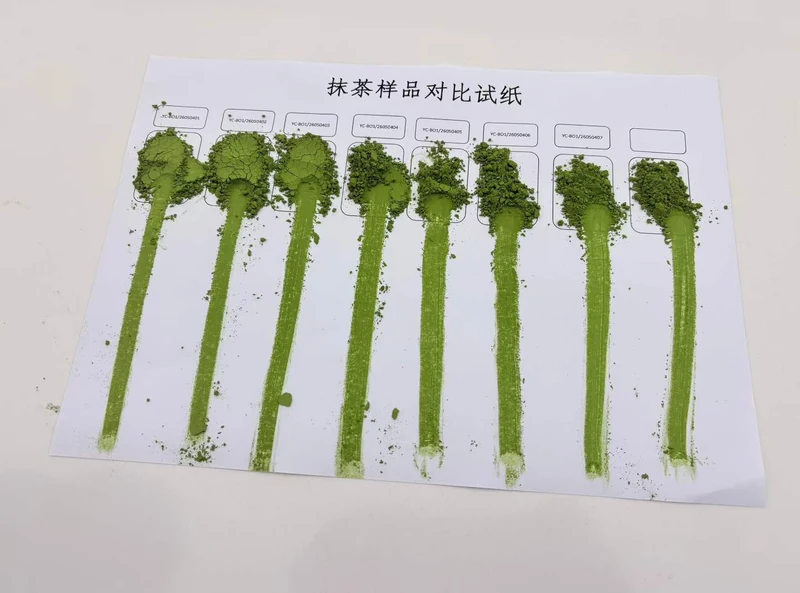
Identify the matcha by commercial grade and lot throughout the comparison. AdoroHu’s approved conventional system uses E-1/E-2 for culinary, E-3/E-4 for premium, and E-5/E-6/E-7 for ceremonial tiers; its organic system uses O-1/O-2 for culinary, O-3 for premium, and O-4/O-5/O-6 for ceremonial tiers. A custard trial recorded only as “matcha” cannot separate dispersion or viscosity drift from a change in grade identity.
Check dispersion after heating as well as before it. A smooth green slurry can still produce visible clusters when proteins or starch thicken around incompletely wetted particles. Compare samples from more than one vessel location, especially when the mixer creates a strong central vortex but weak movement near the wall or bottom.
Key Takeaway: Disperse matcha before structure develops and keep every slurry liquid inside the controlled formula.
How should egg safety be built into the custard process?
Egg-containing custard should follow an approved safety process for ingredient receipt, storage, handling, cooking, cooling, and cross-contamination control. The FDA egg-safety guidance provides safe handling, storage, preparation, and cooking advice for eggs and egg-containing foods. Apply the rules adopted in the production location and validate the actual process.
Do not use viscosity as a food-safety proxy. A starch-rich custard can thicken before the egg process reaches its validated endpoint, while a thinner formula may receive a suitable treatment. Record the critical process evidence separately from sensory and filling checks.
Plan sampling so quality checks do not contaminate the batch. Define sanitized tools, sample locations, operator handling, and disposition for material removed from the controlled vessel.
Separate raw and cooked sampling equipment visually and physically. A shared whisk, thermometer sleeve, or sample cup can undo an otherwise controlled process. Include allergens and cleaning validation in the changeover plan when dairy, egg, nuts, or alternative bases run on the same filling line.
Key Takeaway: Validate egg safety for the actual formula and process; visible thickening alone cannot prove it.
How should the cook endpoint be defined?
The cook endpoint should combine the validated safety process with formula-specific evidence of starch hydration, protein set, and finished viscosity. Define what the operator measures, where the sample comes from, and how agitation continues through the endpoint.
Avoid a universal temperature or time borrowed from another custard. Vessel size, heating rate, scraping, starch type, egg content, solids, and batch mass change the process. Develop the endpoint on the intended equipment, then verify it during scale-up.
Record signs of under- and over-processing. Under-cooked filling may taste starchy, flow excessively, or weaken during hold. Over-processing can create curds, scorching, breakdown, or excessive water loss. A clear deviation route prevents operators from hiding either condition with extra liquid.
Map endpoint measurements to vessel location. Jacketed kettles can develop wall deposits, cool zones, or scraper gaps that a single center reading misses. During validation, compare representative locations and inspect the scraped surface. Once uniformity is demonstrated, choose routine points that can detect a meaningful process change.
Key Takeaway: Define a measured endpoint on the actual formula and equipment, with separate safety and quality acceptance.
How should viscosity be measured for piping and depositing?
Viscosity should be measured under a repeatable sample temperature, shear history, rest time, and test method that reflects the filling operation. A spoon trail is useful for observation but cannot support equipment setup by itself.
Select a practical method appropriate to the facility, such as timed flow, line-spread, back-extrusion, or a calibrated viscometer. Correlate the result with pump pressure, nozzle cutoff, tailing, air pockets, and deposited shape. Record both the instrument or fixture and the procedure.
Condition samples consistently before comparison. A recently sheared hot sample may read differently from custard that has rested, cooled, or passed through a hose. Define the interval between sampling and testing, mixing before measurement, sample depth, and cleaning. Without those controls, the method can add more variation than the filling itself.
The bounded recommendation is to set the viscosity window from successful filling trials, not from an arbitrary round number. A tighter specification than the process can hold will create needless rework; a broad window can allow leaking or underweight products.
Key Takeaway: Measure custard at a defined condition and tie the result directly to filling performance.
How should cooling prevent skin, lumps, and texture drift?
Cooling should move the custard through its controlled process while limiting skin formation, condensation, lumps, and uneven set. Define transfer depth, container, covering method, agitation if used, equipment load, and sampling points. A large deep vessel behaves differently from shallow covered trays or a scraped-surface system.
The FDA Food Code provides model cooling and cold-holding provisions for retail food operations. Local adoption varies, and the model code does not establish a custard shelf life. The facility needs an applicable and validated cooling plan.
Check texture after cooling, not only at the kettle. Starch and protein networks continue to change, and a filling that looks fluid when hot may become unpipeable later. Use the intended fill temperature when defining acceptance.
Review the transfer from cooling container to hopper as part of the process. Scooping, pumping, or remixing can break a weak gel, incorporate air, or create warm pockets. Define whether cooled custard may be gently remixed, which tool or speed is allowed, and how long it may wait before filling begins.
Key Takeaway: Validate cooling in the actual container and judge viscosity at the temperature used for filling.
How should fill weight and depositor performance be controlled?
Fill weight should be controlled with suitable calibrated weighing, a defined sampling plan, and checks across startup, routine running, interruptions, and the end of the batch. Set the tolerance from declared portion requirements and demonstrated depositor capability rather than a generic limit.
Track product temperature and viscosity with the weight checks. A depositor can deliver the correct mass while creating tails, smears, voids, or off-center placement. These defects affect sealing and eating quality even when net content passes.
| Filling check | What to record | Decision supported |
|---|---|---|
| Deposit mass | Individual and average weights | Portion and cost control |
| Custard condition | Temperature and viscosity method | Explains equipment drift |
| Deposit geometry | Centering, height, tail, spread | Predicts closure and appearance |
| Equipment setting | Pressure, speed, nozzle identity | Supports repeatable setup |
| Interruption recovery | First deposits after restart | Prevents hidden startup rejects |
Key Takeaway: Pair fill weight with deposit geometry and custard condition so a passing scale result does not hide poor placement.
How should matcha custard behave inside the bakery product?
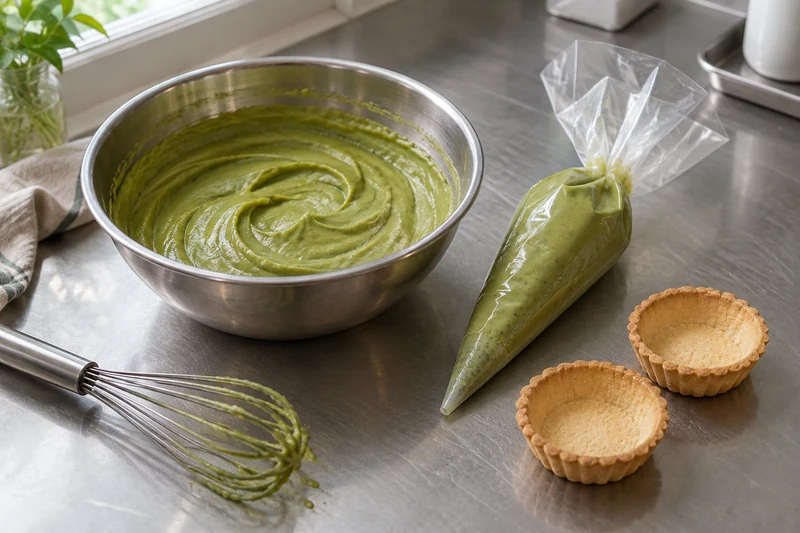
The custard should be tested inside the intended bun, tart, cake, puff, or other carrier because the surrounding product changes heat, moisture, pressure, and perceived flavour. A filling can pass cup tests yet soak a crumb, shrink from a shell, or leak during a second bake.
The published matcha cheesecake formulation guide illustrates how dairy structure and finished-product handling belong together, while the commercial baking guide covers broader powder selection. Custard development should remain focused on controlled filling behavior.
Test the full product after production, cooling, packaging, and intended service. Evaluate fill location, leakage, voids, moisture transfer, crust or crumb softening, colour, flavour, and bite. Approve the combination rather than a cup of filling alone.
Key Takeaway: Release matcha custard only after it performs inside the actual bakery product.
How should formula and storage be validated together?
Formula and storage should be validated together because starch, egg, dairy or plant proteins, sugar, fat, and matcha can change texture and sensory quality over time. A 2015 study of dry cassava-starch custard powders with whole-egg powder evaluated chemical, microbiological, and sensory properties during storage. That matrix differs from fresh matcha custard, so it supports study design rather than a shelf-life claim.
Build the study around the actual cooked filling and carrier product. Use representative lots, process conditions, package, temperature, handling, and planned checkpoints. Define acceptance for safety, viscosity or set, syneresis, colour, flavour, aroma, and fill performance.
Do not transfer a hold period from pudding, crème brûlée, or dry custard powder. Different water activity, heat treatment, package, and post-cook handling can change both hazards and quality loss.
Key Takeaway: Establish the hold period from the actual formula, process, package, and application instead of an adjacent dessert.
How should rework and release decisions be documented?
Rework and release decisions should specify which deviations are recoverable, what evidence is required, and who approves the action. Possible problems include specks, low or high viscosity, incomplete cooking, scorching, skin, temperature abuse, fill-weight drift, and excess hold time. Some are quality issues; others may make the batch unsuitable for rework.
Never thin an over-thick batch or blend an under-processed batch into good product without an approved procedure. The change can alter safety, solids, flavour, allergen control, and filling behavior. Preserve the original batch identity and record any authorized rework ratio.
| Deviation | Evidence to review | Possible disposition |
|---|---|---|
| Matcha specks | Dispersion record and finished appearance | Rework only under an approved method |
| Viscosity outside window | Sample condition, method, and fill trial | Hold for technical review |
| Cook-process deviation | Validated safety criteria and batch record | Do not release on appearance alone |
| Fill-weight drift | Scale checks and affected time range | Segregate and inspect affected units |
| Hold-time exceedance | Safety and quality study boundaries | Reject unless an approved assessment supports use |
Key Takeaway: Predefine rework limits so operators do not improvise with a high-risk, finished filling.
FAQ
- What is matcha custard?
- Matcha custard is an egg-set, starch-thickened, hybrid, or plant-based custard system flavored with matcha and designed for a defined serving or filling use.
- Is matcha custard the same as matcha pudding?
- No. The names can overlap in consumer use, but commercial filling viscosity, piping, bake behavior, packaging, and hold requirements may differ.
- Why does matcha custard become lumpy?
- Check matcha dispersion, starch addition, egg tempering where used, heating rate, agitation, scraping, and the cook endpoint.
- When should matcha be added to custard?
- Add it through a controlled dispersion step that suits the formula and occurs before thickening traps agglomerates.
- How should custard filling viscosity be specified?
- Use a repeatable method at a defined sample condition and correlate the range with successful pumping, depositing, and finished-product performance.
- How long can matcha custard be held?
- Establish the period from the actual formula, validated process, cooling route, package, bakery application, and applicable food-safety requirements.
Conclusion
Commercial matcha custard should be approved as a filling system with a defined structure, dispersion, endpoint, viscosity, cooling route, deposit, and hold period. Test it in the intended bakery product and document deviation and rework limits before launch. For matcha selection and application support, contact AdoroHu Matcha with the formula architecture and filling process.