
Matcha canele succeeds commercially when the formula and bake create a deeply caramelized shell without drying the custardy center or burying the tea. That balance is difficult because the same heat that forms the signature crust also changes green color, aroma, bitterness, moisture loss, and release from the mold.
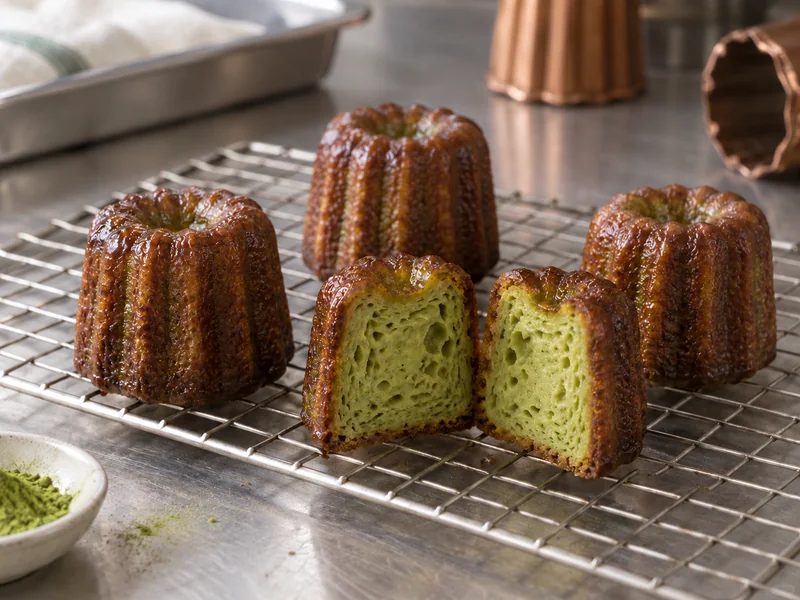
For a matcha canele line, the useful target is a repeatable contrast after cooling: a crisp, dark shell around a soft center with a clear but balanced tea note. Start with a culinary matcha intended for baking, then validate it in the complete pastry rather than judging dry powder color alone.
A commercial matcha canele needs one controlled system for batter composition, rest, mold condition, fill mass, oven load, bake profile, cooling, and hold time. A recipe can suggest a starting point, but the plant must define the operating window on its own equipment. Finished-piece measurements decide whether that window works.
In short:
Key points:
- Protect the crust-and-center contrast before chasing a brighter green interior.
- Control fill mass, mold behavior, oven load, cooling, and hold time as one process.
- Treat published matcha studies as pilot principles, not a validated canele formula.
What makes matcha canele harder to standardize than a plain canele?
Matcha canele adds a heat-sensitive, bitter, particulate ingredient to a pastry already built around opposing textures. The shell needs strong heat transfer and sufficient browning, while the center must set without becoming dry, rubbery, or hollow.
Matcha changes more than color. It adds solids, affects visual endpoint judgment, and can shift perceived sweetness and bitterness. A darker shell may be correct for canele structure even when buyers expect vivid green from the word “matcha.” Commercial teams therefore need separate standards for exterior color, cut-center color, crust thickness, center texture, and tea intensity.
The first trade-off is visual. If the team lowers the bake too far to protect green color, shell development and mold release may suffer. If it pursues a very dark, crisp shell, delicate aroma may become less obvious. Choose the intended eating experience first, then set a realistic color range inside that product brief.
| Attribute | Desired commercial outcome | Common conflict |
|---|---|---|
| Shell | Even caramelization and clean release | More heat can darken tea pigments |
| Center | Moist, set, custardy crumb | More drying improves handling but reduces contrast |
| Matcha character | Recognizable color, aroma, and bitterness | Higher dose can overpower sweetness and dairy notes |
| Yield | Stable saleable pieces across the rack | Small fill and heat differences create rejects |
Key Takeaway: Define shell, center, matcha character, and saleable yield as separate acceptance criteria.
Which matcha grade should a bakery test in canele batter?
Culinary matcha is the practical first trial because the powder faces dairy, sugar, flour, egg, and a high-heat bake. The candidate must deliver value after baking, cooling, and holding, not merely look bright in an opened bag.
AdoroHu’s current grade system places E-1 and E-2 in the culinary tier and O-1 and O-2 in the organic culinary tier. Higher grades may give deeper color, more sweetness, and less bitterness, but a canele process can mask some of that difference. Compare at least two commercially sensible candidates in the same base batter and bake run.
Score the cooled pastry blind. Include cut-center color, tea aroma, bitterness, sweetness balance, shell flavor, and cost per saleable piece. A higher powder price can still be economical if it allows a lower dose or improves yield, but that conclusion needs actual pilot data.
For wider ingredient screening before the canele trial, use the bakery matcha selection guide. Keep the final approval tied to this pastry and its declared hold condition.
Key Takeaway: Approve matcha grade in the cooled, held canele rather than in dry powder or raw batter.
How should matcha be dispersed without overworking the batter?
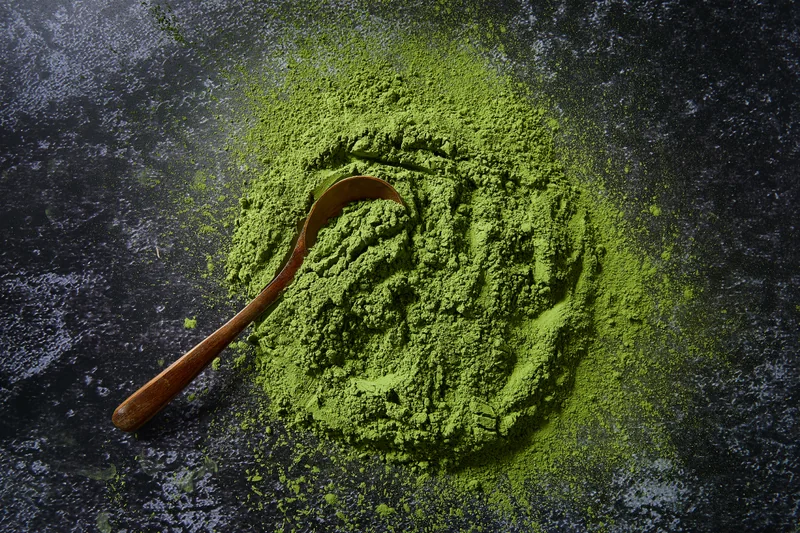
Matcha should enter through a defined dispersion step that removes visible clumps without adding uncontrolled shear or air. Poor dispersion creates bitter green pockets, pale areas, and misleading color readings from one piece to another.
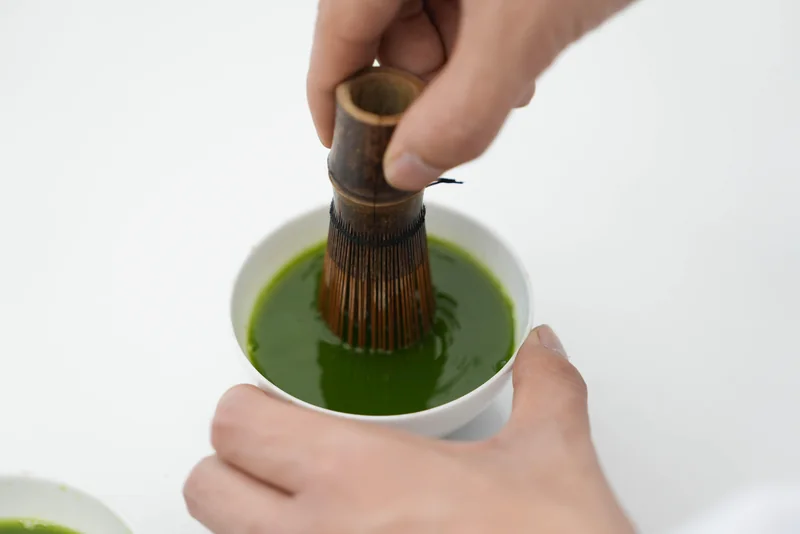
Choose one route and document it: screen matcha with the dry ingredients, or make a controlled slurry with part of a compatible liquid. The right choice depends on powder behavior, mixer design, batch size, and the existing base process. Record screen size or slurry ratio as an internal process setting only after the trial confirms it.
Avoid correcting weak color by tipping extra matcha into a finished batter. That changes solids, bitterness, and mixing history at once. It also makes the first and last deposits hard to compare.
AdoroHu uses ultrasonic screening for ultra-fine matcha, but a fine supplier powder still needs a bakery dispersion check. The line should inspect raw batter for specks, collect first/middle/last deposits, and compare cut surfaces after baking.
Key Takeaway: Lock the dispersion route before adjusting matcha dose.
Why does batter rest need a defined time and temperature window?
Batter rest needs a defined window because hydration, foam release, viscosity, temperature, and food-safety exposure continue changing before filling. “Rest overnight” is too vague for commercial control when one shift rests 10 hours and another rests 18.
Set a minimum and maximum hold for pilot testing, along with container depth, cover, refrigeration condition, and batter temperature at filling. Sample the start and end of the proposed window. Compare viscosity or flow behavior, deposit accuracy, baked height, internal voids, crust adhesion, aroma, and center texture.
The operational choice has a cost. A longer window may help scheduling and hydration, but it occupies cold storage and increases exposure to temperature variation. A shorter window reduces inventory but may make the batter less forgiving. Select the narrowest window that protects both output and production flow.
Do not borrow a home recipe’s rest time as a shelf-life statement. The approved limit should come from the bakery’s formula, sanitation program, temperature control, and qualified food-safety review.
Key Takeaway: Specify rest by elapsed time, batter temperature, container condition, and filling performance.
How do mold material and preparation change the bake?
Mold material and surface preparation change heat transfer, release, shell thickness, and the time needed for the center to set. Copper, aluminum, steel, silicone, coatings, and seasoned surfaces do not behave as interchangeable containers.
Build the initial trial around the production mold that will actually be used. Record mold material, cavity geometry, surface condition, coating method, coating pickup where measurable, preheat practice, and cleaning history. A method validated in one mold should not be assigned to another without a comparison run.
| Mold variable | What to record | Likely production effect |
|---|---|---|
| Material and wall thickness | Supplier and mold specification | Heat-up rate and shell formation |
| Surface condition | New, seasoned, worn, or recoated | Release and patchy color |
| Coating application | Method and consistency | Shell texture and sticking |
| Cavity geometry | Volume, height, and diameter | Center-set time and yield |
The practical recommendation is to avoid changing mold, coating, and bake profile in the same trial. If three variables move together, the team cannot explain a release improvement or a new defect.
Key Takeaway: Treat the mold as part of the thermal process, not as neutral packaging for batter.
How should fill mass and oven load be controlled together?
Fill mass and oven load should be controlled together because they determine the heat demand placed on each cavity and the whole oven. A small per-cavity difference can change headspace, rise, center setting, spillover, and shell-to-center ratio.
Define target fill by weight rather than an imprecise visual level. Then measure several cavities across the depositor cycle. Record total molds per rack, rack position, tray spacing, oven recovery after loading, airflow setting, and whether the molds enter at a consistent temperature.
A pilot should challenge realistic production loads. A beautiful half-empty test oven does not prove the same profile works at full load. Conversely, an overloaded oven may recover slowly and produce pale shells in some zones before the center finishes elsewhere.
This is one of the strongest yield controls available. Standardize fill and load before making expensive changes to matcha grade. Otherwise, ingredient comparisons are confounded by uneven heat demand.
Key Takeaway: Compare matcha candidates only after cavity fill and production oven load are repeatable.
What bake profile preserves the canele shell and center contrast?
The right bake profile supplies enough early and sustained heat for shell formation while allowing the center to set without excessive moisture loss. The line should define this profile through oven trials, not present a borrowed time and temperature as universally valid.
Use the base canele process as the control. Change one planned factor at a time, such as initial heat stage, later heat stage, total time, rack position, or fan setting. Measure oven-zone behavior and finished pieces after a fixed cooling interval.
A 2018 original study of matcha shortbread biscuits tested 2, 4, and 6 grams of matcha per 100 grams of flour and baked the biscuits at 180°C for 15 minutes. The researchers observed roughly 20% total catechin loss in that biscuit system and found color and bitterness influenced acceptance. Those conditions and results do not predict catechin retention in high-moisture canele batter. They support only the narrower principle that heat exposure and matcha dose should be measured together.
The decision rule is straightforward: reject a profile that delivers appealing color but a weak shell, or a strong shell with an over-dried center. A saleable matcha canele needs both attributes in the same piece.
Key Takeaway: Validate the bake on cooled pieces using shell, center, color, mass loss, and yield together.
Which measurements should define a finished matcha canele?
A finished matcha canele should be defined by a compact set of measurements that operators can repeat across trays and shifts. Time and oven setpoint alone cannot describe the product.
Use a fixed cooling time before evaluation. Record pre-bake fill mass, finished mass, mass loss, height, diameter, release defects, exterior color category, cut-center appearance, shell thickness, and center texture. Add sensory scores for matcha aroma, bitterness, sweetness balance, and burnt notes.
Where instruments are available, color values or texture measurements can strengthen the visual and sensory scale. They do not replace a clear sampling plan. Take pieces from defined rack and tray positions, including known hot and cool zones.
| Control point | Simple measurement | Buyer or plant consequence |
|---|---|---|
| Mass loss | (fill mass − cooled mass) / fill mass × 100 | Tracks drying and saleable weight |
| Shell condition | Color band, thickness, release score | Protects signature bite and appearance |
| Center condition | Cut image and texture score | Detects gumminess, voids, or overbaking |
| Packed yield | Saleable pieces / total pieces | Converts process changes into unit economics |
Any numeric targets created from the pilot remain plant-specific. They should be identified as internal operating ranges, not published as universal canele limits.
Key Takeaway: Release the process against the cooled piece and saleable yield, not the oven clock.
How should cooling and hold time be tested before sale?
Cooling and hold time should be tested because the shell continues exchanging moisture with the center and surrounding air after baking. A piece that is crisp at demolding may soften during packing, storage, transport, or service.
Define the demold point, cooling surface, air exposure, packing point, package format, and evaluation times. Compare pieces at the intended sale or service condition, not only warm from the oven. Include shell crispness, center moisture, aroma, condensation, package staining, and cut appearance.
If the product must be refreshed before service, make that step part of the commercial operating method and evaluate its effect on color and center texture. Avoid claiming a shelf life from sensory checks alone; qualified personnel should design the full quality and safety study for the finished product.
The adjacent matcha donut formulation guide offers a useful comparison because frying and baking expose matcha to different heat and moisture paths. The transfer is the measurement discipline, not the process settings.
Key Takeaway: Approve matcha canele at the actual pack-and-serve interval.
How should a bakery design a scale-up trial and record saleable yield?
A scale-up trial should change a small, declared set of factors and trace every finished piece back to ingredients, fill, mold, rack, and hold condition. That record turns defects into decisions instead of anecdotes.
A useful pilot matrix can compare matcha dose and one process factor while holding the base formula constant. Another original matcha rice-cake study used a Box–Behnken design to vary matcha ratio, water ratio, and steaming time, then verified its predicted optimum. Its reported 1.60% matcha, 82% water, and 39-minute steaming condition belongs only to that rice-cake system. The transferable principle is to vary formulation and heat deliberately, define a response, and verify the selected condition in the intended product.
Record batter lot, matcha lot, dose, rest start and end, filling temperature, cavity weights, mold identity, oven load, zone, bake stages, cooling time, defects, and packed yield. Retain first, middle, and last production samples for comparison under the plant’s own sample policy.
Choose the condition with the best repeatable saleable yield, not the single piece with the brightest center. If a promising result depends on one rack position, it is not ready for routine production.
Key Takeaway: Select the operating window that survives full-load repetition and produces the best saleable yield.
FAQ
- What makes a matcha canele commercially successful?
- It needs a repeatable caramelized shell, a moist set center, balanced matcha flavor, clean release, and stable saleable yield after the intended hold.
- Which matcha grade should a bakery test first?
- Culinary matcha is the practical starting point because the powder must perform after mixing, high-heat baking, cooling, and holding.
- Should a canele batter rest be specified only in hours?
- No. The method should also define temperature, container condition, filling temperature, and the acceptable performance window.
- Can a biscuit study predict catechin loss in matcha canele?
- No. Biscuit data can guide pilot variables, but canele has a different formula, moisture level, geometry, and heat-transfer path.
- Why should mold material be part of the process record?
- Mold material, thickness, surface condition, geometry, and coating affect heat transfer, release, shell formation, and center setting.
- What should a scale-up run measure besides bake time?
- Measure fill and cooled mass, mass loss, shell and center condition, rack variation, defects, hold performance, and saleable yield.
Conclusion
Commercial matcha canele improves when the bakery controls the complete path from powder dispersion through service time. Fix the base process, test matcha and heat variables deliberately, and approve the operating window at realistic oven load. Contact AdoroHu Matcha to discuss a baking-matcha sample plan for a structured canele pilot.