
Matcha water activity tests work when buyers define them separately from moisture percentage and lock the method, temperature, and decision rule. Moisture measures how much water is present by mass. Water activity measures the energy state of that water and its availability for microbial growth and chemical or physical change.
Confusing the two can distort supplier comparisons, storage decisions, and release limits. When sourcing bulk matcha powder, define matcha water activity by test temperature, instrument method, lot sampling, and business purpose. A number without those conditions is difficult to reproduce.
Matcha water activity and moisture percentage answer different questions. Buyers should record both only when each supports a defined quality or safety decision. Low water activity can limit microbial growth, but it does not prove sterility or validate shelf life by itself.
In short:
Key points:
- Specify water activity with the method, temperature, equilibration, calibration, and lot identity.
- Do not convert a research threshold or another food's regulatory value into a universal matcha limit.
- Link the result to packaging, storage, microbiological controls, and shelf-life work without asking one number to prove everything.
What Does Matcha Water Activity Measure?
Matcha water activity measures the relative availability of water in the powder at equilibrium. The FDA water-activity guide defines it as the ratio between the food's vapor pressure and the vapor pressure of distilled water under identical conditions. Equilibrium relative humidity divided by 100 gives water activity.
That definition has an immediate procurement consequence. The result describes how strongly the product matrix holds water, not the number of grams of water in the sample. Sugars, proteins, fibres, salts, particle surfaces, and processing history can change that relationship.
| Result | What it describes | Typical buyer use |
|---|---|---|
| Moisture percentage | Total water by mass under a stated method | Drying consistency, mass balance, caking risk |
| Water activity, aw | Available water at equilibrium under stated conditions | Growth potential, reaction risk, storage behavior |
| Relative humidity | Water vapor in the surrounding air | Warehouse and package exposure |
Key Takeaway: Treat aw as an equilibrium property of the powder, not as a second moisture percentage.
How Is Matcha Water Activity Different From Moisture Content?
Matcha water activity differs from moisture content because water can be bound with different strengths inside the powder. FDA notes that some water is held at specific sites and does not act as a solvent. Two lots can therefore report similar moisture percentages while showing different aw values.
The distinction changes what buyers should compare. Moisture content may show whether drying stayed consistent. Water activity is more closely tied to whether water can support microbial growth or accelerate selected chemical and physical changes.
Avoid converting one value into the other with a generic formula. A conversion requires a product-specific sorption relationship at a controlled temperature. Cultivar, milling, particle distribution, composition, and storage history can shift that curve.
Key Takeaway: Use paired measurements or a validated product-specific relationship; never assume a fixed moisture-to-aw conversion.
Why Must a Matcha Water Activity Method State Temperature?
A matcha water activity method must state temperature because aw changes with temperature and the measurement depends on equilibrium. FDA's guide notes that a small temperature difference between the sample and headspace can create a meaningful reading error.
For a buyer comparing laboratories, the practical test is repeatability. Require the instrument principle, test temperature, equilibration procedure, calibration checks, sample preparation, and repeat rule. “Measured by aw meter” leaves too many variables open.
| Record field | Why it matters | Weak record example |
|---|---|---|
| Instrument and principle | Different systems may equilibrate differently | “Hygrometer” |
| Test temperature | Aw is temperature-dependent | No temperature reported |
| Calibration check | Confirms the meter was operating correctly | Annual service only |
| Equilibration/end point | Defines when the reading is accepted | Operator judgment not recorded |
| Sample handling | Limits moisture gain before testing | Open sample held on bench |
| Replicate rule | Shows how variation is handled | One reading, no repeat criterion |
Choose a controlled laboratory method over a fast receiving check when the result drives lot rejection. The added time is cheaper than disputing two non-comparable numbers after shipment.
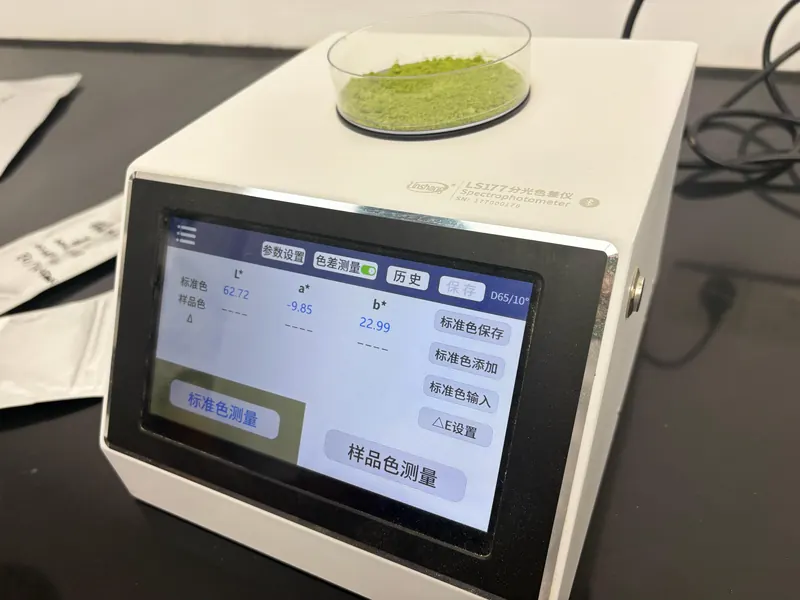
Also confirm which parameter the instrument or report measures. A color-measurement result describes a different quality attribute; request a separate, method-defined water-activity result.
Key Takeaway: An aw limit is enforceable only when the measurement conditions are reproducible.
Which Water Activity Numbers Apply to Matcha?
No single published water activity number automatically applies to every matcha specification. The value must connect to the intended quality or safety decision and supporting evidence.
FDA discusses aw 0.85 as a regulatory-definition point for specific low-acid canned-food and acidified-food rules. That context does not turn 0.85 into a universal dry-matcha target. Likewise, a 2026 matcha storage study found better retention of measured compounds at aw at or below about 0.53 under its experimental conditions. That is a study result, not an FDA limit or an AHM specification.
The strongest purchasing decision avoids copying a neat number from a competitor sheet. Define the failure to prevent, then choose a justified limit with a qualified food-safety or product-stability expert.
Key Takeaway: A numeric limit needs a named purpose, source, matrix, method, and validation basis.
What Did the 2026 Matcha Water Activity Study Find?
The 2026 matcha water activity study examined quality changes under controlled aw and light conditions, not commercial safety validation. The authors stored matcha across aw 0.11 to 0.93 and compared light-shielded samples with continuous laboratory lighting of about 450 to 500 lx.
The published abstract indexed by PubMed reports faster decline in measured polyphenols, flavonoids, antioxidant assays, catechins, and vitamin C under higher aw and light exposure. Under the tested conditions, aw at or below about 0.53 plus light shielding improved retention of measured compounds.
Read the result within its boundaries:
| Study supports | Study does not establish |
|---|---|
| Aw and light jointly affected measured storage quality | A universal matcha purchasing limit |
| Controlled aw changed chemical and physical behavior | A microbial kill step or sterility |
| Light shielding improved retention in the experiment | A finished package's commercial shelf life |
| One study-specific threshold informed quality retention | An AHM lot result or house specification |
Use this study to justify evaluating aw alongside light-barrier packaging. Do not use its threshold as a substitute for product-specific safety and shelf-life work.
Key Takeaway: The study gives a bounded quality signal; it does not supply a universal release specification.
Does Low Matcha Water Activity Mean the Powder Is Sterile?
Low matcha water activity does not mean the powder is sterile. Reducing available water can inhibit microbial growth, but inhibition is not destruction. A contaminated low-moisture food may remain unable to support growth while still carrying viable organisms.
That shifts the approval decision. Keep raw-material controls, sanitation, supplier verification, microbiological criteria, sampling, and any validated lethality process separate from the aw limit. A negative finished-product result can support verification, but one sample cannot prove a process destroyed a hazard.
The practical judgment is to avoid describing a low-aw powder as “safe by aw.” State the narrower claim the evidence supports: the lot met a measured aw specification under the reported method.
Key Takeaway: Water activity is one control input, not a sterility certificate or complete food-safety plan.
How Should Matcha Packaging and Storage Use Water Activity Data?
Packaging and storage should use matcha water activity data to prevent moisture gain after release. A conforming powder can move out of specification if the liner, seal, headspace, warehouse humidity, or repeated opening allows water to enter.
For quality review, pair aw with package integrity and storage evidence. The site's matcha quality guide provides the wider sensory context, while the matcha clumping guide explains why moisture exposure can also become a handling problem.
Use sealed retention samples to investigate drift. If an opened pack gains aw while a sealed control remains stable, the cause may sit in use conditions rather than the production lot. If both drift, investigate the package barrier, seal, or initial conditioning.
Key Takeaway: Preserve the approved aw through package barrier, seal control, humidity control, and defined opened-pack handling.
What Should a Matcha Water Activity Specification Include?
A matcha water activity specification should include the acceptance range, test method, temperature, sampling plan, reporting format, and action for an out-of-specification result. It should also state whether aw supports quality control, microbial-growth control, packaging verification, or a shelf-life study.
Keep shelf-life claims in their own evidence chain. The matcha shelf-life validation guide explains why one initial laboratory value cannot prove performance through the entire claimed period.
A workable specification records:
- exact SKU, lot, manufacturing date, and sample point;
- moisture method and water-activity method as separate entries;
- instrument, temperature, calibration, equilibration, and replicate rule;
- alert and rejection limits with their technical rationale;
- packaging, storage, and opened-pack conditions;
- deviation, retest, hold, investigation, and release authority.
Avoid a universal aw 0.3, aw 0.53, or 5% moisture rule unless product-specific evidence supports that exact limit and purpose. A justified range is more defensible than a popular number copied without its conditions.
Key Takeaway: Write the specification so another laboratory can reproduce both the result and the release decision.
FAQ
Is matcha water activity the same as moisture percentage?
- No. Moisture percentage measures total water by mass, while water activity measures how available that water is at equilibrium under stated conditions.
Is aw 0.53 a universal limit for matcha powder?
- No. About 0.53 was a quality-related boundary reported under one 2026 study's controlled aw and light conditions, not a universal legal or purchasing limit.
Does low water activity prove matcha is free from pathogens?
- No. Low aw can inhibit microbial growth, but it does not prove sterility, absence of contamination, or adequacy of a kill step.
What temperature should a water activity result report?
- Report the actual controlled test temperature required by the chosen method, together with the instrument, calibration, equilibration, and sample-handling details.
Can one water activity test validate matcha shelf life?
- No. Shelf-life validation also needs the intended package, storage conditions, time points, quality endpoints, microbiological controls, and acceptance criteria.
Conclusion
Matcha water activity becomes useful when the method, limit, lot, package, and decision are documented together. Keep moisture, aw, microbiological control, and shelf-life evidence separate enough to show what each result proves. Contact AdoroHu Matcha to discuss the specification fields needed for your application.