
Food packaging migration testing checks whether substances can transfer from the complete food-contact system under its intended use. A generic “food-grade” certificate cannot answer that question when the laminate, ink, adhesive, contact side, storage period, temperature, or destination market is undefined.
For a buyer developing private-label matcha packaging, food packaging migration testing must represent the pack that will touch the product. Otherwise, a clean report may describe a different material or exposure and leave the commercial pack unsupported.
Migration testing evaluates chemical transfer under defined contact conditions. It does not measure oxygen transmission, seal leakage, sensory stability, or shelf life. Approval should combine migration evidence with those separate performance files without treating them as interchangeable.
In short:
Key points:
- Define the complete construction, food-contact side, market, food, time, and temperature.
- Select simulants, analytes, and methods from the actual use and material composition.
- Reassess evidence when a layer, supplier, process, artwork, use condition, or market changes.
What does food packaging migration testing establish?
Migration testing estimates or measures transfer from packaging components into food or a suitable simulant under specified conditions. It supports a defined safety or compliance assessment for the tested construction and use. It does not certify every possible food, temperature, storage period, or jurisdiction.
The starting unit is the food-contact system rather than a marketing name such as “foil pouch.” A converted pouch may include a sealant, barrier layer, adhesive, printing system, coating, zipper, and other components. Transfer can also arise from set-off or unintended contact during storage.
Define the decision before commissioning work. The laboratory needs to know whether the buyer is evaluating a new material, supporting a market declaration, comparing alternatives, investigating a change, or confirming a worst case. Different questions can require different specimens and analytical depth.
Keep the decision narrow: identify which construction and intended use the report supports, the legal basis used, and any limitations. A buyer can then compare the report with the production specification instead of relying on a broad pass statement.
Key Takeaway: Migration evidence supports a named construction and use; it is not a universal approval for the material family.
Which layers and components belong in the migration test brief?
The brief should describe every layer and component that can directly or indirectly contribute migrants under intended use. Include the substrate, food-contact sealant, tie layers, adhesives, coatings, inks, varnishes, closures, zipper, valve, and any recycled content where relevant.
Ask the converter for a layer diagram, material grades, thicknesses, contact side, supplier identities, and declarations. Test a representative converted pack when conversion can change exposure. A resin plaque cannot capture adhesive cure, print set-off, lamination, or the final surface-area relationship.
Sample identity deserves its own control. Record production date, converter batch, artwork revision, dimensions, and who collected and sealed the specimens. Retain an untested sample when practical so a later discrepancy can be checked against the submitted material.
| Construction record | Why the laboratory needs it | Risk of omission |
|---|---|---|
| Layer sequence and thickness | Identifies contact and barrier relationships | Wrong specimen or migration path |
| Resin, adhesive, coating, and ink identities | Supports extractive and analyte selection | Relevant substances may be missed |
| Food-contact side and printed surfaces | Defines direct contact and set-off | Test may expose the wrong surface |
| Converter and process revision | Connects the sample to production | Report may cover an obsolete build |
| Closure, zipper, or valve | Captures auxiliary contact materials | Component evidence remains incomplete |
Key Takeaway: Scope the finished construction, not one convenient film layer, whenever conversion or auxiliary components can affect transfer.
How should the food and simulant be selected for matcha?
Select the food model from the product as sold and used, not from the fact that consumers may later make a drink. Dry matcha powder in long-term pouch contact presents a different use case from a ready-to-drink matcha beverage filled and stored in a bottle.
For dry powder, document whether the package remains sealed throughout storage, how much product contacts the surface, and whether fat, moisture, or other formulation components change the relevant food category. A flavored matcha blend may not be represented by evidence for plain matcha if added ingredients alter contact behavior. Give the reviewer the finished formulation or a controlled composition summary rather than a consumer-facing product name.
The FDA chemistry guidance for food-contact submissions discusses food simulants according to food type, including aqueous, acidic, alcoholic, and fatty applications. That guidance belongs to US food-contact-substance submissions. The laboratory or regulatory reviewer should choose the applicable simulant for the actual food and market rather than copying one from an unrelated protocol.
Give the laboratory the ingredient format, composition relevant to contact, fill state, and expected preparation. Avoid describing powder matcha as an aqueous beverage merely because water is added after opening; that can distort the exposure scenario.
Key Takeaway: Base simulant selection on the food in contact during the claimed use, then document why the chosen model is appropriate.
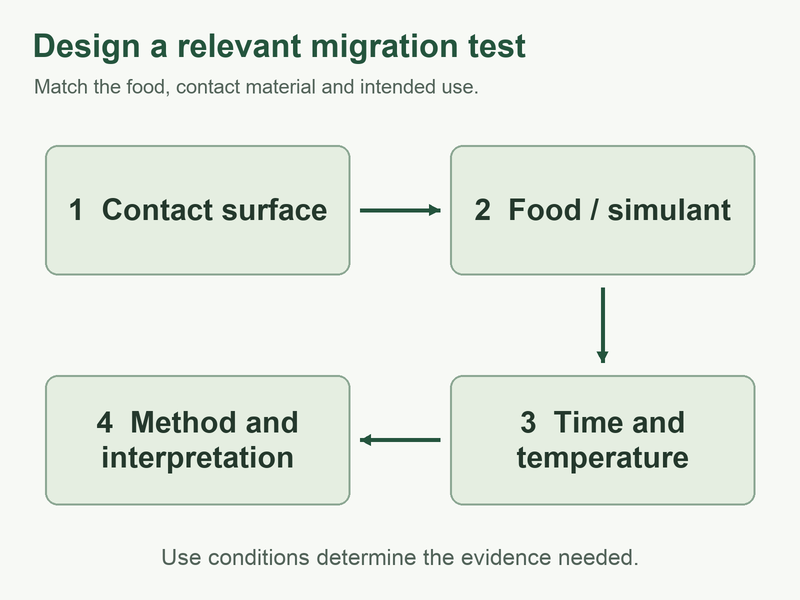
How should time and temperature define migration conditions?
Test conditions should represent intended contact or a scientifically justified worst case. Map filling, sealing, storage, transport, retail display, consumer use, reheating, and reuse only when those stages belong to the claimed application.
Long ambient storage and brief elevated-temperature contact are not interchangeable exposure histories. Record the maximum intended shelf life, normal storage range, foreseeable transport excursions, and any heat used during filling or sealing that affects the food-contact surface. If an accelerated condition is proposed, require an explanation of how it represents the intended contact without degrading the material into an unrealistic state.
FDA’s guidance recommends considering the highest temperatures expected during food contact and using special protocols when standard conditions do not represent use. This principle prevents a room-temperature storage pack from being assessed with an irrelevant hot-fill assumption, or a heated application from being supported by a mild exposure.
Do not select the harshest available condition by reflex. Excessive conditions can damage the specimen or create chemistry that does not represent use. The better brief shows the real exposure and asks the laboratory to justify any acceleration or worst-case bridge.
Key Takeaway: Use a documented contact history and a justified worst case, not an arbitrary severe condition.
What is the difference between overall and specific migration?
Overall migration measures aggregate transfer under a defined test, while specific migration targets a named substance or substance group. They answer different questions, so one cannot automatically replace the other.
Overall migration can screen the total nonvolatile transfer addressed by a method. Specific migration checks substances with individual restrictions or toxicological concern. Depending on the material, market, and authorization, a package may need one, both, or a different chemistry assessment.
| Evidence type | Main question | Limitation |
|---|---|---|
| Overall migration | How much aggregate material transferred under the method? | Does not prove every restricted substance is below its limit |
| Specific migration | How much of the named substance or group transferred? | Covers only the targeted analytes and demonstrated reporting capability |
| Screening or extractables work | What potential migrants may be present? | Identification alone does not complete exposure or safety assessment |
| Declaration of compliance | What does the issuer declare against the legal basis? | Must be supported and scoped; it is not a substitute for missing test data |
Key Takeaway: Use overall and specific migration according to the legal and material questions, and record what each result leaves unresolved.
How should potential migrants and analytical methods be chosen?
Potential migrants should come from the material formulation, manufacturing aids, adhesives, inks, coatings, degradation pathways, impurities, recycled inputs, and prior evidence. FDA chemistry recommendations identify categories such as monomers, oligomers, adjuvants, and catalyst residues, but not every category applies to every laminate.
Build a composition-to-analyte rationale with the converter, raw-material suppliers, laboratory, and regulatory reviewer. Then match analytical techniques and reporting limits to the substances and decision criteria. Broad untargeted screening may help find unexpected peaks, but it does not remove the need to evaluate identified substances.
The rationale should distinguish intentionally used substances from impurities, reaction products, and degradation products. It should also explain which layers are behind a functional barrier and whether the intended conditions could still permit transfer. This makes omissions reviewable: a buyer can see why an analyte was included, excluded, or covered by supplier evidence instead of assuming that a standard panel was comprehensive.
Avoid ordering the same “standard panel” for every pack. It can miss a construction-specific concern while spending money on irrelevant analytes. The consequence is a thick report that still cannot support the intended declaration.
Key Takeaway: Derive analytes from the real construction and process, then choose methods capable of supporting the applicable decision limits.
How should a buyer qualify the laboratory and report?
Qualify the laboratory for the matrix, simulant, exposure, analytes, and method rather than accepting capability by reputation alone. Review accreditation scope where relevant, method references, sample preparation, blanks, recovery, calibration, reporting limits, uncertainty, and deviation handling.
The final report should identify the specimen, condition, surface-area relationship, simulant, analytical method, result, unit, reporting limit, and any qualification. Photographs and sample seals can strengthen identity control when several visually similar constructions exist.
Require the laboratory to record unsuccessful exposures, interferences, contamination, and repeated runs rather than reporting only the final value. Those details help the reviewer distinguish a sound result from one produced after an unexplained method adjustment.
Agree the report format before the study starts. A raw instrument output may satisfy the laboratory workflow yet fail the buyer’s approval file if it omits condition rationale, applicable criteria, or a clear link to the tested construction.
Ask the laboratory to separate “not detected” from “not tested” and from “below a reporting limit.” Those statements lead to different conclusions. A method that cannot report below the decision threshold cannot demonstrate the needed result, even when the instrument prints “ND.”
Key Takeaway: Laboratory competence must match the specific matrix and decision, and the report must expose enough method detail to interpret the result.

How should migration results be interpreted for the destination market?
Interpret results against the legal basis, authorization, restriction, and intended use for each destination. A report produced for one jurisdiction does not automatically create a compliance file for another, even when the numerical result looks favorable.
The FDA overview of food-contact regulation explains that US assessments consider migration under intended use together with toxicological information to evaluate exposure and safety. Other markets may use different positive lists, restrictions, declarations, test conventions, or responsible parties.
Ask the reviewer to state the conclusion and its limits in plain language: approved construction, food, contact condition, market, and exceptions. Do not let procurement translate a laboratory result into a legal declaration without qualified review.
Key Takeaway: A migration number becomes useful only after it is tied to the destination market’s legal basis and the represented use.
What changes trigger migration reassessment?
Reassess when a change could alter composition, transfer, exposure, or the legal basis. Common triggers include resin grade, supplier, layer thickness, adhesive, coating, ink, recycled content, converter, cure condition, artwork coverage, contact side, food, time, temperature, package size, and destination market.
Not every change requires a full repeat program. A qualified reviewer may bridge evidence when the new construction is demonstrably equivalent or covered by a justified worst case. The bridge should name the compared materials, affected migrants, exposure, and regulatory basis.
Reject a bridge based only on the same trade name or similar appearance. Supplier and grade changes can alter additives or impurities, while artwork changes can affect ink coverage and set-off. A short written rationale is cheaper than discovering after launch that the test sample and production pack diverged.
Key Takeaway: Use change control to decide whether existing evidence still applies; never extend a report by visual similarity alone.
How does migration testing fit with barrier, seal, and shelf-life evidence?
Migration testing addresses chemical transfer, while barrier, seal integrity, and shelf-life work answer different performance questions. A pouch can have strong oxygen barrier and still lack adequate migration evidence. It can also pass migration work yet fail through leaks, light exposure, moisture ingress, or sensory deterioration.
Keep the files distinct, then review them together during packaging approval. The matcha oxygen-barrier guide explains gas-transfer evidence, and matcha shelf-life validation covers product change over time in the actual pack.
| Approval file | Decision it supports | It does not establish |
|---|---|---|
| Migration evidence | Chemical transfer under defined contact | Oxygen or moisture protection |
| Barrier data | Gas, moisture, or light transmission performance | Chemical-transfer compliance |
| Seal-integrity evidence | Closure performance and leak control | Product stability over time |
| Shelf-life study | Product quality or safety endpoints over storage | Universal suitability of every material change |
Key Takeaway: Approve chemical safety and pack performance as connected but separate evidence streams.
What evidence should approve a matcha packaging system?
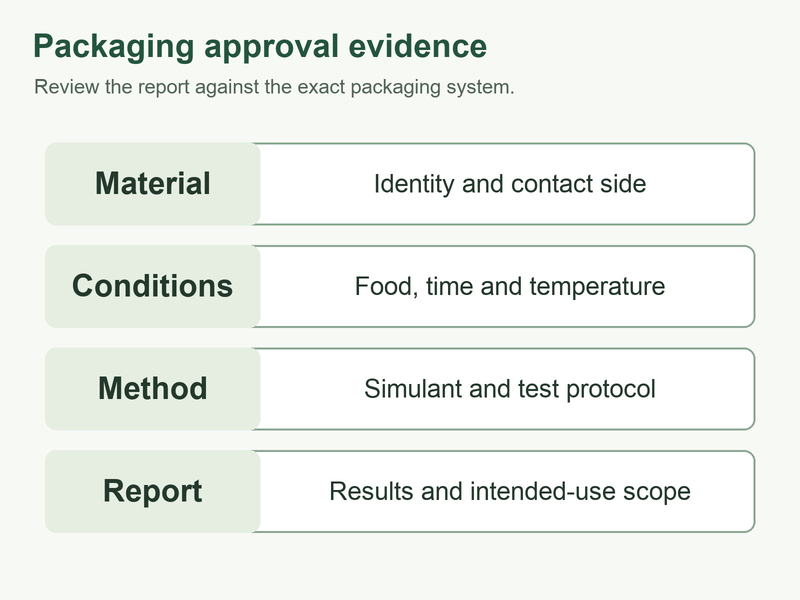
The approval file should bind the exact bill of materials, layer diagram, supplier and converter revisions, intended food, contact conditions, destination markets, declarations, migration rationale, reports, limitations, and change controls. It should also identify the owner who signs the final disposition.
Before launch, compare production samples with the tested construction and confirm that the contact side, dimensions, print, closures, and process are represented. Record any bridge from the test specimen to the commercial configuration. Then connect the migration file with barrier, seal, sensory, and shelf-life evidence.
This final review prevents a common handoff failure: regulatory approves a material, packaging approves a structure, and operations orders a slightly different version. One controlled pack specification should unite those decisions.
Key Takeaway: Release only the pack configuration represented by the migration and performance evidence, with changes routed back through review.
FAQ
- What is migration in food packaging?
- Migration is the transfer of substances from packaging or food-contact components into food or a suitable simulant under defined conditions.
- Is overall migration the same as specific migration?
- No. Overall migration measures aggregate transfer under a method, while specific migration targets named substances or groups.
- Does migration testing prove matcha shelf life?
- No. Shelf life, barrier performance, seal integrity, and migration require separate evidence that is reviewed together for pack approval.
- Which food simulant should be used for matcha?
- A qualified reviewer should select it from the product as sold, intended use, contact conditions, destination market, and applicable protocol.
- Can one migration report cover several laminates?
- Only when a documented equivalence or worst-case rationale shows that the report represents each construction and intended decision.
- When should migration testing be repeated?
- Reassess after material, supplier, process, artwork, use-condition, package-size, or market changes that can affect transfer or compliance.
Conclusion
Food packaging migration testing starts with the commercial pack, food, market, and contact history, then narrows the simulants, analytes, methods, and acceptance basis. Approve the exact construction represented by the evidence and route changes through documented reassessment. Keep migration, barrier, seal, and shelf-life files separate, then bring them together for the final package decision. To align matcha product records with a private-label pack specification, contact AdoroHu Matcha before testing begins.