
Matcha shelf life validation needs representative lots, real packaging, controlled storage, and documented endpoints before a best-before date is approved. B2B buyers need the study behind the claim.
Matcha shelf life validation is a quality-release protocol that follows the actual formulation, package, and intended distribution conditions over time. It is different from the consumer question answered in How Long Does Matcha Last?.
Validate a matcha best-before date with representative production lots in the intended sealed package, predefined storage conditions and checkpoints, approved analytical and sensory methods, and written acceptance criteria. Quality and food-safety questions require separate evaluation. Release the date only after quality, regulatory, and commercial owners approve the evidence for the named product and market.
What claim is a matcha shelf life study trying to support?
Write the claim before designing the study: product identity and grade, package format and fill, unopened or opened state, storage instruction, target market, and the quality attributes expected through the proposed date. The FDA explains that quality-based date labels communicate when packaged food is expected to retain desired quality and flavor; US requirements and terminology still need market-specific review in context. See the FDA’s food date-label overview.
Which lots and samples should be included?
Use samples that represent normal commercial variability, not a hand-selected ideal lot. Record production lot, grade, milling and packing dates, package material, seal settings, fill weight, headspace treatment if used, and sample custody. A pilot lot may inform the design, but a commercial claim should be tied to representative production evidence.
Any sample count or duration is a study hypothesis until justified for the product, process, risk, and market. Buyers should ask which sources of variability were covered and which were excluded.
How should packaging be part of shelf life validation?
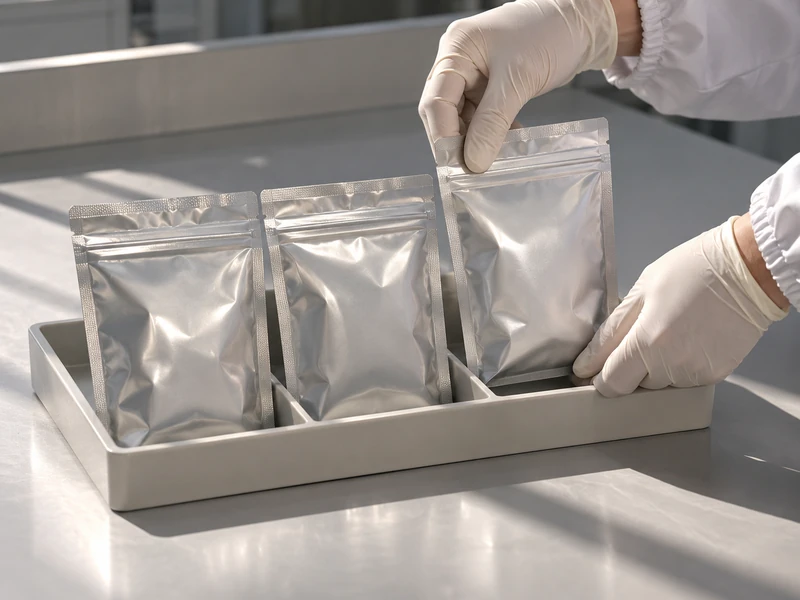
Test the actual sale or shipment pack because light, oxygen, moisture, seal integrity, and repeated opening can change the result. Record material specification, supplier, construction, closure, seal verification, and any protective atmosphere. Changing pouch structure, closure, pack size, or filling conditions should trigger a documented impact assessment rather than an automatic transfer of the old date.
| Evidence set | Buyer should verify | Release question |
|---|---|---|
| Product | Grade, lot, process, initial specification | Is the tested material representative? |
| Package | Structure, closure, seal record, fill | Is this the marketed configuration? |
| Storage | Temperature, humidity, light, excursions | Does it match the label and route? |
| Testing | Method, checkpoint, result, acceptance rule | Was the conclusion predefined? |
Which storage conditions and checkpoints belong in the protocol?
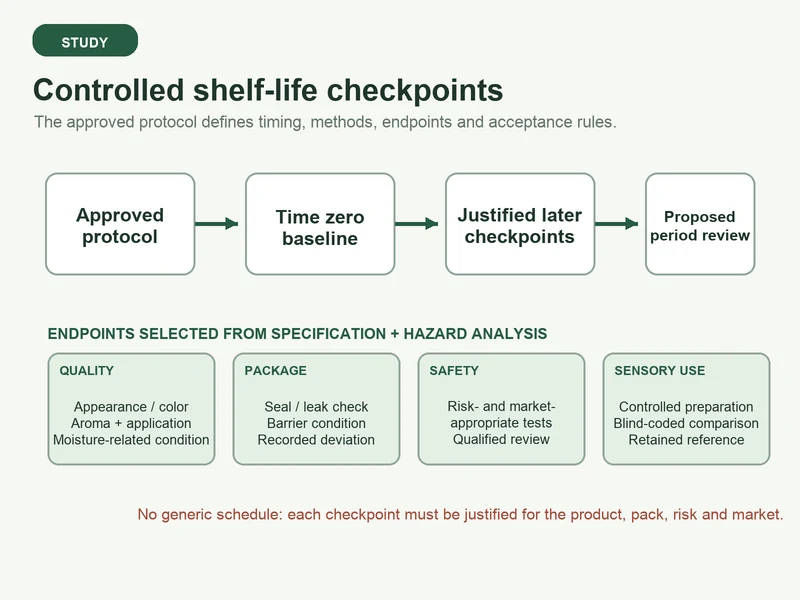
Include the labeled condition and any additional condition needed to answer a defined distribution risk. Record monitored temperature, humidity, light exposure, excursion handling, and the sampling calendar. Checkpoints should include time zero and enough later observations to reveal the trend through the proposed period; the exact schedule must be justified rather than copied from a generic template.
Practitioner judgment: a storage chamber set point is not evidence of sample exposure by itself. Review the monitored record and deviations, because an unexplained excursion can weaken every later result.
What quality and safety endpoints should be reviewed?
Choose endpoints from the agreed product specification and hazard analysis. Quality endpoints may include appearance or instrumental color, aroma, taste in the intended application, moisture-related measures, dispersion, and packaging integrity. Microbiological or chemical tests should follow the product’s risk assessment and market requirements; a sensory pass cannot replace a required safety control.
FDA’s CGMP and preventive-controls overview explains that applicable facilities must address current good manufacturing practice, hazard analysis, and risk-based preventive controls under 21 CFR Part 117. Buyers should have qualified food-safety and regulatory personnel define the applicable plan.
| Endpoint | Method control | Decision record |
|---|---|---|
| Color/appearance | Named instrument or controlled visual method | Result against approved limit |
| Sensory performance | Defined preparation and panel procedure | Acceptance against retained reference |
| Moisture-related condition | Approved laboratory method | Trend and specification status |
| Microbiological/chemical | Risk- and market-appropriate method | Qualified safety review |
| Package integrity | Defined seal or leak check | Pass, deviation, investigation |
How should sensory testing reflect the buyer’s application?
Use a controlled preparation that matches the commercial use: straight whisked matcha, latte, bakery, or another defined system. Fix powder dose, liquid or recipe, equipment, temperature, and evaluation order. Blind-coded samples and a retained reference reduce expectation bias.
Practitioner judgment: for a latte buyer, a dry-powder review alone can miss the endpoint that matters most. Evaluate the product in milk or the intended base when that is the approved use, while retaining the dry-powder checks needed for release. See matcha for latte applications.
Who approves the best-before date and when must it be revisited?
The protocol should name who approves methods and acceptance criteria, who reviews deviations, and who authorizes the final date and storage statement. Quality should control the evidence; regulatory should confirm market wording and obligations; commercial and operations should confirm the tested configuration matches what will be sold.
Reassess the conclusion after material changes to grade, process, supplier, package, fill, storage instruction, distribution route, specification, or test method. The change record should state whether existing evidence remains applicable and whether bridging or a new study is required.
What should a buyer request in a shelf life evidence pack?
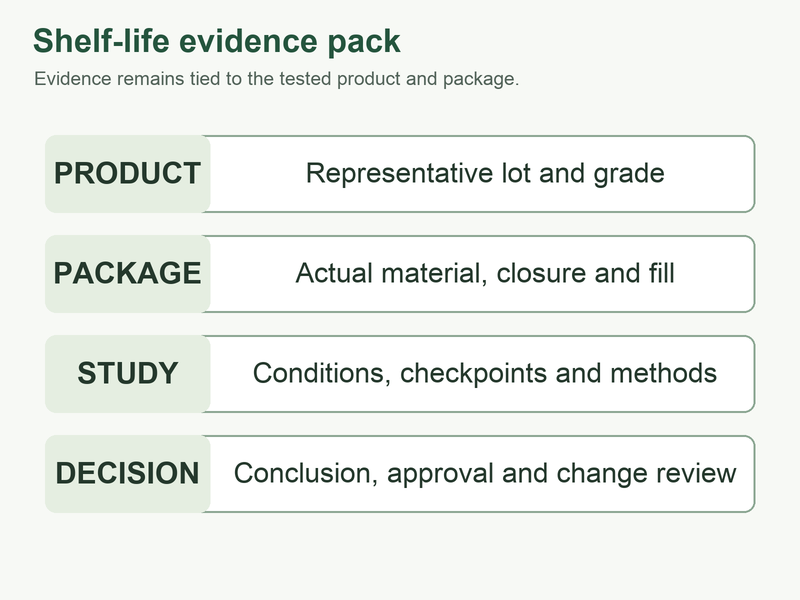
Request the approved protocol and report, sample and lot traceability, package specification, storage-monitoring record, test methods and laboratory identity, raw and summarized results, deviations, conclusion, and approval signatures. Also ask how ongoing retained-sample or complaint data will be trended after launch.
Connect this evidence to the matcha packaging guide and the B2B storage and browning guide. To discuss representative samples and packaging options, contact AdoroHu Matcha.
FAQ
- What is matcha shelf life validation?
It is a documented study showing how the named product in its intended package performs under defined storage conditions through a proposed date. - Can one grade’s shelf life be used for another grade?
Only after a documented technical assessment shows the evidence is applicable. Differences in material, process, specification, or use may require bridging or a new study. - Is accelerated testing enough?
It can support a defined prediction when the model is justified, but it should not be treated as automatically equivalent to real-time evidence. - Does a best-before date prove food safety?
No. Quality dating and food-safety controls answer different questions; qualified personnel must define applicable hazard controls and regulatory requirements. - Should opened-pack shelf life be studied separately?
Yes when an opened-use instruction is claimed, because repeated exposure and handling differ from a sealed-package study. - When should shelf life be revalidated?
After a material product, process, packaging, storage, route, specification, or method change, or when trend and complaint data challenge the current conclusion.
About the author: AdoroHu Matcha is a B2B matcha supply and private-label partner with production in Jingshan, Hangzhou and international operations in Shenzhen. Its approved company profile describes tea-garden resources, clean production workshops, in-house microbiological and physicochemical laboratory capability, and support from samples through bulk supply, packaging, and export service.