
A matcha tres leches cake works in production when the sponge, matcha milk, measured soak uptake, pooling, chilled hold, topping, and slice yield are controlled together. Pouring until the pan “looks wet enough” produces uneven portions and weak evidence for scale-up.
For matcha tres leches, fix the sponge geometry and soak route before tuning matcha intensity. Product developers can screen powders for matcha baking applications and validate the complete chilled dessert in their own facility.
Tres leches is a transfer process as much as a cake formula. The sponge must accept a measured liquid load without dry islands, free pooling, or structural collapse. Matcha dispersion and topping stability must survive the same chilled service window.
In short:
Key points:
- Specify sponge porosity, geometry, and condition before soaking.
- Measure soak addition, uptake, drainage, and portion variation.
- Validate chilled hold, topping, cut quality, and saleable yield under service conditions.
What should a commercial matcha tres leches standard define?
Define ingredient identities, sponge formula, pan, bake and cooling endpoints, perforation method, milk blend, matcha dispersion, applied soak, uptake window, topping, chilled hold, portion, and discard rule. Each term needs a recordable limit.
Use an exact powder code. AdoroHu’s EU Standard Series identifies E-1/E-2 Culinary, E-3/E-4 Premium, and E-5/E-6/E-7 Ceremonial; the Organic Series identifies O-1/O-2 Culinary, O-3 Premium, and O-4/O-5/O-6 Ceremonial. Those codes maintain sample identity but do not predict soak behavior or dessert acceptance.
Key Takeaway: Bind one named sponge, soak, topping, and service method into the standard.
How should matcha tres leches sponge porosity be controlled?
Control the matcha tres leches sponge through the foam or aeration method, batter density, fill, pan, bake endpoint, and cooling. The sponge needs connected pores that accept liquid while retaining enough structure to cut and lift.
Do not borrow the entire process from a matcha cake formulation guide without validation. Chiffon foam control is relevant, but tres leches adds a large post-bake liquid load. Record height, cooled mass, cell distribution, surface condition, and representative core samples before soak application.
A peer-reviewed study on contactless density measurement of highly aerated sponge batters measured batter density as mass divided by a fixed volume and compared formulations with different aeration. It supports density as a repeatable process observation, but its sponge formulas were not tres leches or matcha. Establish a house range from sponges that later meet uptake and slice limits.
Key Takeaway: Approve the unsoaked sponge as a controlled absorbent structure.
How should matcha disperse in tres leches milk?
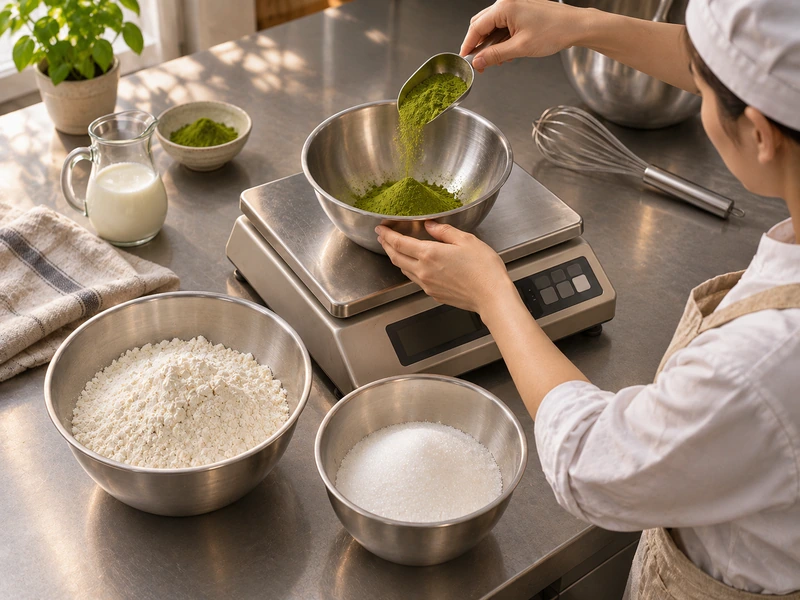
Pre-disperse the weighed matcha in a controlled part of the liquid, then combine it with the remaining milk blend in a fixed order. Cold, high-solids dairy systems can trap dry pockets and foam, creating dark streaks or inaccurate volume readings.
Record liquid temperatures, tool, time, batch mass, foam, residue, and appearance after a short rest. Compare first and last applied portions. Use matcha mixing guidance as related process context while recognizing that tres-leches milk is a different matrix.
Milk is an emulsion and protein-containing dispersion, while matcha adds insoluble plant particles. That combined structure explains why a uniform-looking mixing vessel does not guarantee identical first and last applications. The mechanism supports sampling across the batch; it does not supply a universal shear setting or stability time.
Key Takeaway: Validate dispersion in the actual milk blend and application equipment.
How should matcha tres leches milk and sweetness be balanced?
Balance the matcha tres leches milk blend against the soaked cake and topping, not as a beverage. Sweetened condensed milk, evaporated milk, cream, or alternatives contribute different water, sugar, fat, protein, and viscosity; substitution changes uptake and sensory balance.
| Variable | Process effect | Finished-dessert risk |
|---|---|---|
| Higher viscosity | Slower movement into pores | Wet top and dry center |
| More sugar solids | Changes sweetness and water mobility | Matcha aroma becomes muted |
| More fat | Changes coating and flavor release | Heavy finish or topping conflict |
| Different milk base | Changes emulsion and allergens | Unvalidated uptake and label |
Keep total batch mass constant while comparing a single change. A practitioner should reject a vivid green soak that tastes flat once combined with sweet sponge and cream; color is one attribute, not the release decision.
FDA identifies milk as a major food allergen under US labeling law. A switch to condensed milk, cream, or a plant alternative can change allergen declarations and cross-contact controls as well as uptake. Use current FDA food-allergen guidance for US scope and confirm destination-market requirements; the guidance does not validate the formulation.
Key Takeaway: Approve the milk blend through uptake, flavor, and service performance together.
How can a bakery measure matcha tres leches soak uptake?
For matcha tres leches, weigh the cooled sponge or pan assembly before application, weigh the soak applied, and measure free liquid or drained loss under a defined method. The difference provides a practical uptake estimate, but only when tare, timing, and handling stay consistent.
| Measure | Calculation | Decision use |
|---|---|---|
| Applied soak | Container loss or weighed addition | Confirms dose |
| Apparent uptake | Applied soak minus recovered free liquid | Compares process runs |
| Uptake ratio | Apparent uptake ÷ sponge mass | Normalizes different cakes |
| Portion variance | Portion masses across pan | Finds uneven distribution |
Do not present one successful ratio as a universal target. Pan depth, formula, pore structure, temperature, and service style change what is acceptable.
A materials-science study of macroporous compressible sponges shows that porosity and pore dimensions can govern capillary uptake in that nonfood system. Cake crumb differs in composition, wettability, deformation, and pore structure, so the study is only a physical analogy: it cannot predict tres-leches uptake, pore behavior, or timing. Measure the actual cake by zone and judge cut and sensory acceptance; maximum uptake is not the objective.
Fix the interval between application, free-liquid recovery, and weighing. A longer interval can increase apparent uptake without changing the formula, while handling loss can look like absorption. Use the same pan tare and recovery method for every comparison and report any liquid discarded during portioning.
Key Takeaway: Measure applied, retained, and free liquid with fixed timing and handling.
What matcha tres leches application pattern prevents dry zones?
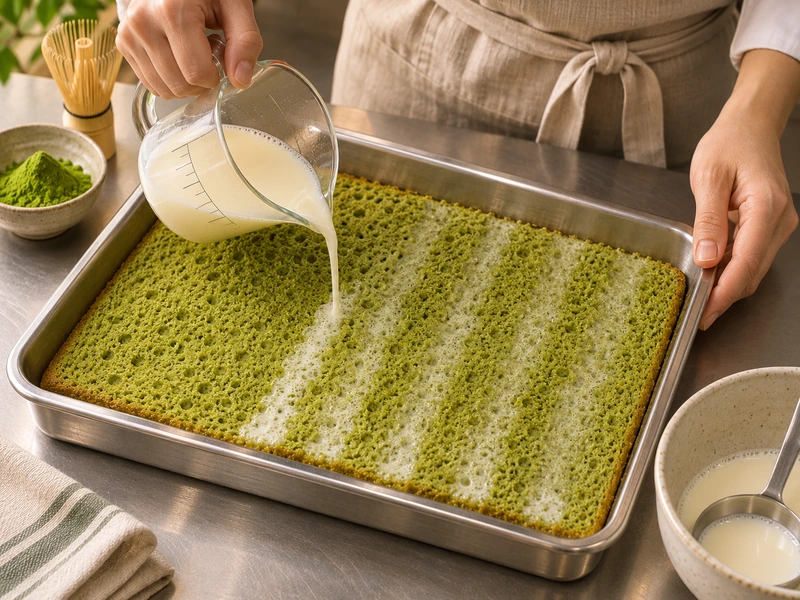
For matcha tres leches, specify perforation size and spacing, cake temperature, pour pattern, number of passes, interval between passes, and edge treatment. Applying the full load to one area can collapse cells before liquid migrates.
Map a trial pan into zones and compare portion mass, color, moisture, and cut quality from the center, edges, and corners. Rotate or change the pattern only after the map identifies a repeatable bias.
Use a fixed application vessel or weighed reservoir and reconcile its starting and ending mass. This catches liquid retained in a jug, hose, or applicator that would otherwise be counted as delivered. Record the cake’s orientation during application and chilling, because rotating an uneven pan between steps can hide the source of a wet zone.
Key Takeaway: Validate the pour pattern across the pan, not from one center slice.
How should matcha tres leches pooling be handled?
Define acceptable matcha tres leches free liquid after a named absorption interval and what happens when the limit is exceeded. Pooling can signal excess dose, poor porosity, blocked surface, high viscosity, cold conditions, or uneven application.
Avoid simply pouring off liquid and releasing the cake. The removed amount changes flavor and yield, while the root cause remains. Record recovered liquid, affected zones, and disposition.
Investigate the sequence before changing the recipe. Confirm sponge mass and temperature, perforation tool, applied amount, pass timing, liquid temperature, and pan level. A tilted rack or warped pan can concentrate free liquid at one edge and mimic a formulation failure. Compare the zone map with the application log before deciding whether the sponge or soak needs adjustment.
If recovery is allowed during development, document the action and evaluate the result separately. Extra chilling, a second perforation pass, or liquid removal may produce an edible cake, but it no longer represents the intended process. Do not blend recovered and standard portions in the same acceptance dataset.
Key Takeaway: Treat free liquid as process evidence and investigate before release.
How should matcha tres leches chilled hold be validated?
Validate matcha tres leches quality under the real pan, cover, refrigerator, topping, cutting, and display conditions. Record temperature using approved procedures, visible pooling, weeping, color, aroma, crumb integrity, and portion lift at planned checkpoints.
The FDA Food Code provides a model for retail-food safeguards; follow applicable state and local requirements and qualified food-safety review. A sensory hold cannot establish a legal time-temperature rule or shelf life.
Whether a specific formula is a time/temperature control for safety food depends on its composition and applicable authority. Milk-based soaked cake should enter that determination rather than assuming the recipe name settles it. The quality study can then operate inside the approved cold-holding and service controls; it cannot replace them.
Key Takeaway: Keep quality-hold evidence and food-safety authority distinct and documented.
What makes a stable matcha tres leches topping?
The matcha tres leches topping should spread or pipe consistently, retain structure, complement the soaked cake, and avoid water release during the approved chilled window. Evaluate topping density, application mass, finished height, weeping, color transfer, and cut cleanliness.
If matcha appears in both soak and topping, vary one component at a time. Otherwise, the bakery cannot tell which change caused bitterness or color drift.
Key Takeaway: Approve topping mass and stability on the fully soaked, chilled cake.
How should matcha tres leches slice yield be calculated?
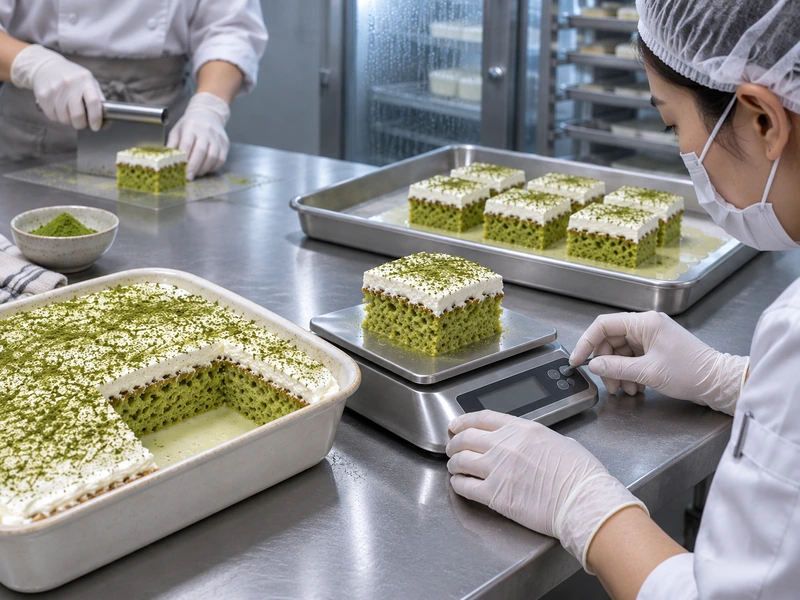
Calculate conforming matcha tres leches slices after edge loss, breakage, wet rejects, topping damage, and leftover pan liquid. Theoretical grid count overstates output when portions cannot lift cleanly.
| Yield point | Evidence | Commercial consequence |
|---|---|---|
| Cooled sponge | Mass and dimensions | Starting process base |
| Soaked cake | Retained soak and free liquid | Uptake control |
| Finished pan | Topping mass and hold loss | Total saleable mass |
| Portions | Conforming count and weight | Actual unit cost |
Prefer the formulation with repeatable conforming portions over the one with the highest liquid uptake.
Key Takeaway: Cost saleable chilled portions, not planned grid squares.
What evidence should approve the finished dessert?
Approve repeated matcha tres leches runs against sponge, dispersion, uptake, zoning, hold, topping, sensory, slice, and yield limits. Retain photographs and zone results as well as averages.
Include portions from the center, edge, and corner at the beginning and end of the intended service window. Weigh each portion with topping and note liquid left in the pan. Reviewers should score matcha aroma, dairy balance, sweetness, bitterness, crumb saturation, structural integrity, topping condition, and aftertaste. The standard should state which defects require rejection and which allow bounded rework during development.
Train cutting and lifting as part of release. Blade condition, cleaning interval, cut sequence, and server geometry affect the apparent yield. If the approved cake cannot be portioned by ordinary staff without frequent collapse, the process is not ready even when the formulation panel likes it.
Revalidate after a meaningful change to matcha, flour, leavening, milk component, pan, perforation, applicator, refrigerator, topping, portion, or package. Contact AdoroHu Matcha early when powder samples or specification documents must be aligned with the test plan.
Key Takeaway: Release the exact chilled dessert system and control later changes.
FAQ
- What is matcha tres leches?
- It is a sponge cake combined with a milk soak containing matcha and usually finished with a chilled topping.
- How do you prevent a soggy tres leches cake?
- Control sponge structure, applied soak, pour pattern, absorption interval, pooling limit, and chilled hold rather than relying on appearance alone.
- Why does matcha clump in the milk mixture?
- Cold liquid, high solids, fast addition, or insufficient wetting can leave dry pockets; a controlled pre-dispersion makes them easier to prevent.
- How should soak uptake be measured?
- Weigh the applied soak and recoverable free liquid against a known sponge mass using fixed tare, timing, and handling.
- Can the cake be prepared in advance?
- Only within a validated quality hold and the applicable food-safety requirements for the actual recipe and storage system.
- When should the standard be revalidated?
- Revalidate after a material ingredient, sponge, soak, pan, application, chilling, topping, portion, or packaging change.
Conclusion
A repeatable matcha tres leches program measures the liquid transfer and follows it through chilled service and saleable slices. The release record should connect every portion to the approved sponge, soak, topping, and hold conditions.