
ISO 17025 vs ISO 9001 compares laboratory technical competence with an organization-wide quality-management system. Matcha buyers should use each credential for the question it can answer, then verify the certificate, issuing body, scope, method, location, and current status.
For supplier approval, ISO 17025 vs ISO 9001 evidence belongs beside the result and specification. The matcha COA guide explains lot-level interpretation; this comparison decides what the laboratory or supplier credential contributes.
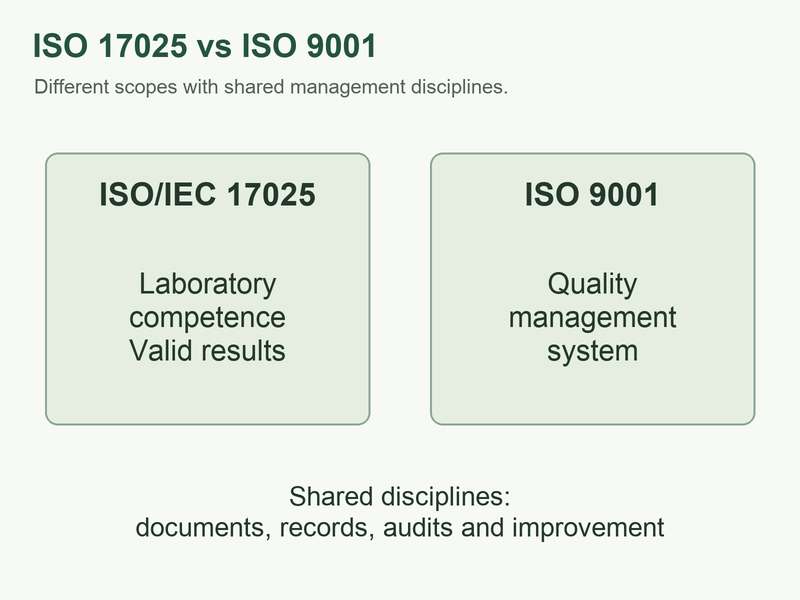
ISO/IEC 17025 addresses competence, impartiality, and consistent operation of testing and calibration laboratories. ISO 9001 sets requirements for a quality-management system across many kinds of organizations. Neither credential alone proves that a particular matcha result is correct or acceptable.
In short:
Key points:
- Use ISO 9001 for organization-level QMS evidence and ISO/IEC 17025 for laboratory competence.
- Verify accreditation scope down to location, field, method, and current status.
- Connect the credential to sampling, result, specification, and buyer decision.
What is the core ISO 17025 vs ISO 9001 difference?
The core ISO 17025 vs ISO 9001 difference is the object of assurance. ISO 9001 specifies requirements for an organization’s quality-management system and its ability to provide consistent products and services. ISO/IEC 17025 specifies competence, impartiality, and consistent-operation requirements for testing and calibration laboratories.
Both contain management-system ideas such as controlled documents, corrective action, internal review, and improvement. ISO/IEC 17025 adds laboratory-specific technical requirements involving personnel, facilities, equipment, metrological traceability, methods, sampling where applicable, handling of items, technical records, uncertainty, and result validity.
Do not describe one as a higher version of the other. They solve different assurance problems and can coexist.
Start with the unanswered question. For document, complaint, and customer-requirement control, review the QMS. For competence to perform a named test, review accreditation scope and technical records. Asking one credential to answer both leaves an approval gap.
Create separate supplier-master fields for QMS certification and laboratory accreditation. Each field should store issuer, certificate or accreditation number, location, scope, effective dates, verified source, and owner. This prevents a purchasing system from collapsing both into one “ISO approved” checkbox and makes expiry review possible without rereading every supplier file.
Key Takeaway: ISO 9001 addresses a broad QMS; ISO/IEC 17025 addresses laboratory competence and operation.
What does ISO 9001 establish for a matcha supplier?
ISO 9001 establishes that the certified organization’s QMS was assessed against the standard within the certificate scope. ISO describes the standard as applicable to organizations seeking consistent products and services and improved customer satisfaction.
Review the legal entity, site, covered activities, certificate dates, certification body, and exclusions or boundaries. A supplier group may hold a certificate that covers one office or activity but not the manufacturing site named on a purchase.
ISO 9001 can support confidence in document control, customer requirements, nonconformity, and improvement. It does not by itself establish a laboratory’s competence for pesticide, microbiological, identity, or color testing.
Check whether the certificate covers design, manufacture, distribution, or another relevant activity. A parent-company credential may sit beside another operating company. Match certificate holder, production site, invoice entity, and supplied product before using it.
Key Takeaway: Use ISO 9001 as scoped organization-level QMS evidence, not as proof of a specific test method.
What does ISO/IEC 17025 establish for a laboratory?
ISO/IEC 17025 establishes laboratory requirements for competence, impartiality, and consistent operation. Accreditation bodies assess a laboratory against those requirements and publish an accreditation scope defining recognized activities.
The scope matters more than the logo. It may list fields, matrices, analytes, methods, ranges, or calibration quantities, depending on the body and program. A laboratory accredited for water chemistry is not automatically accredited for pesticide residues in matcha.
Accreditation also does not approve the buyer’s specification. The lab can competently perform a scoped method while the buyer still needs correct sampling, acceptance limits, and disposition rules.
Read flexible scopes carefully. They may allow methods within controlled boundaries, but the directory may not list each method like a fixed scope. Ask for the current detailed scope or method list and proof the reported method was covered on the test date.
Technical competence is method- and matrix-dependent. Personnel authorization, equipment range, reference materials, calibration, environmental conditions, uncertainty, and quality-control design can differ across tests. A strong pesticide-residue capability cannot be assumed to cover microbiology or sensory analysis. Buyers should trace the exact reported result to the part of the scope and method system that supports it.
Key Takeaway: Confirm that the current accreditation scope covers the relevant laboratory, matrix, analyte, and method.
How should buyers verify an accreditation claim?
Buyers should verify an accreditation claim in the issuing accreditation body’s current directory and certificate records. Match the laboratory name, physical location, certificate number, status, dates, and scope revision. A PDF supplied by a vendor may be outdated or belong to another site.
NIST’s NVLAP is one program that accredits laboratories for specific scopes using ISO/IEC 17025-based requirements. Other recognized accreditation bodies operate in different countries and fields. Buyers should confirm the body and applicable recognition rather than assuming every logo has identical standing.
Save dated directory evidence with the decision because status can change. Distinguish coverage on the report date from current coverage, and define the response if the body suspends, narrows, or withdraws scope.
| Verification item | Buyer check | Risk caught |
|---|---|---|
| Legal identity | Name matches report and directory | Borrowed credential |
| Location | Testing site appears in scope | Off-scope facility |
| Status and dates | Accreditation is current | Expired or suspended claim |
| Scope detail | Matrix, analyte, method, range fit | Unaccredited test |
Key Takeaway: Verify the issuing body’s live directory and the exact scope, not only the certificate image.
How do certification and accreditation differ?
Certification and accreditation refer to different conformity-assessment relationships. An organization can be certified to ISO 9001 by a certification body. A laboratory is accredited to ISO/IEC 17025 by an accreditation body for a defined scope.
In casual speech, suppliers may say “ISO 17025 certified.” Buyers should clarify whether they mean formal laboratory accreditation, an assessment, training, or use of a subcontracted accredited lab. The report should identify the laboratory that performed the work.
Prefer precise credential language in specifications and supplier questionnaires. Ambiguous wording can allow a supplier-wide ISO 9001 certificate to answer a laboratory-competence question it was never designed to settle.
Accreditation also differs from regulatory approval. A method can be accredited yet unsuitable for a specific legal purpose, while a regulatory program can impose added conditions. Keep accreditation, certification, and program authorization as separate fields.
Key Takeaway: Ask whether the organization is certified or the laboratory is accredited, by whom, and for what scope.
Which laboratory details matter beyond the credential?
Laboratory details beyond the credential include sample identity, chain of custody, method version, preparation, equipment, calibration, quality controls, reporting limit, uncertainty where relevant, authorized review, and result format. Accreditation creates a competence framework; the actual test still depends on these records.
Subcontracting requires attention. A supplier may receive samples while another laboratory performs the test. The report and scope should reveal which facility performed each activity and whether the relevant method remains within accredited scope.
Review qualifiers on each report line. Out-of-scope, subcontracted, opinion, or modified-method results may be marked differently. A logo at the top does not automatically cover every result, so resolve coverage before disposition.
Check the report against the laboratory’s rules for use of the accreditation symbol. Some reports can include both accredited and non-accredited activities with explicit marking. Preserve the complete report rather than extracting one result into a spreadsheet without its qualifiers, units, method, or authorization, because those details determine how the buyer may rely on it.
| Test evidence | Question | Buyer consequence |
|---|---|---|
| Sample identity | Does it link to the purchased lot? | Prevents report substitution |
| Method | Is the version fit for matrix and analyte? | Supports result meaning |
| Quality controls | Did the run meet acceptance criteria? | Supports run validity |
| Reporting limit | Can the method assess the specification? | Prevents false compliance |
Key Takeaway: Connect accreditation to the actual sample, method, controls, report, and acceptance decision.
When can ISO 9001 and ISO 17025 work together?
ISO 9001 and ISO 17025 can work together when the supplier’s QMS governs purchasing, specifications, release, complaints, and supplier management while an accredited laboratory provides competent testing within scope. The credentials then support different links in one evidence chain.
A supplier may operate an internal ISO/IEC 17025-accredited laboratory, use an external accredited laboratory, or use a mix based on method. Its ISO 9001 certificate neither adds nor removes the laboratory’s accredited scope.
Choose both forms of evidence when organization-level control and technical laboratory competence materially affect the purchase. Requiring both for every low-risk check can add cost without changing the decision.
Define the interface: the supplier controls sample submission and release use; the laboratory controls technical execution; the buyer controls its specification. A quality agreement can assign notifications without merging these responsibilities.
Key Takeaway: Combine the credentials when the buying decision needs both supplier QMS control and scoped laboratory competence.

Does every matcha test require ISO 17025 accreditation?
Not every matcha test universally requires ISO/IEC 17025 accreditation. Contract terms, destination-market rules, customer policies, certification schemes, and risk may require or favor it for certain tests. The buyer must identify the actual requirement.
FDA’s Laboratory Accreditation for Analyses of Foods program requires accredited laboratories for specified testing circumstances under that program. LAAF does not make ISO/IEC 17025 accreditation universally mandatory for every matcha test.
Use risk and consequence to set the laboratory requirement. Regulatory or release-critical testing may justify accredited scope, while development screening may use another qualified arrangement if the decision and limits are explicit.
Record exceptions by test and purpose rather than granting a blanket waiver. A development result may guide formulation but cannot automatically support a regulatory certificate. Identify the stricter sampling, method, and laboratory requirement before testing.
Cost should follow consequence. Accreditation can add justified assurance for release-critical or legally specified work, but it cannot rescue a vague specification. Before paying for another test, confirm the decision limit, required reporting limit, sampling responsibility, and action after failure. A well-scoped test prevents both unnecessary expense and results that arrive too late to control the lot.
Key Takeaway: Require accreditation where law, contract, program, or risk supports it; do not present it as universal.
What should a buyer request with a matcha test report?
A buyer should request the final report, laboratory identity, sample and lot identifiers, dates, method, result units, reporting limits, relevant accreditation mark or scope reference, and authorized approval. The package should also connect the result to the agreed specification.
Use the matcha pesticide-testing guide for a market-specific example and the supplier audit guide for broader controls. Neither link replaces current scope verification.
| Document | Required match | Decision supported |
|---|---|---|
| Test report | Laboratory, sample, method, dates | What was measured |
| Scope schedule | Site, field, method or analyte | Accredited coverage |
| Specification | Product, market, limit, revision | Pass or fail basis |
| Lot record | Sample-to-shipment linkage | Applicability to purchase |
Key Takeaway: Review the report, scope, specification, and lot link as one evidence package.
What are common credential mistakes in supplier approval?
Common credential mistakes include accepting a logo without checking the issuer, treating ISO 9001 as laboratory accreditation, accepting a broad ISO/IEC 17025 scope for an unlisted method, and extending one site’s credential to another. Expired documents and renamed legal entities create additional ambiguity.
Another mistake is using accreditation to bypass sampling review. A competent test on an unrepresentative or untraceable sample cannot support a lot-level decision. The matcha trial-order guide helps buyers test the wider handoff before scaling.
Create a credential register with verified source, date, expiry point, applicable tests, and owner. Alerts should prompt review before purchasing relies on a changed scope, site, legal identity, or issuing body.
Reject a credential claim that cannot be resolved to a current issuer record and applicable scope. A missing attachment can support conditional follow-up; an unverifiable identity is a more fundamental approval gap.
Buyers should approve ISO 17025 vs ISO 9001 evidence by recording the question each credential answers, verified source, scope, facility, status, and limitation. The approval should name which products, tests, suppliers, and markets can rely on it.
Schedule review before expiry and after laboratory, method, site, ownership, or accreditation-status changes. Preserve the earlier scope so the buyer can determine which historical results were covered at the time.
For wholesale matcha sourcing, connect supplier QMS evidence with the laboratory used for the selected specification. Define product, test, and documentation requirements before requesting evidence.
Key Takeaway: Treat identity, status, scope, sample linkage, and approval boundaries as separate gates.

FAQ
- Is ISO 17025 the same as ISO 9001?
- No. ISO/IEC 17025 addresses laboratory competence, while ISO 9001 addresses an organization’s quality-management system.
- Is ISO 17025 certification or accreditation?
- Laboratories are formally accredited to ISO/IEC 17025 for a defined scope.
- Does ISO 9001 prove a laboratory result is valid?
- No. It can support QMS evidence but does not establish competence for a specific laboratory method.
- Does an ISO 17025 logo cover every test?
- No. The current accreditation scope must cover the relevant location and testing activity.
- Must every matcha test use an accredited laboratory?
- No universal rule applies; the requirement depends on law, program, contract, market, and risk.
- What should buyers verify first?
- Verify the issuer, legal identity, site, status, scope, and connection to the actual test report.
Conclusion
The next decision is whether the buyer needs organization-level QMS assurance, scoped laboratory competence, or both. Verify the issuer and scope before relying on a logo, then connect the credential to the sample and specification. Contact AdoroHu Matcha to define the evidence required for a selected product and market.