
Matcha dango production succeeds when rice-flour identity, hydration, ball mass, boiling endpoint, cooling, and service are controlled as one system. A home recipe can tolerate hand adjustments; a café or commissary needs evidence that each batch will shape, cook, skewer, and eat consistently.
For matcha dango development, start with a fixed flour and a culinary matcha made for food applications. Changing both materials during the same trial hides the cause of cracking, spreading, hard centers, weak colour, or excessive stickiness.
Matcha dango is a hydrated rice-flour dough formed into small balls and cooked before cooling, skewering, and service. Commercial control depends on repeatable flour behavior, water addition, piece mass, cook endpoint, surface handling, and hold conditions. It is a different production task from filled or sheeted mochi.
In short:
Key points:
- Lock the flour specification and hydration method before adjusting matcha dose.
- Use piece mass, core condition, and chew as the boiling decision, not floating alone.
- Validate cooling, skewering, sauce, and service as part of the finished dango system.
What makes matcha dango different from matcha mochi?
Matcha dango is controlled as a formed, boiled ball, while mochi production may involve pounding, steaming, sheeting, filling, or freeze-thaw requirements. The overlap in glutinous-rice ingredients does not make the processes interchangeable. Ball geometry changes water uptake and the route by which heat reaches the center.
That boundary matters during troubleshooting. A dango batch with a firm core may need a different piece mass, hydration, or boiling profile. Advice written for a filled mochi sheet may focus on extensibility and sealing instead. Use the commercial matcha mochi guide for those separate sheet and filling decisions.
Define the dango format before trials: ball diameter, target mass, balls per skewer, sauce or coating, serving temperature, and expected service period. Those choices determine which texture remains acceptable after cooking.
Document the boundary in the development brief so later teams do not import a mochi-sheet solution. Dango trials should follow a ball from portioning through boil and service; mochi filling leakage, sheet dusting, and freezer recovery belong to a different validation. This keeps ingredient comparisons tied to the correct failure mode.
Key Takeaway: Treat dango as a boiled-ball process with its own geometry, endpoint, and service controls.
How should the rice-flour system be specified for matcha dango?
Specify rice flour by botanical and functional identity, supplier grade, milling route, particle distribution, and relevant pasting behavior. “Rice flour” is too broad for repeatable matcha dango because waxy and non-waxy systems do not hydrate or set in the same way.
A 2021 study comparing black, brown, white, and waxy rice flours found differences in gelatinization, enthalpy, pasting, and viscosity. That evidence shows why flour identity can change processing, although it does not establish an AdoroHu formula or a universal dango recipe. Translate it into procurement controls: approve a defined flour, retain its lot identity, and recheck performance after a supplier or grade change.
| Flour record | Production question | Trial consequence |
|---|---|---|
| Rice type and grade | What starch system is being hydrated? | Prevents false comparisons between unlike flours |
| Milling method and particle profile | How quickly and evenly will water enter? | Guides mixing and rest evaluation |
| Pasting or gelatinization data | How may heat change structure? | Supports endpoint investigation |
| Lot and supplier | Can a drift be traced? | Separates material change from operator change |
Key Takeaway: Buy a defined rice-flour system and treat a supplier or grade change as a new process variable.
How should water addition and dough hydration be controlled?
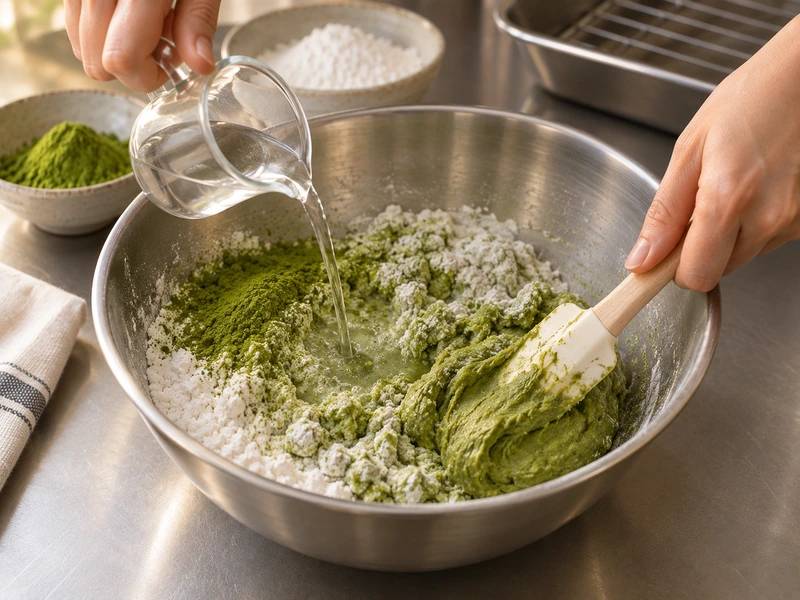
Hydration should produce a cohesive dough that portions cleanly without dry cracks or uncontrolled surface tack. Record water by weight, water temperature, addition sequence, mixing time, rest time, and dough yield. An operator instruction such as “add until soft” cannot distinguish flour absorption from personal preference.
Add water in a controlled sequence and inspect the mass after the defined rest. Dry edges suggest incomplete hydration or poor dispersion; slumping suggests excess free water or insufficient structure. Matcha also contributes fine solids, so a powder-dose change can shift the water balance even when the flour remains constant.
Use a small hydration ladder during development rather than correcting one bowl repeatedly. Make separate batches at deliberate water levels, then compare forming loss, cooked diameter, center texture, and service chew. This preserves cause and effect.
Account for water left in the vessel and on tools as well as the amount weighed into the formula. A nominal addition can overstate effective hydration when dry material remains on the bowl, or understate it when operators wet gloves and benches without recording the water. A mass balance turns those hidden adjustments into visible process loss.
Key Takeaway: Set hydration by weighed inputs and post-rest dough behavior, then verify it against the cooked ball.
How can flour choice change chew and water retention?
Flour choice changes chew by altering gelatinization, gel-network formation, and water retention. A 2025 glutinous-rice-flour study linked amylopectin and pasting differences with hardness, network structure, and water retention in Daifuku. Daifuku is an adjacent matrix rather than boiled dango, so the finding supports a mechanism to test, not a finished-product claim.
For dango, compare candidate flours through the actual boil, cool, and service sequence. Measure or score deformation, surface tack, core firmness, chew, and moisture loss at defined checkpoints. A flour that feels ideal immediately after cooking may firm too quickly for the intended service.
The bounded recommendation is to choose flour on finished dango performance rather than the lowest raw-material price or the softest hot sample. An unstable chew window creates rejects and inconsistent guest experience that can outweigh a modest ingredient saving.
Key Takeaway: Validate flour through the intended service window because hot texture alone cannot predict held dango quality.
Why do milling method and particle size matter?
Milling method and particle size matter because they affect starch damage, water access, swelling, solubility, and gelatinization behavior. A 2026 study of rice flours found that dry, semi-dry, and wet milling produced different physicochemical properties across rice types. The work is procurement evidence, not a dango process specification.
Ask suppliers for a stable grade and change notification when the milling route or particle profile changes. In production, watch for longer hydration, grainy surfaces, cracking during rolling, or unexpected stickiness. These symptoms can appear even when the ingredient name and declared composition stay the same.
Do not respond to a new flour lot by changing water, mixing, ball size, and cook time at once. Hold the process constant first, document the difference, then adjust one variable in a controlled confirmation trial.
Key Takeaway: Milling changes can alter dough behavior without changing the ingredient name, so flour revisions need controlled revalidation.
How should matcha be dispersed without creating green specks?
Matcha should be dispersed through a repeatable dry blend or pre-dispersion step that prevents concentrated pockets. Sift or screen the relevant dry ingredients, define blend order, and check the mixed flour under consistent light before water addition. The goal is uniform distribution, not prolonged mixing that heats or compacts the powder.
Use a commercial matcha baking and application guide to align grade selection with food use, then confirm it in dango. A higher matcha dose affects colour and flavour but also raises total fine solids. Review hydration again after every meaningful dose change.
| Observation | Likely area to check | Controlled response |
|---|---|---|
| Dark green pinpoints | Dry blending or agglomerates | Improve screening and blend sequence |
| Pale and dark balls in one batch | Ingredient distribution or portion mixing | Sample dough from several mixer locations |
| Bitter surface, weak center flavour | Localized powder or coating pickup | Separate dough dispersion from finishing |
| Colour drift between lots | Matcha identity, dose, or process exposure | Hold formula and compare retained standards |
Key Takeaway: Control matcha distribution before hydration and reassess water balance whenever the powder dose changes.
How should ball mass and forming be standardized?
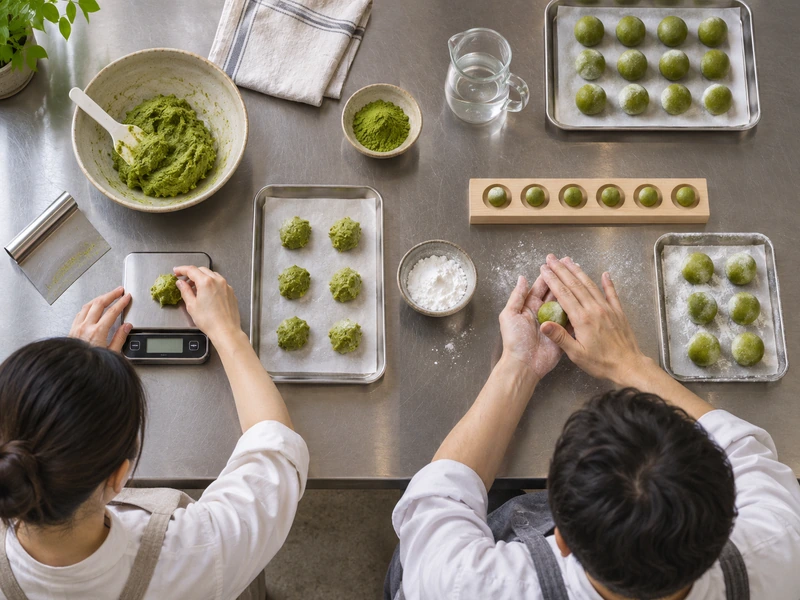
Ball mass should be standardized because geometry controls cooking rate, center condition, skewer appearance, and portion yield. Set a target mass and an internal trial tolerance from actual capability; no universal value applies to every dango format. Check pieces across the beginning, middle, and end of forming.
A calibrated scale can verify mass, while a diameter gauge or visual standard catches misshapen pieces. Record dough left on equipment and trim loss so yield calculations reflect saleable balls rather than theoretical formula weight.
Choose mechanized forming only after the dough window is stable. Equipment cannot repair flour or hydration variability; it will reproduce that variability quickly. For manual forming, define portioning tools, rolling sequence, and the point at which drying dough must be held or discarded.
Run a short capability check before full production. Weigh consecutive pieces from each forming position, then compare their cooked diameters and center texture. If one position drifts, correct the divider or operator method before changing the whole formula. This separates forming variation from a genuine hydration problem.
Key Takeaway: Control individual mass and shape before optimizing line speed because ball geometry determines both cooking and yield.
How should boiling and the float endpoint be interpreted?
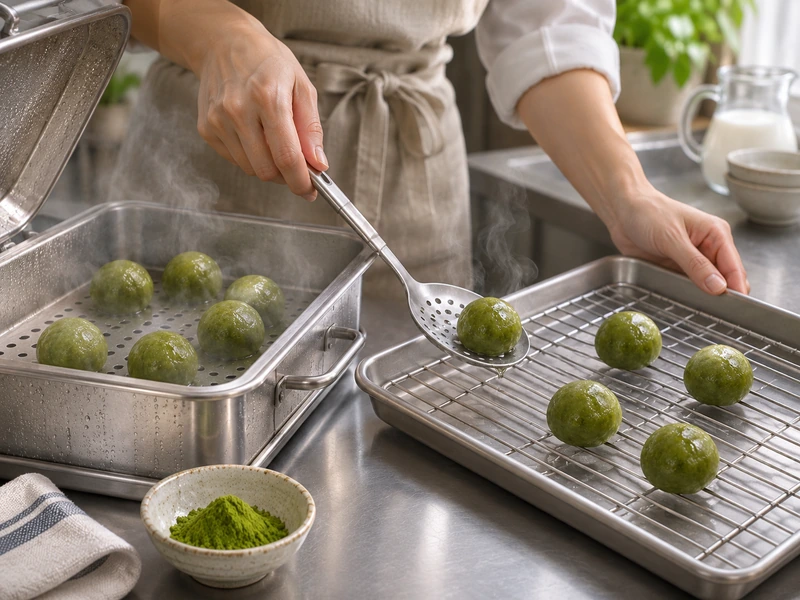
Boiling should be controlled by water load, batch size, recovery after loading, agitation, piece mass, and a verified center endpoint. Floating is a useful observation, but it is not proof that every ball has the required internal texture. Entrapped gas and surface changes can affect buoyancy.
During development, remove pieces at defined stages and cut or compress them to assess the core. Compare the visual endpoint with chew after cooling, because residual heat and starch setting continue to influence texture. Once the relationship is understood, write an operator rule that combines observable process signals with periodic verification.
Control the cooking load as carefully as the clock. Adding too many cold pieces can slow recovery, encourage sticking, and widen the difference between the first and last ball loaded. Record vessel fill, water condition, batch mass, loading sequence, and the point when normal boiling resumes. Those details make endpoint differences explainable.
Avoid setting a universal time from a consumer recipe. Vessel geometry, water ratio, heater recovery, altitude, flour, and ball mass all change the result. The practical choice is a validated endpoint for the actual equipment and format.
Key Takeaway: Use floating as one process signal and verify it against core condition and cooled chew.
How should cooling, skewering, and sauce application be controlled?
Cooling should stop or moderate carryover cooking without causing waterlogging, surface damage, or uncontrolled sticking. Define the cooling medium, contact time, draining method, spacing, and time before skewering. Handle pieces consistently so deformation is not confused with a weak dough.
Skewering introduces its own acceptance checks: piece integrity, spacing, orientation, balls per skewer, and breakage. Sauce or powder coatings change surface moisture and adhesion, so evaluate them on the assembled product rather than on a single fresh ball.
| Stage | Check | Decision |
|---|---|---|
| Cooling | Core texture and surface tack | Adjust cooling route before changing formula |
| Draining | Free water on surface | Prevent diluted sauce and package condensation |
| Skewering | Cracks, splits, and pull-off resistance | Confirm ball strength and skewer method |
| Finishing | Even pickup and runoff | Match sauce viscosity to cooled surface |
| Service | Chew, appearance, and handling | Approve the complete format |
Key Takeaway: Cooling and finishing are process steps that can change texture and yield, not decorative work after cooking.
How should matcha dango be held and released for service?
Matcha dango should be released against a defined service condition covering identity, cook result, appearance, texture, handling, and food-safety controls. The FDA Food Code provides model retail-food provisions for time, temperature, cooling, and holding, but local adoption varies. It does not establish a dango shelf life.
Build the hold study around the actual formula, sauce, package, environment, and service method. Inspect at planned checkpoints for firming, syneresis, surface drying, stickiness, colour change, skewer stability, and sensory acceptance. Use applicable local rules and a qualified food-safety review for the release plan.
Do not extend the service window because the product still looks acceptable. A validated period must cover both safety and quality under representative handling. When either fails, shorten the window or redesign the process.
Key Takeaway: Release dango only within a service window validated for the actual product, handling route, and local requirements.
FAQ
- Is matcha dango the same as matcha mochi?
- No. Dango is controlled as formed rice-flour balls that are cooked and served, while mochi can involve different steaming, sheeting, filling, or freeze-thaw processes.
- Which rice flour is best for matcha dango?
- Choose a defined flour grade from trials of the actual boil, cooling, and service process rather than relying on the generic name “rice flour.”
- Does floating mean dango is fully cooked?
- Floating is one useful signal, but the endpoint should be verified against ball mass, center condition, and cooled chew.
- Why does matcha dango crack while forming?
- Check flour identity, weighed hydration, mixing, rest, surface drying, and piece mass before changing several variables at once.
- How can a producer reduce green specks?
- Control screening, dry-blend order, mixing coverage, and matcha agglomerates before adding water.
- How long can matcha dango be held?
- Set the period from a documented study of the actual formula, finish, package, service conditions, and applicable food-safety rules.
Conclusion
Commercial matcha dango needs one controlled line from flour receipt through hydration, forming, boiling, cooling, skewering, and service. Approve the flour and matcha against the finished ball, then set mass, endpoint, and hold rules from actual trials. For ingredient selection and application support, contact AdoroHu Matcha with the intended format and process.