
Food safety culture is the shared pattern of priorities and behavior that determines how people handle food-safety decisions when supervision, time pressure, and written procedures compete. Buyers should assess what leaders fund, what employees report, and how the organization responds to weak signals.
For a matcha supplier review, food safety culture adds context to technical programs and audit findings. The matcha supplier audit guide can establish process evidence; culture assessment asks whether people consistently raise, understand, and correct problems between audits.
Food safety culture becomes visible through leadership decisions, frontline behavior, communication, competence, and responses to bad news. A survey alone cannot establish it. Buyers need several evidence streams interpreted within the facility and workforce context.
In short:
Key points:
- Compare stated priorities with staffing, time, resources, and management actions.
- Test whether people can report concerns and receive useful follow-up.
- Combine perception, observation, records, and outcomes without inventing one universal score.
What is food safety culture in manufacturing?
Food safety culture in manufacturing is the set of shared values, beliefs, and norms that shape food-safety behavior across routine and abnormal work. The CDC describes culture in terms of shared values and norms influencing behavior. Its evidence focuses on restaurants, so manufacturing teams must adapt the principle to production roles, shifts, equipment, and controls.
Culture does not replace hazard analysis, sanitation, supplier controls, or corrective action. It affects whether people follow those systems, recognize deviation, and act before product moves. A polished policy can coexist with workarounds if production pressure rewards speed and penalizes stoppage.
Define the assessment boundary before collecting evidence. Name the facility, functions, shifts, worker groups, languages, and review period. An office survey cannot represent contract sanitation staff or a night shift that faces different supervision and production constraints.
Avoid labeling the entire organization from one event. A strong response to one complaint and a weak sanitation handoff can coexist. Culture assessment should locate where expectations are reinforced or undermined so improvement reaches the responsible group and work condition.
Key Takeaway: Assess culture as shared behavior within a defined work setting, not as a slogan or company-wide label.
How does leadership shape food safety culture?
Leadership shapes food safety culture through decisions about resources, priorities, response, and example. Leaders show what matters when they choose staffing for sanitation, approve maintenance downtime, review incidents, and respond when a shipment deadline conflicts with a hold.
FDA identifies culture as a core element of its New Era of Smarter Food Safety strategy, emphasizing leadership and sustained behavior. That strategic position supports management attention but does not create a universal culture score or prove any individual facility performs well.
Buyers should compare messages with decisions. Ask for examples of how management handles an inconvenient food-safety concern, how overdue actions are escalated, and which review meetings include food safety. Avoid demanding sensitive personnel records; a redacted decision trail can show governance.
Choose evidence of resource allocation over repeated policy statements. When leaders repeatedly defer a known repair or leave critical roles uncovered, posters and speeches cannot compensate. The consequence is a control that exists on paper but fails during actual workload.
Review what leaders ask after bad news. Questions about affected product, cause, worker input, and recurrence support learning. Questions focused only on who reported or how to close the record quickly can suppress future signals even when the official policy invites reporting.
Key Takeaway: Leadership commitment is credible when priorities, resources, and responses protect food safety under commercial pressure.
What does a healthy reporting climate look like?
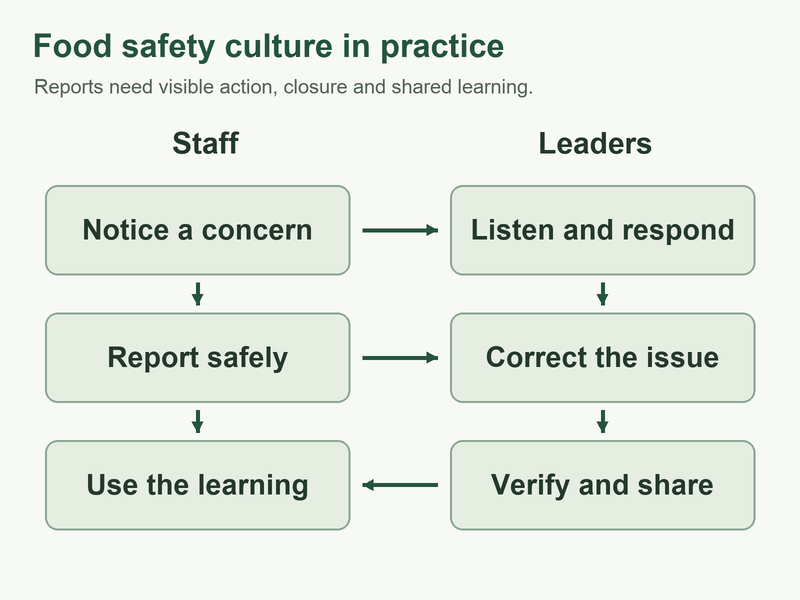
A healthy reporting climate allows workers to raise uncertainty, near misses, and deviations promptly without predictable retaliation or dismissal. The test is not whether the facility reports zero concerns. Very low reporting can mean strong control, weak access, or fear, so the organization must interpret the pattern.
Review reporting routes for different workers and shifts. Employees may use a supervisor, digital system, hotline, or direct quality contact; contractors and temporary staff also need an accessible path. The facility should define urgent escalation and the feedback a reporter can expect.
Measure closure quality as well as volume. Records should show triage, product protection where needed, investigation, ownership, and communication back to affected teams. Repeated anonymous reports about the same issue suggest that formal closure did not restore confidence.
Protect the reporter while preserving enough operational detail to investigate. Confidentiality cannot mean that every report becomes unverifiable. The process should separate identity from the facts distributed to investigators and define when urgent safety needs require limited disclosure.
| Reporting signal | Possible meaning | Follow-up question |
|---|---|---|
| Rising near-miss reports | Better trust or worsening conditions | Are severity and closure improving? |
| Zero reports | Strong control or suppressed reporting | Can workers name and access a route? |
| Repeated theme | Cause remains or response lacks credibility | Was effectiveness checked? |
| Long closure time | Weak ownership or complex investigation | How is interim risk controlled? |
Key Takeaway: Judge reporting by access, response, closure, and trust rather than rewarding a low incident count.

How should food-safety expectations be communicated?
Food-safety expectations should be translated into role-specific decisions, not distributed as abstract policy. A receiving employee needs clear hold and escalation rules; sanitation staff need release criteria; production operators need deviation actions; supervisors need authority boundaries.
Communication must work across languages, literacy levels, shifts, and employment types. Use visual controls, demonstrations, shift handoffs, and concise decision aids where they improve comprehension. Translation should preserve the required action and exception, not merely the headline.
Check whether messages survive change. New products, allergens, equipment, customer specifications, or temporary work can make older instructions unsafe. Version control and briefings should identify what changed, who is affected, and when the new rule begins.
Test the return path as well as the outbound message. Employees need a way to say that an instruction conflicts with equipment, language, or actual workflow. A communication system that only broadcasts can distribute the same unsafe assumption consistently.
The matcha specification-change guide shows how a technical change enters controlled review. Culture evidence adds whether affected people heard, understood, and used the revised expectation.
Key Takeaway: Communication succeeds when each role can explain and perform the required decision, including exceptions and escalation.
How can competence be distinguished from training attendance?
Competence means a person can perform the food-safety task and respond to realistic deviations; training attendance records only participation. A sign-in sheet may prove exposure to content but cannot show that the employee can identify an incorrect label, damaged seal, sanitation failure, or unapproved workaround.
Define competence by role. Methods may include observation, demonstration, scenario questions, record review, or supervised performance. The assessor should know the success criteria and what happens after a weak result.
Review transfer to work after training. If the same error recurs, the problem may involve unclear instructions, poor tools, workload, supervision, or incentives rather than memory. Repeating the same slide deck without diagnosing the barrier wastes time and leaves the behavior unchanged.
Competence can decay when a task is rare or changes. Define refresher triggers from time, process change, extended absence, weak observation, or incident evidence. The trigger should match the task rather than impose one training frequency on every role.
Prefer direct demonstration for high-consequence tasks. This bounded choice costs more than a quiz but reduces the risk of accepting knowledge that fails under actual conditions.
Key Takeaway: Treat attendance as one record and verify competence through role-specific performance and deviation response.
How should recognition and accountability work together?
Recognition and accountability should reinforce the same expected behavior. Recognize early reporting, careful handoffs, and responsible stoppage, while addressing deliberate bypass or repeated negligence through a fair process. Rewarding output while disciplining only visible food-safety failures creates conflicting incentives.
Separate human error, at-risk behavior, and intentional disregard before deciding a response. The classification should use evidence and consider system conditions. A confusing label interface or impossible production target can make repeated error more likely even after coaching.
Accountability also applies to management. Overdue resources, unreviewed trends, and exceptions approved without rationale should enter leadership review. Employees notice when frontline breaches are punished while management decisions escape examination.
Track whether similar events receive similar responses across shifts and employment groups. Unexplained inconsistency weakens trust and encourages employees to wait for a preferred supervisor. Documented discretion is possible, but the decision should reflect risk and evidence rather than status.
Key Takeaway: Align recognition and accountability with the same food-safety priorities and examine system causes before assigning blame.
What should buyers observe during a facility review?
Buyers should observe routine work, handoffs, and responses rather than stage a culture inspection around prepared interviews. Useful observations include whether staff can explain hold authority, whether supervisors respond consistently, whether records match physical practice, and whether temporary conditions receive controls.
Sample different roles and shifts where practical. Ask open questions about a recent change, near miss, or difficult decision without requesting names. Compare answers for coherence rather than memorized wording. Contradictions identify where the buyer should seek records or clarification.
Observe whether the facility prepares a special route for visitors. Clean staging and rehearsed answers can still show control, but they reduce the value of the sample. Compare the tour with routine logs, shift records, and worker explanations before drawing a conclusion.
| Observation area | Behavior to examine | Risk if absent |
|---|---|---|
| Product hold | Staff know who can stop and release | Suspect material may move |
| Shift handoff | Exceptions transfer with ownership | Issues disappear between teams |
| Maintenance | Product protection accompanies repair | Debris or uncontrolled restart |
| Supervisor response | Concern receives timely, respectful action | Reporting declines |
Use the matcha production-process verification guide to connect observed behavior with records for the relevant process. A single good observation is still a sample, not proof of performance across the year.
Key Takeaway: Observe decisions at real handoffs and exceptions, then compare behavior with the documented system.

How should surveys, interviews, records, and outcomes be combined?
Food safety culture should be assessed with mixed evidence because each method has blind spots. Surveys capture perceptions at scale but can be influenced by response fear or wording. Interviews add context but cover fewer people. Observations show behavior in a limited window, while records and outcomes may lag or reflect reporting practices.
Triangulate themes rather than averaging incompatible measures. If survey confidence is high but near-miss closure is slow and interviews describe retaliation, investigate the contradiction. If complaints rise after a new reporting channel, the increase may reflect better visibility rather than worsening control.
Segment results only where confidentiality can be protected. Shift, role, tenure, or language patterns can reveal a targeted mechanism, but very small groups may identify respondents. Combine categories or use an independent reviewer when anonymity would otherwise be weak.
GFSI’s culture framework groups dimensions around vision and mission, people, consistency, adaptability, and hazard and risk awareness. It is a management framework, not a statutory global scoring formula. Select indicators that fit the facility while keeping definitions stable enough to compare over time.
| Evidence stream | Strong use | Main limitation |
|---|---|---|
| Survey | Broad perception patterns | Response and wording bias |
| Interview or focus group | Mechanisms and context | Small, nonrandom sample |
| Observation | Behavior at work | Short observation window |
| Records and outcomes | Actions, timing, recurrence | Reporting and lag effects |
Key Takeaway: Combine methods, investigate contradictions, and avoid reducing culture to one unvalidated composite score.
What food-safety-culture evidence can a buyer request?
A buyer can request the culture policy or objective, leadership-review evidence, role-based competence approach, reporting and escalation design, anonymized trend themes, improvement actions, and follow-up results. The request should show how culture supports the supplied process without exposing personal responses.
The EU’s Regulation (EU) 2021/382 added food-safety-culture duties concerning management commitment, leadership, employee awareness, communication, and resources for food businesses within its scope. It is an EU requirement, not a universal mandate for every Chinese facility. Applicability depends on the business, activity, and relevant market obligations.
Buyers should also review how culture evidence connects to technical findings. The matcha quality-complaint guide provides a concrete route for issue evidence and corrective action. Culture assessment asks whether the organization receives and learns from that signal.
Set a reasonable evidence window. A single current survey may miss whether actions changed behavior, while several years of aggregated data may hide the present organization. Preserve dates, population, response rate, method, and major operational changes beside the interpretation.
Key Takeaway: Request anonymized, scoped evidence linking leadership, competence, reporting, and improvement to the supplied operation.
How should food safety culture be improved and reviewed?
Improvement should target a demonstrated mechanism, assign ownership, and define the behavior or result expected to change. If workers hesitate to report, revise access and supervisor response. If change communication fails, improve the handoff and competence check. Generic retraining rarely fixes a conflicting incentive.
Prioritize a small number of material gaps. Set a baseline from several evidence streams, implement actions, and review leading and lagging indicators at a suitable interval. Preserve the limits of the evidence and watch for unintended effects such as reporting falling after a punitive response.
Do not set a universal pass score. Compare the same facility and defined groups over time, while accounting for workforce, process, language, and reporting changes. Benchmarking can prompt questions, but it does not explain a local mechanism.
End each review with a decision: sustain the action, revise it, escalate resources, or close it with evidence. Buyers assessing wholesale matcha supply should record which culture gaps affect supplier approval and when those gaps will be revisited.
Make the improvement visible to affected workers. Feedback should state what was heard, what will change, what cannot change, and when results will be reviewed. Closing that loop supports future reporting and prevents repeated consultations from appearing performative.
Key Takeaway: Improve a specific behavioral mechanism, verify the effect with mixed evidence, and record the next management decision.
FAQ
- What is food safety culture?
- Food safety culture is the shared pattern of values, priorities, and behavior that shapes food-safety decisions.
- Can a survey measure food safety culture by itself?
- No. Surveys should be interpreted with interviews, observations, records, and outcome trends.
- Does more incident reporting mean a weaker culture?
- Not necessarily. Higher reporting may reflect greater trust, so severity, response, closure, and recurrence also matter.
- Is training attendance evidence of competence?
- Attendance proves participation; competence requires role-specific demonstration or performance evidence.
- Does EU food-safety-culture law apply worldwide?
- No. Regulation (EU) 2021/382 has an EU legal scope and should not be presented as a universal mandate.
- What should a buyer request from a supplier?
- Request scoped, anonymized evidence of leadership review, reporting, competence, behavior, improvement actions, and follow-up.
Conclusion
The next buyer decision is whether the facility’s leadership, reporting climate, competence, and corrective learning support its technical controls. Record the strongest evidence, contradictions, and actions that affect supplier approval. Contact AdoroHu Matcha to connect that review with a specific matcha product and intended use.