
Mass balance traceability reconciles opening stock and receipts with production outputs, shipments, recorded losses, samples, rework, and closing stock inside a defined period. It tests whether lot records describe a physically plausible flow without pretending every variance proves fraud or contamination.
For matcha buyers, mass balance traceability strengthens forward and backward traceability during supplier approval and recall exercises. The matcha recall plan guide explains response ownership; the mass-balance workpaper tests whether quantities and lot identities support that response.
Food mass balance compares inputs, outputs, and stock changes within a defined boundary and unit. The workpaper should expose missing flows and unexplained variance while preserving legitimate process loss. It is different from sustainability attribute allocation or book-and-claim accounting.
In short:
Key points:
- Define the facility, products, lots, period, and common unit before calculating.
- Reconcile receipts, transformations, shipments, waste, samples, rework, and stock.
- Investigate variance through records and process mechanisms instead of forcing zero.
What is mass balance traceability in food processing?
Mass balance traceability is a quantitative check that all major material flows within a defined food process can be reconciled. The Commission for Environmental Cooperation method describes mass balance using inputs, outputs, and changes in stock. That food-loss methodology supplies an accounting structure, not an FDA tolerance.
The traceability workpaper should connect quantities with lot identity and events. A total may reconcile while individual lots cross incorrectly, so both quantity and genealogy matter. For matcha, grade, blend, certification status, package format, and ownership can define separate pools.
Separate physical reconciliation from accounting valuation. Purchase value, standard cost, and sales value can explain commercial records but cannot replace net quantity. The workpaper should use the best physical evidence available and cross-check financial records only to locate missing transactions. This keeps price changes from looking like material movement.
Assign a preparer and independent reviewer with access to source systems. The reviewer should be able to reproduce totals, trace adjustments, and challenge exclusions rather than checking only the final percentage.
Exclude sustainability credit allocation, RSPO-style mass balance, and book-and-claim systems from this exercise. Those systems account for attributes under their own rules; this article concerns physical food lots, process yield, and shipment records.
Key Takeaway: Treat food mass balance as physical quantity reconciliation linked to lot genealogy within a declared boundary.
Which boundary and period should the exercise use?
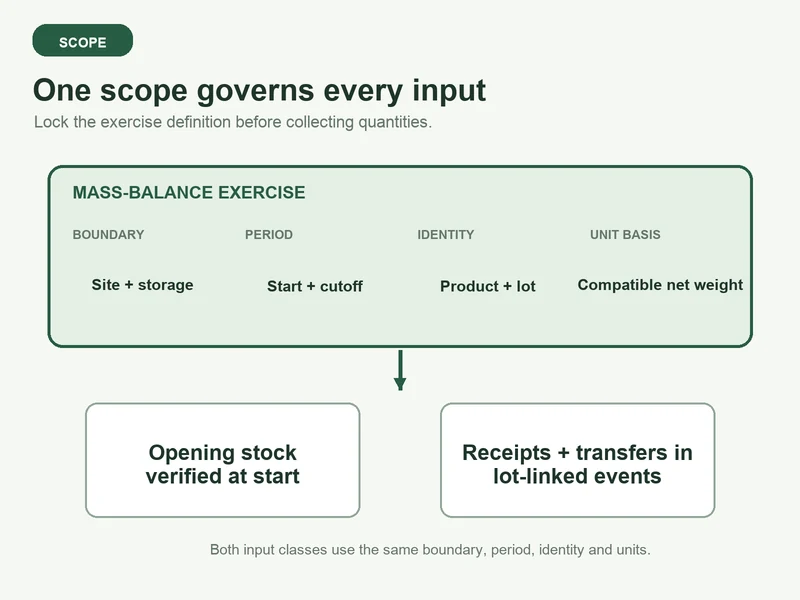
The exercise should use a boundary narrow enough to trace and broad enough to capture every material flow affecting the selected lots. Define legal site, storage areas, process lines, subcontractors, product codes, units, and whether packaging is included. State exclusions before extracting data.
Choose a period that includes complete transformations and shipment cycles. A short window can leave work in progress open; a long window can hide timing errors. Record cutoff times and handle receipts or dispatches posted after physical movement.
Use one unit basis or documented conversions. Net powder weight, packaged units, and gross carton weight cannot be added directly. If moisture or processing changes mass, capture that mechanism instead of treating the difference as record failure.
Choose the exercise direction before starting. A backward test begins with a selected finished lot or shipment and traces quantities to inputs. A forward test begins with an input lot and accounts for every output and destination. A robust program performs both directions because a single total can hide incorrect allocation among customers.
| Boundary decision | Required definition | Risk if omitted |
|---|---|---|
| Site and storage | Physical locations included | Stock disappears between locations |
| Product and lot | Codes, grades, status pools | Incompatible lots are combined |
| Period cutoff | Physical and system timestamps | Timing becomes variance |
| Unit basis | Net weight and conversions | Unlike quantities are added |
Key Takeaway: Lock boundary, cutoff, identity pools, and unit conversions before calculating any variance.
What records form the opening and receipt inputs?
Opening and receipt inputs come from verified beginning inventory, goods receipts, returns accepted into stock, transfers in, and process carryover. Each record needs lot, product, status, quantity, unit, location, and timestamp. Reconcile system stock with physical evidence where risk justifies it.
Receiving records should connect supplier lot to internal lot identity. Relabeling or aggregation must preserve the relationship. A certificate or invoice without the internal receipt transaction cannot support the quantity trail.
Check reversals, duplicate receipts, quarantine stock, and goods received but not released. Commercial ownership and physical possession can differ, so state which basis the workpaper uses. Do not count the same powder in both supplier consignment and usable inventory.
Opening inventory deserves the same scrutiny as receipts. Reconcile it to the previous closing balance and explain adjustments posted between periods. If a physical count is used, record count method, scale, container tare, partial-pack estimate, status, and independent review. An unsupported opening figure can make every later transaction appear accurate while shifting the error outside the exercise.
Key Takeaway: Build inputs from lot-linked stock and receipt events, resolving duplicates, timing, and status before production use.
How should production transformation and yield be recorded?
Production transformation should record which input lots entered each batch and which outputs, rework, residues, and losses resulted. The batch record needs actual quantities rather than only formula targets. Blending creates a genealogy relationship even when no intentional mass loss occurs.
Grinding, screening, transfer, sampling, dust collection, and line clearance can create expected loss. Define how each is measured and whether recovered material becomes rework, waste, or another product. An estimated loss should remain visibly estimated.
For blends, calculate both total mass and component genealogy. A batch can balance overall while using too much of one input lot and too little of another. Preserve formulation targets, actual additions, correction additions, and remaining component stock. This matters when one source lot is later held or recalled.
The matcha production-process verification guide helps trace process records. Mass balance adds the quantitative test: whether recorded yield and loss are plausible for the actual batch.
Key Takeaway: Link actual input lots to every output and classify process loss, residue, and rework without hiding estimates.
How should shipments and closing stock be reconciled?
Shipments and closing stock should reconcile every finished lot to dispatch, remaining inventory, samples, destruction, returns, and transfers out. Shipping quantity should come from confirmed picks or weights rather than ordered quantity when they differ.
Closing inventory must use the same cutoff and unit basis as opening stock. Segregate released, held, rejected, damaged, and consigned stock. A lot can be physically present yet unavailable, which matters for recall quantity and commercial disposition.
Reconcile packaged count with declared net content and actual bulk consumption. Package overfill, giveaway, rejected packs, and label changeovers can create legitimate differences. Use measured average fill or another supported basis rather than multiplying nominal label weight when production records show a material deviation.
| Output flow | Record source | Reconciliation question |
|---|---|---|
| Customer shipment | Pick, dispatch, invoice | What quantity left and to whom? |
| Closing stock | Inventory and physical check | What remains by lot and status? |
| Sample or retain | Sample log | Was non-sale quantity recorded? |
| Waste or destruction | Disposal record | Is loss measured and authorized? |
Key Takeaway: Reconcile dispatch and remaining stock by lot, status, destination, and cutoff, not by sales orders alone.
What formula should a food mass balance use?
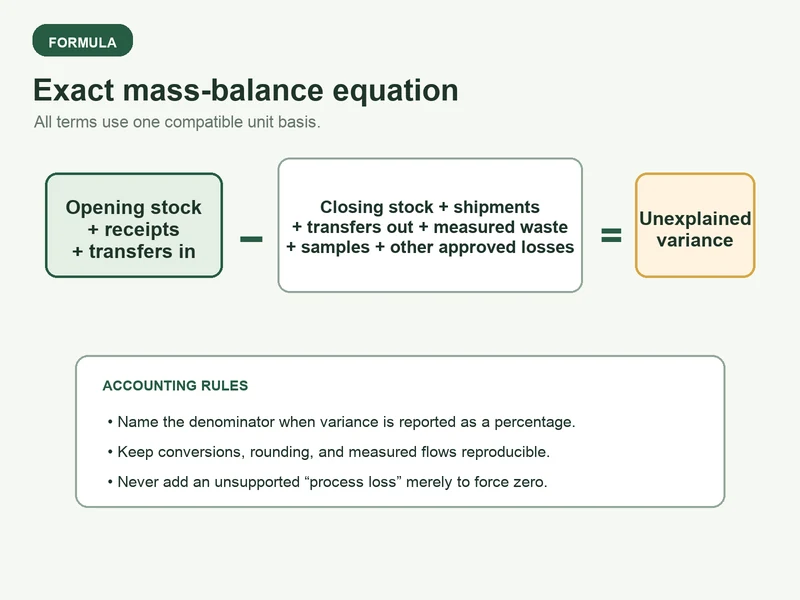
A food mass balance should express accounted input against accounted output and stock change in one consistent convention. One practical arrangement is opening stock plus receipts and transfers in, less closing stock, shipments, transfers out, measured waste, samples, and other approved losses. The remainder is unexplained variance.
Teams can report variance as weight and as a percentage of a defined denominator, but the denominator must be named. Percentage of total available input differs from percentage of consumed material. Rounding rules and unit conversions should be documented.
Do not force the workpaper to zero by adding “process loss” as a balancing plug. Recorded loss needs a measurement or justified estimate and an owner. A residual can be acceptable within an approved, evidence-based tolerance while still requiring trend review.
Show the calculation at lot and aggregate levels. Aggregation can let positive and negative lot variances cancel. A dashboard may summarize the period, but the retained workpaper should allow a reviewer to reproduce each source total and conversion from the underlying records.
Key Takeaway: Use a transparent equation with named denominator, conversions, measured flows, and a visible residual.
How should rework, samples, waste, and moisture be handled?
Rework, samples, waste, and moisture should be handled as distinct flows because they have different identity and control consequences. Rework returned to production is not a final loss; it needs source lot, quantity, status, destination batch, and timing.
Samples and retains can become material variance when teams record count but not weight. Waste can include powder, dust, damaged packs, spills, and residue left in equipment. Measure representative losses where practical and document estimation methods.
Moisture gain or loss can alter weight without missing physical material. The CEC methodology warns that missing flows and water changes can create large inaccuracies. For dry matcha, do not invent a moisture correction; apply one only when the process and evidence justify it.
Returned product needs an explicit route. Record whether it reenters saleable stock, becomes rework, remains on hold, or is destroyed. A customer credit note proves a commercial event, not the physical receipt or disposition. Match quantity and lot status before including a return in available input.
Key Takeaway: Classify secondary flows separately and support estimates rather than using one miscellaneous-loss line.
How should unexplained variance be investigated?
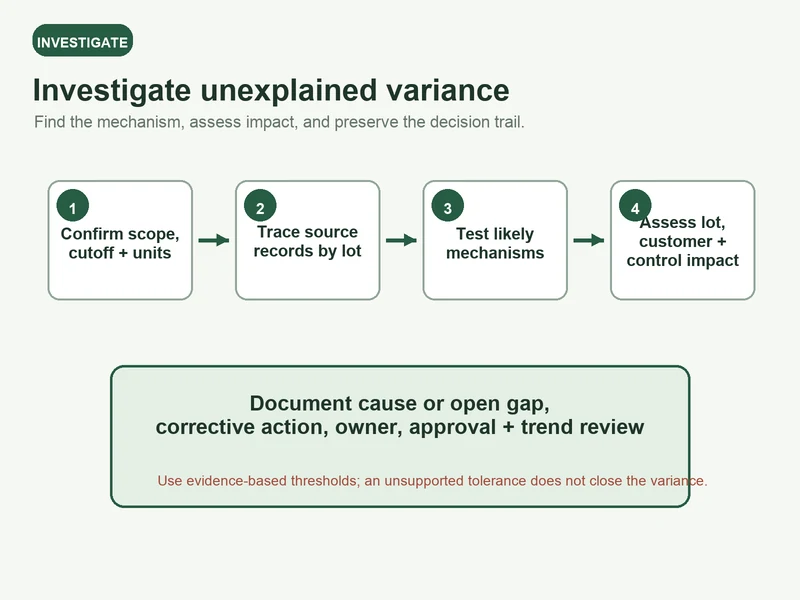
Unexplained variance should be investigated through transaction timing, unit conversion, duplicate or missing events, scale records, line loss, rework, returns, relabeling, and lot genealogy. Start with the largest and most plausible mechanisms before alleging diversion or fraud.
Repeat the calculation independently and preserve the original workpaper. Correct source records through controlled processes instead of overwriting figures to make the balance fit. If the variance affects recall scope, product status, or certification claims, escalate to authorized owners.
Rank investigation steps by expected explanatory value. First check cutoff, units, duplicate transactions, and opening stock; then examine yield, rework, waste, and physical count. Escalate to deeper genealogy or security review when ordinary explanations fail. This sequence speeds resolution without assuming misconduct.
| Variance pattern | Likely check | Potential action |
|---|---|---|
| Equal offset across periods | Cutoff timing | Align physical and system dates |
| Constant percentage | Yield or conversion | Review basis and measurement |
| One-lot spike | Missing event or loss | Trace batch and transaction history |
| Repeated grade mismatch | Identity mapping | Hold and correct genealogy |
Reject an arbitrary tolerance copied from another plant. Set thresholds from measurement capability, expected process loss, product, scheme, customer, and regulatory needs, then review trends.
Key Takeaway: Investigate the mechanism and record impact; never use an unsupported tolerance to close unexplained variance.
How does mass balance support FDA traceability records?
Mass balance supports FDA traceability records by testing whether quantitative flows agree with the key data elements and critical tracking events recorded for covered foods. The FDA Food Traceability Rule overview explains record duties for foods on the Food Traceability List.
The rule does not prescribe one universal mass-balance formula. Applicability, exemptions, compliance timing, and required records must be checked for the actual food and entity. Mass balance can expose missing receipts or shipments, but it cannot replace required KDEs, traceability lot codes, or the traceability plan.
Use the workpaper during a trace exercise to compare the quantity located with the quantity expected. A gap changes search scope and may reveal an unrecorded destination, waste event, or inventory error.
Keep the regulatory assessment current. The Food Traceability List, covered activities, exemptions, and compliance schedule can change or be interpreted for particular operations. A buyer should document the applicable conclusion and date instead of labeling every matcha lot as subject to the same additional records.
Key Takeaway: Use mass balance as a quantitative verification aid around required traceability records, not as their substitute.
What mass-balance evidence should a matcha buyer review?
A matcha buyer should review the scope, period, formula, workpaper, source-record references, unit conversions, lot genealogy, explained losses, variance, investigation, approval, and corrective action. The exercise should be reproducible from retained records.
Connect it to the matcha supplier audit guide and a representative matcha trial order. One successful exercise does not prove every period, but it can show whether records and owners can answer a bounded traceability question.
For wholesale matcha, prefer a workpaper that preserves residual variance over a perfect total built from unsupported adjustments. Align lot and shipment evidence with a specific supply review.
Key Takeaway: Approve a reproducible workpaper with lot-linked sources, visible variance, investigation, and decision ownership.
FAQ
- What is the basic food mass-balance formula?
- It compares opening stock and inputs with outputs, shipments, recorded losses, and closing stock in consistent units.
- Should a food mass balance always equal zero variance?
- No. A supported tolerance may reflect measurement and process loss, but unexplained variance remains visible.
- Is food mass balance the same as book and claim?
- No. This exercise reconciles physical food lots and quantities, not allocated sustainability attributes.
- How should rework be counted?
- Record rework as a traceable intermediate flow until it enters another batch or receives final disposition.
- Does FDA prescribe one mass-balance formula?
- No. FDA traceability duties require defined records, while mass balance is a complementary reconciliation aid.
- What should buyers check first?
- Check the boundary, period, common unit, lot genealogy, source records, and visible variance.
Conclusion
The next decision is whether the workpaper can account for the selected lots without unsupported balancing entries. Trace every material flow, investigate the residual, and record its effect on product and recall scope. Contact AdoroHu Matcha for a lot-specific documentation review.