
Matcha bagels require a strong, low-hydration dough, controlled fermentation, a boil-before-bake step, and enough tea character to survive crust formation. Skipping the boil creates green bread rings, not the same product. The matcha baking guide provides broader application context.
Build matcha bagels around dough strength, ring geometry, proof readiness, poach time, and bake loss. Keep those controls fixed while comparing powders and count only accepted cooled rings when calculating yield.
In short:
Key points:
- Disperse matcha in the flour before developing the stiff dough.
- Standardize the poach because it sets the skin and changes oven expansion.
- Validate freezing and reheating with the actual bagel and package.
What makes matcha bagels different from matcha bread?
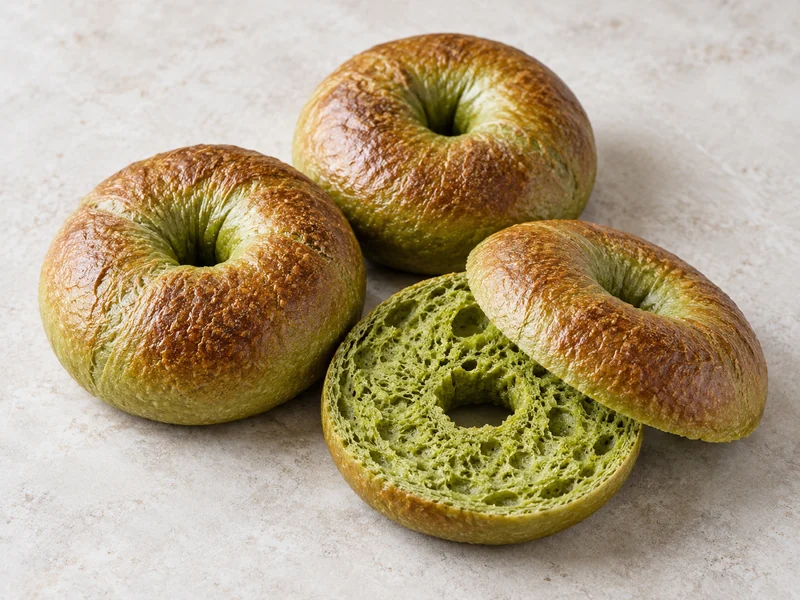
Matcha bagels are yeast-raised rings that are poached before baking. The poach sets the surface, supports shine and chew, and limits free oven expansion. Product criteria should include piece weight, hole retention, crust, crumb density, chew, and cooled tea finish.
Choose the bagel identity before optimizing color. Avoid increasing hydration only to make green dough easier to mix; the consequence can be spread, weak chew, and closed holes.
Key Takeaway: The boil-before-bake process and dense chew define the product.
What matcha quantities and yields do ranked bagel recipes use?
Baking with Butter’s matcha bagels state 12 g (2 Tablespoons) matcha and yield 8. Kayla Zenner states 1 tbsp matcha and yields 6 bagels. These are separate formulas and the tablespoon values should not be converted or averaged beyond what each source states.
| Published benchmark | Matcha | Declared yield | Knead instruction |
|---|---|---|---|
| Baking with Butter | 12 g (2 Tablespoons) | 8 | Around 10 min |
| Kayla Zenner | 1 tbsp | 6 | 10–15 min |
Use each source batch as a discrete starting point, then weigh divided dough pieces. Costing from six or eight pieces is meaningless until the bakery confirms the piece weight behind that count.
Key Takeaway: Tie the source matcha quantity to its complete formula and actual divided weight.
How should matcha enter stiff bagel dough?
Preblend matcha thoroughly with the flour before water and yeast enter. Low-hydration dough offers little later mobility, so green streaks that survive initial mixing usually remain through shaping. Sieve the tea, inspect the dry blend, and scrape the mixer bowl before judging dough uniformity.
Record water weight, flour lot, matcha lot, dough temperature, mixer load, and final development. Avoid adding an unmeasured splash of water to cure stiffness; the dough then changes both handling and poach response.
Key Takeaway: Solve dispersion in the dry phase and keep total water measurable.
What mixing and fermentation benchmarks are useful?
Baking with Butter kneads for around 10 minutes, rests dough balls 5 minutes, then proofs shaped bagels around 30 minutes while the oven and poaching water prepare. Kayla Zenner kneads 10–15 minutes, gives the dough a 1-hour bulk rise or until doubled, then gives the shaped bagels an additional 1-hour rise.
| Process point | Baking with Butter | Kayla Zenner | Plant record |
|---|---|---|---|
| Knead | Around 10 min | 10–15 min | Dough temperature and development |
| Intermediate rest | 5 min for balls | Not same method | Extensibility before shaping |
| Bulk fermentation | Source uses a different sequence | 1 hour or until doubled | Dough volume before dividing |
| Shaped proof | Around 30 min shaped | Additional 1 hour shaped | Ring volume and handling cue |
Clock time is supporting evidence. Choose proof readiness by dough condition and verify it through poach and bake performance.
Key Takeaway: Bind fermentation time to dough temperature and observable readiness.
How should matcha bagels be divided and shaped?
Kayla Zenner divides the dough into 6 equal pieces, then opens the center of each ball with a thumb. Baking with Butter shapes eight. A commercial line can use a rope-and-seam method or a punched ball, but it should not mix methods within one trial.
Weigh every test piece and set a raw hole diameter that remains open after proof, poach, and bake. Record seam failure, ovality, and closed holes. Choose the method that operators can repeat at the target throughput.
Key Takeaway: Standardize piece weight, shaping method, and raw hole diameter together.
What poach should a bakery test before baking?
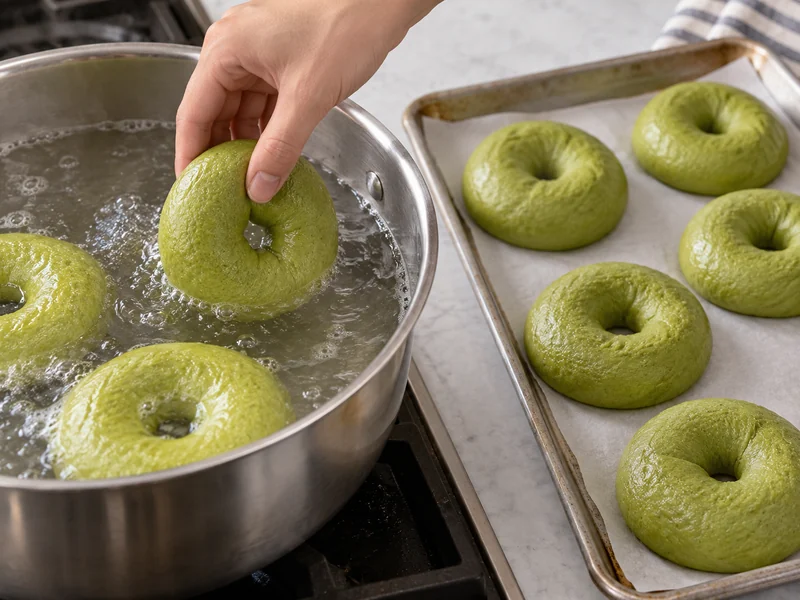
Baking with Butter boils 2–3 bagels at a time for 1 minute, flipping after 30 seconds. That is a clear source benchmark for kettle occupancy and dwell. Use it without silently changing water composition, batch size, or drain time.
| Kettle control | Published benchmark | What to record |
|---|---|---|
| Load | 2–3 bagels | Temperature recovery and crowding |
| Total dwell | 1 minute | Skin set and expansion |
| Flip | After 30 seconds | Even exposure |
| Drain | Before tray | Surface water and topping adhesion |
Choose a dwell that provides chew and shine without wrinkling or excessive restriction. Avoid changing poach and oven conditions in the same comparison.
Key Takeaway: Treat kettle load, flip, dwell, and drain as one controlled operation.
Which oven profile should follow the bagel poach?
Baking with Butter preheats to 400°F/200°C and reports 25 minutes cooking. The source also applies sesame while the surface remains sticky from poaching. Commercial ovens require their own load and recovery check.
Record tray position, actual oven temperature, time, pre- and post-bake weight, crust color, and bottom firmness. Choose the earliest fully baked endpoint that preserves tea aroma. Avoid baking darker simply to make the crust look conventional; darkening can mask matcha and reduce yield.
Key Takeaway: Select the bake endpoint by crumb set, chew, and cooled flavor after the controlled poach.
Which matcha grade should buyers test in bagels?
AdoroHu E-1/E-2 and O-1/O-2 identify culinary tiers for application trials. The culinary matcha product page is the actual product destination, and matcha for baking provides the application route.
Compare samples through mixing, poaching, baking, and cooling. Score dough uniformity, crust and crumb color, tea finish, bitterness, and documentation. A bright raw dough is not enough evidence for purchase.
Key Takeaway: Approve matcha after the full poach-and-bake process.
How should bagel yield, freezing, and reheating be validated?
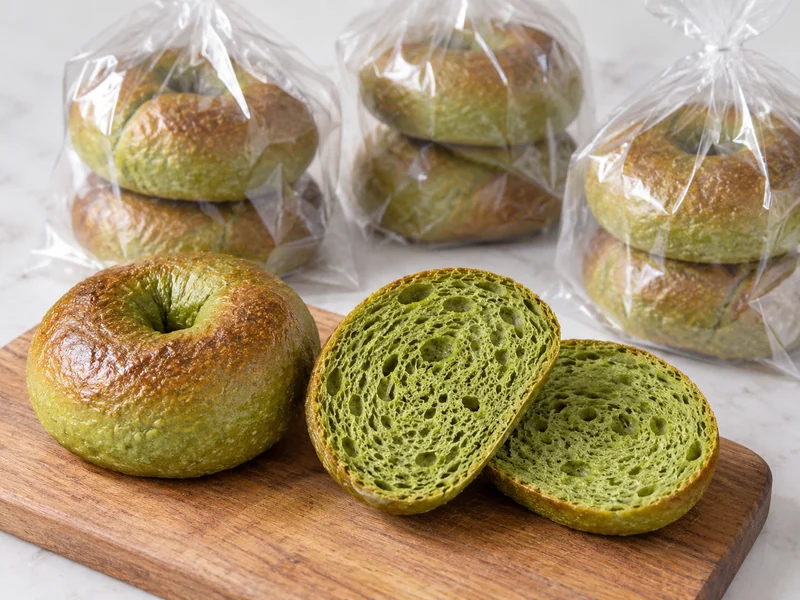
Count accepted cooled bagels after closed holes, seam splits, wrinkles, and weight failures. Test freezing and reheating using the intended bag, freeze rate, thaw method, and service equipment. The commercial matcha cookies guide offers adjacent bakery costing context but no bagel hold claim.
Choose the reheat that restores crust and chew without drying the crumb. Avoid borrowing a shelf-life date from bread or a recipe page; the actual formula and pack require validation.
For ingredient handling and sanitation, use the operation’s validated plan and local requirements; the FDA safe food-handling guidance is an official public baseline rather than a bagel-specific process limit.
Key Takeaway: Cost accepted rings and validate the complete freeze-to-service route.
FAQ
- Do matcha bagels have to be boiled?
- Boiling is part of the bagel process covered here; skipping it produces a different bread-ring format.
- How long does a published recipe poach bagels?
- One ranked source uses 1 minute total and flips after 30 seconds.
- How much matcha is in a published bagel recipe?
- One source states 12 g (2 Tablespoons) for 8 bagels; another states 1 tbsp for 6.
- Why do bagel holes close?
- Raw hole size, proof, dough strength, shaping, poach, and oven expansion can all contribute.
- Does AdoroHu manufacture finished bagels?
- No. AdoroHu Matcha supplies matcha powder; the bakery owns dough, process, and validation.
- Can a bread shelf life be applied to bagels?
- No. Validate the actual bagel, package, storage, freezing, and reheating route.
Conclusion
Matcha bagels become repeatable when the bakery connects dough development and proof to a measured poach and bake. Contact AdoroHu Matcha with the dough system, target certifications, and expected volume when requesting samples.