
Matcha chia pudding is a cold hydration product, so uniform seed suspension and matcha dispersion matter more than cooking. A product team can begin with culinary matcha powder, one milk system, one chia ratio, and a timed remix before filling.
Published recipes agree on simple ingredients but differ in dairy, dose, set time, and container. Those differences affect texture, claims, labor, and serving yield. Treat each as an external benchmark rather than an AdoroHu-tested formula.
A useful matcha chia pudding trial records liquid, chia, matcha, sweetener, first mix, remix, set time, fill weight, and refrigerated texture. “Overnight” is a scheduling choice, not proof of shelf life. The finished cup must be assessed with its actual ingredients and pack.
In short:
Key points:
- Select dairy-free milk, yogurt blend, or coconut milk before comparing texture.
- Remix early to break seed clusters and limit matcha settling.
- Cost the filled cup from actual yield and rejected cups, not stated servings alone.
Which matcha chia pudding base fits the intended label?
The matcha chia pudding base should match the intended label and eating texture before dose optimization. One published benchmark uses 1 cup dairy-free milk, ¼ cup chia, 2 tsp matcha, and yields 2 servings. Another uses ¾ cup Greek yogurt plus ¼ cup milk, 2 tbsp chia, 1 tsp matcha, and yields one jar.
Those are different products. The yogurt jar starts with more body and dairy allergens; the dairy-free milk formula relies more heavily on chia for structure. Choosing one avoids false comparisons between spoonability and powder performance.
| Base | Published structure | Product consequence |
|---|---|---|
| Dairy-free milk | 1 cup liquid with ¼ cup chia | Seed gel drives most of the body |
| Yogurt and milk | ¾ cup yogurt, ¼ cup milk, 2 tbsp chia | Thicker base; dairy and cultured flavor |
| Full-fat coconut milk | 1 cup liquid with ¼ cup chia | Richer mouthfeel; coconut can cover tea |
Key Takeaway: Lock the base and label position before changing matcha or chia.
What published chia-to-liquid ratios make useful benchmarks?
Published matcha chia pudding benchmarks cluster around ¼ cup chia to 1 cup liquid, but the yogurt example uses 2 tbsp chia with one cup of yogurt-plus-milk. Vanilla and Bean also gives ¼ cup chia as 50 g and 1 cup cashew milk as 254 g, which is useful when a team wants a weight-based reproduction.
Preserve the source’s own units. A ¼-cup volume in one chia brand is not automatically 50 g unless that source supplies the conversion. Measure the team’s actual fill weight, number of cups, and leftover product.
Choose the lower-seed yogurt system for a creamy spoonable jar. Choose the ¼-cup-to-1-cup system when the seed gel should define the texture. Avoid blending ratios from both; the result can be overly dense and expensive.
Key Takeaway: Select one complete ratio and measure it before tightening or loosening the gel.
When should matcha chia pudding be remixed?
Matcha chia pudding should be remixed during early hydration before seed clusters become fixed. Vanilla and Bean states a second shake after 10 minutes. Choosing Chia states a remix after 2–3 minutes. These are concrete trial points.
Prepare matched jars and compare the two timings using the same agitation. Inspect the bottom, corners and surface after set. Record dry pockets, seed clumps, matcha sediment and fill variation.
A production tank or depositor may require another timing, but that is a separate scale trial. The published 2–3-minute and 10-minute points are useful because they turn “stir again” into a measurable action.
Key Takeaway: Test an early remix time and judge uniformity through the full cup, not only at the surface.
How long should matcha chia pudding set before evaluation?
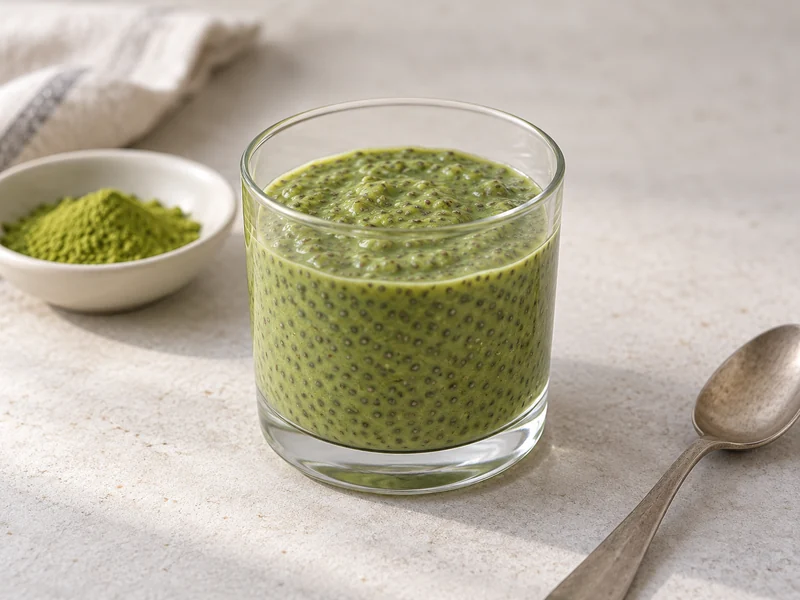
Matcha chia pudding set times should be tied to the selected formula. Published examples state at least 1½ hours, 2 hours, 4 hours, or overnight. The yogurt formula states at least 4 hours; two ¼-cup-chia formulas state 2 hours; Vanilla and Bean states at least 1½ hours after its remix.
| Set checkpoint | Buyer question |
|---|---|
| 1½ hours | Is the faster benchmark spoonable through the center? |
| 2 hours | Does the milk-based cup hold seeds evenly? |
| 4 hours | Does the yogurt blend reach its intended body? |
| Overnight | Does extra time change firmness or syneresis? |
Do not call the earliest set time a validated service limit. Evaluate temperature, fill depth and the actual pack.
Key Takeaway: Approve a minimum set time only for the chosen formula and fill depth.
Which matcha grade belongs in a chilled chia cup?
A chilled matcha chia pudding cup can reveal more tea aroma than a baked product, but coconut, yogurt, maple syrup and fruit can still mask differences. AdoroHu identifies E-1/E-2 and O-1/O-2 as Culinary grades, with higher numbers in each series offering deeper color, more sweetness and less bitterness.
Blind-code adjacent grades in the same plain cup. Taste after the approved set time and again with the intended topping. Choose a higher grade only if the customer-facing cup shows a useful improvement.
Avoid starting with a ceremonial claim because one recipe happens to name ceremonial matcha. Ingredient marketing in an external recipe does not define the best commercial grade or the finished product’s certification.
Key Takeaway: Compare grades in the set cup and its real topping system.
How should a team prevent matcha settling in chia pudding?
Matcha settling in chia pudding should be controlled through pre-dispersion, early remixing, and consistent fill timing. Whisk matcha into a measured part of the liquid before adding chia, then standardize total mixing time. Fill matched cups at the same delay from the final mix.
Cut or spoon through the center after set. Photograph the top, middle and bottom under fixed light. A green layer at the bottom can indicate settling even when the surface looks even.
If a flavor layer is added, test it after the plain cup passes. Mango, berry and granola change water migration and visual contrast. The matcha dessert sourcing guide helps compare those ingredient decisions, and the matcha baking recipe guide provides adjacent food applications.
Key Takeaway: Inspect the full vertical profile before blaming powder for uneven color.
How should filled chia cups be costed and checked?
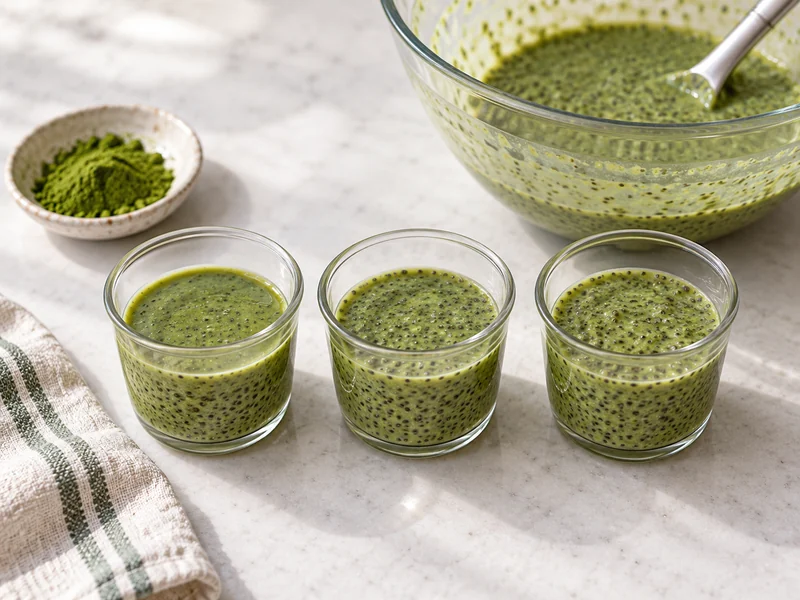
Filled matcha chia cups should be costed by actual accepted fills. Record mixed batch weight, target fill, number of complete cups, residual product, underweight cups and rejected cups. A published yield of “2 servings” or “1 jar” is not enough for a production cost.
Check lid contamination, seed distribution, syneresis, spoonability and flavor at planned refrigerated checkpoints. Recipe pages state storage notes of three or four days, but those notes do not validate a commercial duration for a different formula and pack.
Depending on the base and toppings, the cup may contain milk, nuts or other allergens. Use the FDA allergen overview as U.S. context and review the complete finished product.
Key Takeaway: Measure filled yield and product-specific refrigerated quality; do not inherit a recipe site’s storage claim.
What should a matcha chia pudding sample brief include?
A matcha chia pudding sample brief should include the milk system, chia ratio, sweetener, matcha dose, set time, fill depth, remix method, toppings, destination market, certifications and color target.
AdoroHu supplies pure matcha powder, not prepared pudding. Buyers can review its matcha application for food development and contact AdoroHu Matcha with the control formula and evaluation sheet.
Key Takeaway: Send the supplier the hydration system and finished-cup target, not just a flavor name.
FAQ
- How much chia should matcha chia pudding use?
- Published examples use ¼ cup chia with 1 cup liquid, while a yogurt-based jar uses 2 tbsp with one cup of yogurt and milk. Choose one full system and test it.
- Why remix matcha chia pudding after the first mix?
- Published methods use a second mix after 2–3 minutes or 10 minutes to break early seed clusters and improve distribution.
- Can matcha chia pudding be evaluated after 90 minutes?
- One published formula states at least 1½ hours, but other systems require 2 or 4 hours. Use the time attached to the selected formula.
- Does coconut milk make the cup vegan?
- Only if every ingredient, topping, processing aid and shared-equipment consideration fits the intended vegan claim.
- How can a team check matcha settling?
- Inspect and photograph the top, middle and bottom of a set cup, using consistent fill timing and lighting.
- Do recipe storage notes establish commercial shelf life?
- No. Commercial shelf life requires product-specific work on formulation, process, pack, refrigeration, safety and sensory quality.