
Matcha sorbet should be defined as a dairy-free frozen product built from water or plant liquid, sugar, matcha, and any declared stabilizer. A team using culinary matcha powder should exclude cream and milk from the baseline rather than treating “cream sorbet” search examples as equivalent.
The sparse published formulas still offer useful benchmarks: a three-ingredient water formula, a protein formula, and a rice-milk professional-style mix. Their quantities belong to their own systems and are not AdoroHu-tested recipes.
A true dairy-free matcha sorbet needs a declared liquid and solids system, a freezing method, a draw or serving condition, and an allergen review. Cream-containing products can inform competitive contrast, but they cannot validate a dairy-free formula or claim.
In short:
Key points:
- Keep milk and cream out of the sorbet baseline.
- Compare complete published systems rather than isolated matcha doses.
- Evaluate hardness, iciness, melt and color after the actual freeze and service cycle.
What qualifies as true dairy-free matcha sorbet?
True dairy-free matcha sorbet contains no dairy ingredients in its formula. Food.com’s published benchmark uses only 1 tbsp matcha, ⅔ cup sugar, and 2 cups water. That is a clear water-based baseline.
By contrast, one ranked product is called “Matcha Cream Sorbet,” and another bowl recipe simply portions 1–2 scoops of that product. Without a full formula, neither can prove dairy-free status. The name “cream” is a reason to verify, not a reason to infer.
Choose the water or verified plant-liquid route when dairy-free positioning is required. Avoid adding milk or cream for body and retaining the sorbet claim; the consequence is a misleading product identity and a changed allergen profile.
Key Takeaway: Set a no-dairy formula boundary before texture work begins.
Which published matcha sorbet system is a useful baseline?
A useful matcha sorbet baseline matches the available equipment and desired label. Three published systems illustrate distinct choices.
| Published benchmark | Stated base and matcha | Process fact |
|---|---|---|
| Food.com | 2 cups water, ⅔ cup sugar, 1 tbsp matcha | Manual freezer; stir every 30–60 minutes; yield 4 servings |
| SharkNinja | 2 cups water, ¾ cup sugar, 1 scoop vanilla protein, 2 tbsp matcha, lemon | Freeze at least 24 hours for a CREAMi process; yield 4 |
| Sosa recipe | 1000 g rice milk, 200 g sugar, 20 g matcha, 100 g Prosorbet 100 Cold Natur (Sosa), 20 g glycerin | Rest at least 6 hours; churn; hold at −15°C |
The water formula is the cleanest first identity benchmark. The protein and professional mixes add solids and processing aids that change texture, label and cost. Do not lift the 20 g matcha figure out of the 1340 g stated mix and apply it to the two-cup water formula.
Key Takeaway: Choose one complete frozen system and preserve all of its surrounding solids and process facts.
How do sugar and added solids affect matcha sorbet?
Sugar and added solids affect matcha sorbet sweetness, freezing behavior and scoopability. The two water-based sources use ⅔ cup and ¾ cup sugar with 2 cups water, but the latter also adds protein powder and lemon juice. Their hardness cannot be attributed to sugar alone.
The rice-milk example adds 100 g of the named commercial blend Prosorbet 100 Cold Natur (Sosa), plus glycerin and sugar. Preserve that product identity: 100 g is not an interchangeable dose for a generic pure stabilizer or another blend. Record every solids source before comparing draw and melt.
Avoid reducing sugar solely to sharpen the tea flavor without measuring the frozen result. The consequence may be a harder, icier product that no longer portions at service.
Key Takeaway: Change one solids system at a time and judge the frozen product, not the liquid mix.
When should matcha enter the sorbet process?
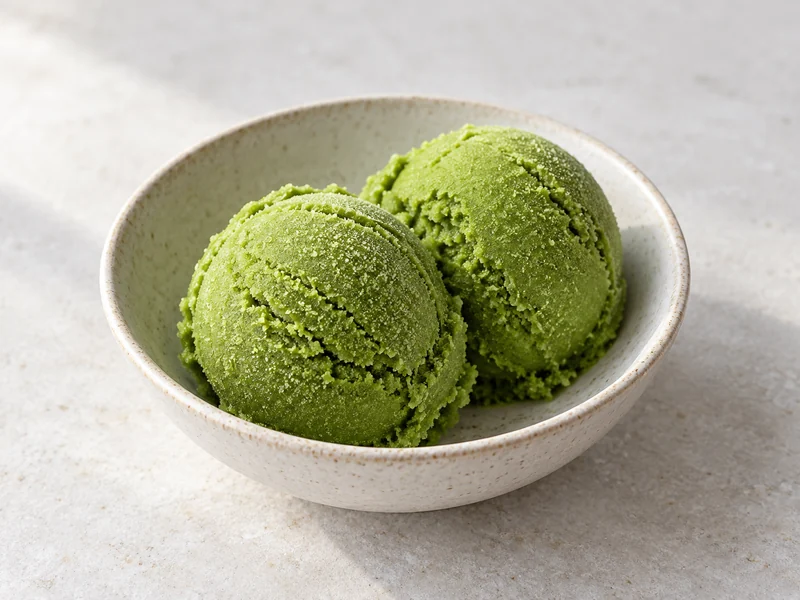
Matcha should enter the sorbet after the hot sugar phase has been controlled, unless the selected source specifies another route. Food.com mixes sugar and matcha, heats with water, then cools the pan in cold water to room temperature. The Sosa example is a cold-process professional system with a six-hour rest.
Record mix temperature when matcha is added, dispersion method, cooling time, and color before freezing. Heat exposure and long residence can affect the tea character, so changing addition order and grade together would obscure the cause.
Use a fine sieve and a repeatable high-shear or whisk step appropriate to the batch. Foam should be recorded because it can distort fill and overrun observations.
Key Takeaway: Standardize matcha addition temperature and dispersion before comparing color or bitterness.
Which freezing route fits a matcha sorbet operation?
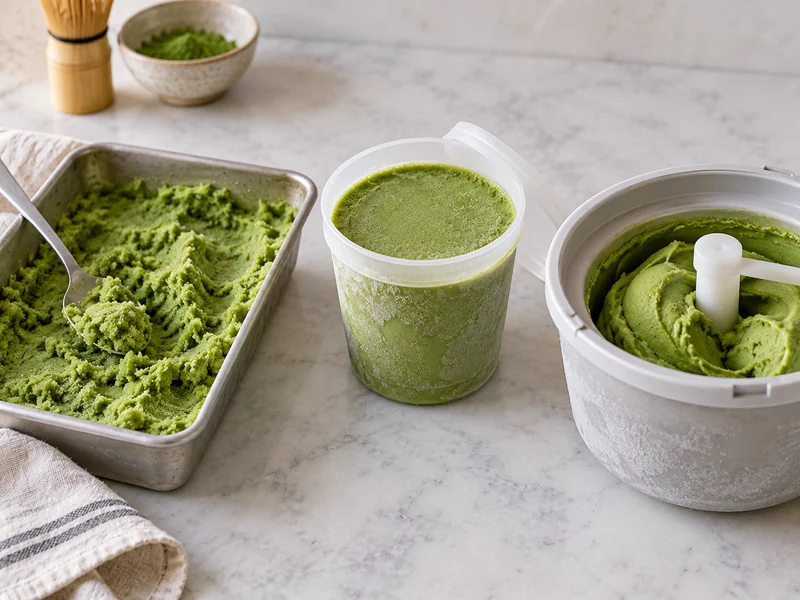
The matcha sorbet freezing route should fit the intended volume and service. A manual freezer benchmark calls for stirring every 30 minutes to one hour. A CREAMi benchmark freezes at least 24 hours before processing. The rice-milk system rests at least 6 hours and then uses an ice-cream machine.
| Route | Labor or equipment | Buyer risk |
|---|---|---|
| Manual freeze and stir | Repeated timed intervention | uneven crystal size between containers |
| Frozen pint processor | 24-hour frozen inventory | limited same-day recovery |
| Batch churn | dedicated freezer and draw control | scale and overrun need measurement |
Choose the route the operation can repeat during peak demand. Avoid approving a formula from one machine and assuming it will transfer unchanged to another.
Key Takeaway: Equipment is part of the formula because it determines crystal formation and throughput.
Which matcha grade should be tested in sorbet?
Matcha sorbet can expose bitterness because the water-based matrix has little fat. AdoroHu’s E-1/E-2 and O-1/O-2 are Culinary grades, with higher numbers in each series indicating deeper color, more sweetness and less bitterness.
Freeze adjacent grades in the same selected base. Temper samples to the same serving condition and blind-code them. Choose the higher grade only if the scoop shows a cleaner flavor or stronger color that supports the cost.
Do not judge the liquid mix alone. Frozen temperature changes perception, and a winner before freezing may not remain the winner in the bowl.
Key Takeaway: Evaluate grade at the same serving temperature and scoop condition.
How should dairy-free status and allergens be checked?
Dairy-free matcha sorbet status should be checked across the complete ingredient list, processing aids, toppings, and shared equipment. Rice milk or water does not resolve cross-contact or a protein powder’s composition.
The FDA allergen overview explains major allergens in the United States. The operator must verify each supplier document and the destination-market label. A “cream sorbet” competitor should remain outside the dairy-free baseline until its composition is known.
Key Takeaway: Verify the full supply chain before using dairy-free language.
How should a frozen team evaluate matcha sorbet?
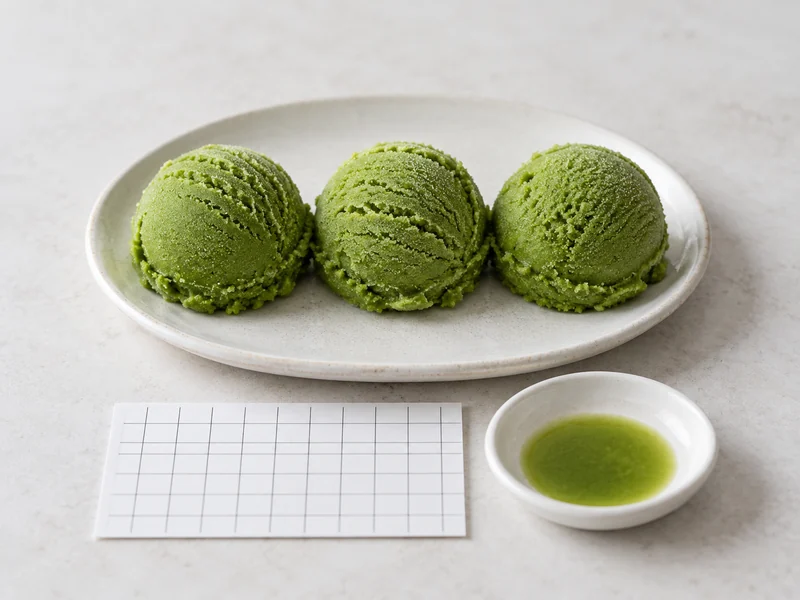
A frozen team should evaluate matcha sorbet after hardening and at the intended serving temperature. Record draw condition, hardening time, storage temperature, temper time, scoop force, crystal perception, melt, color and tea finish.
Run a controlled temperature-cycle trial if distribution includes door openings or transport. This proposed trial is a quality screen, not shelf-life validation. The matcha dessert sourcing guide supports ingredient selection, while the matcha baking guide provides adjacent dessert context.
Key Takeaway: Approve the scoop after its real hardening and temper sequence, not directly from the machine.
What should a matcha sorbet sample brief specify?
A matcha sorbet sample brief should specify water or plant base, sugar and solids system, stabilizer if any, addition temperature, freezing equipment, target color, serving temperature, dairy-free documentation needs, and market.
AdoroHu supplies pure matcha powder rather than finished sorbet. Buyers can review the matcha food application pathway and contact AdoroHu Matcha with the selected frozen system.
Key Takeaway: Give the supplier the complete dairy-free matrix and freezing route.
FAQ
- Can matcha sorbet contain cream?
- A product containing dairy cream does not fit the true dairy-free sorbet baseline used here.
- Is the three-ingredient water formula a commercial specification?
- No. Its 2 cups water, ⅔ cup sugar, and 1 tbsp matcha are one external recipe benchmark for a bench trial.
- Why can’t matcha doses be copied between sorbet recipes?
- Water, rice milk, protein, stabilizer, glycerin, sugar, batch size and equipment all change the surrounding system.
- Which freezing method is best for matcha sorbet?
- Choose the manual, frozen-pint, or batch-churn route that the operation can repeat, then validate texture on that equipment.
- How should matcha grades be compared in sorbet?
- Freeze them in the same base and taste at the same serving temperature and temper condition.
- Does dairy-free matcha guarantee dairy-free sorbet?
- No. Every ingredient, processing aid, topping and shared-equipment risk must be reviewed.