
Matcha biscotti succeed when the first bake creates a sliceable log and the second bake creates a dry, clean snap without burning the tea. A bakery testing culinary matcha powder should record log geometry, cooling time, slice thickness, second-bake exposure, breakage and packed texture.
Published formulas vary sharply in yield, fat system and decoration. Their value is the linked process evidence: a log length, a first bake, a cooling window, a cut dimension, and a second bake.
Matcha biscotti are a two-bake product, so oven time alone does not describe throughput. A useful benchmark follows one log from dough weight through first bake, slicing, drying, cooling, and packing. Published quantities are external examples, not AdoroHu production specifications.
In short:
Key points:
- Design the log and slice before choosing the final second-bake time.
- Track broken slices because stated yield is not sellable yield.
- Test the finished biscuit in its pack; dryness at the rack is only the starting condition.
Which two-bake matcha biscotti benchmark fits the product?
The right matcha biscotti benchmark is the one with the closest slice size, yield and fat system. Three published examples all use a shaped log, but they give different outputs.
| Published benchmark | Matcha and fat | Log, yield and first bake |
|---|---|---|
| TurmericMeCrazy | 1 tsp matcha; ¼ cup butter | 12-inch log; 6 pieces; 30 min at 350°F |
| Bakes and Blunders | 1 tbsp matcha; 80 g butter; almond flour and chips | 12-inch log; 14 biscotti; 30–40 min at 350°F |
| Wanderlust Kitchen | 1½ tsp matcha; ½ cup oil | cylinder pressed to ½-inch thick; yield 12; 25–30 min at 375°F |
Choose the butter formula when a richer bite is intended; choose the oil formula only when that different spread and handling behavior fits the brief. Do not average their matcha doses or bake times.
Key Takeaway: Reproduce one complete two-bake system before optimizing powder or inclusions.
How should log geometry be specified for matcha biscotti?
Matcha biscotti logs need a stated length, width, thickness and dough weight because geometry controls the first-bake center. TurmericMeCrazy and Bakes and Blunders both state a 12-inch log. Wanderlust Kitchen presses its cylinder to ½-inch thickness and uses a 13-by-9-inch sheet.
Record dimensions at shaping and after the first bake. A wider log produces longer cookies and a longer moisture path; a thinner log may set sooner but yield fragile slices. Use guides or a marked sheet rather than relying on visual memory.
Avoid scaling by making one oversized log. The center may remain too soft when the exterior is ready, delaying slicing and increasing breakage.
Key Takeaway: Scale by adding matched logs, not by changing the control log’s cross-section.
When is the first-baked matcha biscotti log ready to slice?
The first-baked matcha biscotti log is ready when it is set enough to cut without compression but not so dry that it shatters. Published cooling windows provide real starting points: 20 minutes for TurmericMeCrazy, 15 minutes before rack transfer for Bakes and Blunders, and 10 minutes for Wanderlust Kitchen.
Test the chosen window with a sharp serrated knife and record end loss, cracked slices and deformation. Room temperature, inclusion size and log thickness can change the result, so the source time is a benchmark rather than a universal endpoint.
Choose the shortest window that produces clean, repeatable cuts. Avoid slicing hot to gain speed when it raises breakage; the lost yield can cost more than the saved minutes.
Key Takeaway: Make slice integrity the cooling endpoint, then document the time that reaches it.
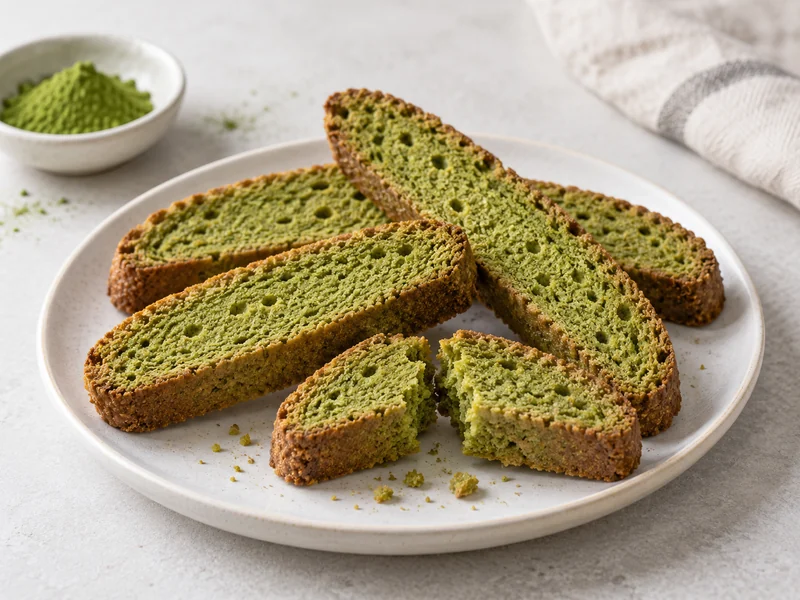
How does slice thickness change matcha biscotti yield and snap?
Slice thickness changes matcha biscotti count, drying time and breakage. TurmericMeCrazy and Wanderlust Kitchen state ½-inch slices, while Bakes and Blunders states 1-inch cookies on a slight diagonal.
A 1-inch slice is not simply a larger ½-inch slice: it has a longer drying path and a heavier serving. Specify thickness and angle, then count intact pieces from each log. Use actual accepted count for costing rather than the recipe’s stated yield.
| Slice decision | Likely effect | Measure |
|---|---|---|
| ½-inch crosswise | More pieces; faster drying; greater fragility | breakage and edge color |
| 1-inch diagonal | Fewer, heavier pieces; longer drying path | center snap and pack fit |
| Mixed thickness | Uneven dryness in one oven load | reject or re-sort rate |
Key Takeaway: Fix thickness before setting the second bake or package count.
What should the second bake control in matcha biscotti?
The second bake for matcha biscotti should control final dryness and color without pushing matcha toward a dull or bitter finish. TurmericMeCrazy lowers the oven from 350°F to 320°F and bakes the slices a further 25 minutes. Wanderlust Kitchen uses another 7–10 minutes per side. Bakes and Blunders reheats to 325°F and places slices upright.
These orientations expose different surfaces. Choose one, note rack position and rotate only if the control calls for it. Weigh a fixed sample before and after the second bake to compare moisture loss directionally; that does not replace product-specific shelf-life work.
Key Takeaway: Treat temperature, orientation and time as one drying step, not interchangeable knobs.
Which matcha grade survives two biscotti bakes?
A culinary matcha grade should be the first comparison because matcha biscotti receive two heat exposures. AdoroHu’s E-1/E-2 and O-1/O-2 are Culinary tiers; higher numbers within a tier indicate deeper color, more sweetness and less bitterness.
Blind-code center slices from matched logs and inspect them after the second bake, not after mixing. Choose the step-up only if color and tea finish remain distinct beside vanilla, almond or chocolate.
Avoid buying on raw-powder color. The first and second bake may erase the apparent gap while leaving the cost difference intact.
Key Takeaway: Judge matcha after the complete two-bake process and full cooling.
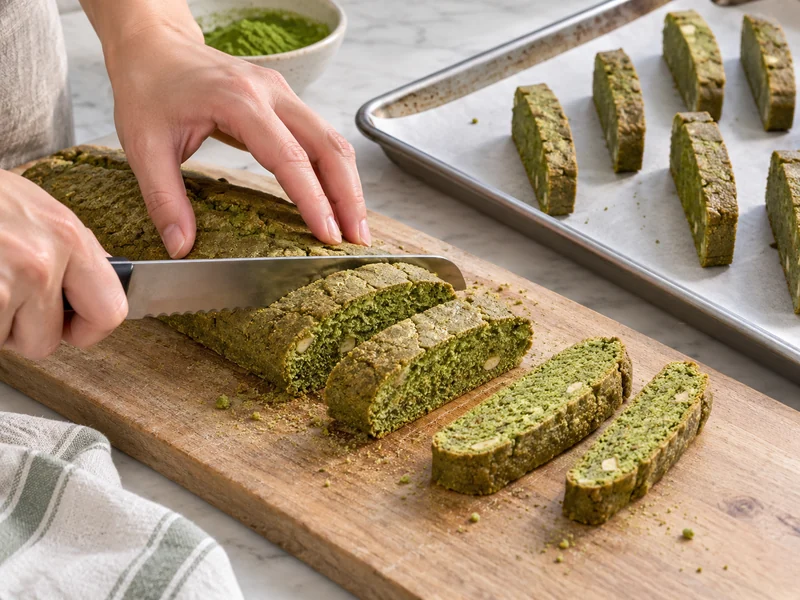
How should nuts, chips, or glaze be handled in matcha biscotti?
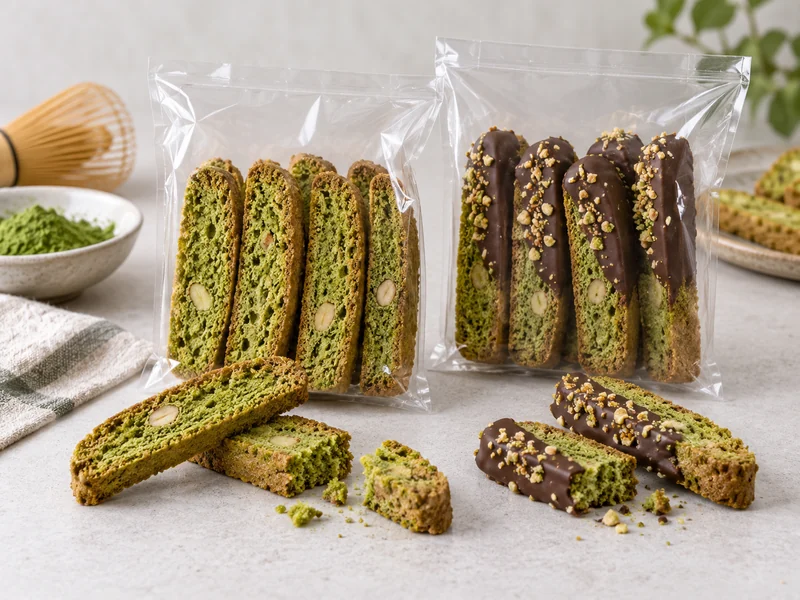
Nuts and chips in matcha biscotti affect cutting; glaze affects packing. Bakes and Blunders states 100 g mini chocolate chips in its dough and 30–50 g semisweet chocolate for finishing. Wanderlust Kitchen includes a matcha glaze made separately after baking.
Run the plain log first. Then test one inclusion at a size that the serrated knife can pass without tearing the slice. For glaze, measure application weight and hardening time; Wanderlust Kitchen states 15 minutes for its glaze to harden.
The matcha baking guide helps position biscotti beside cookies, while the dessert sourcing guide supports powder selection across the line.
Key Takeaway: Add inclusions only after the plain log slices cleanly, and treat glaze drying as production time.
How should packed matcha biscotti be evaluated?
Packed matcha biscotti should retain snap without crumbling during sealing, storage and transport. Record cooled piece weight, pack count, broken pieces after handling, visible grease or glaze transfer, and sensory texture at planned checkpoints.
A dry biscuit can still pick up moisture through a poor barrier or from an incompletely set coating. Published storage language cannot validate the bakery’s shelf life because formula, drying endpoint, pack and distribution differ.
Finished biscotti may contain wheat, egg, milk, nuts or soy. The FDA allergen overview provides U.S. context; labels must follow the actual formula and market.
Key Takeaway: Approve the biscuit and its pack together, using intact sellable pieces as the yield.
What belongs in a matcha biscotti sourcing request?
A matcha biscotti sourcing request should state two-bake temperatures, total heat exposure, intended inclusions, target color after drying, annual volume assumptions, required certifications and sample comparison plan.
AdoroHu supplies pure matcha powder, not finished biscotti. Its 10 kg and 20 kg cartons have sealed food-grade liners. Buyers can review the matcha baking application and contact AdoroHu Matcha with the selected benchmark and acceptance sheet.
Key Takeaway: Give the supplier the second-bake exposure and finished-color target, not only the word “biscotti.”
FAQ
- Why are matcha biscotti baked twice?
- The first bake creates a sliceable log; the second dries the cut surfaces to create the intended snap.
- How long should the first-baked log cool before slicing?
- One example states 10 minutes and another states 20 minutes before slicing. Bakes and Blunders states 15 minutes on the tray before rack transfer, followed by further cooling before slicing. Use clean slice integrity as the endpoint.
- Should matcha biscotti be cut ½ inch or 1 inch thick?
- Choose the thickness from portion, drying and pack needs, then keep it fixed because it changes yield and second-bake behavior.
- Can a bakery make one larger log when scaling?
- That changes the cross-section and center bake. Multiple matched logs preserve the tested geometry more closely.
- When should chocolate or glaze be added?
- Add chips only after the plain log cuts cleanly, and apply glaze after full baking with its hardening time included in production.
- Does a crisp rack sample prove packaged shelf life?
- No. Shelf life depends on final dryness, coating, packaging barrier, storage, safety and sensory acceptance.