
Matcha fudge in the current recipe set is a condensed-milk and white-chocolate confection, not a traditional beaten cooked-sugar fudge. A confectionery team should choose that identity, use culinary matcha powder, and control chocolate ratio, heat route, pan depth, chill, and cut count.
Published examples share an 8-inch square pan but state yields from 16 to 36 pieces and chills from one to three hours. Those differences create useful portion and throughput questions; they do not create an AdoroHu-tested formula.
Matcha fudge should be benchmarked as one declared confectionery system. Preserve each source’s matcha, chocolate, condensed milk, heat method, pan, chill, and yield as a linked set. Evaluate smoothness, oiling, cut quality, sweetness, color, and wrapper release in the actual process.
In short:
Key points:
- Choose saucepan or microwave processing before comparing matcha.
- Fix pan depth and target cut because 16 and 36 pieces are different products.
- Reject grainy or oily slabs before making a grade decision.
Which matcha fudge system should a confectioner benchmark?
The matcha fudge benchmark should use one complete condensed-milk and white-chocolate system. Cooking Therapy states ¾ cup condensed milk, 14 oz white chocolate, and 2 tbsp matcha. Sweet Mouth Joy states 395 g condensed milk, 475 g white chocolate, and 12 g matcha. A Taste of Madness states a 300 mL can condensed milk, 3½ cups white chocolate chips, ¼ cup butter, and 2 tbsp matcha.
These formulas cannot be merged safely by matching one ingredient. Their chocolate formats, units, butter and ratios differ. Select the route closest to the intended ingredient supply and keep it intact for the first reproduction.
Key Takeaway: Choose one white-chocolate system and preserve its full ratio before optimizing it.
What do the 16-piece and 36-piece fudge yields mean for buyers?
The 16-piece and 36-piece yields describe very different matcha fudge portions from an 8-inch pan. Sweet Mouth Joy states 36 pieces; Cooking Therapy states 16 people. If the slab area is comparable, the 36-cut top area is less than half the 16-cut area before kerf and edge trim.
| Published benchmark | Pan and yield | Set condition |
|---|---|---|
| Cooking Therapy | 8×8-inch; 16 | cool 15–20 min, then chill at least 3 hr |
| Sweet Mouth Joy | 8-inch tin; 36 pieces | refrigerate at least 1 hr |
| A Taste of Madness | 8-inch square; yield unstated | refrigerate at least 2 hr |
Choose the 16-cut concept for a substantial confection and the 36-cut concept for a smaller tasting piece or assortment. Then weigh the real slab and accepted cuts. Do not use the stated yield as a weight guarantee.
Key Takeaway: Set piece dimensions before costing powder and packaging.
How should matcha be dispersed in condensed milk?
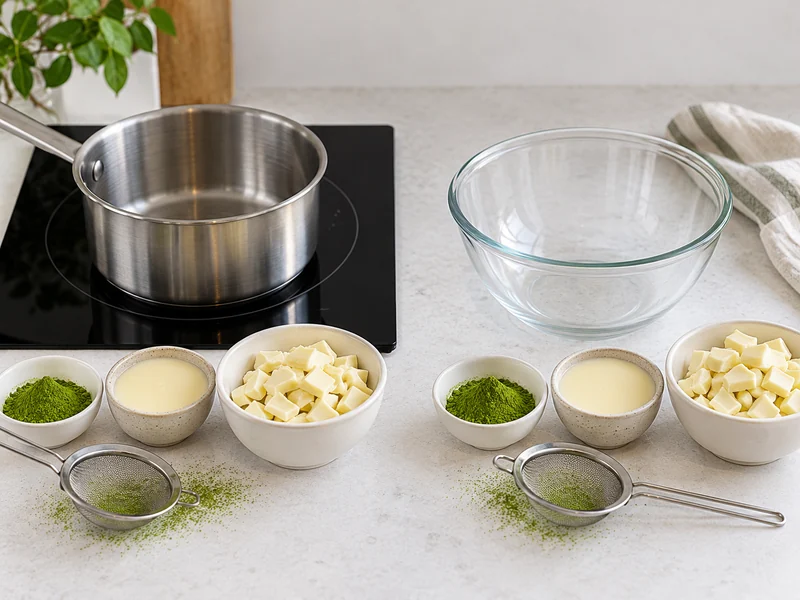
Matcha should be sifted and dispersed without leaving dry specks in the viscous fudge base. Cooking Therapy heats matcha and condensed milk together over medium-low heat and explicitly says to sift the matcha into the pan.
That route gives a defined first trial. Record condensed-milk temperature, whisk or spatula, mixing time, wall scraping and time before chocolate addition. Compare samples from the first and last poured areas of the slab.
Avoid increasing heat to force out clumps. The consequence can be local thickening, scorching, or a darker tea note that is then misdiagnosed as a powder problem.
Key Takeaway: Standardize sifting and dispersion before changing dose or grade.
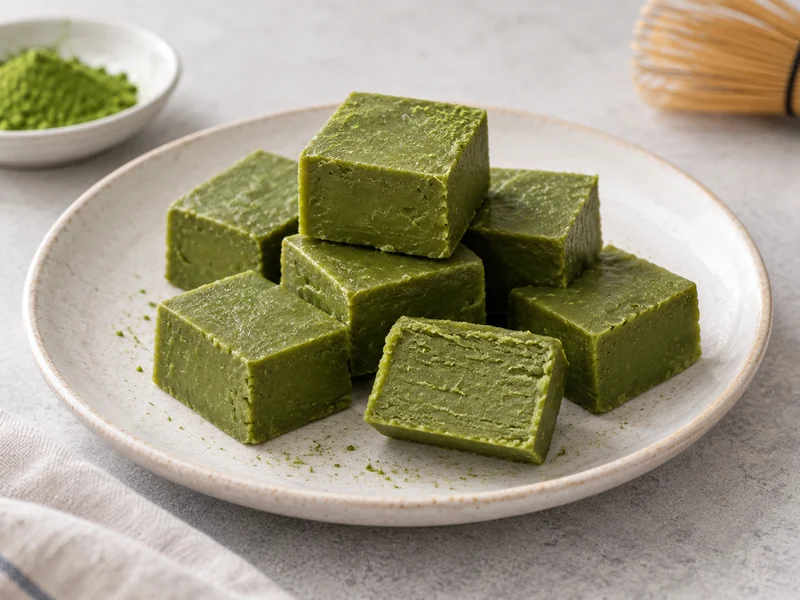
Should matcha fudge use a saucepan or microwave?
Matcha fudge can use a saucepan or microwave, but the routes need separate controls. Cooking Therapy uses medium-low saucepan heat for matcha and condensed milk. A Taste of Madness melts chocolate, condensed milk and butter in 30-second microwave intervals. The published Sweet Mouth Joy formula uses a melted mixture but does not state an interval.
For the saucepan, record pan size, heat setting, product temperature and time. For the microwave, record wattage, interval count, stir pattern and final temperature. Choose the route that delivers a smooth slab across repeated batches.
| Heat route | Published control | Record in the pilot |
|---|---|---|
| Saucepan | medium-low heat with matcha in condensed milk | pan, heat, time, product temperature |
| Microwave | 30-second melt-and-stir intervals | wattage, interval count, stir pattern |
Do not transfer a time from one microwave to another without checking power and mass. Short prep claims describe source conditions, not production capacity.
Key Takeaway: Heat route is a controlled process choice, not a convenience note.
What causes graininess or oiling in matcha fudge?
Graininess or oiling in this matcha fudge system points first to chocolate handling, water balance, overheating, or incomplete emulsification. Matcha particles can make defects more visible, but they should not be blamed before the base process passes.
Inspect the melted mass before casting, then cut the chilled slab through the center. Record visible oil, sugar grit, crumble, drag on the knife, sticky edges, and color bands. Reheat and overmix trials should be labeled deviations rather than folded into the control.
Choose the lowest heat exposure that fully combines the selected chocolate and condensed milk. Reject a batch that only looks smooth while warm but oils after chilling.
Key Takeaway: Approve the emulsion after chilling and cutting, not only in the pan.
Which matcha grade fits a sweet white-chocolate fudge?
Sweet white-chocolate matcha fudge needs enough tea character to remain clear in a concentrated sugar and fat matrix. AdoroHu’s E-1/E-2 and O-1/O-2 are Culinary grades; higher numbers in each series indicate deeper color, more sweetness and less bitterness.
Compare adjacent grades in the same control slab and blind-code equal center pieces. Choose the step-up only if color or finish remains meaningfully better after the full chill.
Avoid selecting ceremonial positioning from a recipe label or dry sample. The buyer pays for finished-piece performance, not terminology borrowed from a consumer recipe.
Key Takeaway: Grade the chilled center and calculate matcha cost per accepted piece.
How should set time and cutting be validated for matcha fudge?
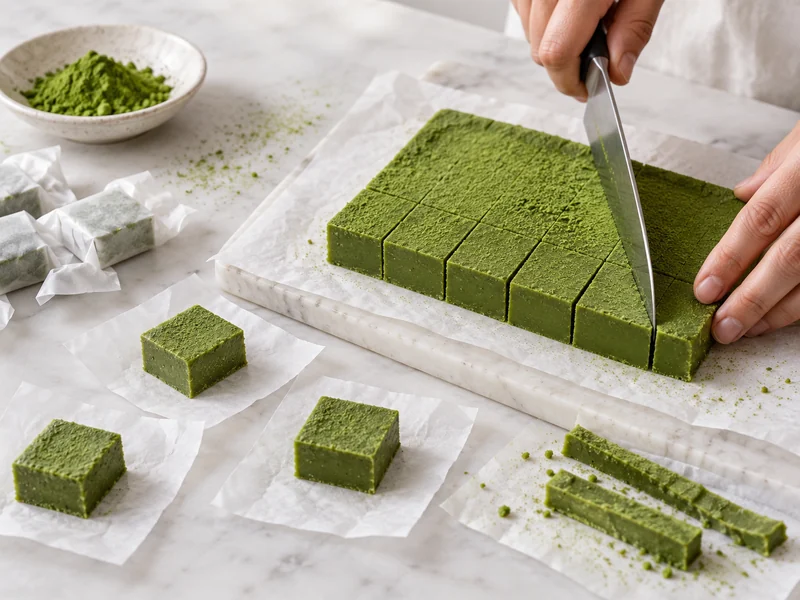
Matcha fudge set time and cutting should be validated together because a slab may feel cool before its center cuts cleanly. Published chill instructions range from at least one hour to at least three hours, with one source adding 15–20 minutes of room-temperature cooling first.
At fixed checkpoints, cut one strip from the same slab position and record edge compression, crumbs, sticking and knife cleaning. Do not repeatedly cut saleable slabs during production; create a defined test piece or pilot method.
The matcha baking guide gives adjacent confectionery context, and the dessert sourcing guide supports grade and ingredient decisions.
Key Takeaway: Define the earliest clean-cut checkpoint for the selected slab depth and formula.
How should matcha fudge be packed and labeled?
Matcha fudge should be packed only after the center has set and the surface no longer transfers oil or moisture to the wrapper. Record piece weight, dimensional variation, wrapper release, abrasion, and color after the intended handling.
White chocolate and condensed milk typically introduce milk, and chocolate may introduce soy; the full formula controls the label. The FDA allergen overview provides U.S. context. Published chill or storage language does not validate a commercial shelf life.
AdoroHu supplies pure matcha rather than finished fudge. Buyers can review the matcha food application and contact AdoroHu Matcha with the chosen chocolate system and cut standard.
Key Takeaway: Approve the chilled piece and wrapper as one sellable unit.
FAQ
- Is this matcha fudge a traditional cooked-sugar fudge?
- No. The published benchmark set is based on white chocolate and sweetened condensed milk, with saucepan or microwave melting.
- Why do two 8-inch pans yield 16 and 36 pieces?
- The sources use different target cuts. Piece dimensions must be chosen before cost, packaging and serving comparisons.
- Can 12 g matcha be treated as equal to 2 tbsp?
- No. Preserve each source’s original unit unless that source provides the conversion.
- How long should matcha fudge chill?
- Published examples state at least one, two, or three hours. Validate the earliest clean cut for the selected formula and slab depth.
- Why is the chilled fudge oily?
- Review chocolate composition, heat, water balance and emulsification before blaming matcha.
- Does a recipe’s refrigerator note prove commercial shelf life?
- No. The final formula, process, pack, storage, safety and sensory acceptance require product-specific assessment.