
Matcha blondies should taste like a brown-sugar bakery bar with a clear tea finish, not a white-chocolate brownie under another name. Begin with matcha powder for culinary applications, establish the butter-and-sugar control, and treat chips, nuts, citrus, and white chocolate as deliberate inclusions.
That order matters in commercial development. Brown sugar changes moisture and caramel notes; inclusions affect portion weight and cutting; matcha has to remain identifiable after both. A formula that changes all three at once produces an attractive sample but little usable evidence.
A matcha blondie benchmark starts with brown sugar, butter, flour, egg, and a defined matcha dose. It should have a chewy edge, a soft center, and enough tea character to remain clear beside any inclusion. Published recipes are trial references rather than AdoroHu-tested formulas or shelf-life specifications.
In short:
Key points:
- Keep the brown-sugar base central and screen inclusions after the plain bar works.
- Use published doses, pans, temperatures, and yields in their stated units.
- Set cut size and cooling method before comparing grade cost or menu margin.
What makes a matcha blondie tea-forward rather than brownie-like?
A tea-forward matcha blondie gets its main structure and flavor from butter, brown sugar, flour, egg, and matcha. White chocolate can appear as a chip or accent, but it does not have to form the melted fat phase as it does in the brownie benchmark.
Cooking Therapy’s published blondie uses 1 cup light brown sugar, ½ cup butter, 1 egg, 2 tbsp matcha, and ½ cup chocolate chips. Sudachi uses 100 g light brown sugar plus 50 g granulated sugar, 115 g butter, 1 egg and 1 yolk, 6 g matcha, and 50 g filling. Both preserve brown sugar as a defining input even though their proportions differ.
Choose this product when the menu needs an adaptable bar whose tea flavor can carry nuts, dark chocolate, or citrus. Choose the brownie concept when a melted white-chocolate phase and denser fudge character are essential. Blurring the two weakens purchasing briefs and makes customer expectations harder to manage.
Key Takeaway: Write “brown-sugar bar with tea-forward flavor” into the control standard before selecting inclusions.
Which blondie benchmark best matches the intended cut?
The right matcha blondie benchmark depends on piece size, pan, and ingredient system. Current published recipes range from a 9-cut conventional bar to a 16-piece metric formula and a 6-piece vegan small batch.
| Published recipe benchmark | Stated system | Pan, yield and oven facts |
|---|---|---|
| Cooking Therapy | 2 tbsp matcha; 1 cup light brown sugar; ½ cup chips | 8×8-inch; 9 blondies; 25–30 minutes at 350°F |
| Sudachi | 6 g matcha; 100 g light brown plus 50 g white sugar; 50 g filling | 20 cm square; 12–16 cuts; 18–20 minutes at 160°C |
| Nutritious Delights | 1 tbsp matcha; almond butter, oat and almond flours; optional vegan white chocolate | 6×4-inch or 8-inch loaf pan; yield 6; 30 minutes at 350°F |
These examples answer different business questions. Cooking Therapy suits a larger café-square reference. Sudachi gives a metric baseline and an explicit range of 12–16 cuts. Nutritious Delights is a separate vegan, gluten-free style whose flours and binders change the bar.
Avoid averaging their doses or bake times. The consequence would be a hybrid with no published control and no clear reason for a failure.
Key Takeaway: Pick one benchmark that matches the desired cut and claim set, then reproduce it without borrowing variables from the others.
How should brown sugar be tested in matcha blondies?
Brown sugar should be tested as a flavor and moisture variable, not as a cosmetic choice. Cooking Therapy uses only light brown sugar in its stated sugar phase. Sudachi combines light brown and granulated sugar. These systems will not produce the same caramel note, spread, or center texture.
Hold total formula and process steady while comparing the chosen sugar route. Record batter weight, baked slab weight, edge height, center compression, sweetness, matcha finish, and next-day chew. If dark brown sugar is considered, run it as a separate trial because its stronger molasses character can cover a mild matcha.
Choose the sugar system that leaves a recognizable tea finish at the intended serving age. Avoid solving weak matcha flavor by raising the powder before checking whether the sugar base is masking it; that can add bitterness without fixing balance.
Key Takeaway: Set the sugar profile before setting the final matcha dose.
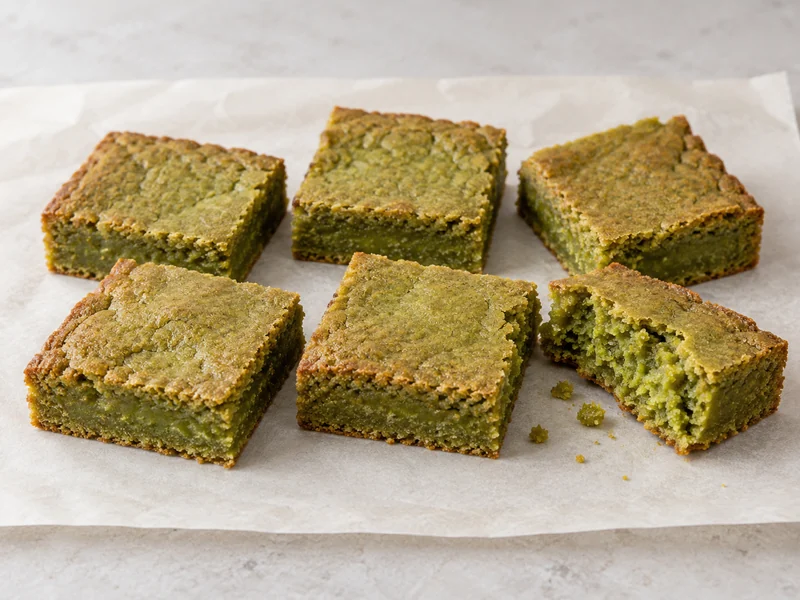
What does the 6 g, 20 cm, 160°C blondie example teach a bakery?
The Sudachi example provides a useful linked set of facts: 6 g matcha, a 20 cm square pan, 160°C, an 18–20-minute bake, and 12–16 pieces. Its 115 g butter, 100 g light brown sugar, 50 g granulated sugar, and 50 g filling define the surrounding matrix.
For a bakery, the value is not the number 6 g in isolation. It is a complete starting condition that connects powder use to pan area, bake exposure, and possible yield. Reproducing that linked set lets the team measure actual batter depth, piece weight, color, and cost per accepted cut.
If the bakery chooses 12 rather than 16 cuts, it changes portion weight and revenue per slab. Make that decision before comparing powder grades so the sensory panel and costing sheet refer to the same product.
Key Takeaway: Treat dose, pan, temperature, time, and cut count as one benchmark package.
Which matcha grade fits a brown-sugar blondie?
Culinary matcha is the logical first screen for a brown-sugar blondie. AdoroHu identifies E-1 and E-2 as Culinary in its EU Standard Series and O-1 and O-2 as Culinary in its Organic Series. Higher numbers within a series indicate deeper color, more sweetness, and less bitterness.
Compare adjacent grades in the same plain blondie before adding chips. Judge the center under fixed lighting, then taste at the service temperature and again the next day if that is part of the sales plan. The grade step-up is justified only when the difference remains visible or flavorful in the finished bar.
Powder cost should be divided by accepted pieces rather than theoretical pieces. A higher grade that improves color but also exposes uneven mixing or increases rejects may not improve the real margin.
Key Takeaway: Select grade from the plain baked bar and the accepted-piece cost, not from dry color.
How can matcha stay even in a thick blondie batter?
Matcha stays even when it is sifted with the flour and the dry blend is folded through a consistent wet base. Cooking Therapy explicitly recommends sifting to prevent clumps. Sudachi also states sifting 130 g flour with 6 g matcha before incorporation.
For the control, record sieve, fold count or mixing time, bowl scrape pattern, and delay before panning. Check the first, center, and last cut for dark specks or pale zones. A thick batter can hold an inclusion in place while still hiding poor powder distribution.
Do not add extra liquid merely to make mixing easier without a separate trial. Added liquid can alter spread, starch hydration, cooling set, and the next-day center, making the dispersion fix more expensive than the original defect.
Key Takeaway: Validate distribution across the whole slab before changing the formula to make mixing easier.
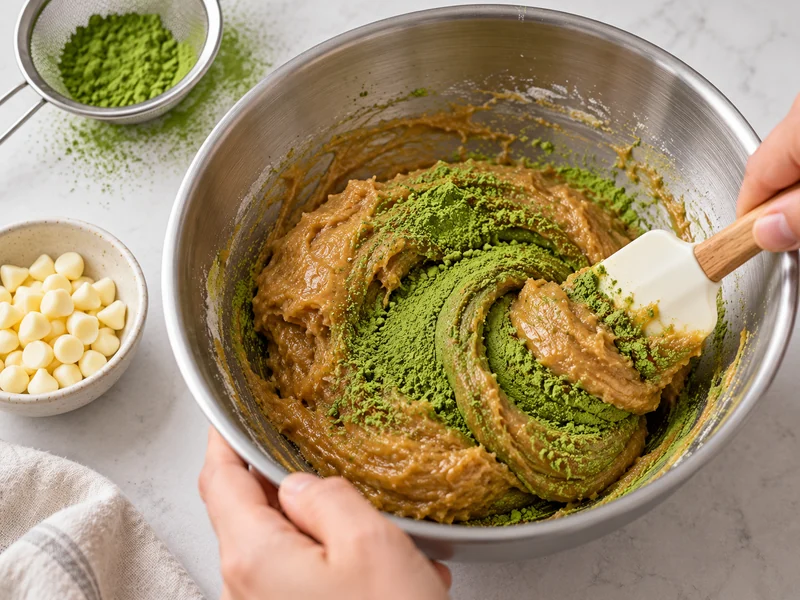
Which inclusions belong in a matcha blondie line?
An inclusion belongs when it supports the brown-sugar and tea profile and distributes cleanly at the chosen cut. Sudachi states 50 g of filling and suggests holding back 1–2 tbsp for the top. Cooking Therapy states ½ cup chocolate chips. Those facts provide two different inclusion benchmarks without implying a universal dose.
| Inclusion direction | What it adds | What to inspect |
|---|---|---|
| Dark chocolate | Bitter contrast and visible pieces | tea recognition, chip distribution, cut drag |
| Macadamia or pistachio | Fat, crunch and premium cue | oxidation, nut allergens, piece breakage |
| Lemon zest | Aroma without large pieces | bitterness, batch-to-batch zest variability |
| White chocolate chips | Sweetness and pale visual contrast | milk/soy label, sweetness ceiling, scorching |
The plain control should pass before any of these are added. The commercial matcha baking guide helps compare the blondie with other formats, while the matcha dessert sourcing guide covers wider ingredient decisions.
Key Takeaway: Add one inclusion at a time and reject it if tea identity or cutting yield falls.
How should cooling and cutting be built into blondie costing?
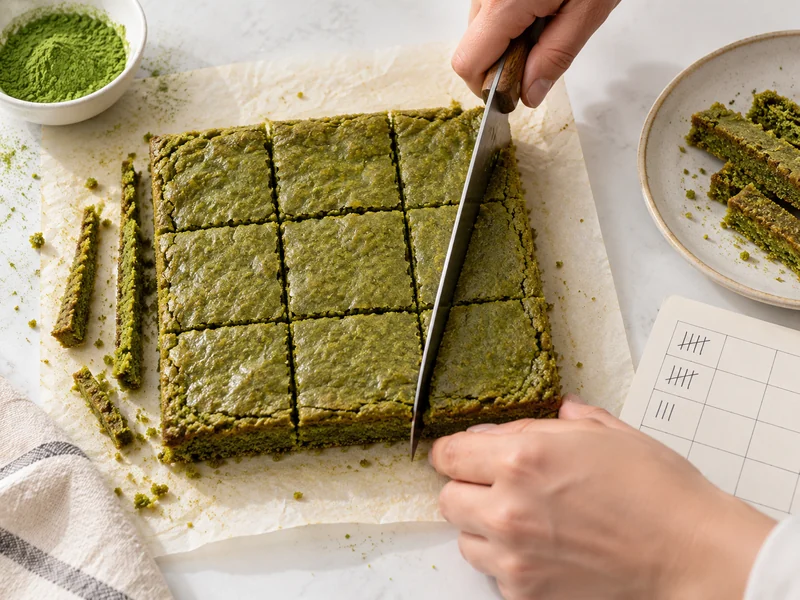
Cooling and cutting belong in the cost model because a soft center can tear, compress, or mark the pack. Cooking Therapy states 10 minutes of cooling before cutting. Sudachi states 10–15 minutes in the pan, then transfer to a rack, and notes that chilling for a few hours produces an extra-fudgy texture. Nutritious Delights states at least 20 minutes and ideally 60 minutes for full set.
Those instructions describe different products and handling choices. A café may accept a warm 9-cut bar; a wrapped retail piece needs cleaner geometry. Record the time to a cuttable slab, labor, knife cleaning, crumbs, edge trim, and accepted yield.
Choose a longer cooling route when it materially improves intact cuts and packaging. Avoid advertising a faster throughput based on oven time alone; the consequence is a queue of slabs that cannot yet be packed.
Key Takeaway: Cost the time from mixing to an accepted packed piece, not only the bake window.
What must a blondie pilot verify before sale?
A matcha blondie pilot must verify the formula, allergen statement, process repeatability, cut yield, service quality, and intended pack. Depending on ingredients, the finished bar may contain egg, milk, wheat, soy, tree nuts, or sesame. The FDA food-allergen overview provides U.S. context, while the operator remains responsible for the actual recipe, shared line and label market.
Do not transfer storage language from a recipe page into a commercial shelf-life claim. Observe the real bar in its pack, but use product-specific safety and shelf-life work for any final duration.
AdoroHu supplies pure matcha powder, not finished blondies. Buyers can review its baking application pathway and then contact AdoroHu Matcha with the chosen benchmark, grade comparison, market and document needs.
Key Takeaway: Approve the blondie only after the intended cut and pack pass, not when the warm slab first looks good.
FAQ
- Do matcha blondies need white chocolate?
- No. White chocolate can be an inclusion, but the benchmark can derive its identity from brown sugar, butter, flour, egg, and matcha.
- Can the 6 g matcha dose be moved into another blondie recipe?
- Not by itself. The published 6 g example belongs with its 20 cm pan, sugar and fat system, 160°C oven setting, and 18–20-minute bake.
- Why should a bakery choose between 12 and 16 cuts before grade testing?
- Cut count changes portion weight, customer experience, packaging and cost per piece, so the grade comparison must use the product that will be sold.
- Should matcha blondies use light or dark brown sugar?
- Start with the chosen published control and test sugar changes separately. Darker sugar can add moisture and molasses character that masks a mild tea finish.
- When should chips or nuts be added to the trial?
- Add one inclusion only after the plain blondie passes for texture, matcha distribution and flavor, then measure distribution and cutting loss.
- Can a cooling note from a recipe establish retail shelf life?
- No. Cooling guidance helps reproduce handling; retail shelf life requires product-specific work on formula, process, packaging, safety and sensory quality.