
Matcha milkshake development starts with cold dispersion, a fixed ice-cream-to-liquid system, and a blend endpoint that the café can repeat. A drink that looks thick in the blender can become thin during a two-minute handoff, so the formula must be judged at service. The matcha drink recipe guide supplies adjacent menu context.
A matcha milkshake is a frozen drink system, not a baking formula. Standardize the ice cream, liquid volume, matcha premix, blend time, cup weight, and handoff delay before comparing flavor or cost.
In short:
Key points:
- Disperse matcha in a measured liquid portion before it reaches the frozen base.
- Cost finished cup weight, not variable scoops or blender volume.
- Test viscosity and separation through the real order-to-handoff interval.
What should a commercial matcha milkshake specification include?
A matcha milkshake specification should state cup size, finished weight, serving temperature, straw diameter, draw resistance, sweetness, tea intensity, blend time, and maximum handoff delay. These are operational requirements, not decorative tasting notes.
Choose whether the drink is spoon-thick or designed for a standard straw. Avoid asking one formula to do both: staff will compensate with unmeasured milk, changing yield and matcha strength from order to order.
Key Takeaway: Define the service texture and cup weight before setting ingredient quantities.
What matcha quantities and yields appear in published milkshakes?
A Cookie Named Desire’s matcha milkshake states 1 tablespoon matcha and 2 servings. Proportional Plate states 1.5 tsp culinary matcha, 3 scoops vanilla ice cream identified as 1.5 cups, and a yield of 1. A Spice & Tea Exchange ingredient list includes both 2 Tbsp Sweet Matcha and 2 tsp Matcha Tea for two 10-ounce milkshakes; because the captured list gives no alternative marker, the benchmark preserves both as listed.
| Published benchmark | Matcha stated | Frozen base stated | Declared yield |
|---|---|---|---|
| A Cookie Named Desire | 1 tablespoon | Source formula | 2 servings |
| Proportional Plate | 1.5 tsp | 3 scoops / 1.5 cups ice cream | 1 |
| Spice & Tea Exchange | 2 Tbsp Sweet Matcha plus 2 tsp Matcha Tea | Source formula | Two 10-oz drinks |
Sweet Matcha and plain Matcha Tea are different ingredients. The source lists both, so a buyer should not interpret either quantity alone as the complete source benchmark.
Key Takeaway: Preserve the source ingredient identity and units when building the first costing comparison.
How should matcha be dispersed into a cold milkshake?
Proportional Plate instructs the maker to whisk matcha with 3 tablespoons milk or non-dairy milk to remove clumps before blending. That provides a direct cold-dispersion benchmark. The same source uses 3 tablespoons liquid when blending with matcha ice cream.
For a café trial, whisk the stated 1.5 tsp matcha into the stated 3 tablespoons liquid, then add that premix to the frozen base. Compare it with the current house dispersion method while holding ice cream and blend time fixed. Check the cup wall and final sip for green specks.
Avoid adding unmeasured warm water to make dispersion easier. It changes temperature, sweetness, and melt rate before the drink reaches the customer.
Key Takeaway: Use a measured premix and account for that liquid inside the total formula.
What ice-cream-to-liquid ratio should a café test?
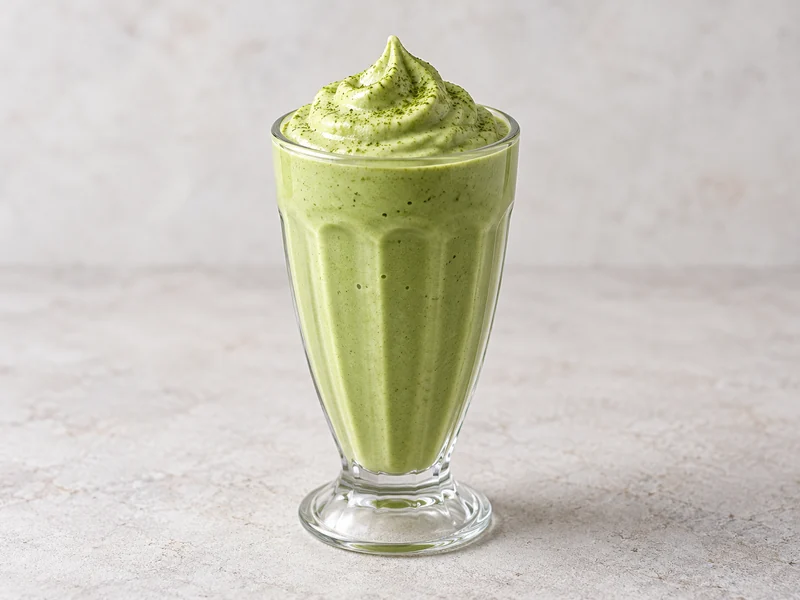
The Proportional Plate benchmark pairs 1.5 cups vanilla ice cream with 3 tablespoons milk and yields one drink. That is a concrete starting system, not a universal ratio. Ice cream brands differ in overrun, fat, stabilizers, and scoop density.
| Trial arm | Ice cream | Liquid | Matcha | Purpose |
|---|---|---|---|---|
| Published benchmark | 1.5 cups | 3 tablespoons | 1.5 tsp | Reproduce source texture |
| House base check | Same finished weight | 3 tablespoons | 1.5 tsp | Isolate brand effect |
| Service adjustment | Same as chosen base | One measured change | Same | Set straw draw and handoff stability |
Weigh the ice cream and finished drink during development even when service later uses a calibrated scoop. Select the liquid level that blends reliably without sacrificing the specified draw.
Key Takeaway: Establish the frozen-base mass first, then adjust liquid by a measured amount.
How long should a matcha milkshake be blended?
The Spice & Tea Exchange instructs blending on high for 30 seconds or until smooth. That gives a useful source benchmark and an endpoint cue. Actual equipment, jar load, and ice-cream temperature will change the required time.
Record starting base temperature, blender model, speed, load, blend seconds, finished temperature, and cup weight. Stop once the drink is smooth and circulating. Avoid repeated pulse-and-check cycles; they add heat and create a different melt history for every order.
Key Takeaway: Use smoothness as the endpoint and record the seconds needed on the actual blender.
How should sweetness and matcha intensity be balanced?
Vanilla ice cream, matcha ice cream, sweetened matcha blends, and syrups carry different sugar loads. Evaluate the complete drink cold because low temperature suppresses aroma and changes sweetness perception. A plain matcha powder trial should not inherit the same dose as a premixed Sweet Matcha product.
Choose one base and one sweetener system before comparing powder samples. Avoid stacking sweetened frozen base, sweet matcha, flavored syrup, whipped cream, and sauce unless that build is the deliberate menu concept; the tea becomes hard to identify and the cost hard to control.
Key Takeaway: Fix the base’s sugar contribution before tuning matcha intensity.
Which dairy-free base should be used for a matcha milkshake?
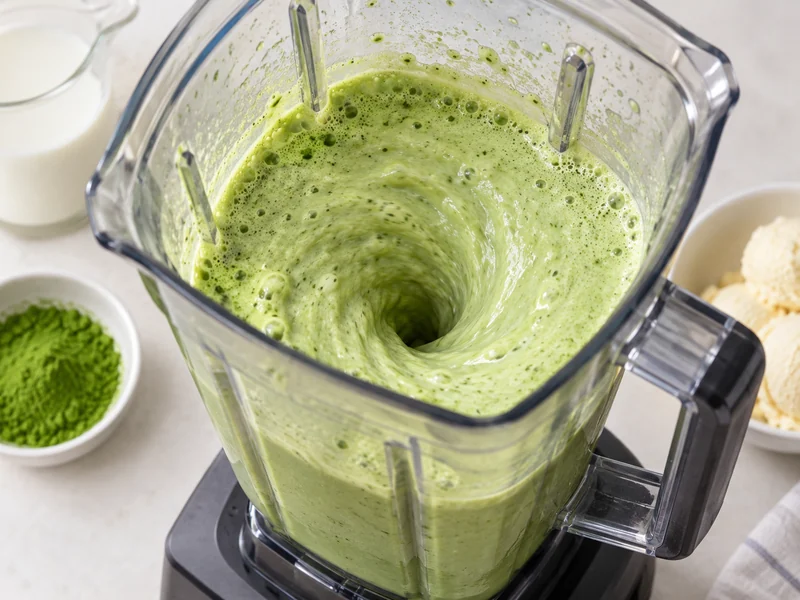
A dairy-free frozen dessert is a complete base change. Coconut, oat, soy, and nut systems differ in fat, stabilizers, flavor, and melt behavior. Replacing only the splash of milk does not create a valid dairy-free version if the ice cream remains dairy-based.
Develop one dairy-free frozen base as its own SKU. Keep its cup target and matcha premix measurable, then test straw draw and separation on the same handoff timeline. Review allergen controls and labeling for the exact ingredients used.
Key Takeaway: Treat dairy-free milkshake development as a separate base validation, not a milk swap.
How should cafés measure melt rate and handoff quality?
Pour the finished drink into the service cup and evaluate it at 0, 2, 5, and 10 minutes under the intended room conditions. Record finished temperature, visible separation, drip or pour behavior, and straw draw. Those intervals are internal test points, not shelf-life claims.
| Checkpoint | Record | Service consequence |
|---|---|---|
| 0 min | Cup weight, temperature, straw draw | Blender release standard |
| 2 min | Separation and draw | Typical counter handoff |
| 5 min | Melt and flavor dilution | Queue or delivery risk |
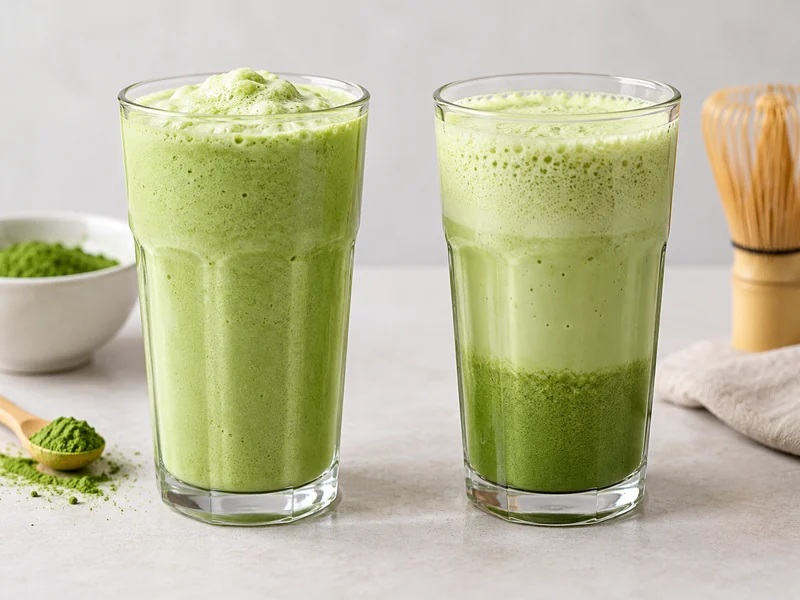
| 10 min | Phase separation | Defines failure mode, not safe life |
Choose the formula that survives the real handoff rather than the one that photographs thickest at second zero.
Key Takeaway: The usable texture window must cover preparation, queue, and customer handoff.
Which matcha grade should a café test in milkshakes?
AdoroHu E-1/E-2 and O-1/O-2 identify culinary tiers for structured sampling. The culinary matcha product page is the actual product destination; matcha for latte provides a related cold dairy application.
Compare samples in the chosen frozen base at the actual serving temperature. Score dispersion, tea aroma, bitterness, sweetness balance, finished color, and lot documentation. AdoroHu supplies powder, not a validated milkshake formula.
Key Takeaway: Approve matcha in the finished cold base and bind the sample to its documentation.
How should a café cost and control each milkshake?
Cost the drink from weighed frozen base, measured liquid, matcha, toppings, cup, lid, straw, and accepted finished yield. Record blender residue and overfill. Calibrate scoops by weight at the start of a shift because visual scoop size drifts.
For cleaning, allergens, and cold ingredient handling, follow the operation’s validated plan and local requirements. The FDA safe food-handling guidance is a public baseline, not a milkshake-specific process validation. The matcha ice cream guide can inform the frozen-base discussion without supplying a milkshake hold time.
Key Takeaway: Tie margin and consistency to finished cup weight and a documented blender routine.
FAQ
- Can matcha powder go straight into ice cream?
- It can, but a measured liquid premix provides a clearer clump-control benchmark and keeps added liquid accountable.
- How much milk does a published matcha milkshake use?
- One ranked recipe uses 3 tablespoons milk with 1.5 cups ice cream for one drink.
- How long is a published milkshake blended?
- One source specifies 30 seconds on high or until smooth; the café should verify that endpoint on its blender.
- Can matcha ice cream replace vanilla ice cream?
- Yes, but it changes the matcha and sugar contributions, so it needs a separate formula and sensory check.
- Does AdoroHu manufacture finished milkshakes?
- No. AdoroHu Matcha supplies matcha powder; the café owns formulation, allergen, safety, and service controls.
- Can a milkshake recipe establish a safe holding time?
- No. Use the operation’s validated ingredients, temperature controls, cleaning plan, and local requirements.
Conclusion
A commercial matcha milkshake needs a measured cold premix, fixed frozen-base mass, repeatable blend endpoint, and real handoff test. Contact AdoroHu Matcha with the base type, cup target, certification needs, and forecast volume when requesting powder samples.