
Matcha brownies work best as a fudgy white-chocolate bar in which matcha replaces cocoa as the defining flavor. For a bakery trial, start with a clearly specified culinary matcha powder and keep the white-chocolate fat phase, pan geometry, cut size, and endpoint visible in the batch record.
The name is used loosely online. Some formulas are conventional wheat-flour brownies, some resemble chocolate-chip blondies, and others use mochiko for a springy mochi texture. A buyer cannot compare cost or powder performance until those products are separated.
A useful matcha brownie benchmark has a white-chocolate and butter fat phase, a compact fudgy crumb, and a defined cut yield. Published recipes offer credible starting conditions, but they do not establish AdoroHu formulas, commercial bake settings, food-safety controls, or shelf life.
In short:
Key points:
- Define a conventional fudgy brownie before testing powder grades or inclusions.
- Compare published pan, yield, dose, and bake examples in their original units.
- Price the sellable cut and measure the endpoint in the bakery’s own oven.
What makes matcha brownies different from matcha blondies or mochi bars?
Matcha brownies are best defined here as compact bars built around a melted white-chocolate and butter phase, while matcha blondies lead with brown sugar and optional inclusions. Mochi brownies use glutinous rice flour and produce an elastic chew, so they belong in a separate development brief.
That boundary affects purchasing. A white-chocolate brownie has cocoa butter, milk and soy considerations from the chocolate, and the melted phase changes viscosity before flour enters. A blondie can omit white chocolate entirely. A mochi bar in one published benchmark uses 2⅓ cups mochiko and 1⅓ cups milk in a 9-by-9-inch pan, a structure that cannot serve as the control for a wheat-flour brownie.
| Product | Structural cue | Commercial consequence |
|---|---|---|
| Fudgy matcha brownie | Melted white chocolate and butter; compact crumb | Chocolate cost and melt control belong in the specification |
| Matcha blondie | Brown-sugar base; chips or nuts can be optional | Sugar profile and inclusion distribution drive identity |
| Matcha mochi brownie | Mochiko and substantial liquid | Chew, allergen review and holding behavior need a separate test |
Key Takeaway: Choose one product identity before comparing formulas; otherwise cost and texture data describe different goods.
Which published matcha brownie benchmark is useful for the first trial?
The most useful first benchmark is the one closest to the intended portion and process, not the recipe with the brightest photograph. Three published conventional examples use an 8-by-8-inch pan, yet their yields and bake conditions differ enough to change piece economics and oven scheduling.
| Published recipe benchmark | Matcha and fat-phase facts | Stated pan, yield and bake |
|---|---|---|
| Cooking Therapy | 2 tbsp matcha; 4 oz white chocolate; ½ cup browned butter | 8×8-inch; 9 brownies; 20–25 minutes plus another 10 minutes |
| No Recipes | 20 g matcha; 140 g white chocolate; 80 g butter | 8×8-inch; 16 servings; about 18–20 minutes at 320°F/160°C |
| Texanerin | 2 tbsp matcha; butter or 105 g coconut oil; semisweet chips | 8×8-inch; 16; 19–24 minutes at 350°F/176°C |
These are external recipe facts, not interchangeable specifications. Keep grams, tablespoons, ounces, and cups in their source units; converting volume matcha to grams without the source’s own conversion would create false precision.
For a premium café square, the 9-cut examples are the more relevant portion reference. For a smaller packaged bite, the 16-cut examples give a better denominator. Actual weight, trim and breakage still need measurement.
Key Takeaway: Select the source benchmark by the intended cut and fat system, then reproduce it before optimizing it.
How should a brownie team choose a matcha grade?
A brownie team should compare culinary grades first because sugar, butter and white chocolate already compete with tea aroma. AdoroHu’s EU Standard Series identifies E-1 and E-2 as Culinary; its Organic Series identifies O-1 and O-2 as Culinary. Higher numbers within each series indicate deeper color, more sweetness and less bitterness.
Run the same white-chocolate formula with two adjacent samples and blind-code the baked pieces. Score the center, not only the top crust. Choose the higher grade only if the baked color or cleaner finish remains obvious enough to support the added ingredient cost.
Avoid selecting from dry powder alone. White chocolate can make a powder look brighter in the bowl than it tastes after baking, so a dry comparison can push purchasing toward cost without a sellable gain.
Key Takeaway: Grade the baked center at the intended serving age, then calculate powder cost per accepted piece.
How does the white-chocolate fat phase control matcha brownie texture?
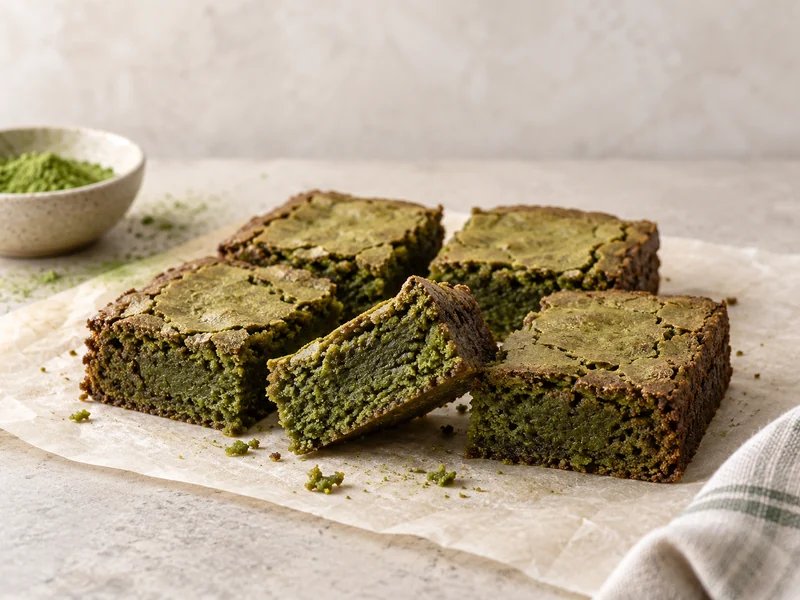
The white-chocolate fat phase controls viscosity, sweetness and the path to a fudgy crumb. In published examples, Cooking Therapy combines 4 oz white chocolate with browned butter, No Recipes uses 140 g white chocolate with 80 g butter, and Teak & Thyme pours browned butter over 100 g white chocolate before mixing.
Those are three different systems. Browned butter removes water and adds toasted milk-solid flavor; changing to plain melted butter is not a neutral substitution. Chocolate quantity also changes cocoa butter and sugar, so changing the matcha dose and chocolate dose in the same round makes the result hard to diagnose.
For the first controlled comparison, lock one fat phase. Reject any batch with visible oiling, seized chocolate, or matcha specks before judging flavor; those defects point to process, not powder quality.
Key Takeaway: Hold the chocolate and butter system constant while screening matcha, because both determine the brownie matrix.
Which mixing controls protect a glossy top and dense center?
Matcha brownie mixing should standardize temperature, aeration time and the point at which the matcha-chocolate phase enters. Cooking Therapy states a 5–10-minute beating step before streaming in its matcha ganache. Teak & Thyme states 7–10 minutes of beating eggs and sugar. Those long aeration windows can alter the top and apparent lift.
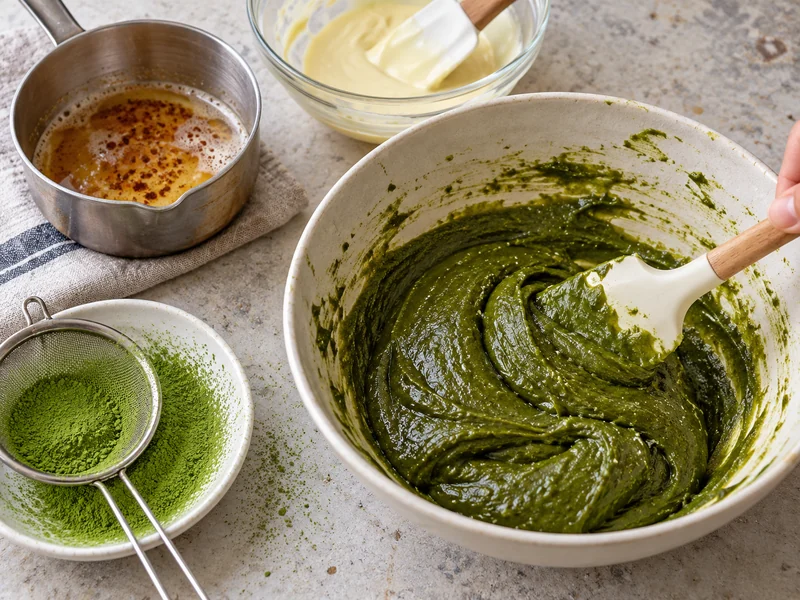
Record the start and finish temperature of the melted phase, mixer type, speed, time, and batter weight placed in the pan. Sift matcha with the dry ingredients when following a dry-dispersion formula; disperse it into the chocolate phase only when reproducing a source that does so. Do not switch routes midway and attribute the difference to grade.
Photograph a fixed center cut after complete cooling. The useful comparison is a clean, dense slice with even green color, not a warm corner chosen because it looks softer.
Key Takeaway: Fix aeration and dispersion before diagnosing crust, color or center density.
What do pan size, yield and bake time change in matcha brownies?
Pan size, yield and bake time change the sellable unit and the risk of overbaking. In the same nominal 8-by-8-inch pan, a 9-cut layout gives each piece about 16/9, or 1.78 times, the top area of a 16-cut layout: roughly 78% more. This is a nominal area comparison, not a claim about piece mass or cost across different formulas.
Published bake windows also diverge. No Recipes states about 18–20 minutes at 320°F/160°C, Texanerin states 19–24 minutes at 350°F/176°C, and Cooking Therapy uses 20–25 minutes followed by another 10 minutes. The correct conclusion is not that one universal time exists. Formula, endpoint and method differ.
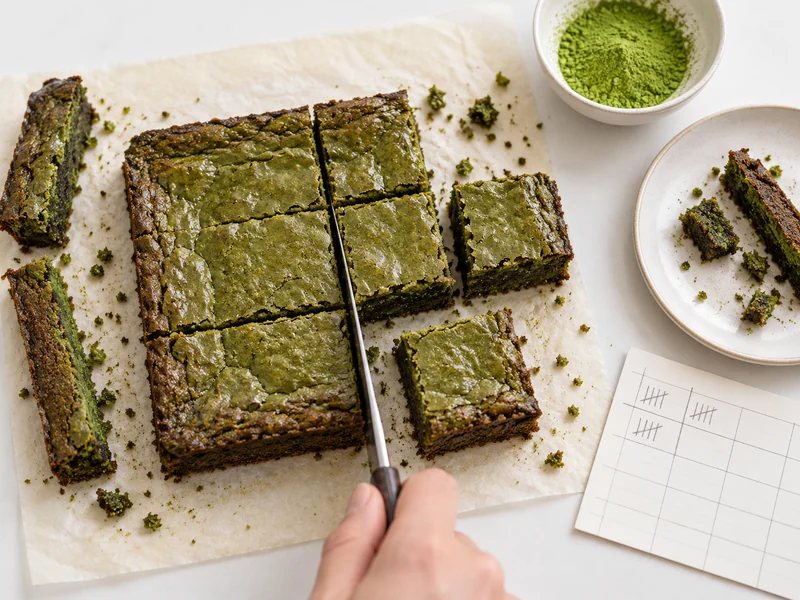
Choose a target cut before the pilot, then record baked slab weight, trim, number of intact pieces and rejected pieces. Avoid costing from the stated recipe yield alone; the consequence is an optimistic margin when the bakery’s cut standard produces more waste.
Key Takeaway: Cost the bakery’s actual accepted pieces and validate the endpoint in its own pan and oven.
Which inclusions suit matcha brownies without erasing the tea?
Inclusions should create contrast while leaving the white-chocolate and matcha center recognizable. Dark chocolate pieces can sharpen bitterness; sesame adds roast; raspberry adds acid and water; salt changes the finish without adding bulk.
Test the plain brownie first. Then add one inclusion at a fixed percentage and record distribution, cut damage and flavor balance. Texanerin’s published example includes 2/3 cup semisweet chips plus 1/3 cup mini chips on top, while the white-chocolate-led examples use a different identity. That is a useful contrast, not a reason to merge both into one formula.
Teams planning a wider bakery line can use the matcha baking recipe guide to place the bar beside cakes and cookies, and the dessert sourcing guide to compare purchasing criteria.
Key Takeaway: Approve the plain brownie before adding one inclusion; reject combinations that hide the tea or damage cutting yield.
How should matcha brownies be checked after cooling and packing?
Matcha brownies should be checked after full cooling, after cutting and again in the intended pack. No Recipes instructs removing the slab from the hot pan to prevent residual cooking. Texanerin states about 2 hours of cooling before cutting. Teak & Thyme cools completely in the pan. Each route can change handling and center set.
Build the pilot around the chosen route and record cool time, slab temperature at cutting, knife treatment, edge loss, wrapper marking and next-day texture. A home recipe’s storage note does not validate a commercial shelf life.
The finished brownie may contain milk, egg, wheat and soy, depending on the formula and chocolate. The FDA’s food-allergen overview is a useful U.S. reference, but the operator must review the actual ingredients, shared equipment and destination-market label.
Key Takeaway: Release the process only after the brownie survives the real cooling, cutting and packing sequence.
What should a matcha brownie sample request tell the supplier?
A matcha brownie sample request should state the white-chocolate system, oven exposure, target cut, desired center color, bitterness ceiling, market, required certifications, and the two powder grades to compare. Include the control formula and photographs under fixed lighting.
AdoroHu supplies pure matcha powder rather than finished brownies. Its 10 kg and 20 kg cartons use sealed food-grade liners, which helps a buyer plan storage and batch drawdown; it does not establish a minimum order or lead time. Buyers can also review the matcha application route for baking before requesting samples.
Ask for a lot-specific specification and certificate of analysis suited to the purchase. When the pilot has a defined control and acceptance sheet, contact AdoroHu Matcha with those details.
Key Takeaway: A sample brief should describe the brownie matrix and acceptance test, not merely ask for “baking matcha.”
FAQ
- Are matcha brownies the same as matcha blondies?
- No. This benchmark uses a white-chocolate and butter fat phase for a compact fudgy bar; the blondie benchmark leads with brown sugar and optional inclusions.
- Can a mochi brownie formula be used as the conventional brownie control?
- No. Mochiko and its higher-liquid structure produce a different chew, process and holding behavior, so it needs a separate trial.
- Why do published matcha brownie bake times differ so much?
- Their formulas, temperatures, pan sizes, endpoints and methods differ. Treat each time as part of its own published benchmark and validate the endpoint in the bakery’s oven.
- Should matcha be measured in grams or tablespoons for brownie trials?
- Preserve the source unit when reproducing a published recipe. For an internal control, weigh the powder consistently, but do not invent a tablespoon-to-gram conversion.
- How should a bakery compare matcha grades in brownies?
- Bake adjacent grades in the same formula, blind-code center pieces, score color and flavor, and compare powder cost per accepted cut.
- Does a published storage note prove brownie shelf life?
- No. Commercial shelf life depends on the finished formula, process, packaging, distribution, safety assessment and sensory acceptance.