
Consistent matcha castella needs controlled whole-egg foam, weighed pan fill, a tested bake profile, and a defined rest. Drift can reduce height, create dense bands, or increase trim loss.
Color cannot approve the cake. A commercial matcha castella standard must connect powder ratio, batter, oven load, cooling, and slice yield. Teams developing matcha for baking applications should release only conditions their line reproduces.
Matcha castella slices evenly when the bakery controls the matcha-flour premix, whole-egg foam endpoint, batter density, pan-fill mass, bake profile, cooling, wrapping, and rest. Record trimming and conforming slices as yield, because cake height alone can hide commercial loss. Recipe benchmarks can start development, but they are not universal production limits.
In short:
Key points:
- Weigh matcha against flour and qualify the premix before changing the full formula.
- Control foam, batter loss, pan fill, oven position, cooling, and rest as one process.
- Approve saleable slice yield and defects, not appearance at the oven door alone.
What makes matcha castella a distinct production system?
Matcha castella is a foam cake whose production control centers on whole eggs, sugar or syrup, flour, matcha, pan geometry, baking, and post-bake rest. This page keeps that system separate from oil-based chiffon and yeast-leavened dough.
Castella formulas use whole-egg or separated-egg methods, sifted flour-matcha blends, and wrapped rests. These choices affect air retention, crumb moisture, and cutting, so the bakery should define its castella before borrowing another method.
Yeast-based matcha bread formulation controls fermentation and gas retention instead. Mixing those rules into a castella trial can send the team toward the wrong corrective action.
Key Takeaway: Freeze the intended whole-egg or separated-egg castella system before setting process limits.
How should a bakery set the matcha castella powder ratio?
A bakery should set the matcha castella ratio by matcha mass relative to flour mass, then confirm color, bitterness, foam, crumb, and cost. Weight-based ratios allow scale-up without relying on spoon fill.
Published formulas include 10 g matcha with 100 g flour and 1.5 tablespoons with 200 g flour. Mass and volume are not equivalent, and neither value is an AHM specification.
| Trial variable | Hold constant | Evaluate after bake and rest |
|---|---|---|
| Matcha-to-flour ratio | Egg, sugar, syrup, flour, pan and bake | Color, tea character, bitterness, crumb and yield |
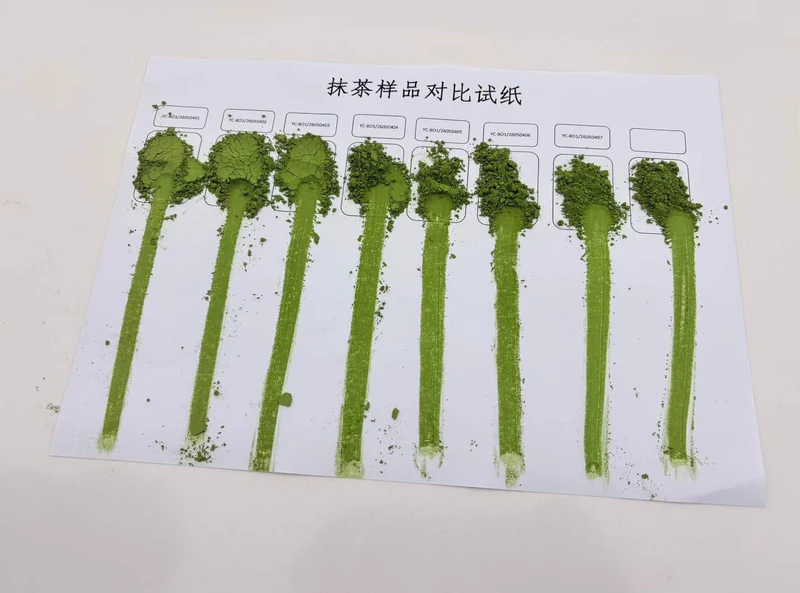
| Matcha code or lot | Formula and process | Foam behavior, color and flavor shift |
| Flour-matcha premix method | Ingredient ratio | Specking, streaks and dense pockets |
Start with a narrow weight-based series. Wide jumps provide little evidence about the acceptable operating range.
Key Takeaway: Express matcha as a flour-relative mass and approve it from finished-cake evidence, not recipe popularity.
How should matcha and flour be premixed for castella?
Matcha and flour should be combined with a repeatable screening and folding method that distributes color without deflating the foam. In matcha castella, premix quality shows up as green streaks, dry pockets, or local dense bands after slicing.
One published method sifts matcha with flour before gradual addition, while another sifts the blend twice. Those are useful process options, but “twice” is not a universal requirement. Screen choice, powder condition, flour, batch size, and handling all change the result.
Record the sieve, pass count, blend time, hold, addition sequence, and rejects. Avoid adding matcha directly to finished foam without a trial; extra folding can cost volume.
Key Takeaway: Qualify a premix method that produces even color with the least corrective folding.
What foam endpoint should control matcha castella batter?
The foam endpoint should be a documented physical condition that operators can recognize and verify before flour addition. For matcha castella, mixer minutes alone cannot control foam because egg temperature, batch load, bowl geometry, and mixer energy vary.
Choose endpoints such as ribbon persistence, foam temperature, volume, or an approved density measure. Keep speed and time as supporting settings. A warm whole-egg, soft-peak method applies only to the formula validated with it.
Reject the habit of extending mixing until the foam “looks bigger.” Excessive aeration can create fragile bubbles that collapse during folding or baking, leaving coarse cells and uneven slices.
Key Takeaway: Release foam against a defined endpoint, with mixer settings recorded as process context.
How should matcha castella batter density and transfer loss be checked?
Batter density and transfer loss should be checked at the same process point on every matcha castella batch. Together they show whether foam survived ingredient addition and whether the planned pan fill can be delivered.
Use a fixed-volume cup or validated vessel, tare it, fill consistently, and record batter mass. Hold temperature, technique, and delay constant. Compare with a formula-specific range from acceptable batches, not a chiffon target.
Track batter before folding, after folding, in pans, and on transfer tools. This converts “sticky batter” into measurable loss and identifies a poor vessel or transfer route.
Key Takeaway: Pair batter density with transfer recovery so foam loss and material loss cannot hide behind the same symptom.
How can pan fill keep matcha castella height and slices consistent?
Pan fill stays consistent when the bakery controls fill mass, pan internal dimensions, liner, batter level, and oven position. Matcha castella height cannot be compared fairly across pans with different geometry or loading.
Tare each pan or verify net fill. Record the fill range and pan position when the oven has hot or cool zones. Hold pan and batter depth constant during scale-up.
| Pan-fill control | Record | Failure it helps explain |
|---|---|---|
| Net batter mass | Target and actual by pan | Unequal height or bake time |
| Internal pan size | Length, width and depth | Different batter depth |
| Liner and release | Material and placement | Edge tearing or compression |
| Oven position | Rack and lane | Uneven color, set or moisture |
Key Takeaway: Approve net fill and pan geometry together; one number without the other cannot control cake height.
How should the matcha castella bake profile be validated?
The bake profile should be validated as oven settings plus measured product results, not temperature and time copied from a recipe. Matcha castella responds to oven recovery, load, airflow, pan material, batter depth, and sensor position.
One published formula uses a staged 180°C then 160°C bake. That is a development comparison, not a transferable endpoint. A different oven can deliver another product temperature and moisture path at the same display setting.
Record preheat, load, rack position, programmed stages, elapsed time, endpoint, sidewall set, top condition, and post-rest crumb. Prefer the broadest acceptable operating window; narrow profiles create rejects under normal variation.
Key Takeaway: Bind oven settings to the pan, load, endpoint, and post-rest result that were actually tested.
Why do cooling, wrapping, and resting affect matcha castella slicing?
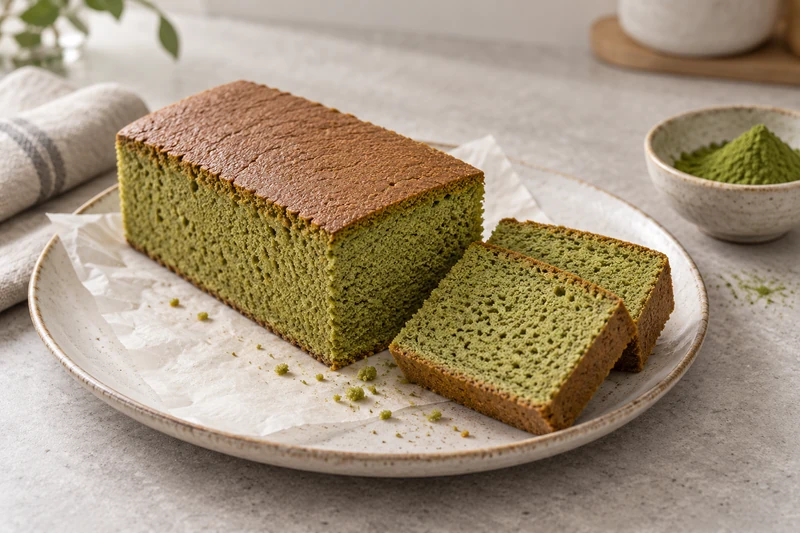
Cooling, wrapping, and resting affect slicing because the cake continues redistributing moisture and setting after baking. Matcha castella should therefore be cut only after a defined post-bake sequence.
Published methods include sealing the warm cake and chilling for several hours, resting about half a day, or wrapping and refrigerating overnight. These methods are not interchangeable shelf-life or safety rules. They show why immediate slicing can misrepresent the final crumb.
Specify demould timing, orientation, wrap, cooling, rest, and temperature. Inspect adhesion, compression, moisture gradient, crumb pull, and knife fouling. Extend rest only when it improves conforming slices.
Key Takeaway: Validate the complete post-bake sequence and judge it at the intended cutting point.
How should a bakery measure matcha castella slice yield?
A bakery should measure matcha castella yield as conforming saleable slices after edge trimming and defect removal. Gross cake weight can hide uneven ends, collapsed zones, torn surfaces, and slices outside the target dimensions.
Define trim, thickness, dimensions, mass range, appearance limits, and defect categories before testing. Record baked mass, trim, loss, conforming slices, downgrades, and scrap.
| Yield measure | Calculation | Commercial meaning |
|---|---|---|
| Trim rate | Trim mass ÷ baked cake mass | Cost of edge and shape correction |
| Conforming slice rate | Accepted slices ÷ total slices | Ability to meet the sale specification |
| Saleable mass yield | Accepted slice mass ÷ baked cake mass | Revenue-bearing output from the bake |
| Defect rate by type | Defect count ÷ total slices | Priority for process correction |
Choose the process with better conforming yield, even if another produces a taller untrimmed cake. Height that must be cut away does not improve margin.
Key Takeaway: Release the process on saleable slice yield and named defects, not gross cake appearance.
What evidence should approve a commercial matcha castella batch?
Approval should connect the matcha lot, formula, premix, foam, density, pan fill, bake, rest, allergen controls, and slice yield. A commercial matcha castella record needs both process evidence and finished-product disposition.
AdoroHu’s in-house microbiology and physical-chemical laboratories can support powder-side checks within approved methods, but not a bakery’s foam or bake profile. Record the exact matcha code and lot, then review material or process changes.
For U.S. packaged foods, FDA food-allergen guidance identifies nine major allergens, including egg and wheat. That makes formula review, label approval, rework identity, and changeover evidence part of batch release; destination-market rules still need separate confirmation. If the same plant also makes matcha cheesecake, keep its set mechanism and allergen matrix in a separate specification.
Key Takeaway: Approve the exact product and process together, with allergen and change-control records tied to the released formula.

FAQ
- Is matcha castella the same as matcha chiffon cake?
- No. This castella framework controls a whole-egg or separated-egg foam, flour-matcha premix, pan fill, bake, rest, and slicing; chiffon uses a different formula and process system.
- Should matcha castella use a spoon or weight ratio for matcha?
- Use a weight ratio for commercial trials because spoon volume changes with fill and packing, while weighed matcha can be compared across batch sizes.
- Why does matcha castella form dense bands?
- Dense bands can come from uneven premix, foam loss, excessive folding, delayed transfer, unequal pan fill, or an unsuitable bake profile, so investigate the recorded process before changing one ingredient.
- Does matcha castella need to rest before slicing?
- It should rest for the post-bake period demonstrated by the bakery’s trial, with wrapping, temperature, and cut point defined in the specification.
- How should a bakery compare matcha castella trials?
- Hold the pan, fill, oven, rest, and slice specification constant, then compare foam, batter density, loss, defects, sensory result, and saleable yield.
- When should a matcha castella process be revalidated?
- Review it after a material change to the matcha, flour, egg system, formula, premix, mixer, pan, oven, rest, or slicing method.
Conclusion
Even slices come from controlling matcha castella from premix through rest, then measuring the product after trimming. Use recipe values only to frame trials and keep approval inside the tested formula, equipment, and line conditions. Contact AdoroHu Matcha to align powder samples and specification records with your bakery trial.