
Matcha cheesecake formulation starts by separating baked and cold-set products, because they rely on different set mechanisms and failure tests. Treating both formats as one recipe can hide weak dispersion, serum release, or an unsuitable refrigerated-control plan. Culinary matcha for cheesecake trials should be tested in the intended dairy matrix and process.
A commercial brief needs more than a preferred green shade. It must define powder addition, finished pH measurement, set strength, syneresis, sensory balance, and storage checkpoints without turning raw-powder data into finished-food validation.
Choose the cheesecake format before screening matcha. Compare powder dose and dispersion in the finished matrix, then measure set, serum release, color, flavor, and refrigerated performance under controlled conditions.
In short: Baked and cold-set cheesecake need separate formulation paths and separate acceptance limits.
Key points:
- Hold slurry liquid, shear, and temperature constant during dispersion trials.
- Measure finished-product pH, set, syneresis, color, and sensory response.
- Treat Food Code timing as applicable retail or foodservice handling, not factory shelf-life proof.
Is the matcha cheesecake baked or cold-set?
Choose baked or cold-set matcha cheesecake before screening ingredients. Baked cheesecake depends on egg and dairy protein setting, heat transfer, and bake loss. Cold-set cheesecake depends on gelatin or another refrigerated gel and may respond differently to mixing temperature and acid balance.
Use separate control formulas, process records, and release limits. For baked products, record center temperature, mass loss, cooling, cracking, and slice texture. For cold-set products, record gel addition, fill temperature, conditioning time, and deformation after demolding. Combining the results would conceal which set mechanism failed.
| Format | Primary process variables | Core acceptance checks |
|---|---|---|
| Baked | Mix order, bake profile, cooling, bake loss | Cracks, set, slice texture, color |
| Cold-set | Gel system, fill temperature, conditioning | Demolding, deformation, syneresis, color |
Key Takeaway: Establish one primary format before dose and supplier comparisons begin.
How should matcha cheesecake powder be dispersed without uncontrolled water?
Compare direct dry blending with a standardized slurry while keeping final composition equal. Hold slurry liquid, shear, temperature, addition point, and delay before filling constant. No cited primary source validates one universal slurry ratio for matcha cheesecake.
Score visible specks, color uniformity, trapped air, batter or mix temperature, and finished slice appearance. Deduct slurry liquid from the main formula rather than adding it on top. If a bench slurry requires manual scraping that production equipment cannot reproduce, treat it as a diagnostic method instead of the final process.
Key Takeaway: Standardize the slurry and total liquid so dispersion improvements are real rather than hydration changes.
Which pH result determines matcha cheesecake regulatory handling?
Measure calibrated equilibrium pH in the finished matcha cheesecake at a defined temperature and time. Powder pH does not classify the finished dairy food, and matcha is not evidence that the product is acidified. The responsible food-safety team must determine whether the finished product is time/temperature control for safety food under the applicable rules.
Where the FDA Food Code 2026 applies through local adoption, section 3-501.16 uses cold holding at 5°C/41°F or less for applicable food. The Food Code is a retail and foodservice model. It does not establish an unopened factory product's process or shelf life.
Key Takeaway: Base handling decisions on calibrated finished-product measurements and the locally applicable classification.
How do you quantify matcha cheesecake set strength?
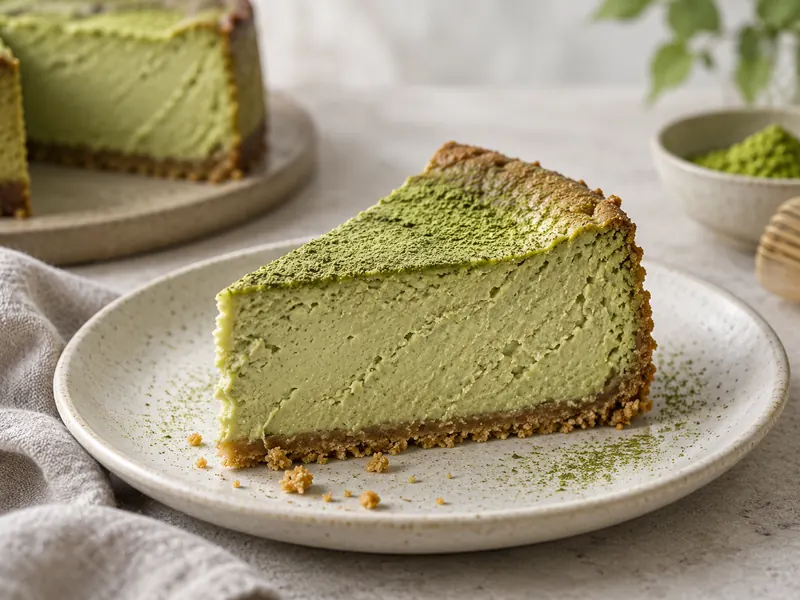
Quantify matcha cheesecake set at a fixed product temperature after a fixed conditioning period. Penetration, compression, or rheology can support the decision, while slice deformation shows what customers and packing lines experience. No cited study supplies a transferable commercial cheesecake threshold.
Define sample geometry, test speed, probe, conditioning time, and measurement location. Keep baked and cold-set limits separate. A baked slice that holds under compression and a cold-set slice that resists slump may reach similar visual outcomes through different structures.
| Measurement | Control required | Operational meaning |
|---|---|---|
| Penetration or compression | Geometry, probe, speed, temperature | Cutting and eating texture |
| Slice deformation | Slice size, time, temperature | Display and pack stability |
| Bake loss | Initial and final mass | Yield and concentration |
| Demolding failure | Fixed sample count | Cold-set line rejects |
Key Takeaway: Use format-specific set measurements tied to cutting, packing, and service needs.
How should matcha cheesecake syneresis be screened?
Measure released serum directly rather than predicting whether more matcha will help. A 2017 set-yogurt study of green-tea and green-coffee powders found that 0.02% green-tea powder reduced syneresis compared with the control, while 2% increased it. That dose-dependent reversal is a yogurt analogy, not a cheesecake result.
Use it only to justify a dose ladder within the intended cheesecake. Record released serum by mass, visible package pooling, texture, and slice condition across stated refrigerated time points. Hold dairy base, gel system, process, fill mass, and package constant so a supplier or dose comparison remains interpretable.
Key Takeaway: Expect a dose-dependent response and measure its direction in the actual cheesecake.
How should finished matcha cheesecake color be approved?
Approve color in the finished matcha cheesecake at day 0 and planned storage checkpoints. Use fixed lighting and defined Lab* or ΔE tolerances against an approved product control. Evaluate baked and cold-set systems separately because their heat exposure and matrix structure differ.
No cited source provides a matcha-cheesecake color threshold. The acceptance window must come from the product brief and application trials. The matcha cake formulation guide offers related baked-matrix questions, while the matcha bakery heat and color guide covers broader powder selection.
Key Takeaway: Set color limits from the finished format and process, not from raw powder appearance.
Can sugar mask a stronger matcha cheesecake dose?
Do not assume sugar will repair an excessive matcha cheesecake dose. A 2018 matcha-biscuit response-surface study found that consumers preferred 2 g matcha per 100 g flour, and increasing sugar did not significantly improve acceptability as matcha increased. This biscuit result is not a cheesecake optimum.
Run cheesecake-specific sensory work with coded samples. Score tea aroma, bitterness, astringency, dairy flavor, sweetness, aftertaste, and texture separately. Holding the base and process constant reveals whether the next trial should change powder dose, sweetness, or the dairy system.
Key Takeaway: Choose dose through finished-product sensory testing instead of relying on sugar to hide imbalance.
Which refrigerated shelf-life controls apply to matcha cheesecake?
Apply retail or foodservice date marking only when the finished matcha cheesecake is classified as applicable refrigerated ready-to-eat time/temperature control for safety food. Under FDA Food Code 3-501.17, applicable food held more than 24 hours has a seven-day maximum at 5°C/41°F or less, subject to local adoption.
Preparation is day 1 for food prepared in the establishment. Opening is day 1 when a commercially processed container is opened there. Those triggers describe the model code's covered handling situations; they do not validate the shelf life of an unopened factory-made cheesecake.
Key Takeaway: Keep establishment date marking and factory shelf-life validation as separate evidence streams.
FAQ
- Should baked and cold-set matcha cheesecake use the same acceptance limits?
- No. Their set mechanisms and process stresses differ, so they need separate controls and limits.
- Is there a universal matcha slurry ratio for cheesecake?
- No. Compare controlled dispersion methods at equal final composition in the intended process.
- Can raw matcha pH classify the finished cheesecake?
- No. Regulatory handling depends on the finished food, calibrated measurements, applicable classification, and local rules.
- Does green-tea powder always reduce syneresis?
- No. A yogurt study found opposite responses at 0.02% and 2%, and cheesecake must be tested directly.
- Does the seven-day Food Code limit prove factory shelf life?
- No. It is a model-code rule for applicable retail and foodservice handling, not unopened factory shelf-life validation.
Conclusion
Separate format, dispersion, set, syneresis, sensory, and handling decisions so one attractive slice does not stand in for commercial validation. Matcha shelf-life validation for powder-storage context can protect the ingredient before use, but it does not establish cheesecake shelf life. AdoroHu Matcha supplies raw powder; the cheesecake producer owns finished-food manufacture, safety, and shelf-performance validation. To arrange raw-powder comparisons, contact AdoroHu about raw-powder samples.
Institutional author: AdoroHu Matcha