
Matcha condensation is prevented by keeping cold packages sealed until their surfaces have warmed above the surrounding air’s dew point. Opening a cold liner in warm, humid air can let condensation form on the liner, tools, or powder. Teams handling wholesale matcha need a pack-specific release criterion rather than a fixed waiting-time slogan.
Keep refrigerated matcha sealed during acclimation. Use room conditions and package-surface temperature to judge condensation risk. After suspected wetting, hold the affected pack until evidence supports release or rejection.
In short: Safe opening depends on dew point, package temperature, pack format, and handling sequence.
Key points:
- Condensation forms on surfaces colder than the surrounding air’s dew point.
- Large packs, insulation, pallet position, and room airflow change warm-up time.
- Exterior droplets, liner wetting, and powder moisture pickup are different evidence states.
Where does matcha condensation form?
Condensation can form on the outer carton, primary liner, lid, scoop, transfer container, or powder when a surface remains colder than the air’s dew point. NIST's humidity work relates dew point to saturation vapour pressure at the stated air conditions; this is the physical boundary behind the sealed-acclimation rule. The location depends on what is exposed and when.
If a sealed pack enters a warm room, moisture can appear outside while the protective liner remains dry. If the cold liner is opened too early, humid room air reaches colder internal surfaces and can deposit water where it matters most.
Key Takeaway: Identify the cold surface exposed to room air before deciding whether the powder was at risk.
Why must the package stay sealed during acclimation?
The sealed barrier separates the cold product and inner surfaces from humid room air while temperatures equalize. Opening removes that protection.
Inspect the pack before staging. A punctured or poorly closed liner cannot be assumed to protect the contents. Place the sealed unit in the designated dry area, record time and conditions, and avoid opening for spot checks that reset exposure.
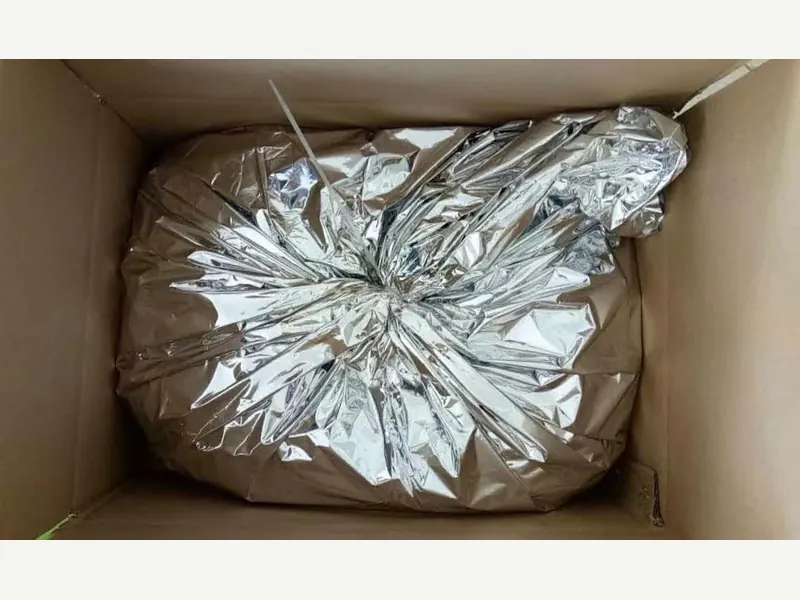
AdoroHu's approved bulk configuration is 10 kg or 20 kg per carton with a sealed food-grade liner. Keeping that liner sealed during acclimation preserves the supplied exposure barrier; the fact does not establish a universal warm-up time or prove protection after puncture, poor closure, or repeated opening.
Key Takeaway: Sealed acclimation protects the powder while the package warms.
How do package size and construction affect warm-up time?
Larger masses and insulated or multilayer packs usually warm differently from small pouches. Pallet position, carton arrangement, airflow, starting temperature, and room conditions also change the curve.
| Factor | Expected influence | Evidence to collect |
|---|---|---|
| Product mass | More thermal mass can lengthen equilibration | Pack size and temperature profile |
| Carton and liner | Layers affect heat transfer | Exact pack construction |
| Pallet position | Centre and edge units may differ | Logger or probe mapping |
| Airflow | Changes surface warming | Staging location and room map |
Do not transfer a wait time from a 30 g pouch to a 20 kg lined carton.
Key Takeaway: Validate acclimation for each meaningful pack format and staging arrangement.
How should room temperature, RH, dew point, and pack temperature be recorded?
Record room temperature and relative humidity with a qualified device, then obtain dew point from the instrument or a validated calculation. Measure package-surface temperature at a defined location with a suitable method.
ISO 2233:2000 describes controlled temperature and relative-humidity conditioning for complete transport packages. It supports disciplined environmental records, while the site must still validate its own matcha pack, staging area, and opening criterion.
Preserve timestamps, instrument identity, calibration status, pack ID, start condition, and release reading. Avoid measuring only the outer carton when the approved criterion concerns the liner or product-facing surface.
Key Takeaway: A release record needs both the room’s dew point and a representative package temperature.
When is a pack safe to open without a universal wait time?
A pack is ready when the approved measurement shows that the relevant surface has sufficient margin above the room dew point and the packaging remains intact. The organization should validate the margin and method for its conditions.
Use mapping trials to establish likely staging ranges, but keep the release tied to conditions when weather and room loads vary. Clock time can support planning; it should not override contradictory temperature evidence.
Practitioner decision: avoid rules such as “always wait two hours.” A timer alone can release a large cold pack too soon or delay a small pack without benefit.
Key Takeaway: Release by a validated temperature-and-dew-point criterion, supported by time rather than replaced by it.
What handling sequence applies to partially used bulk packs?
Partially used packs need a defined cycle for issue, portioning, closure, return, and next opening. Repeated cold-to-warm cycling increases opportunities for error.
Consider keeping a smaller working quantity in a controlled area while the master pack remains protected. Record remaining mass, closure condition, storage location, and the responsible operator. The matcha packaging guide can help align working-pack size with use frequency.
Key Takeaway: Reduce repeated thermal cycling by matching working-pack size to actual consumption.
How should scoops, containers, and liners be kept dry?
Use clean, dry tools stored in the controlled handling area. Do not bring a cold scoop or container into humid air and use it immediately without assessing condensation risk.
Inspect transfer containers before use, keep lids closed, and avoid placing liners on wet or cold surfaces. Assign tools where cross-contact controls require it and follow the site’s sanitation program.
Key Takeaway: Dry handling equipment is part of condensation control, not a separate housekeeping issue.
What signs suggest moisture pickup rather than ordinary clumping?
Evidence may include wet liner surfaces, localized dark or sticky powder, changed aroma, persistent hard agglomerates, poor flow, or changed water-activity or moisture results. None of these alone proves the full cause.
Compare with an unaffected unit and retained sample. Fine matcha can agglomerate from pressure and cohesion, so document texture, location, exposure, package state, and whether normal preparation restores performance.
Key Takeaway: Investigate wetting through package, exposure, product, and control-sample evidence together.
Which retained-sample or water-activity checks support investigation?
Use retained and unaffected samples to establish whether the change is local to one handling event. Water activity and moisture content may support different parts of the investigation when measured under suitable methods.
The matcha shelf-life validation guide explains why product evidence must match the exposure and decision. A 2026 original study exposed matcha to controlled water activities from 0.11 to 0.93 and either light shielding or continuous laboratory LED light of about 450–500 lx. The study found progressively greater losses in measured polyphenols, flavonoids, antioxidant activity, catechins, and vitamin C under higher water activity and light. These scoped results justify checking whether actual wetting changed the product; they do not create a universal release threshold for a condensation event.
| Evidence | Use | Limitation |
|---|---|---|
| Retained sample | Lot baseline | Storage must be documented |
| Unaffected unit | Local comparison | May have different pallet history |
| Water activity | Available-water comparison | Method and equilibration matter |
| Moisture content | Total-water comparison | Does not locate the exposure |
Key Takeaway: Select tests that can answer the disposition question and compare them with traceable controls.
When should affected powder be held or discarded?
Hold the powder when internal wetting is suspected, package integrity is uncertain, or product properties changed. Restrict use and preserve the evidence before sampling.
Release only when authorized review finds that the barrier remained protective and relevant criteria are met. Discard or reject material when evidence shows it is unsuitable, or uncertainty cannot be resolved within the company’s risk standard. Do not dry, sieve, or blend affected powder as an undocumented workaround.
Key Takeaway: Contain first, then decide from documented exposure and product evidence.
How should the SOP change across seasons and facilities?
The SOP should use local room conditions, package formats, refrigeration settings, staging space, instruments, and workflow. Seasonal humidity can change dew point even when room temperature looks similar.
Run mapping during representative high-risk and lower-risk periods. Review staging capacity, sensor placement, door activity, and whether production pressure encourages early opening. Update training when facilities or packs change.
Key Takeaway: Maintain one decision principle while validating its operating details at each facility.
What training and records prevent repeat events?
Train operators to understand sealed acclimation, dew point, representative temperature measurement, dry tools, and hold authority. Use a short record that fits the workflow.
The record should include lot, pack size, cold-store exit, staging location, room condition, surface temperature, release time, opener, deviations, and disposition. Supervisors should review near misses, not only damaged product.
Validate the procedure with representative packs at the coldest credible starting condition and demanding room conditions. Map more than one location on large packs or pallets until the team knows which point warms slowest. Repeat the work when pack mass, carton, liner, pallet pattern, cold-room setting, or staging airflow changes materially.
Define the measuring point so different operators obtain comparable results. An infrared instrument measures a surface and can be affected by target properties, distance, angle, and neighbouring surfaces. A contact method has its own placement and response considerations. The procedure should name the approved device, point, technique, and action for an implausible reading.
Separate staging release from product release. The first permits opening under controlled conditions; it does not certify powder that already had a damaged liner, unexplained wetting, or abnormal sensory properties. Those observations still trigger the site’s hold and investigation process.
Plan exceptions before production pressure arrives. Examples include a torn liner discovered during acclimation, a room RH spike, missing temperature data, a pack opened early, droplets found inside a lid, or a cold tool placed in powder. The record should tell operators whom to call, what to isolate, which photographs and samples to preserve, and what not to do.
Review repeated deviations for a system cause. Congested staging, insufficient working packs, unclear labels, inaccessible thermometers, and production schedules can encourage premature opening. A practical corrective action changes the workflow that produced the error and then verifies that later packs follow the intended sequence.
Label staged packs with status so “warming,” “ready to measure,” “released to open,” and “held” cannot be confused. If several lots share the area, preserve separation and traceability throughout acclimation.
Audit the process by observing real shifts, including humid days and busy production periods. Records can appear complete while operators measure the easiest carton instead of the slowest representative location.
Practitioner decision: give operators authority to hold a pack when the record or conditions are wrong. The cost of a short delay is easier to contain than moisture exposure across a production batch.
Key Takeaway: Prevention depends on clear authority and traceable release evidence.
FAQ
- Why does cold matcha need to warm before opening?
- Warm, humid air can condense on colder internal surfaces if the package is opened before it has safely acclimated.
- How long should refrigerated matcha sit before opening?
- Use a validated pack-specific criterion based on room dew point and representative package temperature rather than one universal wait time.
- Is condensation on the outer carton proof that matcha is wet?
- No. Exterior condensation shows a cold surface met humid air; inspect liner integrity and internal evidence before judging the powder.
- Can clumped matcha still be used?
- Clumping has several causes, so hold questionable material and assess exposure, package condition, comparison samples, and relevant tests before use.
- Should a partially used matcha pack return to cold storage?
- Follow a validated site procedure that controls closure, thermal cycling, acclimation, and use frequency; a smaller working pack may reduce repeated exposure.
Conclusion
Matcha condensation control turns a vague waiting rule into a measured sealed-acclimation process. For pack formats, samples, and handling plans, contact AdoroHu Matcha.
Institutional Author
AdoroHu Matcha