
Matcha waffle formulation should begin with the service route because a fresh waffle and a frozen-reheat product face different failures. Batter flow and plate release dominate fresh production, while packaging, freezing, and reheat can change mass, temperature, color, and texture. Screen wholesale matcha powder for waffle production in the intended route.
The common sourcing mistake is to blame powder when batter age or plate condition changed. A useful commercial trial holds formula solids, batter temperature, iron condition, bake settings, cooling time, and measurement methods constant.
Choose fresh-service or frozen-reheat as the primary product before optimizing matcha dose. Measure batter drift, sticking, color, and texture at fixed times, then validate any frozen product in its actual pack and appliance.
In short: Waffle approval requires controlled batter, plate, cooling, and service-route evidence.
Key points:
- Build an application-specific dose ladder at equal total solids.
- Use timed flow, plate-release, fixed-zone color, and defined texture methods.
- Treat published storage values as package-bound comparisons, not matcha shelf-life claims.
Is the matcha waffle target fresh-service or frozen-reheat?
Choose the primary matcha waffle route before optimizing the formula. Fresh-service development prioritizes batter hold, plate release, immediate crispness, and short service time. Frozen-reheat development adds freezing, package barrier, storage, center heating, mass loss, and texture recovery.
No cited study tested matcha frozen reheat. Maintain separate acceptance plans even if both products begin with one batter. Otherwise, a change that improves immediate crispness may perform poorly after freezing, or a frozen formula may seem too firm during fresh service.
| Route | Main process risks | Release evidence |
|---|---|---|
| Fresh-service | Batter drift, sticking, bake consistency | Flow, rejects, color, fixed-time texture |
| Frozen-reheat | Freeze damage, moisture movement, uneven heating | Pack, storage, reheat, mass, center temperature, texture |
Key Takeaway: Optimize one primary service route and validate the second as a separate product decision.
How should a matcha waffle dose ladder be built?
Build a matcha waffle control plus several flour-weight doses while holding total solids constant. No primary matcha-waffle study supplies a universal optimum, so the chosen levels become line-specific application data. Record whether matcha replaces flour or is added on top.
Keep liquid, leavening, fat, sugar, and batter temperature controlled. Assess tea flavor, bitterness, batter flow, spread, sticking, color, and texture. A visually stronger dose that increases rejects or overwhelms flavor does not meet the commercial brief.
Key Takeaway: Screen several controlled doses and let finished-product performance define the useful range.
What should matcha waffle batter hold testing measure?
Measure matcha waffle batter flow, density, and temperature at realistic hold points. A 2017 study of batter ingredients and fresh egg-waffle sticking timed 100 mL of batter leaving a cup through a 10 mm outlet. Less than 300 seconds was that study's own process criterion.
Reuse the timed method only as a repeatable comparison, not its criterion as a universal matcha-waffle limit. Add the matcha cake batter and texture guide for related batter questions, then define hold points from actual production. Include the first and last depositor portions so settling or aeration drift becomes visible.
| Hold-point check | Method control | What it can reveal |
|---|---|---|
| Timed flow | 100 mL, 10 mm outlet, fixed temperature | Thickening or thinning during hold |
| Density | Fixed cup and filling method | Aeration or settling change |
| Temperature | Same probe and location | Process-driven viscosity drift |
| Portion comparison | First and last deposition | In-tank nonuniformity |
Key Takeaway: Track timed flow with density and temperature, while validating the acceptable window on the intended line.
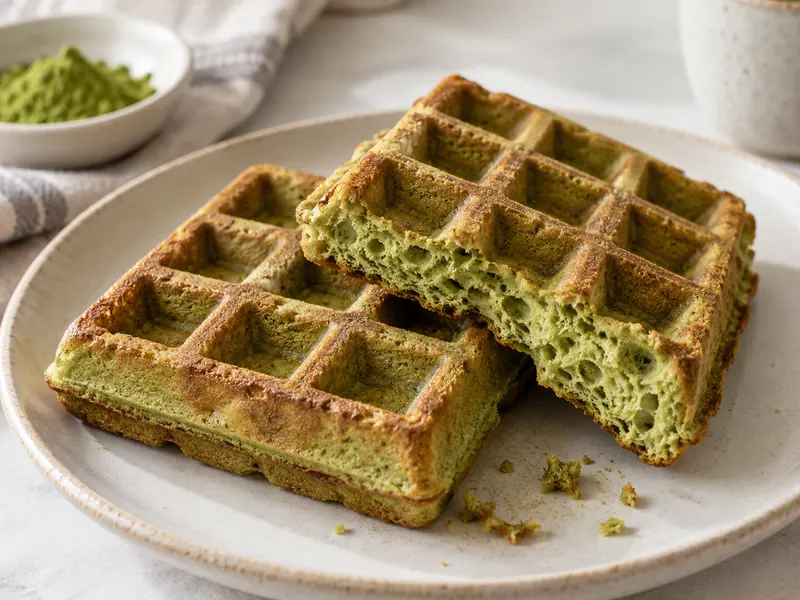
How do you test matcha waffle iron release and sticking?
Test release with controlled plate temperature, cleaning, seasoning, deposit mass, and bake time. In the 2017 non-matcha fresh egg-waffle study, potato starch produced less than 7% sticking at 30% flour replacement, while rice flour produced nearly 50%. The comparison shows that formulation can dominate plate release.
It does not show how matcha will behave or set a starch recommendation. Count residue, incomplete release, torn pieces, and rejected waffles across a defined run. Reject supplier comparisons made on differently conditioned plates, because plate history can create a false powder-lot diagnosis.
Key Takeaway: Standardize the iron before attributing a release problem to matcha.
How should matcha waffle browning and green color be balanced?
Measure matcha waffle surface color in fixed zones after a fixed cooling interval. The 2017 egg-waffle study measured three surface zones after 30 minutes of post-bake equilibration. That is a useful method model, but the source contains no matcha result and its timing does not validate crispness.
Set Lab* or ΔE tolerances against an approved waffle at the same age. Record bake time, plate temperature, deposit mass, and zone location. Use the matcha bakery heat and color guide for the supplier brief, while keeping final color limits product-specific.
Key Takeaway: Fix measurement zones and cooling time so browning and green-color comparisons remain reproducible.
Which matcha waffle crispness test belongs in release?
Use a defined texture method at a fixed cooling time for matcha waffle release. In a 2024 study of non-matcha crispy waffles containing 30% okara flour, hardness was measured with a TA-XTplus P/0.25S ball probe at 1 mm/s over 3 mm with a 5 g trigger, using 12 measurements.
Those settings do not provide a limit for a different waffle geometry. Validate probe location, sample support, cooling time, and number of pieces for the target product. Add a sensory crispness check and breakage count because an instrumental peak alone does not describe eating quality or pack damage.
Key Takeaway: Define texture geometry and sample age before setting a crispness limit.
What matcha waffle frozen-reheat protocol is defensible?
Freeze matcha waffles in the intended pack, define storage checkpoints, and specify the actual reheat appliance and time. Compare mass loss, center temperature, color, surface and center texture, and sensory quality before and after reheat. Neither cited waffle source tested matcha frozen reheat.
Do not transfer a 60-day claim or generic reheating instruction from another formula. Record freezer conditions, pack seal, product loading, thaw status, appliance power, and serving delay. The commercial matcha cookie process guide provides related baked-product control questions, but it cannot replace waffle validation.
Key Takeaway: Bind frozen-reheat claims to the actual formula, pack, storage, appliance, and serving method.
How should matcha waffle moisture and water activity be used?
Use moisture and water activity to compare matcha waffle storage conditions, not as stand-alone shelf-life proof. In the same 2024 study, non-matcha 30%-okara cocoa crispy waffles stored in 12 × 20 cm PET/aluminum/PE zip pouches had water activity of 0.378±0.004 at day 0, 0.354±0.004 at day 30, and 0.371±0.003 at day 60.
That series is bound to its formula, pouch, and method. It does not validate matcha, frozen reheat, or a 60-day commercial life. The FDA water activity guide also notes the equilibrium and temperature basis of the measurement. Pair each result with package identity, texture, sensory condition, and applicable safety work.
Key Takeaway: Interpret water activity only with the exact formula, method, package, temperature, and time.
FAQ
- Should fresh and frozen matcha waffles use one acceptance plan?
- No. Frozen-reheat products add package, storage, heating, and texture-recovery questions that fresh service does not answer.
- Is there a published optimum matcha dose for commercial waffles?
- No. Test an equal-solids dose ladder in the intended formula and process.
- Is less than 300 seconds a universal batter-flow target?
- No. It was the cited study's criterion for timing 100 mL through a 10 mm outlet and must be revalidated for the intended waffle line.
- How should rice flour and potato starch results guide a waffle application trial?
- At 30% flour replacement, potato starch produced less than 7% sticking while rice flour produced nearly 50%, so test the intended flour and starch system on controlled plates rather than assigning release behavior to matcha.
- Do the day 0, 30, and 60 water-activity values prove matcha waffle shelf life?
- No. They came from a non-matcha okara cocoa waffle in a specified pouch and do not transfer to another formula or frozen-reheat product.
Conclusion
Control batter age, iron condition, measurement time, and service route before comparing powder lots. Approve each lot through the chosen route and a retained control; AdoroHu Matcha supplies raw powder, while the waffle producer owns finished-food manufacture, safety, and shelf-performance evidence. To arrange raw-powder samples for the trial, contact AdoroHu about raw-powder samples.
Institutional author: AdoroHu Matcha