
Matcha color measurement gives buyers comparable evidence only when sample preparation, instrument settings, reference material, and decision rules stay controlled. A bright photograph or a single instrument reading cannot establish grade, flavour, origin, authenticity, or compliance. Start with the commercial question, then connect colour with the broader matcha quality attributes that matter in the intended product.
Without a written method, powder depth, cup shape, lighting, exposure, dispersion time, and formula can move the result. Teams then argue about whether the material changed when the method changed instead. A repeatable protocol turns colour into one useful line of evidence for approve, hold, investigate, or reject decisions.
“Measure the sample state that matches the commercial decision. Keep preparation and instrument conditions fixed, compare against a suitable reference, and confirm material differences in the intended application. Colour supports a decision; it does not prove authenticity by itself.”
In short:
Key points:
- Define whether the decision concerns powder, water dispersion, or a finished formula.
- Lock sample preparation and instrument settings before creating a tolerance.
- Combine measurements with visual, sensory, process, and document evidence before lot disposition.
What commercial decision should matcha color measurement answer?
Matcha color measurement should answer a named decision such as lot consistency, supplier comparison, storage drift, or finished-product appearance. One method rarely answers all four because each decision uses a different sample state, reference, and consequence.
Write the decision statement before measuring. “Compare incoming powder with the approved reference” is actionable. “Check whether the matcha is green enough” leaves the sample, range, application, and authority undefined. Link the result to a disposition and the other evidence reviewers need.
| Decision | Sample under test | Supporting evidence |
|---|---|---|
| Incoming lot consistency | Controlled dry powder | COA identity, retained reference, sensory review |
| Formula approval | Finished beverage or food | Pilot formula, process settings, visual target |
| Storage investigation | Time-point sample under defined handling | Package, light, temperature, opening and moisture records |
| Supplier comparison | Like-for-like samples prepared together | Specification, origin/process documents, application trial |
Key Takeaway: A colour number becomes useful when it is tied to one material, method, reference, and action.
Should buyers measure dry powder, dispersion, or the finished product?
Buyers should measure the state closest to the decision and may need separate methods for powder, dispersion, and finished product. Dry powder helps screen incoming consistency, while the finished application shows what customers will see.
Powder colour can change with packing density and surface preparation. A water dispersion adds concentration, temperature, mixing, foam, settling, and elapsed time. Milk, sugar, fat, flour, cocoa, fruit, pH, and heat can change the finished colour again. Record these as different methods instead of treating them as interchangeable readings.
For a latte, measure a standardised matcha beverage application after the process step that best predicts saleable appearance. For baking, the relevant result may be after heating rather than in raw batter.
Key Takeaway: Measure powder for powder control and the finished matrix for customer-visible performance.
How should matcha samples be conditioned and prepared?
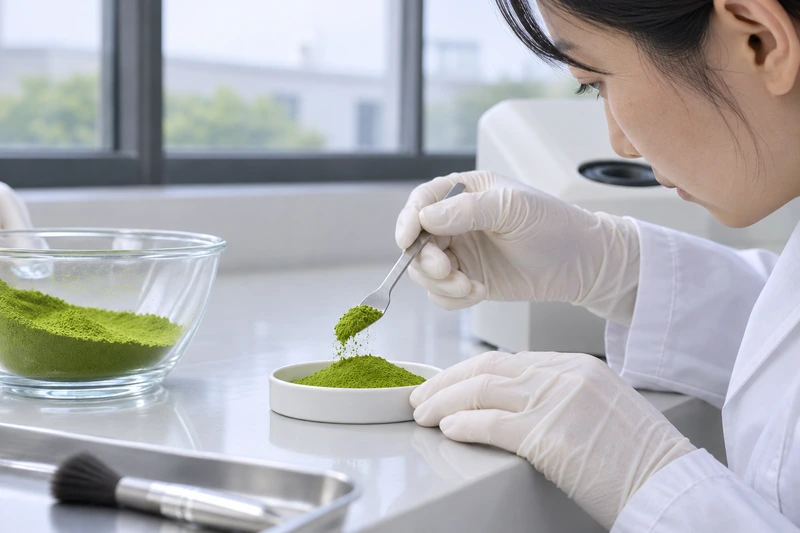
Samples should be conditioned and prepared with a written routine that fixes container, depth, mass or volume, surface, temperature, mixing, timing, and exposure. The routine should also prevent one sample from contaminating the next.
For dry powder, use the same cup, fill procedure, bed depth, surface levelling, and delay before reading. Avoid pressing one sample harder than another. For dispersions, specify water, concentration, vessel, mixing energy and time, temperature, foam handling, and measurement time. Prepare replicates independently so repeatability includes sample preparation rather than repeated readings of one untouched cup.
| Method element | Dry powder control | Dispersion or product control |
|---|---|---|
| Sample identity | Lot, container, opening history | Lot plus formula and batch identity |
| Presentation | Cup, fill, depth, level surface | Vessel, concentration, mix and hold time |
| Environment | Temperature and exposure conditions | Temperature, light and processing stage |
| Reading sequence | Replicate fills and instrument checks | Replicate preparations and defined timing |
Key Takeaway: Preparation variation must be smaller than the difference the buyer intends to act on.
Which instrument settings must remain fixed for comparable colour data?
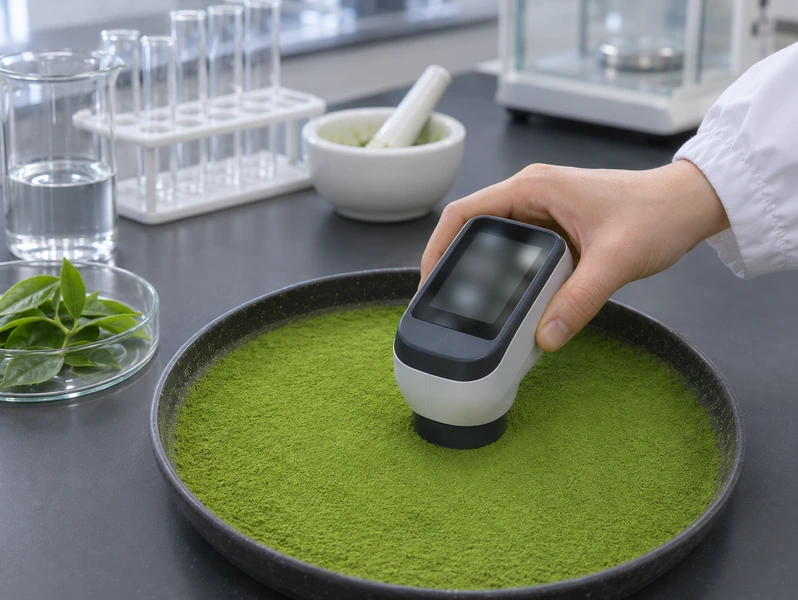
Instrument type, measurement geometry, light source setting, observer setting, aperture, calibration, sample holder, and reporting colour space must remain fixed. Results from different configurations should not be pooled until a documented comparison shows they are suitable for the same decision.
Identify the device and software version in the method. Record calibration checks, measurement mode, inclusion or exclusion of surface effects where the instrument offers that choice, and the backing or cup. An aperture that sees a small uneven area may behave differently from one that averages a larger powder bed.
ISO/CIE 11664-1:2019 specifies two sets of colour-matching functions: the CIE 1931 standard colorimetric observer for fields of about 1° to 4°, and the CIE 1964 observer for fields greater than about 4° under its stated viewing conditions. A report should therefore preserve the selected standard observer rather than treating 2° and 10° observer settings as interchangeable. Changing that setting can change reported coordinates even when the powder has not changed.
A phone photograph is not an instrumental colour method. Automatic exposure, white balance, display processing, ambient light, camera angle, and shadows can all change the image. Photographs may support a controlled visual record when a colour reference, fixed lighting, fixed exposure, and consistent layout are used, but they should remain separate from instrument data.
Key Takeaway: Comparability depends on method identity, not on two reports using the same colour-space labels.
How do L*, a*, b*, chroma, hue, and colour difference support a buyer decision?
L*, a*, and b* describe measured lightness and opposing colour directions, while derived chroma, hue, and colour-difference values help compare a sample with a reference. Buyers should interpret the pattern against their validated method and application rather than rank powder by one coordinate.
A shift in lightness may be commercially visible even when the green-red direction changes little. Two samples can also show a similar overall difference while moving in different directions, which may matter after dilution or heating. Keep the coordinates and the calculated comparison together so reviewers can see what changed.
| Output | Practical reading | Buyer caution |
|---|---|---|
| L* | Relative lightness under the method | Surface and packing can influence powder readings |
| a* and b* | Direction of colour shift | No coordinate proves quality or authenticity alone |
| Chroma and hue | Saturation and colour angle summaries | Derived values inherit method variation |
| Colour difference | Distance from a named reference | Perceptibility and acceptability are application-specific |
The public description of ISO/TR 21380:2022 frames matcha through plant source, cultivation, manufacture, grinding, and sensory analysis. It does not turn colour into an independent proof of matcha identity or a universal commercial grade.
Key Takeaway: Read coordinates as a controlled comparison, not as a universal matcha score.
How should repeatability and method uncertainty be established?
Repeatability should be established through independent replicate preparations and readings under the same operating conditions. Changes across routine operators, days, or equipment assess intermediate precision, while comparisons across laboratories or sites assess reproducibility. ISO 5725-1:2023 defines the general principles for evaluating trueness and precision of controlled measurement methods, including powders where heterogeneity is considered.
Start with representative material and include the expected sample forms. Separate instrument repeatability from full-method repeatability: several readings from one powder cup test the device and presentation, while refilling the cup tests preparation too. If operators, sites, or instruments will share a limit, compare them before using one tolerance.
Practitioner decision: avoid setting a narrow acceptance window from one polished reference reading. Normal method noise can then create unnecessary holds, supplier disputes, and repeated testing without improving product control.
Key Takeaway: Establish how the method varies before treating a sample difference as material drift.
How can a retained reference anchor lot-to-lot comparisons?
A retained reference can anchor lot comparisons when its identity, storage, opening, age, and suitability are documented. It should be measured in the same session or under a verified control process so instrument and environmental drift remain visible.
Create rules for reference issue, use, review, replacement, and bridging. A reference that has faded, absorbed moisture, oxidised, compacted, or been repeatedly opened can misclassify fresh lots. Where practical, keep protected reserve material and use a working reference for routine handling.
AdoroHu's EU Standard Series E-1 to E-7 and Organic Series O-1 to O-6 describe pure matcha options across culinary, premium, and ceremonial tiers. Within a tier, a higher number corresponds to deeper colour, more sweetness, and less bitterness. These commercial grade facts can guide sample selection, but each buyer still needs an application-specific reference and tolerance.
Key Takeaway: Reference control is part of the method because the comparison changes when the reference changes.
How should visual review and instrumental colour data be combined?
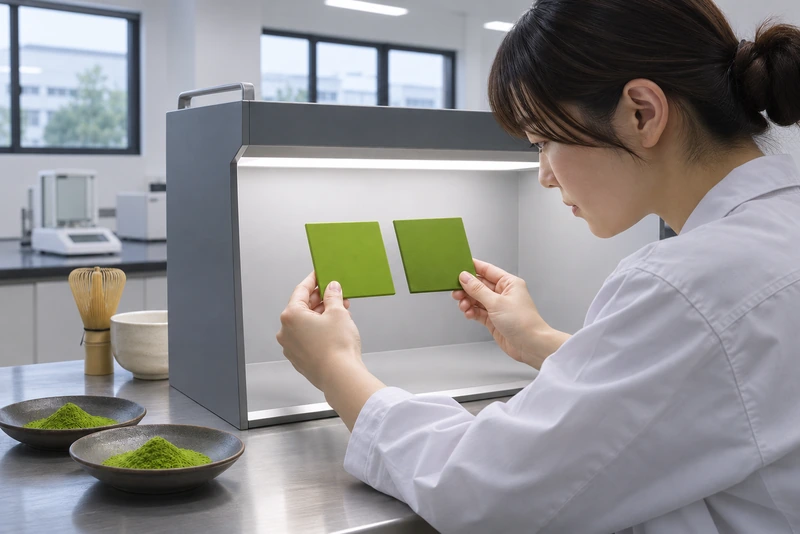
Visual review and instrumental data should answer complementary questions under controlled conditions. The instrument measures a defined surface or sample area; trained reviewers can notice unevenness, specks, foam, sediment, gloss, or application effects that one numerical summary may miss.
Use a neutral viewing area, defined light, consistent background, coded samples, and an agreed observation sequence. Describe the attribute before judging acceptance. The public description of ISO 13299:2016 supports a general methodology for establishing sensory profiles, but it does not supply matcha-specific colour limits.
If visual and instrument results disagree, investigate sample presentation, heterogeneity, calibration, and the decision endpoint. Do not average disagreement away. The matcha quality guide can help place colour beside aroma, taste, texture, documentation, and application performance.
Key Takeaway: Use instruments for reproducible coordinates and controlled visual review for appearance features the coordinates may hide.
How are application-specific colour tolerances set without a universal number?
Application-specific colour tolerances should be built from an approved reference, method capability, historical acceptable lots, pilot products, and stakeholder judgement. A borrowed colour-difference limit can fail because instrument settings, matrices, packaging, lighting, and customer expectations differ.
First define unacceptable outcomes in the real product. Then measure lots that experienced reviewers and product owners already classify as acceptable, marginal, or unacceptable. Compare these groups with method variation and confirm the proposed rule on new lots. Revisit the range when the formula, process, package, instrument, or reference changes.
Practitioner decision: avoid using the deepest green sample as the automatic target. The consequence can be a powder that looks strong in the cup but misses flavour, dispersion, cost, or finished-product requirements. Buyers comparing wholesale matcha supply should state the intended formula and target experience before selecting a colour window.
Key Takeaway: A tolerance is defensible when it separates acceptable and unacceptable application outcomes beyond normal method variation.
What action should follow a colour drift or out-of-limit result?
A colour drift should trigger confirmation, containment, and a cause-based investigation before final disposition. Repeat the controlled preparation, check the instrument and reference, confirm sample identity, and place affected material on the appropriate hold while the evidence is reviewed.
Investigate process and storage records, package integrity, light and moisture exposure, blend or raw-material changes, and the finished application. Colour alone cannot prove adulteration, origin, freshness, or safety. Escalate authenticity or compliance questions to suitable document review and qualified testing instead of stretching the colour method beyond its purpose.
Disposition may be release, conditional use in a validated application, rework where lawful and controlled, rejection, or a wider investigation. Record who made the decision and which lots or products it covers.
Key Takeaway: Confirm the signal, contain the affected scope, and investigate causes before deciding the lot's use.
FAQ
- Can a smartphone photo replace instrumental matcha color measurement?
- No. A controlled photograph can support visual records, but camera processing, lighting, angle, background, exposure, and display conditions prevent it from replacing a defined instrument method.
- Does greener matcha prove higher quality or authenticity?
- No. Colour is one quality signal, while authenticity and fitness for use require relevant process, document, sensory, application, and, where appropriate, laboratory evidence.
- Should buyers measure matcha powder or a prepared drink?
- Measure the state that matches the decision: powder for incoming consistency, a controlled dispersion for preparation behaviour, and the finished product for customer-visible appearance.
- What should a matcha colour report record?
- Record sample and lot identity, preparation, container, timing, instrument and software, settings, calibration check, replicate results, reference identity, calculations, and disposition.
- Can one colour-difference limit apply to every matcha product?
- No. The useful tolerance depends on the method, sample state, application, historical acceptable lots, normal variation, and the commercial consequence of a mismatch.
Conclusion
A reliable colour method helps buyers detect change without turning greenness into a claim it cannot support. To compare pure matcha samples for a defined beverage or food application, contact AdoroHu Matcha with the sample state, formula, process, and target appearance.
Institutional Author
AdoroHu Matcha