
Matcha buttercream development should begin with one buttercream system and mixer, because fat structure, sugar, water, and incorporated air control consistency before matcha lots can be compared. Start with culinary matcha powder for buttercream trials in a fixed American, meringue, shortening, or plant-based base.
A bench batch can pipe cleanly while a larger batch traps different air, warms during mixing, or loses its green appearance. Buyers need density, mixer history, rheology or extrusion results, piping-window tests, and color measurements tied to the actual application.
"Fix the buttercream system, mixer, batch size, and temperature before comparing matcha lots. Match color at equal aeration because air volume changes both yield behavior and visible light scattering."
In short:
Key points:
- Keep buttercream type, sugar-to-fat ratio, mixer geometry, and batch size fixed.
- Compare dry addition with controlled predispersion while holding added liquid constant.
- Release piping behavior and color across the real mixing, holding, and application window.
Which matcha buttercream system should be fixed first?
Choose American buttercream, Swiss or Italian meringue buttercream, shortening icing, or a plant-based system before powder trials. Their fat crystal networks, aqueous phases, proteins, and sugar structures differ.
| System | Structural basis | Main process risk |
|---|---|---|
| American | Butter, powdered sugar, limited liquid | Graininess or excessive stiffness |
| Meringue buttercream | Egg foam plus butter emulsion | Emulsion break or temperature sensitivity |
| Shortening icing | Plastic fat plus sugar | Waxy texture or weak flavor release |
| Plant-based | Alternative fat and aqueous phase | Softening or phase separation |
Do not compare matcha lots across different systems. A change in fat or water can outweigh the powder effect and create a false ranking.
Key Takeaway: Lock the buttercream system before testing matcha dose.
How should matcha enter buttercream without specking?
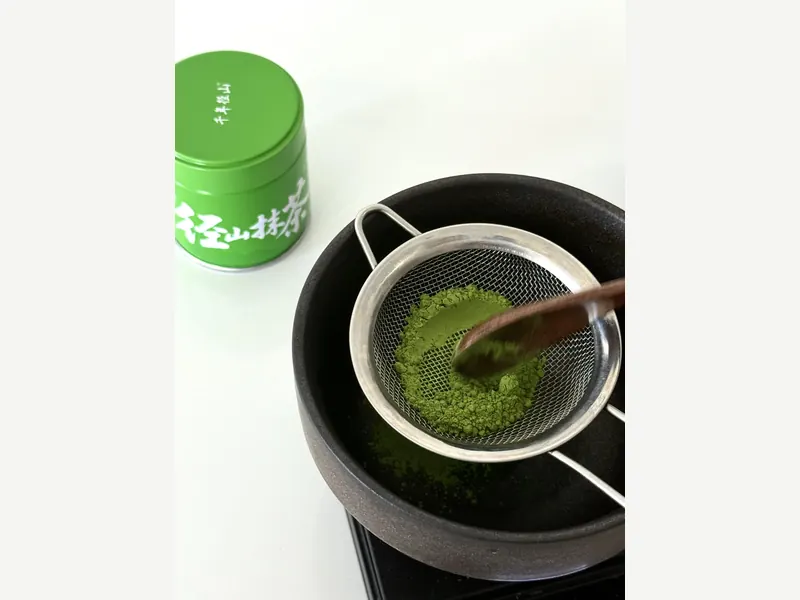
Compare screened dry addition with controlled predispersion while holding added liquid constant. Record visible specks, lump count, color uniformity, density, and piping response.
Dry addition protects the formula's water balance but may disperse slowly. Predispersion can improve uniformity while changing liquid content or local temperature. Treat each as a separate process cell.
AdoroHu uses ultrasonic screening for raw matcha. That is a powder-processing fact, not proof that a finished buttercream will be smooth under every mixer and formula.
Key Takeaway: Choose addition method through finished-icing dispersion and piping data.
Why must mixer and batch size be fixed for matcha buttercream?
Fernandes and coauthors' 2024 paper Aeration and rheology of buttercream icings used two benchtop planetary mixers and found asymptotic aeration behavior. Mixer geometry and history were part of the material response.
Record mixer, tool, bowl, batch size, speed sequence, time, starting and ending temperature, and final density. When scale changes, repeat the release tests rather than transferring the small-batch endpoint.
The matcha bakery heat and color guide provides broader bakery context.
Key Takeaway: Treat mixer and batch size as formulation variables.
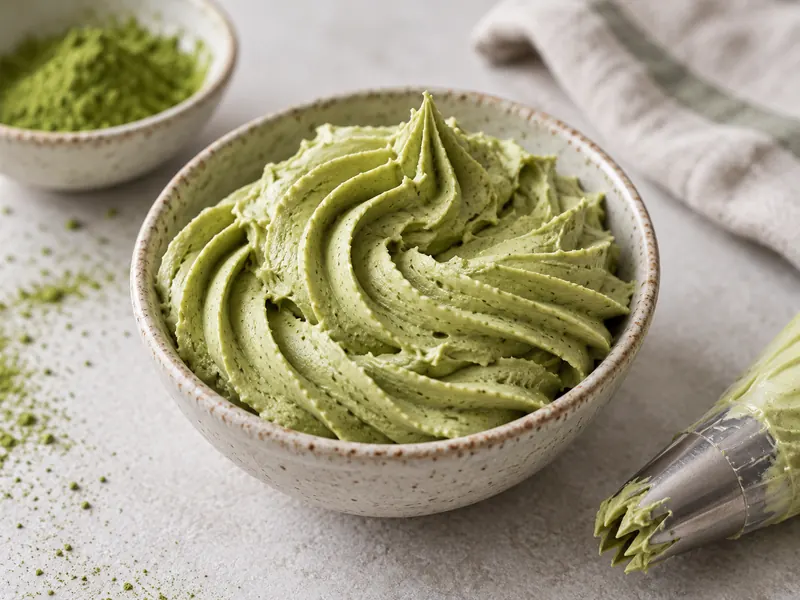
Which formulation basis makes matcha buttercream trials comparable?
The 2024 buttercream experiment fixed a 2:1 weight ratio of sugar to butter. A commercial formula may use another ratio, but it must remain fixed across powder and process comparisons.
Track fat lot, sugar particle specification, liquid, salt, flavor, matcha dose, and total batch mass. If consistency is corrected with extra liquid or sugar, record that as a new formula cell.
| Basis field | Keep constant | Reason |
|---|---|---|
| Sugar-to-fat ratio | Weight basis | Controls solids and structure |
| Added liquid | Type and mass | Changes flow and dispersion |
| Temperature | Start, finish, application | Changes fat state |
| Density | Fixed sampling method | Indicates incorporated air |
Key Takeaway: Use one declared formulation basis for every supplier comparison.
How should matcha buttercream piping behavior be measured?
Use squeeze-flow, extrusion, or a controlled piping test across the actual application rate. The 2024 study used lubricated compression to examine extensional rheology across shear rates from 0.001 to 100 per second.
Those settings describe the published non-matcha buttercream method, not universal piping limits. For the commercial icing, measure extrusion force, deposited weight, ridge definition, peak hold, and operator or depositor consistency at defined temperatures.
The matcha cake texture guide covers the adjacent cake crumb; this page owns external icing performance.
Key Takeaway: Test buttercream at the piping rate and temperature used in production.
Why can overmixing change matcha buttercream consistency?
The 2024 study treated buttercream as a four-phase material involving sugar, the butter emulsion, and air. Microscopy and X-ray microtomography showed small bubbles near sugar-particle size plus larger wire-generated voids. Yield stress depended strongly on air volume fraction.
More mixing can therefore change density, bubble structure, yield behavior, and apparent color. Measure density or overrun at the chosen endpoint and define a maximum mixing window.
If a batch becomes soft, do not correct it blindly with more sugar. First check temperature and air volume, because a formula correction can hide a process fault.
Key Takeaway: Set mixing endpoint with temperature and density, not time alone.
How should matcha buttercream color be released?
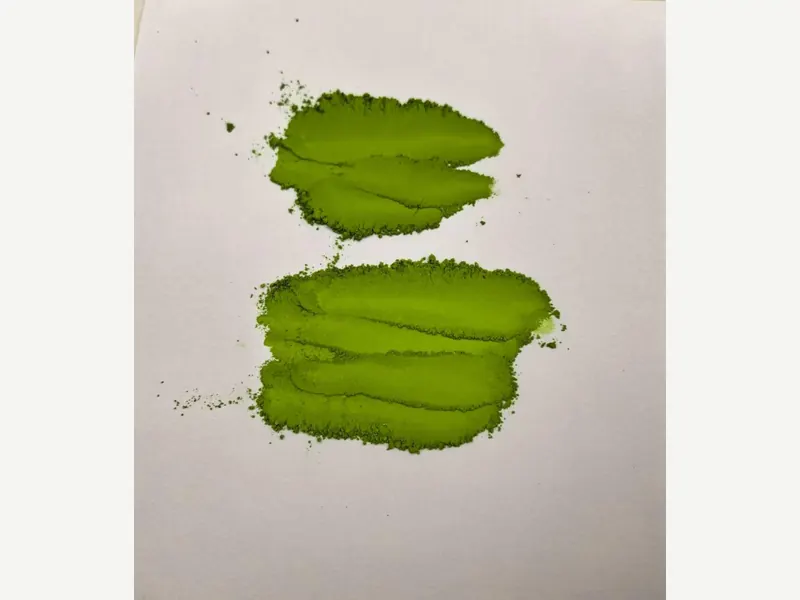
Measure L*a*b* values or color difference after mixing, at the end of the piping window, and after the intended chilled or ambient exposure. Keep sample depth, surface finish, lighting, and aeration consistent.
The 2020 paper Effect of storage temperature on the antioxidant activity and catechins stability of Matcha (Camellia sinensis) found that higher storage temperature reduced the study's green-color response in stored powder. It supplies no buttercream temperature or color limit.
Reject color comparisons at unequal aeration. Air changes light scattering, so two batches can look different even when their matcha dose is identical.
The best matcha for baking guide supports broader powder selection.
Key Takeaway: Compare color only at matched air volume, temperature, and age.
What belongs in a matcha buttercream pilot-release sheet?
Record buttercream system; fat, sugar, and matcha lots; powder dose and addition method; batch size; mixer and tool; time and speed; starting and ending temperature; density or overrun; rheology or extrusion method; piping window; deposit shape; and color.
AdoroHu supplies raw matcha and has in-house microbiology and physical-chemical laboratories. Those capabilities support powder documentation and sampling, not a claim that AdoroHu manufactures finished buttercream.
Contact AdoroHu with the buttercream system, mixer, target color, application temperature, and piping method.
Key Takeaway: Make the release sheet trace formula, aeration, temperature, piping, and color.
FAQ
- What matcha grade should a buttercream manufacturer test first?
- Start with a culinary grade and approve it in the fixed fat, sugar, liquid, mixer, and piping system.
- Should matcha be sifted directly into buttercream?
- Compare screened dry addition with controlled predispersion while holding added liquid constant, then choose the route that meets dispersion and piping targets.
- Does longer mixing always make matcha buttercream smoother?
- No. More mixing can change temperature, air volume, bubble structure, density, yield behavior, and visible color.
- Can raw matcha color predict the finished buttercream color?
- No. Fat, sugar, air, temperature, surface finish, and storage age affect the finished icing's appearance.
- Does AdoroHu manufacture finished buttercream?
- AdoroHu supplies matcha ingredients and raw-powder testing capabilities; finished-buttercream manufacturing is outside the documented supply role.
Conclusion
Commercial matcha buttercream needs a fixed formula, mixer, air level, application temperature, and piping method. Use the AdoroHu contact page to plan raw-powder samples for the selected icing system.