
Matcha ganache works commercially when the chocolate system, tea dispersion, emulsion method, and application temperature are specified together. A glossy bench sample can become grainy, streaked, too firm, or too loose after scale-up. That inconsistency affects depositing, filling weight, finish, and waste.
For matcha ganache, begin with the use case rather than a universal ratio. AdoroHu’s culinary matcha for baking applications gives pastry and confectionery teams a practical range for cakes, tarts, molded pieces, cookies, and deposited fillings.
A scalable matcha ganache is an application-specific emulsion. Define the chocolate, fat phase, target texture, service temperature, and deposition method before choosing the powder. Then prove dispersion and stability through the complete production and package sequence.
In short:
Key points:
- Set the application and texture target before selecting a grade.
- Control matcha dispersion and emulsion sequence before changing the dose.
- Approve supplier evidence together with pilot and packaged-product results.
Which application should define a matcha ganache brief?
The final application should define the matcha ganache brief because a cake drip, macaron filling, tart layer, truffle center, and cookie sandwich need different flow and set. One formula cannot serve all five well without changes.
Write the target in operational terms:
- deposit, spread, pipe, whip, cut, or enrobe;
- warm and flowing or cool and firm at use;
- target layer thickness and bite;
- dairy, plant-based, or compound-chocolate system;
- ambient, chilled, or frozen distribution;
- desired green shade and tea intensity.
This prevents a common mistake: calling a ganache “too thick” without naming the temperature or task.
Key Takeaway: Define what the ganache must do before defining what it contains.
Which matcha grade works with white chocolate ganache?
Culinary or premium matcha can work with white chocolate ganache, depending on the application and flavor target. AdoroHu’s EU Standard Series uses E-1 and E-2 for culinary grades and E-3 and E-4 for premium grades. Its Organic Series uses O-1 and O-2 for culinary use and O-3 for premium use.
White chocolate gives matcha a pale, sweet background, so small differences can remain visible. Compare one culinary and one premium candidate in the finished ganache. Avoid choosing ceremonial grade by default; the chocolate and heat may cover delicate aroma without delivering enough value.
| Application | Useful starting comparison | Main decision |
|---|---|---|
| Cake filling or cookie sandwich | Culinary versus premium | Flavor after chilling |
| Thin decorative drip | Premium versus fine culinary | Color and smooth flow |
| Truffle or molded center | Two culinary grades | Bitterness against sweetness |
Key Takeaway: Let the final chocolate system decide the grade.
When should matcha enter the ganache process?
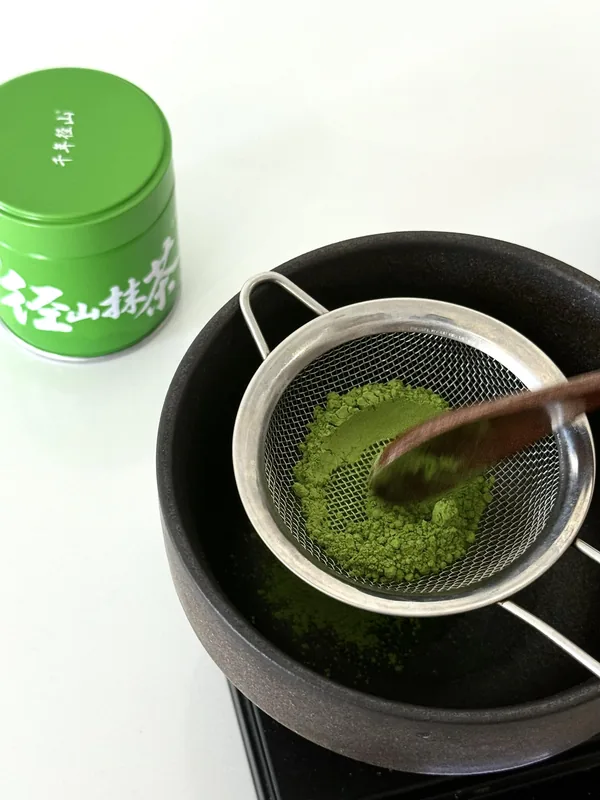
Matcha should enter through a smooth predispersion at a repeatable point before the emulsion becomes too viscous. Dry powder added to a finished ganache often leaves dark flecks and forces extra shear.
Compare two controlled routes: disperse matcha into a compatible warm liquid, or screen it into the chocolate phase before emulsification. Record temperature, order, shear time, and final appearance. The preferred route is the one the production equipment can repeat.
AdoroHu uses ultrasonic screening for ultra-fine matcha, supported by stone, ball, and continuous ball-milling equipment. That helps reduce persistent agglomerates, but it does not replace a controlled wetting step.
Key Takeaway: Fix the addition sequence before increasing shear or powder.
How should a plant verify matcha dispersion at deposit?
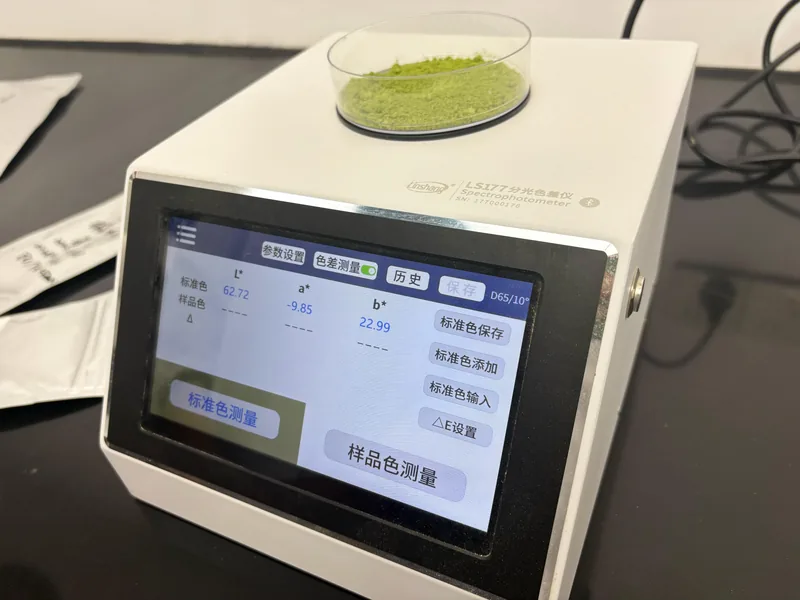
A plant should verify matcha dispersion with a consistent visual drawdown and first-to-last deposit samples. Matcha ganache exposes powder pockets because its surface should look smooth and uniform, while a mixer-only check can miss defects that appear after hold.
Do not rely on a final pass with a stick blender to rescue every batch. Excessive late shear may add air or change the set. Instead, prepare the matcha through the selected addition route, then sample the mixer, hopper, first deposit, and last deposit.
Use a visual drawdown on a white card to compare streaks and specks. Check again after the ganache sets, because defects may become clearer as the surface firms.
Key Takeaway: Verify dispersion through the full deposit run and after set.
What causes matcha ganache to split or feel grainy?
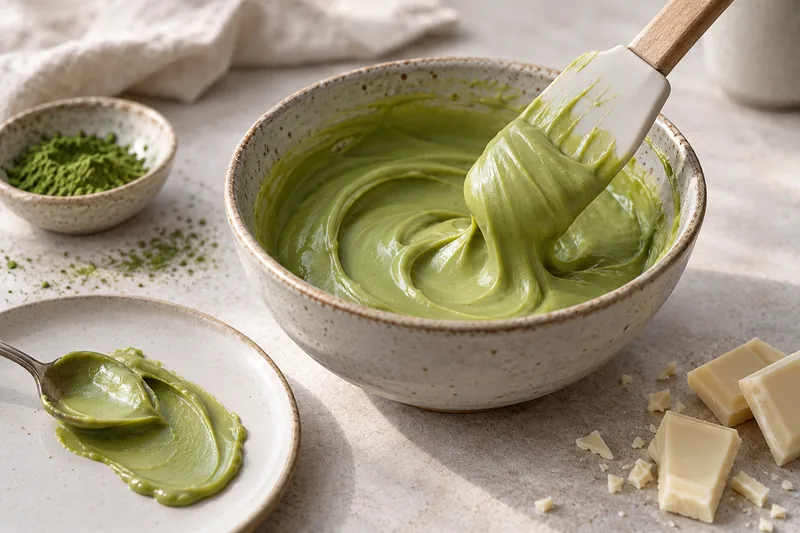
Ganache can split or feel grainy when the fat-water balance, temperature, mixing sequence, or chocolate condition falls outside the process window. Matcha may reveal the defect, but it is not always the cause.
| Symptom | Likely area to inspect | Corrective direction |
|---|---|---|
| Oily surface | Emulsion balance or temperature | Review phase ratio and addition sequence |
| Grainy mouthfeel | Chocolate condition or powder dispersion | Separate crystallization from matcha clumps |
| Dull, thick mass | Cooling or solids load | Check working temperature before reformulating |
| Air bubbles | Shear and handling | Adjust mixer position and transfer method |
The practical judgment is to avoid adding liquid by eye to a split batch. An undocumented rescue may look acceptable but create a different set and shorter process tolerance.
Key Takeaway: Diagnose the failure mechanism before changing the formula.
How should sweetness and bitterness be balanced?
Sweetness and bitterness should be balanced in the final application at its actual serving temperature. Cold ganache can mute aroma, while a thick layer can make sweetness and tea intensity feel stronger per bite.
Build a small coded matrix around matcha dose and chocolate sweetness. Score tea identity, bitterness, sweetness, aroma, color, and aftertaste. Evaluate the ganache alone and inside the pastry, because a tart shell, cake, or cookie changes the result.
Avoid using more matcha only to force a darker green. The extra solids can make the finish dusty and disturb the texture before the color becomes commercially useful.
Key Takeaway: Approve the assembled product, not a spoonful of filling.
What should a commercial ganache pilot record?
A commercial pilot should record ingredient lots, phase temperatures, addition sequence, shear method, batch time, deposit behavior, set, and finished yield. These details connect sensory approval with production repeatability.
Record matcha and chocolate lots, liquid and fat inputs, vessel load, temperatures before combination, mixing time, rest time, deposition temperature, piece weight, and line interruptions. Retain samples from the beginning and end of the deposit run.
AdoroHu’s in-house microbiology and physical-chemical laboratories support lot documentation. That helps buyers investigate whether a variance belongs to the matcha or the ganache process.
Key Takeaway: A pilot record should explain the first deposit and the last deposit.
How should service temperature and packaging be validated?
Service temperature and packaging should be validated together because ganache texture changes as fat crystallizes or softens. A filling that pipes cleanly may become too firm in a chilled dessert or migrate in a warm display.
Test the final product in its sale package through planned transport, storage, and service conditions. Inspect cracking, oiling, color, aroma, moisture migration, adhesion, and cut quality at defined checkpoints. The AHM guide to matcha oxygen-barrier packaging adds useful context for protecting the tea ingredient.
Do not borrow shelf life from a recipe blog. The final formula, process, package, and food-safety assessment must support the claim.
Key Takeaway: Validate ganache inside the final product and package.
Which allergen decisions belong in matcha ganache development?
Allergen decisions belong in development because chocolate, cream, plant bases, emulsifiers, and inclusions can introduce milk, soy, or tree nuts. Shared pastry and confectionery lines add scheduling and sanitation questions.
The FDA’s food-allergen guidance identifies nine major food allergens in the United States. This defined list shapes label review and preventive controls for US products.
Map each compound ingredient and processing aid, then confirm line cleaning, rework, and declaration rules. The AHM guide to matcha allergen review helps procurement connect ingredient statements with the finished-product review.
Key Takeaway: Choose the chocolate system with the plant’s allergen route in mind.
What supplier evidence should buyers request?
Buyers should request a current specification, lot-specific Certificate of Analysis, allergen statement, traceability information, storage guidance, and applicable certification evidence. A smooth sample without documents is not ready for launch.
AdoroHu lists USDA Organic (NOP), EU Organic, JAS Organic, BRCGS Food Safety, FDA registration, ISO 22000, Halal, and Kosher among its current certifications. Buyers should verify only the scopes needed for their product and market.
For production handling, AdoroHu offers bulk matcha in sealed food-grade liners within 10 kg or 20 kg cartons. Plants can use those actual formats to plan opening, resealing, and controlled line-side staging.
Key Takeaway: Approve the product identity, lot evidence, and handling plan together.
When does custom matcha development make sense?
Custom matcha development makes sense when standard grades cannot meet a measured color, flavor, claim, or cost target in the locked ganache. It should follow controlled trials, not replace them.
Send the supplier the chocolate type, formula constraints, processing temperatures, application, target market, package, and approved reference. AdoroHu’s custom formula development is most useful when the brief names the exact gap.
First confirm that the problem is not poor dispersion, uncontrolled temperature, or a changing chocolate system. Custom powder cannot stabilize an undefined process.
Key Takeaway: Customize against measured product performance.
FAQ
- What grade of matcha is best for commercial matcha ganache?
- Culinary matcha is a practical starting point, while visually delicate applications may justify a controlled premium-grade comparison.
- How can manufacturers prevent clumps in matcha ganache?
- Screen and pre-wet the matcha, then add it at a repeatable point before the emulsion becomes too viscous.
- Why does matcha ganache split?
- Splitting can result from the fat-water balance, temperature, addition sequence, or chocolate condition, so teams should diagnose the mechanism before adjusting the formula.
- Can matcha ganache be used for macarons and cakes?
- Yes, but each application needs its own texture, deposition, service-temperature, and package targets.
- How should matcha ganache shelf life be set?
- Test the final ganache inside the final product and package through the intended distribution conditions using appropriate quality and safety methods.
- What documents should accompany a matcha sample?
- Request a specification, lot-specific Certificate of Analysis, allergen statement, traceability information, storage guidance, and applicable certification evidence.
Conclusion
Commercial matcha ganache needs an application-led texture target, controlled dispersion, stable emulsification, and packaged-product validation. Compare powders in the final chocolate system and serving condition. Contact AdoroHu Matcha to discuss a sample plan for your pastry or confectionery brief.