
Matcha macaron formulation works best when developers choose where the tea belongs, then test the shell and assembled product separately. A powder can deliver good flavor yet expose weak foam control, variable macaronage, or rapid texture change after filling. Culinary matcha for shell and filling trials should therefore be screened in a fixed process rather than judged by powder color alone.
The commercial risk appears after scale-up: attractive bench shells may crack, lose their feet, or soften unevenly in the finished pack. A controlled pilot connects ingredient choice to measurable shell geometry, texture, color, and refrigerated handling.
Test shell-only, filling-only, and dual-placement versions before choosing a matcha system. Hold egg white, sugar, mixing, deposition, baking, filling, and storage conditions constant so the result identifies the variable that changed.
In short: Matcha placement, foam control, shell measurements, and filled-storage checks belong in one approval plan.
Key points:
- Compare three placement cells before adding matcha to both components.
- Measure shell flow, geometry, texture, color, water activity, and filled-product change.
- Apply refrigerated controls only after the finished product's classification and local rules are confirmed.
Should matcha macaron flavor sit in the shell, filling, or both?
Run shell-only, filling-only, and dual-placement matcha macaron cells before selecting the formula. Shell placement exposes matcha to aeration and baking; filling placement avoids that burden but changes moisture migration and flavor release. Dual placement may deepen flavor, yet it also adds powder cost and another source of variation.
Keep total filling mass, shell size, bake profile, and finished-product age equal. Score tea aroma, bitterness, shell feet, surface finish, interior hollows, and assembled texture. Choose the least complex placement that meets the sensory target, because adding matcha to the shell without a clear benefit makes foam and color control harder.
| Pilot cell | Main question | Release evidence |
|---|---|---|
| Shell only | Can baked color and tea flavor survive the shell process? | Feet, cracks, color, shell texture, flavor |
| Filling only | Can the filling carry flavor without over-softening the shell? | Filling texture, migration, assembled bite |
| Shell and filling | Does added flavor justify extra process variation? | Combined sensory and storage comparison |
Key Takeaway: Select placement from a three-cell comparison, not from the greenest fresh shell.
How do you isolate matcha macaron effects from egg-white and sugar variation?
Lock egg source, heat history, sugar level, addition sequence, whip endpoint, and batter temperature before blaming matcha for foam variation. A 2023 study of heated liquid egg whites with sucrose or salt pasteurized samples at 70°C for 3 minutes. At 10% sucrose, foam stability was highest across four egg sources, ranging from 57.22% to 80.03%, while pasteurization reduced foaming performance.
Those values do not prescribe a macaron formula. They show that egg source and processing can move the foam response enough to hide a powder effect. Record specific gravity or density at the chosen whip endpoint, then compare matcha cells against a no-matcha control from the same egg lot.
Key Takeaway: Control the foam system first so a matcha comparison does not become an egg-white comparison.
What should the matcha macaronage endpoint measure?
A useful matcha macaronage endpoint combines deposited mass, spread after a fixed time, and baked shell height. Fold counts are operator-dependent and do not describe the batter delivered to the depositor. No cited source establishes a universal flow target, so each line needs its own validated window.
Deposit a fixed mass onto a marked surface, measure diameter at the agreed interval, and record batter temperature. After baking, compare shell diameter, height, foot height, hollows, and rejected pieces. This approach also makes a bench-to-line change visible when bowl geometry, batch size, or transfer delay changes.
Key Takeaway: Approve a measurable deposition window that predicts the baked shell on the intended line.
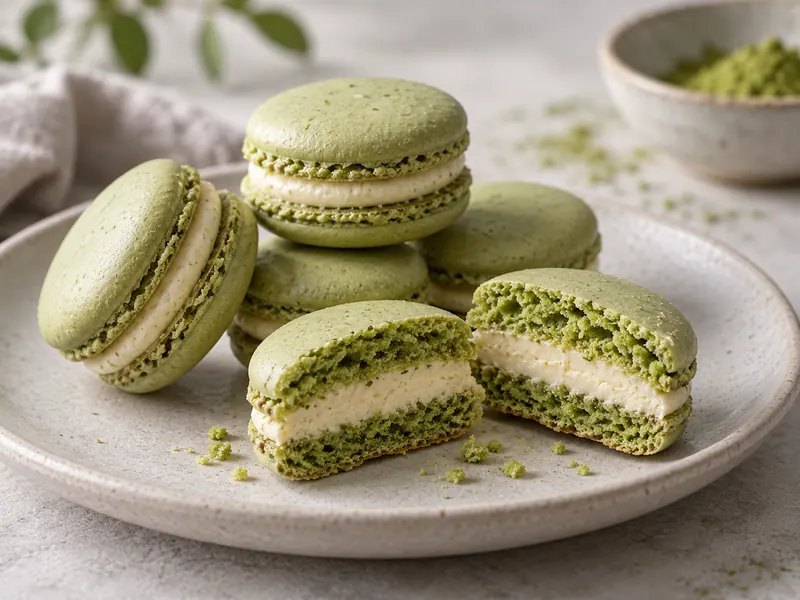
Which matcha macaron shell metrics replace a pass/fail visual check?
Use geometry, defect counts, and instrumental texture alongside visual inspection. A 2023 study of unfilled whey-protein-isolate macarons used 125 g almond flour and found that increasing erythritol from 0 to 60 g reduced hardness from 63.81±2.24 N to 11.84±0.19 N. Fracturability fell from 63.08±3.02 N to 10.98±1.14 N.
That experiment did not use egg-white shells or matcha, so its numbers are not specifications for this product. It demonstrates why two visually acceptable shells can behave very differently during packing and eating. Define the probe, test speed, sample age, and conditioning temperature, then pair the result with feet, hollows, cracks, and breakage. The commercial matcha cookie process guide offers a related baked-product control framework.
| Attribute | Method control | Buyer consequence |
|---|---|---|
| Feet and height | Fixed image setup and dimensions | Detects spread or lift drift |
| Hollows and cracks | Defined sample count | Predicts rejects and fragility |
| Hardness/fracturability | Fixed instrument method and age | Supports packing and bite targets |
| Breakage | Count after normal handling | Connects texture to saleable yield |
Key Takeaway: Combine defect rates with defined texture measurements instead of releasing shells by appearance alone.
How should baked matcha macaron color be approved?
Approve matcha macaron color on the finished shell under fixed lighting. Set Lab* values or a ΔE tolerance against an approved baked control, and record bake profile, shell age, and measurement location. Powder color cannot predict the combined effects of aeration, sugar, heat, and surface browning.
Decide whether added colorants are permitted in the product brief before the trial, then compare only compliant systems. Keep the matcha dose, colorant policy, bake profile, cooling time, and measurement setup with the approved standard. The matcha bakery heat and color guide can support the broader raw-powder and baked-color discussion.
Key Takeaway: Release finished baked color against a physical control and fixed measurement method.
How should matcha macaron moisture and texture be tested after filling?
Measure water activity and texture separately for the shell and assembled matcha macaron. In the same 2023 unfilled whey-protein-isolate macaron study, water activity fell from 0.207±0.001 to 0.176±0.001 as erythritol increased, while hardness also fell. Lower water activity therefore did not mean a harder shell in that specific system.
The study did not test matcha, egg-white shells, fillings, or migration. For the intended product, record shell texture before filling and assembled texture at stated refrigerated time points. Weigh released moisture or package pooling where relevant, and photograph the cut section before and after conditioning.
Key Takeaway: Water activity cannot replace a texture result or prove how a filled macaron will change.
Which refrigerated controls can apply to filled matcha macarons?
Apply refrigerated controls only if the finished filled matcha macaron is classified under the applicable jurisdiction as ready-to-eat time/temperature control for safety food. The FDA Food Code 2026 is a model for retail and foodservice adoption. Sections 3-501.16 and 3-501.17 use cold holding at 5°C/41°F or less and date marking when applicable food is held more than 24 hours, with a seven-day maximum.
For food prepared in the establishment, preparation is day 1. For a commercially processed container opened in the establishment, opening is day 1. These rules depend on product classification and local adoption, and they do not validate unopened factory shelf life.
Key Takeaway: Confirm finished-product classification and local adoption before applying model-code cold-holding and date-marking rules.
How should buyers approve a matcha macaron lot for repeat production?
Approve each matcha macaron powder lot through a lot-linked application comparison using the selected placement and process. Retain an approved control lot, record finished sensory and color results, and compare bench and line outcomes. Predefine actions for color drift, deposition change, texture failure, or sensory rejection.
Raw-powder documentation and application performance answer different questions. Use an industrial bakery matcha sourcing review for supplier controls, then keep finished-macaron manufacture and shelf-life validation with the producer. AdoroHu Matcha supplies raw powder; it does not manufacture the finished macaron described here.
Key Takeaway: Link powder-lot approval to repeatable application results and a retained control.
FAQ
- Should matcha go in the macaron shell or filling?
- Test shell-only, filling-only, and dual-placement versions, then choose the simplest system that meets flavor, color, texture, and storage targets.
- Can fold count define the macaronage endpoint?
- Fold count alone is operator-dependent; pair deposited mass with timed spread and baked-shell dimensions on the intended process.
- Does lower water activity guarantee a crisper shell?
- No. Water activity and instrumental texture answer different questions and should be measured separately.
- Does the FDA Food Code set factory shelf life for packaged macarons?
- No. It is a retail and foodservice model code, and its cold-holding and date-marking provisions depend on finished-product classification and local adoption.
- What should a repeat-production lot approval include?
- Include lot identity, the fixed application method, sensory and color results, shell and assembled-product checks, and comparison with a retained control.
Conclusion
Build the approval around placement, controlled foam, measurable deposition, baked-shell release criteria, and the assembled product. To compare raw-powder lots for that work, contact AdoroHu about raw-powder samples.
Institutional author: AdoroHu Matcha