
A matcha parfait holds its layers when every component has a defined texture, deposit condition, portion, and cold-hold role. Attractive assembly can fail when fruit releases liquid, sauce migrates, crumbs soften, or a frozen top melts into the glass. Choose pure premium matcha for the intended flavor, then validate the whole cup rather than the green component alone.
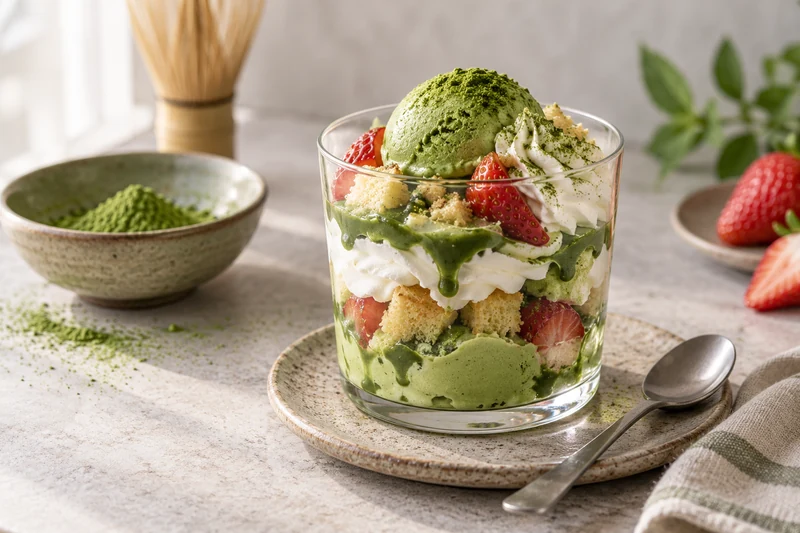
The current Nakamura Tokichi reference layers fruit, koicha-style matcha sauce, sponge cake, matcha ice cream, and a matcha dusting. It is a useful home assembly benchmark. Commercial service still needs portion, temperature, allergen, holding, and line-speed controls.
A stable matcha parfait assigns each layer a job and controls when it enters the cup. Wet, dry, aerated, and frozen components must remain compatible through the intended hold and eating sequence. The finished cup, package, and service method determine acceptance.
In short:
Key points:
- Design the spoon path before choosing the layer order.
- Control moisture migration, deposit temperature, and portion at every station.
- Validate the assembled cup through its real refrigerated or immediate-service window.
What should a commercial matcha parfait brief define?
The brief should define cup geometry, serving channel, hold time, spoon path, layer count, target mass, temperature zones, and visual standard. A made-to-order café cup and a refrigerated grab-and-go cup are different products.
| Brief item | Decision | Buyer consequence |
|---|---|---|
| Service model | Immediate or held | Sets migration and melt risk |
| Cup geometry | Width, depth, clear area | Changes visible band height |
| Matcha roles | Sauce, cream, cake, dusting | Changes flavor intensity and labor |
| Portion target | Layer and total weights | Controls cost and consistency |
Key Takeaway: Define how the customer buys and eats the parfait before arranging its layers.
Which component should carry the main matcha flavor?
One component should carry the main matcha flavor, while other green elements support it. A sauce gives immediate intensity, a cream gives a longer release, cake adds body, and dusting gives aroma but can absorb moisture quickly.
The Nakamura Tokichi reference uses matcha in sauce, ice cream, sponge, and dusting. A separate Magnum recipe uses one matcha cream as the green anchor, then layers it with chopped chocolate-coated ice-cream pieces and chocolate sauce. These are two documented architectures, not proof that more matcha components are better. Multiple green components add inventory, weighing, and color-matching work. Start with one anchor and one accent.
The tradeoff is complexity versus recognition. A single sauce is easier to control; a multi-layer matcha story may justify more labor only if sensory testing shows a clear benefit.
Key Takeaway: Put the strongest matcha dose in one controlled anchor layer.
How should the layer order be chosen?
Layer order should be chosen by density, deposit force, moisture, spoon access, and the intended eating sequence. A heavy sauce can sink through a soft mousse. A crisp inclusion placed beneath wet fruit can lose texture before service.
Map each component as wet, dry, aerated, gelled, baked, or frozen. Pamela Salzman’s published parfait puts a soft frozen smoothie into the glass first, adds a separately thickened and chilled matcha chia pudding above it, and adds kiwi and bee pollen last. The Magnum recipe repeats chopped frozen pieces, soft-peak matcha cream, and sauce. Those orders show that component condition and deposit sequence are real design choices, while the quantities remain household benchmarks.
| Component behavior | Placement question | Risk |
|---|---|---|
| Wet fruit | Is a barrier or drainage step needed? | Serum migration |
| Crisp crumb | Can it avoid prolonged wet contact? | Texture loss |
| Soft mousse | Can it support the next deposit? | Blurred bands |
| Frozen scoop | Is service immediate? | Melt and temperature drift |
Key Takeaway: Order layers by physical behavior and spoon experience, not color alone.
How can matcha sauce remain smooth and visible?
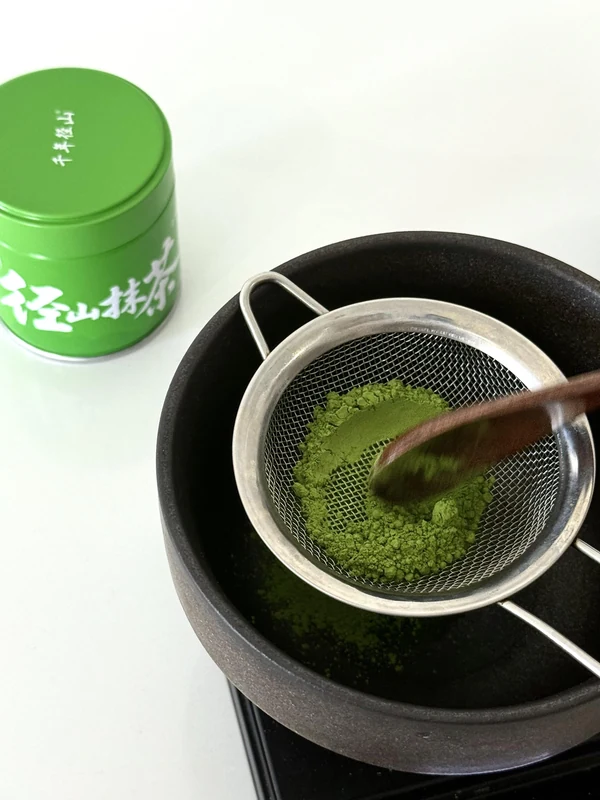
Matcha sauce remains smooth when matcha is sifted, dispersed into a compatible phase, and deposited within a controlled flow range. Too thin a sauce disappears between layers; too thick a sauce drags adjacent components and creates uneven bands.
The Tokichi recipe gives a concrete small-batch method: sift the matcha into a tea bowl, add a small amount of hot water, then whisk slowly until a smooth, thick paste forms. It provides no water quantity, temperature, viscosity, or commercial hold result, so a production team must define those values in its own sauce trial rather than treating “koicha” as a complete specification.
Record matcha lot, formula, preparation order, hold temperature, deposit tool, portion, and time after preparation. Use the matcha solubility guide to frame dispersion expectations. Do not promise full dissolution or a universal sauce life.
Key Takeaway: Set a flow and deposit standard that preserves both smoothness and a visible band.
How should fruit and wet inclusions be controlled?
Fruit and wet inclusions should be controlled for cut size, drainage, ripeness, temperature, and portion. Variable juice release changes layer boundaries and can thin matcha sauce or mousse.
Run a control without fruit and compare it with the complete parfait. If fruit is the failure source, changing matcha or stabilizer wastes time. Choose between fresher texture and longer hold based on the real service window.
Key Takeaway: Standardize fruit preparation before blaming green layers for migration.
How can cake, crumbs, and crisp layers keep texture?
Cake, crumbs, and crisp layers keep texture when contact area, moisture exposure, piece size, and assembly time are controlled. Tokichi places fruit, matcha sauce, sponge pieces, matcha ice cream, and dusting in one glass. Salzman instead chills and thickens pudding before placing it over a soft frozen layer, while Magnum combines frozen coated pieces with aerated cream and sauce. None of these sources measures migration during a commercial hold, so cake softness and crisp survival remain trial outcomes rather than published facts.
Use the matcha jelly guide and matcha mousse guide for component-specific context without repeating their formulation tasks. In this article, the decision is how those components coexist in one cup.
Key Takeaway: Treat dry texture as a timed property of the assembled cup.
What does portion control look like on the line?
Portion control should assign a target and tolerance to every layer, then verify total cup mass and visible band placement. Operators also need a defined deposit sequence, tool, nozzle depth, and wipe standard.
The Magnum two-serving benchmark uses 1.5 teaspoons of matcha with one cup of cream, two chopped ice-cream bars, and two tablespoons of chocolate sauce. Its cream is whisked to soft peaks, layered repeatedly with the frozen pieces and sauce, then chilled for 10–15 minutes. These numbers document that recipe’s portion architecture only; they do not establish a scale ratio, filling tolerance, or commercial holding life.
| Check | Sample across run | Consequence of drift |
|---|---|---|
| Layer weight | Beginning, middle, end | Cost and flavor imbalance |
| Band height | Multiple cup positions | Weak visual consistency |
| Rim cleanliness | Before closure | Seal and presentation defects |
| Total mass | Finished cups | Net-content risk |
The operational tradeoff is speed versus precision. Fewer, wider layers may deliver a cleaner cup and faster service than many thin bands.
Key Takeaway: Design the assembly for repeatable deposits, not a single styled photograph.
How should cold holding and food safety be validated?
Cold holding and food safety should be validated for the actual dairy, egg, fruit, cake, sauce, and frozen components. The FDA major-allergen guide is relevant because milk, egg, wheat, tree nuts, soy, or sesame may apply depending on the formula.
For a cooked parfait component that is actually time/temperature control for safety, the 2022 FDA Food Code §3-501.14 provides model guidance for cooling that component. The Food Code PDF does not by itself set the later cold-holding or shelf-life plan, and local adoption and product applicability require qualified review. Matcha does not preserve the parfait or establish shelf life.
Key Takeaway: Build the hold plan from the complete formula and service jurisdiction.
What should a parfait pilot and release record contain?
The pilot record should include every component lot, matcha lot, preparation condition, deposit order, portion, assembly time, cup, closure, hold schedule, visual cutaways, texture, sensory result, allergen review, and disposition. Photograph cups under fixed lighting at the same orientation.
Approve a service window only when the actual cup retains acceptable bands, texture, temperature, and flavor. A household recipe or one freshly assembled cup cannot establish commercial shelf life.
Key Takeaway: Release the assembled cup against timed evidence, not the quality of its separate components.
FAQ
- Which parfait layer should contain matcha?
- Choose one anchor layer such as sauce or cream, then add another matcha accent only when sensory testing shows a clear benefit.
- Why do parfait layers blur?
- Deposit force, temperature, density, weak set, fruit liquid, and holding time can all disturb boundaries.
- Can a crisp layer stay crunchy in a refrigerated parfait?
- It may, but the actual contact area, barriers, formula, assembly order, and hold time must be tested.
- Does matcha preserve a parfait?
- No; safety and shelf life require product-specific controls and evidence for the complete formula and package.
- How many layers should a commercial parfait have?
- Use the fewest layers that deliver the intended spoon experience, visual identity, and price while remaining repeatable on the line.
- What should be checked before closing the cup?
- Check total mass, visible bands, rim cleanliness, top garnish, closure, temperature, and lot traceability.
Conclusion
Build the parfait around a deliberate spoon path, compatible textures, controlled deposits, and a real hold test. For pure matcha samples suited to a defined sauce, cream, cake, or dusting trial, contact AdoroHu Matcha with the components, service model, and market.