
Matcha RTD stability needs separate checks for sediment, colour, flavour, packaging, and safety in the finished beverage. A green, smooth pilot can still develop hard sediment or a stale aroma during distribution. Approving it from a fresh tasting risks rejected stock and a second production trial.
The beverage formulation and supply guide covers the broader ingredient brief. This matcha RTD stability plan focuses on deciding what to measure, which comparisons are credible, and when the evidence supports advancing a formula.
Validate a matcha ready-to-drink beverage in its intended formula, process, package, and storage conditions. Track physical and sensory quality separately from the product-specific safety program, and define acceptance criteria before the trial begins.
In short: The usable result is a decision about one defined beverage system, supported by repeatable observations over its intended life.
Key points:
- Establish powder and finished-drink baselines so incoming variation does not masquerade as storage deterioration.
- Measure redispersibility as well as the amount of sediment.
- Test process and package changes in controlled comparisons before assigning shelf life.
What must the matcha RTD stability brief define?
Define the matcha RTD's formula, intended consumer, distribution conditions, package, process, and acceptance criteria before selecting tests. Specify whether the drink is refrigerated or intended for ambient storage, and whether a consumer shake is part of normal use. These choices determine which appearance changes are commercially acceptable.
Start with failure descriptions the team can recognize. “No unacceptable sediment” is incomplete until you say how much settling is allowed and how the drink must redisperse. “Retain green colour” needs a reference, a measurement procedure, and a sensory decision.
| Attribute | Define before testing | Decision it supports |
|---|---|---|
| Sediment | Layer measure and permitted redispersion effort | Whether the last sip remains usable |
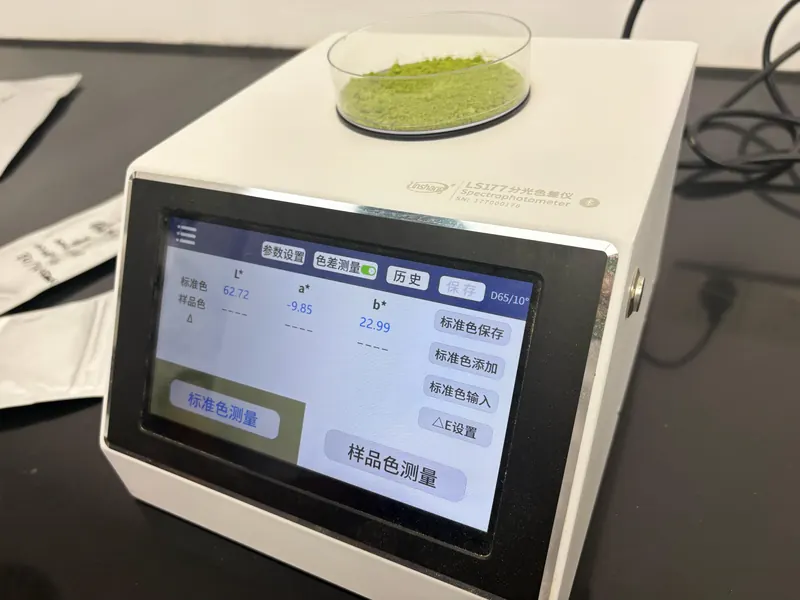
| Colour | Instrument settings, sample preparation, reference | Whether storage drift exceeds the approved appearance |
| Flavour | Coded comparison and rejection descriptors | Whether the drink remains acceptable |
| Package | Exact container, closure, fill and exposure | Whether the result applies to the sale pack |
Key Takeaway: Approve a written failure definition for each quality attribute before making the pilot.
Which incoming matcha measurements belong in the RTD baseline?
Record incoming matcha properties separately from the time-zero finished RTD measurements. Najman and colleagues' 2023 study compared ten matcha powders using instrumental colour, water activity, water solubility index, and water holding capacity. It also measured pH, soluble-solids readings in degrees Brix, and osmolality in 2.5% aqueous preparations.
Those methods answer different questions. Powder colour and water activity describe the incoming ingredient; a fixed aqueous preparation can make powder comparisons more consistent. The study's 2.5% concentration is a comparison condition, not a beverage recipe or evidence of finished RTD shelf life. Its published methods support separating these measurements rather than treating one “matcha quality” score as the baseline.
In practice, retain the lot code, sampling date, storage history, and approved comparator. Measure the finished drink after processing and cooling as its own starting point, so process damage is visible before storage begins.
Key Takeaway: Keep an incoming-powder baseline and a separate finished-product baseline for every pilot lot.
How should the matcha RTD formulation matrix be built?
Build the matcha RTD comparison matrix by changing a defined factor while preserving a reference formula. Hold the matcha lot constant when screening bases, then hold the selected base constant when comparing matcha candidates. Otherwise, a colour or sediment difference has several possible causes.
Use a staged screen. First assess base compatibility, matcha dose, and practical mixing; then test the most promising combinations through the intended process. Include a base without matcha when it helps identify protein flocculation, creaming, or a cooked note originating in the carrier.
Choose a smaller interpretable trial over a large set in which sweetener, stabilizer, tea dose, and process all change together. The latter may find an appealing sample but leaves the next production failure difficult to diagnose. For ingredient selection, compare culinary matcha candidates in the actual beverage rather than buying from grade language alone.
Key Takeaway: Preserve a reference and isolate the variable responsible for each improvement before expanding the trial.
How should matcha RTD sediment and redispersibility be measured?
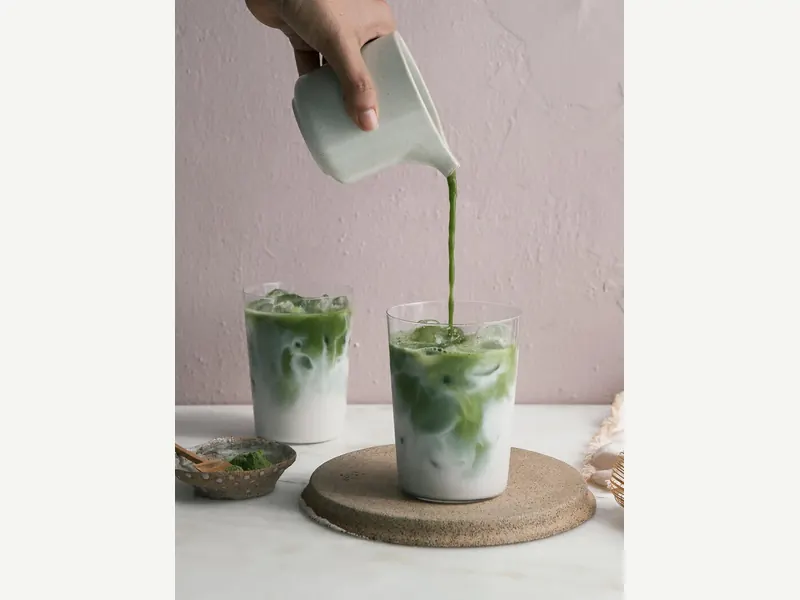
Measure matcha RTD sediment at fixed intervals and then test whether the settled material returns to a uniform drink under a defined shaking procedure. Haraguchi and colleagues' 2003 fine-matcha study reported particle ranges of 1–100 micrometres for normal powder and 1–20 micrometres for fine powder. Their reported particle diameters were 11.5 and 3.2 micrometres, respectively, and fine matcha settled more slowly in water.
That comparison supports investigating particle distribution, but it does not establish a milk-beverage particle limit. Protein, fat, viscosity, and aggregation can change the outcome. Ask for the measurement method and distribution, rather than assuming a single average predicts the shelf result.
Then compare equal-fill containers without disturbing them before inspection. Photograph the layer against a scale, apply the same inversion procedure, and inspect for hard packing, floating clumps, and unequal colour. Prefer easily redispersed settling over a superficially clear bottle that develops an immovable bottom layer, if the intended consumer use permits shaking.
Key Takeaway: Approve sediment behaviour by both settling and recovery under the product's intended use.
How should matcha RTD colour and chemical change be tracked?
Track finished-drink colour against its own time-zero measurement, while recording the matcha powder's earlier storage history. Kim and colleagues' 2020 study stored matcha powder for two months at 4, 25, 35, 45, and 80°C. It reported declining brightness and green value with increasing temperature and time, alongside changes in catechins.
This was powder research, not a finished RTD shelf-life experiment. It supports checking whether the raw ingredient has already changed before a beverage trial begins. It does not justify converting time at 80°C into months of beverage storage.
For the drink, standardize instrument settings, sample temperature, redispersion, and measurement geometry. If the commercial question involves a specified catechin content, commission a suitable chemical method; a colour reading cannot substitute for it. Compare objective readings with coded visual assessment because an instrument difference and a buyer rejection are separate decisions.
Key Takeaway: Separate raw-powder deterioration, process colour loss, and subsequent beverage colour drift in the records.
How should heat and mixing enter a matcha RTD trial?
Run matcha RTD trials through a recorded mixing and thermal sequence that can be reproduced at pilot and production scale. Capture pre-wetting, addition order, shear device, duration, aeration, come-up, hold, cooling, and delay before filling. A nominal temperature or mixer rpm alone cannot describe the treatment received by the drink.
At the next stage, compare samples before and after processing. A change that appears immediately after heat calls for a different investigation from one that appears weeks later. Keep process trials within the product's qualified safety design; reducing heat to preserve colour is not an editorial formulation recommendation.
For U.S. facilities subject to preventive controls, 21 CFR 117.165 addresses verification appropriate to the food, facility, and control. The responsible technical team must connect the quality trial to that applicable program, including scientifically valid testing where required.
Key Takeaway: Record the complete process and establish its safety basis before interpreting its quality trade-offs.
How should the matcha RTD package and light exposure be tested?
Test the intended matcha RTD package under relevant light conditions with a protected comparator. Baek and colleagues' 2021 study examined green-tea infusion in oxygen-impermeable glass covered with different films. After 20 days under fluorescent lighting at 4°C, EGCG, a tea catechin, had declined by 10.8% with complete light protection and by 42.2% under plain polylactic acid film. The comparison supports testing light exposure separately from formula changes.
That design is useful even though an infusion differs from a matcha suspension. Hold the beverage, fill, closure, and storage temperature constant while comparing the actual package with a protected sample. Record headspace and dissolved oxygen where they are part of the technical investigation, so a fill difference does not get mistaken for a light-barrier effect.
The matcha packaging guide addresses ingredient-packaging considerations. Finished beverages need their own container and closure assessment; powder-pack barrier performance does not establish RTD shelf life.
Key Takeaway: Compare the sale package with a protected control while keeping fill and storage conditions matched.
How should sensory testing guide matcha RTD decisions?
Use coded matcha RTD samples to identify the attribute that becomes unacceptable and when it changes. Score green-tea aroma, bitterness, astringency, cooked notes, oxidized notes, body, chalkiness, and aftertaste separately. “Less fresh” alone leaves the formulation team without a specific next trial.
For comparison, serve each sample at the intended temperature with the prescribed shaking and pouring procedure. Include the approved reference and, where useful, a base-only control. Keep serving order controlled so the strongest or sweetest sample does not always precede the others.
Choose the lowest-cost ingredient that meets the finished-drink target consistently, rather than assuming a more expensive powder will survive heat or mask base defects. A higher-priced grade that offers no accepted difference after processing consumes margin without solving the observed failure.
Key Takeaway: Use sensory results to name the failing attribute and choose the next ingredient or process comparison.
What storage design makes a matcha RTD study interpretable?
Use separate, unopened matcha RTD containers for planned destructive readings, and distinguish real-time storage from diagnostic stress trials. Repeatedly opening one bottle changes its oxygen exposure and contamination opportunity. Its later readings cannot represent an unopened retail pack under the same conditions.
Before the trial, assign container codes, sampling checkpoints, temperatures, light conditions, and measurement methods. Keep enough independently prepared product to assess repeatability; several readings from one bottle do not demonstrate batch consistency. Record deviations such as a temperature excursion or closure leak with the affected samples.
| Sample set | Purpose | Interpretation limit |
|---|---|---|
| Intended storage | Observe actual product evolution | Applies to the tested formula, process, and package |
| Defined stress condition | Reveal a possible failure mechanism | Does not automatically predict expiry |
| Protected comparator | Investigate light or other controlled exposure | Requires other variables to remain matched |
| Retained incoming powder | Investigate ingredient drift | Does not represent the finished beverage |
Key Takeaway: Design independent sample sets so the storage condition and handling history remain known.
When should a matcha RTD formula advance, change, or stop?
Advance a matcha RTD formula only when its physical, sensory, package, and applicable safety evidence meet the agreed criteria. Assign each failure to a specific next action instead of reporting the whole study as “unstable.” A reversible sediment problem and an unresolved safety question require different decisions.
For example, reformulate when the controlled matrix trial identifies an ingredient interaction. Change the process when comparable pre- and post-process samples isolate the loss there. Revisit packaging when protected and exposed containers diverge. Stop advancement when the intended shelf claim extends beyond the evidence or the manufacturer cannot execute the required controls.
AdoroHu Matcha supplies the raw matcha powder used in development. The beverage brand and its qualified manufacturer own the finished formula, process validation, packaging qualification, and shelf-life decision.
Key Takeaway: Advance only the tested system, and assign every unresolved failure an owner and a specific follow-up trial.
FAQ
- Does finer matcha guarantee a stable RTD beverage?
- No. Finer powder reduced settling in a published water comparison, but the finished beverage also depends on its base, aggregation, viscosity, process, and storage.
- Is some sediment always a failure?
- No. Judge it against the agreed appearance and redispersibility criteria for the intended product and consumer use.
- Can powder storage research determine beverage shelf life?
- No. Powder studies can inform incoming ingredient checks, but shelf life needs evidence from the finished beverage system.
- Can an accelerated test replace real-time storage automatically?
- No. A stress test can reveal failure mechanisms, but a shelf-life prediction needs a justified relationship to the actual product and conditions.
- Does an acceptable colour prove the drink is safe?
- No. Colour is a quality endpoint; safety needs the applicable product-specific controls and verification.
Conclusion
Bring the formula revision, process record, intended package, and acceptance criteria to the pilot review. To compare raw matcha lots for that trial, contact AdoroHu Matcha with the beverage brief and the measurements you need.
Institutional author: AdoroHu Matcha