
Matcha marshmallow development should lock the foaming and gelling system before powder lots are compared. Gelatin, agar with albumin, and other hydrocolloids build different aerated structures. Start with culinary matcha powder for confectionery trials in one defined architecture.
A light fresh batch can still fail through uneven bubbles, texture drift, late-deposit density changes, sticky surfaces, or color loss. The pilot must follow the foam from addition through cure and packaged hold.
Choose the gel system and matcha addition point first. Then control syrup endpoint, whip, temperature, deposit delay, density, bubble size, texture, water activity, color, cure, and package.
In short: Matcha marshmallow approval requires separate foam, gel, water-activity, and process-hold measurements.
Key points:
- Do not compare powder lots across different gelling systems.
- Keep fracture compression and two-cycle texture-profile analysis distinct.
- Set a validated kettle-to-depositor delay before scale-up release.
Which matcha marshmallow architecture should the brief choose?
Choose gelatin, agar with albumin, or another matcha marshmallow system before dose work. Each architecture forms and stabilizes air differently, so density, bubble size, cure, elasticity, and moisture response cannot share one universal target.
Define the permitted ingredients, serving format, target bite, coating, and package. Keep gel and foaming-agent lots fixed during powder comparison. A result from an agar-albumin model can guide methods but does not validate a gelatin matcha marshmallow.
| Architecture | Main structure control | Primary release question |
|---|---|---|
| Gelatin foam | Bloom, syrup, whip, cooling | Does elasticity hold through cure? |
| Agar-albumin foam | Agar set and albumin aeration | Are bubbles and fracture repeatable? |
| Alternative hydrocolloid | System-specific gelation | Does the chosen method survive deposit and hold? |
Key Takeaway: Fix the gelling architecture before comparing matcha dose or lot.
When should matcha enter a marshmallow process?
Compare syrup-stage and late-whip addition while holding final solids, thermal history, and shear constant. Syrup-stage addition increases heat exposure, while late addition can complicate dispersion and air retention. No primary source here establishes a universal addition point.
Record powder pre-dispersion, addition temperature, whip speed and time, exit temperature, and density. Use the commercial matcha dessert sourcing guide for ingredient questions, then choose the addition point through the finished confection.
Key Takeaway: Select the addition stage from matched foam, texture, color, and flavor results.
Which foam measurements belong in matcha marshmallow trials?
Measure density or gas hold-up, bubble-size distribution, and volume retention in matcha marshmallow trials. The 2021 paper Effect of Addition of Chokeberry Juice Concentrate and Foaming Agent on the Physical Properties of Agar Gel found that, at 5% chokeberry concentrate, increasing albumin from 0.5% to 2% changed gas hold-up from 65.1% to 71.4% and mean bubble diameter from 67.6 to 37.2 micrometres.
The matrix contained agar, albumin, and chokeberry concentrate, not matcha. Use its separate foam measurements as a method model. Record immediately after whipping and after defined 30-minute and 24-hour holds so density and bubble coarsening remain visible.
Key Takeaway: Measure gas hold-up and bubble size independently because one cannot stand in for the other.
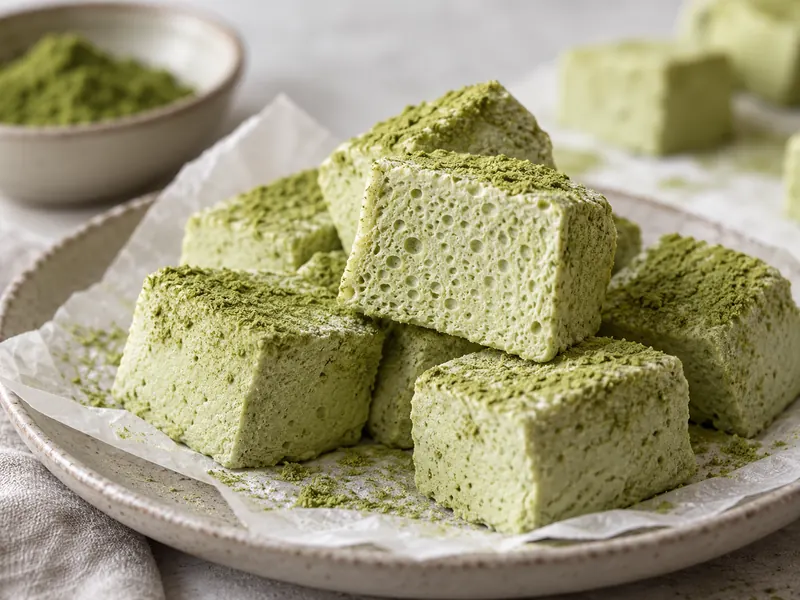
How should matcha marshmallow texture be released?
Use a fixed cure time and defined mechanical method for matcha marshmallow release. The 2021 agar-gel foam paper by Ewa Jakubczyk, Anna Kamińska-Dwórznicka, Patricia Lopez-Sanchez, and Anna Ström tested 15 mm cubes at 1 mm/s. Fracture testing compressed samples to 70% strain, while texture-profile analysis used two 30% compression cycles separated by 5 seconds.
These settings create a reproducible comparison, not matcha acceptance limits. Fix cube dimensions, cure, temperature, orientation, and coating. The fracture test and two-cycle TPA answer different questions and should not be merged into one number.
| Texture method | Source setup | Intended comparison |
|---|---|---|
| Fracture compression | 15 mm cube, 1 mm/s, 70% strain | Maximum deformation and break behavior |
| TPA | 15 mm cube, two 30% cycles, 5-second gap | Recovery and repeat-compression behavior |
Key Takeaway: Preserve the exact method identity before setting a product-specific texture window.
What does water activity prove in matcha marshmallows?
Water activity supports a matrix-specific stability assessment but does not prove sterility or shelf life alone. In the 2021 agar-gel study's 20% concentrate system, water activity stayed near 0.609 to 0.607 across albumin levels while mean bubble diameter changed from 89.5 to 59.9 micrometres.
Equal water activity therefore did not mean equal foam structure. The FDA water activity guide also requires temperature context. Pair the result with texture, surface condition, microbiological validation, package, and storage evidence.
Key Takeaway: Water activity cannot replace foam, texture, safety, or shelf testing.
How should matcha marshmallow color be measured?
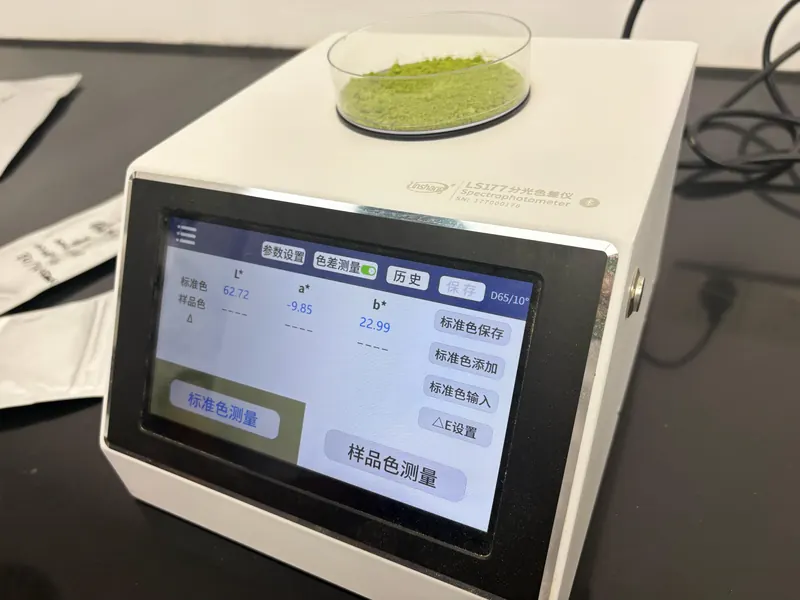
Measure matcha marshmallow Lab* values or ΔE after cure and during packaged storage. The 2020 paper Effect of storage temperature on the antioxidant activity and catechins stability of Matcha (Camellia sinensis) found a reduced green-color response at higher storage temperature, but it supplies no confectionery heat or shelf limit.
Fix lighting, sample thickness, surface, coating, cure age, and measurement time. Evaluate color alongside flavor and texture because a greener piece may not have the preferred tea balance. The matcha bakery heat and color guide can support the raw-powder discussion.
Key Takeaway: Set color limits on cured, packaged pieces under one measurement method.
Which matcha marshmallow scale-up hold is most risky?
Map kettle-to-depositor delay against matcha marshmallow density, deposit weight, shape, and texture. Cooling raises viscosity and can change air retention, flow, and leveling. Sampling only the first deposits hides late-batch drift.
Test early, middle, and late deposits at fixed intervals and temperatures. Set a maximum validated delay. Correcting a late batch with extra shear changes the foam history and should be treated as a new trial rather than an operator adjustment.
Key Takeaway: Release a maximum deposit delay from time-resolved density and piece measurements.
What should a matcha marshmallow pilot sheet record?
Record powder lot, gel system, solids, syrup endpoint, addition point, whip speed and time, exit temperature, deposit delay, density, bubble size, texture method, water activity, cure, coating, package, and storage condition. Include deviations and sample age.
AdoroHu Matcha supplies raw powder; the confectionery manufacturer owns finished-product processing, safety, and shelf validation. The matcha water activity testing guide provides adjacent technical context without setting a finished-marshmallow limit.
Key Takeaway: Connect the powder lot to the complete foam, gel, cure, and package history.
FAQ
- Can powder lots be compared across gelatin and agar marshmallows?
- No. Fix the gelling and foaming system before comparing matcha performance.
- Does smaller bubble size prove better marshmallow texture?
- No. Measure density, bubble distribution, fracture, and recovery separately in the target matrix.
- What is the correct fracture setup from the adjacent foam study?
- It used 15 mm cubes, a 1 mm/s test speed, and compression to 70% strain.
- Is the two-cycle TPA the same as fracture testing?
- No. TPA used two 30% compression cycles with a 5-second gap, while fracture used 70% compression.
- Does water activity around 0.61 validate marshmallow shelf life?
- No. That range came from an agar-albumin-chokeberry model and cannot establish safety or shelf life for matcha marshmallows.
Conclusion
Fix architecture, addition point, foam measurements, texture method, deposit delay, and package before powder approval. To arrange raw-powder samples, contact AdoroHu about raw-powder samples.
Institutional author: AdoroHu Matcha