
Matcha shortbread becomes commercially consistent when the powder, fat system, mixing order, dough handling, bake endpoint, and package are controlled together. A good bench cookie can spread, brown, streak, or lose its tea aroma on a production line. Those changes affect both yield and brand appearance.
For matcha shortbread, choose powder in the finished cookie rather than from a dry tasting. AdoroHu’s matcha for baking applications gives commercial bakeries a practical starting point for trials across butter-rich, plant-based, filled, layered, and coated formats.
Commercial matcha shortbread needs a measurable target for color, tea flavor, sweetness, snap, spread, and piece weight. The process must distribute matcha evenly without overworking the dough. Final approval should include packaged retains, supplier documents, and line results.
In short:
Key points:
- Select the grade against the baked cookie because fat, sugar, and heat change matcha perception.
- Standardize mixing, dough temperature, thickness, and bake endpoint before adjusting powder dose.
- Compare suppliers by acceptable packed yield, not price per kilogram alone.
Which matcha grade fits commercial matcha shortbread?
Culinary matcha usually fits commercial shortbread because butter, sugar, flour, and baking heat create a strong matrix. AdoroHu’s EU Standard Series uses E-1 and E-2 for culinary grades and E-3 and E-4 for premium grades. Its Organic Series uses O-1 and O-2 for culinary applications and O-3 for premium use.
Begin with two culinary candidates, then include premium only if the brand requires a cleaner aroma or brighter appearance. Avoid ceremonial grade by default. Heat and fat may mute the qualities that command its higher cost.
| Product style | Starting comparison | Main decision |
|---|---|---|
| Classic butter shortbread | Two culinary grades | Flavor after baking and cooling |
| Pale plant-based cookie | Culinary versus premium | Color and aftertaste |
| Organic-certified range | Organic culinary versus premium | Claim scope and finished quality |
Key Takeaway: Select the grade through the baked and cooled cookie.
How does fat affect matcha shortbread flavor and color?
Fat affects matcha shortbread by changing aroma release, perceived bitterness, dough handling, and surface appearance. Butter brings its own flavor and milk solids, while plant fats can produce a cleaner or waxier result depending on the system.
Lock the fat source before fine-tuning matcha. A later switch can change spread, snap, and tea perception enough to invalidate the approved dose. Evaluate cookies at room temperature and after the planned storage period because fat structure changes the bite over time.
The practical judgment is to avoid raising matcha simply because butter masks aroma. First compare grade, bake endpoint, and cookie thickness; extra powder can create a dry, bitter finish.
Key Takeaway: Treat the fat system as part of the matcha specification.
How should a bakery define the color target?
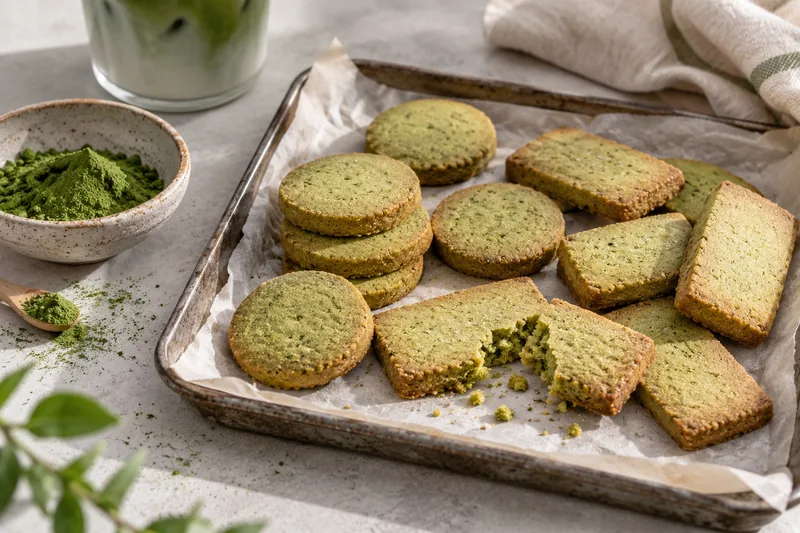
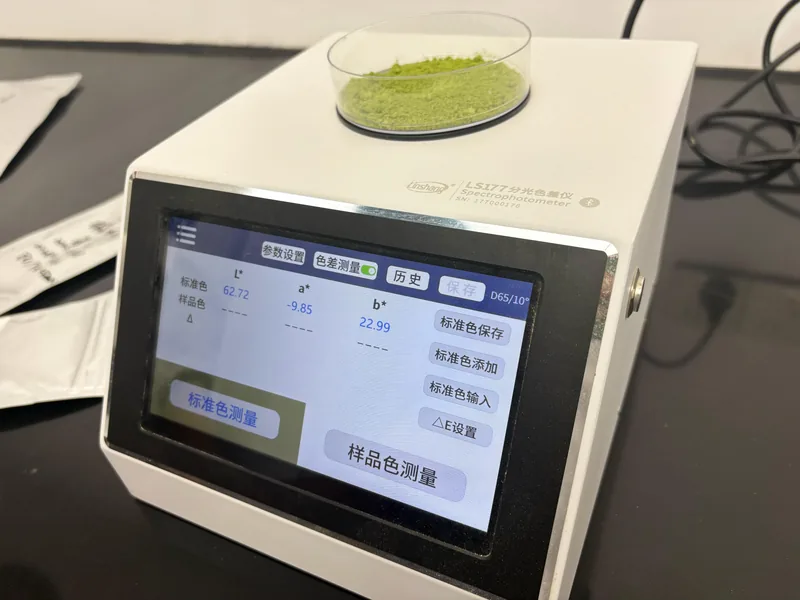
A bakery should define the color target with an approved baked reference viewed under consistent light. Dry powder color is not an acceptance standard for matcha shortbread because oven exposure and ingredient background change the result.
Use a retained reference or controlled image standard for the top, base, and broken interior. Note acceptable edge browning and whether inclusions or coatings alter the target. Score color only after a fixed cooling time.
AdoroHu offers E-1 through E-7 and O-1 through O-6 across culinary, premium, and ceremonial tiers. A structured grade system lets buyers screen candidates against a defined target instead of requesting “the greenest powder” without a cost boundary.
Key Takeaway: Approve a baked color range, not a dry-powder shade.
What mixing order prevents streaks in matcha shortbread?
A controlled dry preblend usually prevents streaks better than adding matcha directly to creamed fat. Once localized powder contacts moisture and fat, dark pockets can persist through the dough.
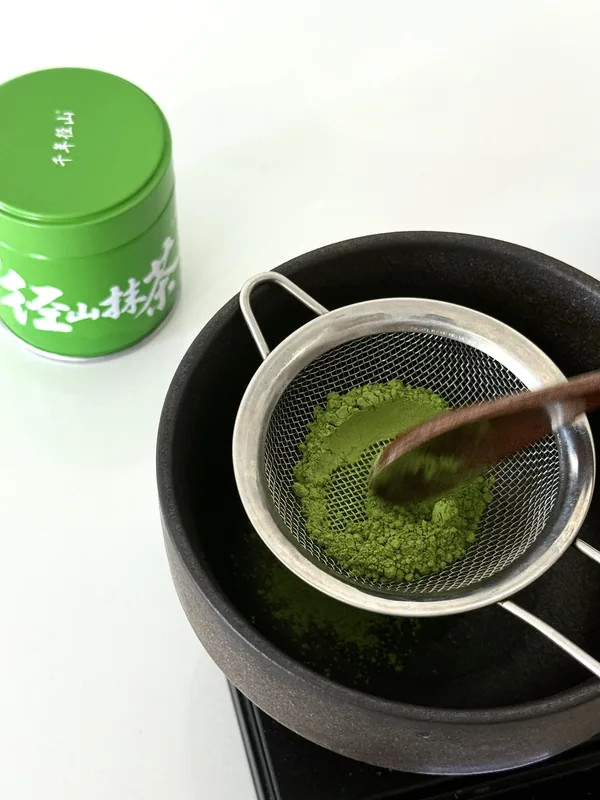
Screen matcha with compatible dry ingredients, verify preblend uniformity, then introduce it through the normal mixing sequence. Record mixer load, speed, time, scrape points, and dough appearance. Overmixing to correct streaks can develop structure, warm the dough, and increase spread.
AdoroHu uses ultrasonic screening for ultra-fine matcha, supported by 20 stone mills, 56 ball mills, and 8 continuous ball mills. Fine, screened powder helps dispersion, while the bakery’s preblend and mixer determine the final cookie uniformity.
Key Takeaway: Build matcha uniformity into the dry phase before dough structure develops.
How should dough handling be standardized?
Dough handling should be standardized around temperature, rest, thickness, portion weight, and transfer method. Matcha shortbread can change shape when warm dough softens, chilled dough cracks, or scrap is reworked repeatedly.
Create a short process window for each forming route:
- sheet-and-cut: record sheet thickness, rest, cutter release, and scrap ratio;
- slice-and-bake: record log diameter, chill condition, and slice thickness;
- rotary or deposited: record dough feed, definition, sticking, and piece weight;
- layered product: record layer weights and compression method.
Avoid using extra flour as an unrecorded fix for warm dough. It may improve handling while making the finished cookie drier and weakening tea flavor.
Key Takeaway: Control dough condition before changing the formula.
What bake endpoint protects matcha color and cookie texture?
The bake endpoint should deliver the required structure with the least unnecessary browning. Time alone is weak control because oven load, piece thickness, dough temperature, and airflow all affect the result.
Define acceptable edge color, base color, internal set, moisture or texture criterion, and cooling condition. Compare samples across oven zones rather than pulling one attractive tray. If the cookie is filled or coated later, evaluate whether the base still performs after assembly.
The operational recommendation is to reject a darker bake that gains handling strength but loses the brand’s green target. Improve thickness and oven uniformity before asking matcha dose to compensate.
Key Takeaway: Specify the baked endpoint with appearance and texture together.
What should a matcha shortbread pilot record?
A pilot should record ingredient lots, dough temperatures, mixing sequence, forming data, oven settings, piece weights, yield, and defects. These details show whether a matcha shortbread variance began in the powder, dough, oven, or package.
Record matcha and fat lots, flour condition, room conditions, mixer load, mix time, rest time, dough thickness, scrap rework, oven zones, bake loss, breakage, and packed yield. Photograph top, base, and interior under one light source.
| Pilot record | What it isolates | Commercial effect |
|---|---|---|
| Dough temperature | Handling condition at forming | Spread, sticking, and definition |
| Piece-weight spread | Portioning consistency | Bake uniformity and declared net weight |
| Oven-zone samples | Heat distribution | Color and breakage variation |
| Packed yield | Total usable output | True cost per saleable pack |
AdoroHu’s in-house microbiology and physical-chemical laboratories support lot documentation. That helps buyers compare powder evidence with the bakery’s production record during an investigation.
Key Takeaway: A pilot must connect incoming lots to acceptable packed yield.
How should packaging trials be designed for matcha shortbread?
Packaging trials should protect matcha shortbread from oxygen, light, moisture, odor transfer, and breakage. A good barrier cannot compensate for a tray or carton that lets the cookie crumble in distribution.
Test the final cookie in the final pack through intended transport and storage. Inspect snap, crumbs, color, aroma, fat bloom on coatings, seal integrity, and piece presentation at planned checkpoints. The AHM guide to matcha oxygen-barrier packaging adds a useful ingredient-protection framework.
Do not copy a home-recipe storage period. Commercial shelf life must be supported by the final product, process, package, and test plan.
Key Takeaway: Validate barrier and physical protection in one trial.
How do allergens affect a shortbread line?
Allergens affect the formula, line schedule, cleaning, rework, and label. Butter, milk chocolate, nuts, sesame, soy lecithin, and compound inclusions can change the control plan.
The FDA’s food-allergen guidance identifies nine major food allergens in the United States. This defined scope gives US teams a concrete basis for ingredient and label review.
Map each ingredient and shared contact surface before finalizing the concept. The AHM guide to matcha allergen review helps connect matcha documentation with the finished-cookie assessment.
Key Takeaway: Resolve the allergen route before artwork and production scheduling.
What supplier evidence should procurement request?
Procurement should request a current specification, lot-specific Certificate of Analysis, allergen statement, traceability information, storage guidance, and applicable certification evidence. These records support repeat purchasing and change control.
AdoroHu lists USDA Organic (NOP), EU Organic, JAS Organic, BRCGS Food Safety, FDA registration, ISO 22000, Halal, and Kosher among its current certifications. Each serves a different requirement, so buyers should verify the documents relevant to their cookie and market.
AdoroHu supplies bulk matcha in sealed food-grade liners within 10 kg or 20 kg cartons. Bakeries can plan controlled opening, resealing, and line-side staging around real usage instead of exposing the full lot.
Key Takeaway: Approve a documented ingredient and handling plan, not only a sample.
When does custom development help a shortbread brand?
Custom development helps when standard grades cannot meet a measured color, flavor, claim, and cost target in the locked cookie. It may also help a private-label program that needs coordinated powder, packaging, and product positioning.
Send the supplier the fat system, formula constraints, mixing and baking conditions, target market, package, and approved reference. AdoroHu’s matcha private-label service is most useful when the brief defines the product rather than asking for a generic green cookie.
First prove that the gap comes from the powder rather than dough temperature, overmixing, or oven variation.
Key Takeaway: Customize after the bakery has stabilized its own process.
FAQ
- What grade of matcha is best for commercial matcha shortbread?
- Culinary matcha is the usual starting point, while pale or premium-positioned cookies may justify a controlled premium-grade comparison.
- Why does matcha shortbread turn brown?
- Excessive bake exposure, oven variation, ingredient background, and piece thickness can all move the cookie away from its green target.
- How can a bakery prevent green streaks in shortbread dough?
- Screen matcha into a controlled dry preblend before adding it through the standard dough-mixing sequence.
- Can plant-based fat be used in matcha shortbread?
- Yes, but the fat source must be evaluated for flavor, spread, snap, dough handling, allergens, and packaged stability.
- How should matcha shortbread shelf life be set?
- Test the final cookie in the final package through intended distribution conditions using defined quality and safety criteria.
- What documents should accompany a matcha sample?
- Request a specification, lot-specific Certificate of Analysis, allergen statement, traceability information, storage guidance, and applicable certification evidence.
Conclusion
Commercial matcha shortbread needs an application-led grade choice, controlled dough handling, a defined bake endpoint, and package validation. Compare samples in the baked cookie and include yield, breakage, allergens, and line time in the decision. Contact AdoroHu Matcha to discuss a matcha specification for your bakery brief.