
Matcha syrup must move through the intended pump, deliver a repeatable dose, and disperse predictably after dilution. High solids can improve body while making flow, remix, and tea suspension harder to control.
Develop matcha syrup on the real bottle, pump, nozzle, and drink builds. The matcha café recipe guide gives menu context, but the concentrate needs measured solids, dispense, dilution, and hold checks.
Fix solids, matcha dose, dispersion sequence, temperature, dispenser, and dilution before comparing batches. Release requires repeatable flow, dose mass, sediment, finished-drink flavor, and sanitation controls.
In short:
Key points:
- Treat solids, viscosity, and dispense accuracy as one operating system.
- Weigh repeated pump doses across the container and service hold.
- Validate every declared hot, iced, milk, or water dilution separately.
What should a commercial matcha syrup brief define?
Define use case, dose per drink, dispensing method, tea intensity, sweetness, viscosity, dilution, service hold, package, and daily use. A pump bottle, bag-in-box, and batch concentrate impose different flow and remix requirements.
Separate café service from packaged shelf-stable ambitions. The latter needs its own process and safety validation.
Key Takeaway: Lock the dispensing and use model first.
How should syrup solids and sweetness be selected?
Build a measured solids ladder while holding matcha constant. Record sweetness, flow, dilution, coating of equipment, and finished-drink balance.
Higher solids may improve body but can slow pumping and make tea taste flatter. Choose the lowest practical solids level that meets flavor and handling needs.
| Solids trial | Flow observation | Finished-drink check |
|---|---|---|
| Lower-solids syrup | Faster flow, more splash risk | Body and tea intensity after dilution |
| Target-solids syrup | Intended pump response | Dose repeatability and balance |
| Higher-solids syrup | Slower flow, coating of parts | Pump effort and sweetness |
Key Takeaway: Approve sweetness and pump behavior together.
Which matcha candidates should be screened?
AdoroHu’s E-1/E-2 Culinary, E-3/E-4 Premium, and O-3 Organic Premium codes create stable sample identities. Compare them in the same syrup and diluted drink.
A candidate that looks strong in concentrate may taste weak or harsh after dilution. Select from the final beverage.
For controlled trials, the premium matcha powder page is the relevant product route.
Key Takeaway: Choose from the intended dilution.
How should matcha be dispersed in a high-solids base?
AdoroHu uses ultrasonic screening and several milling routes, including 20 stone mills, 56 ball mills, and 8 continuous ball mills. Confirm matched process and specification, then standardize a lower-viscosity pre-dispersion before adding full syrup solids.
Matcha is a suspension, as the matcha solubility guide explains. Do not claim true dissolution because the concentrate looks smooth.
Keep the powder decision connected to matcha beverage brands guide.
Key Takeaway: Control wetting before viscosity rises.
What proves pumpability and dose accuracy?
Test the actual pump, nozzle, tubing, container, temperature, and hold time. Weigh repeated dispenses at the start, middle, and end of the container.
A thicker syrup may reduce drips but increase dose variation and operator effort. Approve the range that protects both speed and drink consistency.
| Dispense point | Weigh | What it detects |
|---|---|---|
| Start of container | Several pump doses | Initial calibration |
| Mid-container | Same pump sequence | Hold and remix drift |
| End of container | Same pump sequence | Sediment or feed inconsistency |
Key Takeaway: Measure real dispenses, not visual pump strokes.
How should dilution behavior be tested?
Dilute the syrup into every intended hot and cold beverage using the real addition order. Record clumps, streaks, foam, sediment, color, and flavor after a fixed time.
One syrup may not suit both iced and hot drinks. Choose separate use instructions or separate formulas when compromise weakens both.
Key Takeaway: Validate every declared beverage use.
What measurements belong in a syrup trial?
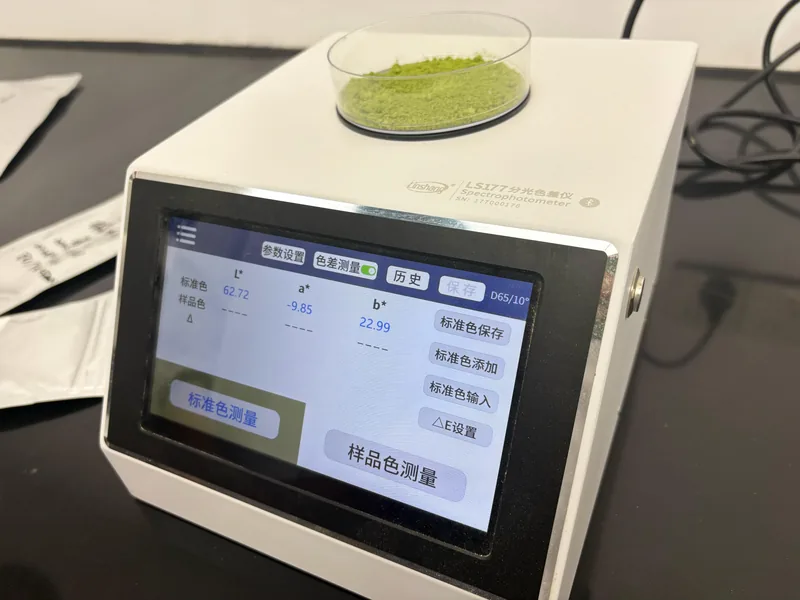
AdoroHu’s in-house labs can support lot-linked powder COA inputs; the buyer validates the finished syrup. Record formula mass, temperature, flow or viscosity method, dose variation, sediment, dilution ratio, yield, and sensory result.
Define each method so another operator can reproduce it. A viscosity number without temperature and method is not comparable.
Use matcha solubility guide for the adjacent manufacturing context.
Key Takeaway: Measure concentrate and diluted drink.
How should sanitation and hold limits be handled?
Under 21 CFR 117.80, processing and holding controls must minimize microbial growth, allergen cross-contact, contamination, and deterioration. A high-sugar formula is not automatic proof of safety or shelf stability.
Use the site’s approved food-safety plan for heat treatment, cooling, filling, cleaning, storage, and discard decisions. Do not invent a life from a bench trial.
| Dilution use | Control | Release question |
|---|---|---|
| Hot drink | Liquid order and temperature | Does syrup disperse without streaks? |
| Iced drink | Ice mass and final volume | Is tea clear after dilution? |
| Milk or water base | Exact base and ratio | Does one instruction fit this use? |
Key Takeaway: Keep safety validation separate from flavor testing.
What evidence should release matcha syrup?
AdoroHu’s 10 kg and 20 kg formats use sealed food-grade liners. Align pack size with production use and post-opening storage. Release only after repeat batches meet dispersion, flow, dose, dilution, sediment, sensory, sanitation, and package limits.
Keep formula, lots, process temperatures, equipment, dose data, hold observations, deviations, and approvers together.
Key Takeaway: Release a reproducible concentrate and dispensing method.
FAQ
- Is matcha syrup a dissolved matcha product?
- No. Matcha particles remain suspended, so dispersion, viscosity, remix, and dispensing conditions determine uniformity.
- Why does matcha syrup clog a pump?
- High solids, agglomerates, viscosity, cooling, nozzle geometry, and hold time can all restrict flow, so test the actual dispensing system.
- Can one matcha syrup work in hot and iced drinks?
- It may, but each drink needs a separate dilution and addition-order check because temperature, ice, milk, and carbonation change performance.
- Does high sugar make matcha syrup shelf stable?
- Not by itself. Shelf stability requires a validated formula, process, package, storage condition, and applicable food-safety review.
- What records belong in a commercial syrup trial?
- Keep formula, lots, temperatures, dispersion method, viscosity or flow method, dispense weights, dilution checks, sanitation, deviations, and approvals.
Conclusion
Matcha syrup is ready when the concentrate flows, doses, dilutes, and remixes consistently in the intended service system. Share the target drinks, solids range, dispenser, batch process, and trial volume through the contact page for sample planning.